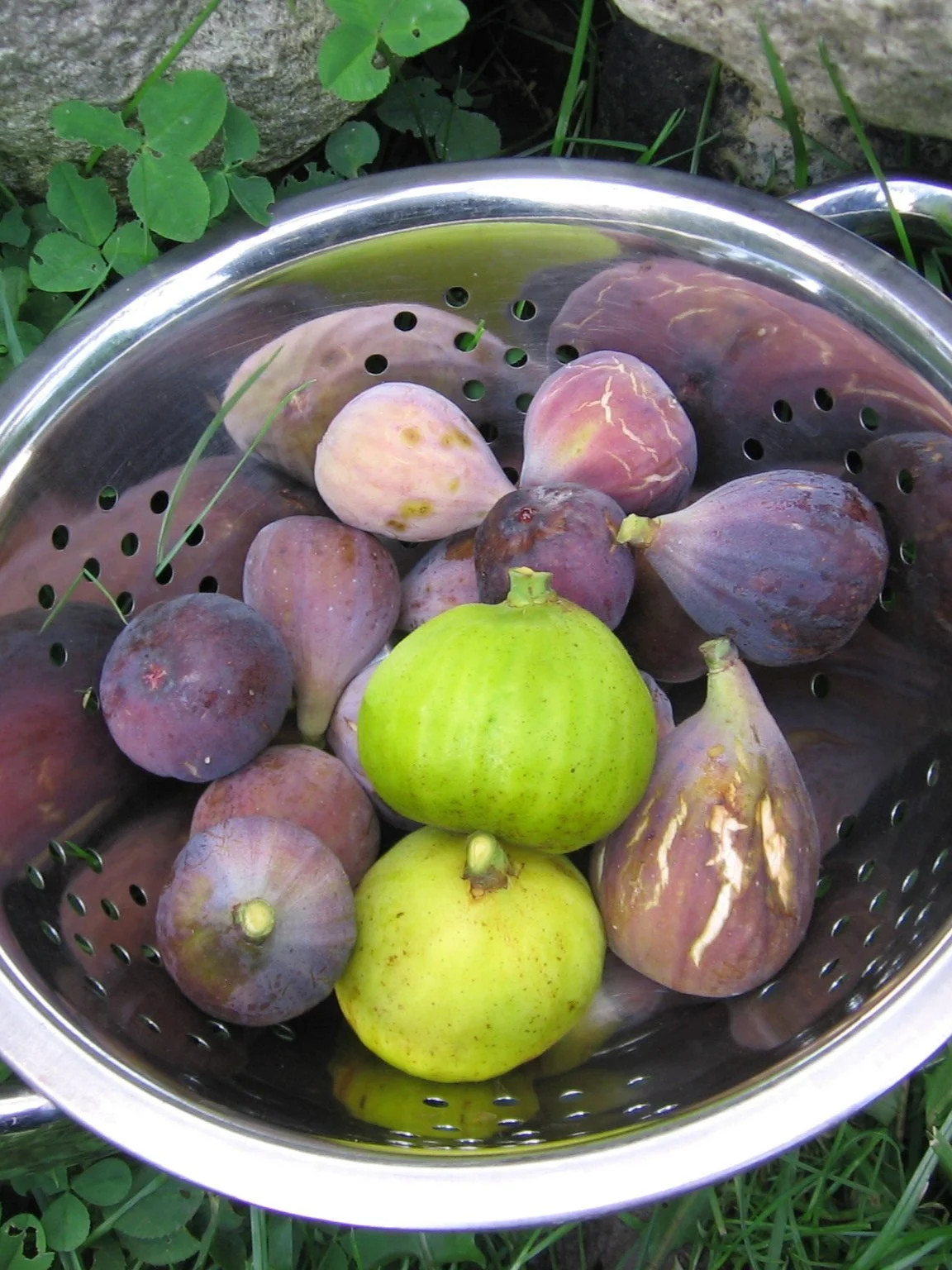
How to Keep Squirrels Away from Fig Trees

Do squirrels eat figs? They sure do. They also dig in potted fig trees, sometimes uprooting young plants.
The most reliable way to reduce squirrel damage is physical exclusion: chicken wire over newly potted plants, a barrier over the soil in larger pots, netting around a tree, or organza bags to discourage squirrels from sampling individual figs.
Baffles can work in the right setting. Scent deterrents are less dependable.
Below, I’ll show you what I’ve tried, what has worked, and what hasn’t.
Stop Squirrels Digging in Potted Fig Trees
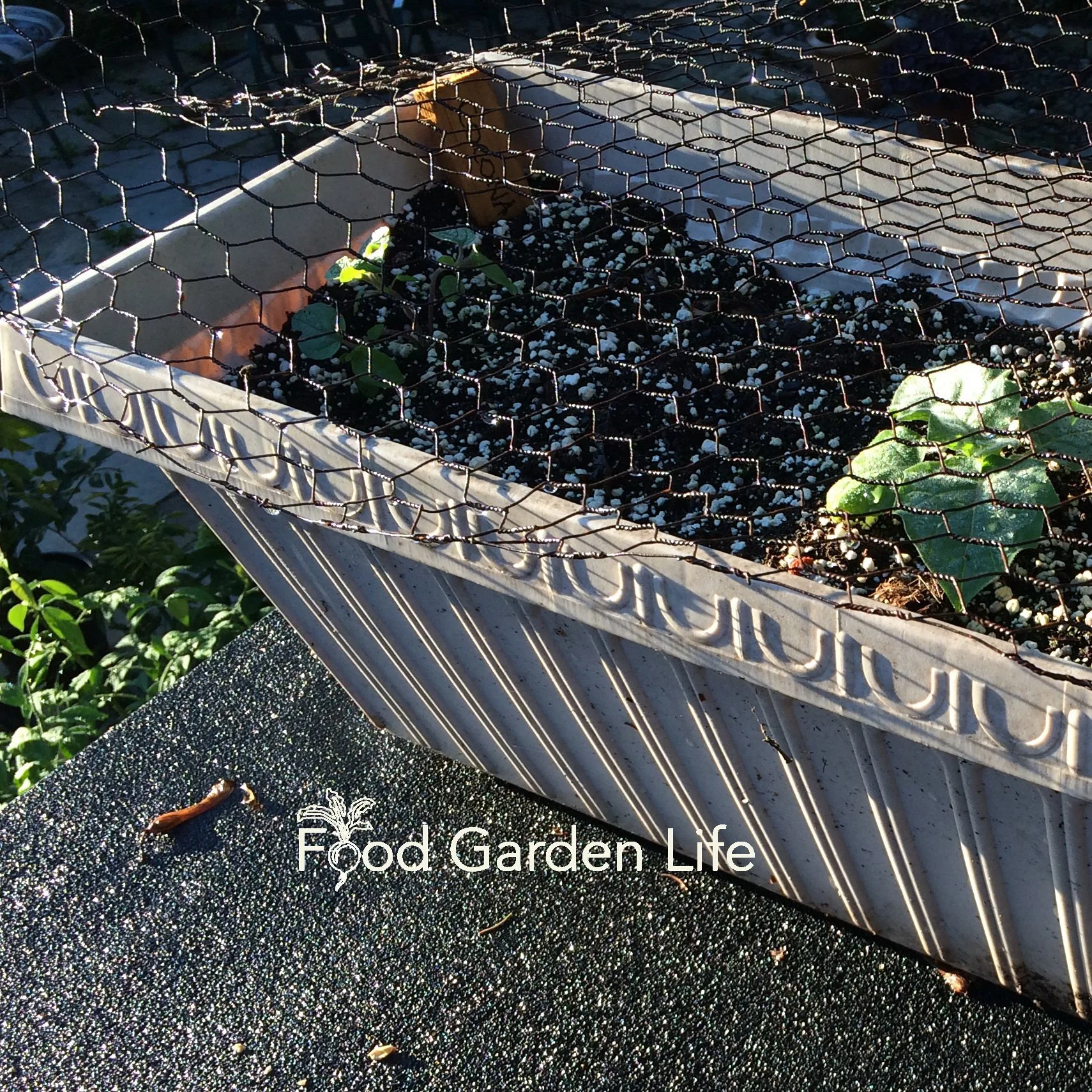
Prevent squirrels from digging up plants by excluding them with chicken wire. (In case you’re wondering, that’s not a fig plant in the photo.)
Protect Young Potted Fig Plants
When it comes to squirrels digging up young potted fig plants, I’ve found the easiest thing to do is to physically exclude the squirrels.
Chicken wire works well to prevent squirrels from uprooting young potted fig trees.
If you’re having a bad year for squirrel damage, this is worth it!
I’ve come home to find an entire tray of young potted fig plants uprooted and strewn on the patio. Positively infuriating!
With newly potted fig trees, snip the wire so that it can be wrapped around the plant, and then folded over the side of the pot. Like a skirt.
Or, make a small cage to cover a full tray of young potted fig plants.
One more idea: I’ve put an upturned laundry basket over top of trays of newly potted plants for a couple of weeks, so they have time to get established.
(Excluding squirrels works well for other plants too. My friend Claus uses it to keep squirrels from digging up his potted pepper plants.)
Protect Mature Potted Fig Trees
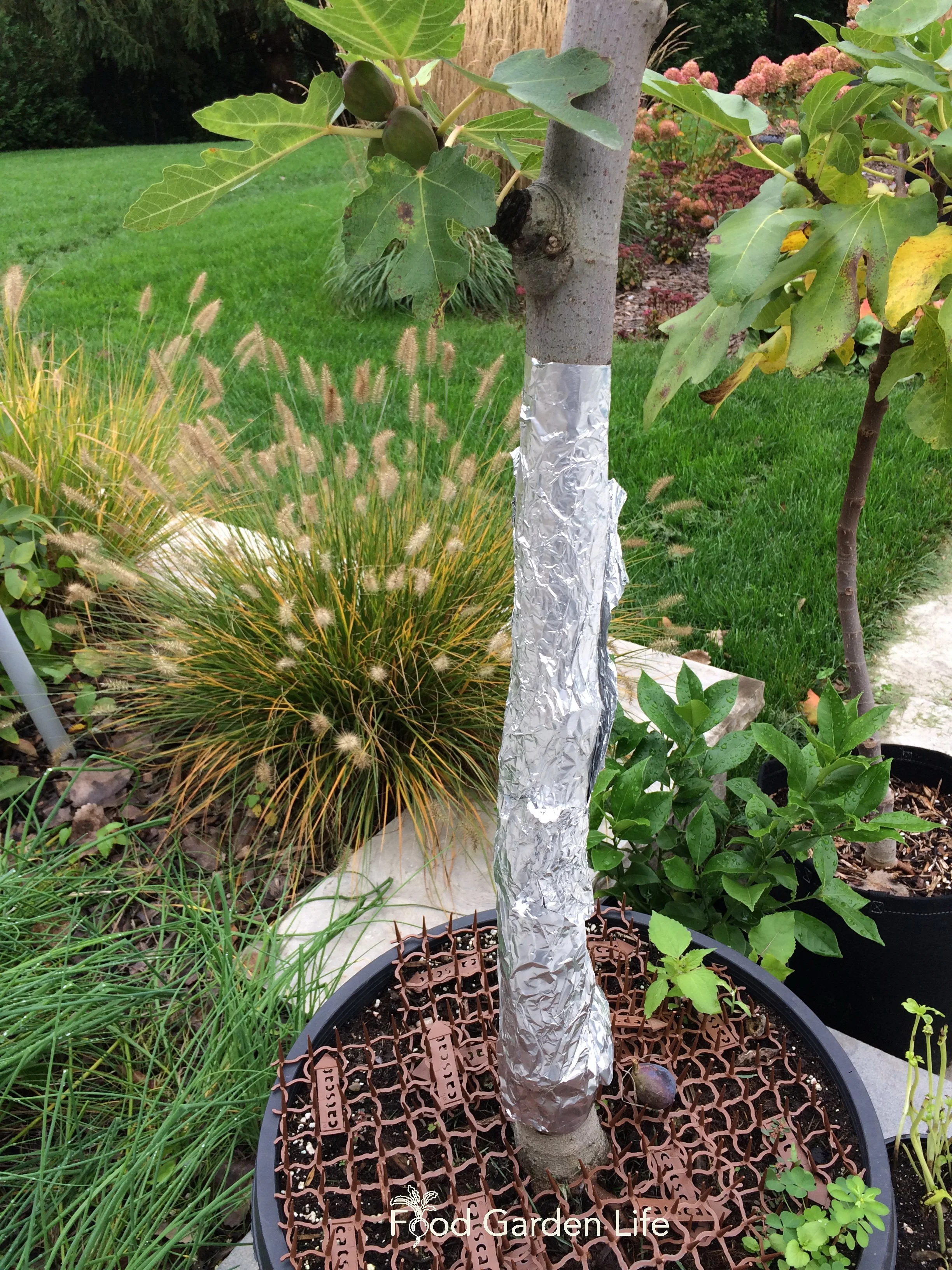
The spiky mat prevented digging. The foil baffle didn’t work.
I often get horse chestnuts poking up next to my potted figs. Every fall the squirrels eagerly bury the nuts in the potted figs…and then forget about them.
If this is a problem, you can physically exclude the squirrels as you would with young fig plants.
Chicken wire works well.
You can see in the picture the spiky bird-deterrent mat that a friend used to prevent squirrels from digging in potted fig trees.
I don’t do this because it’s extra work—and the squirrels digging in larger pots with well-formed roots rarely causes damage to worry about.
Stop Squirrels Eating Figs
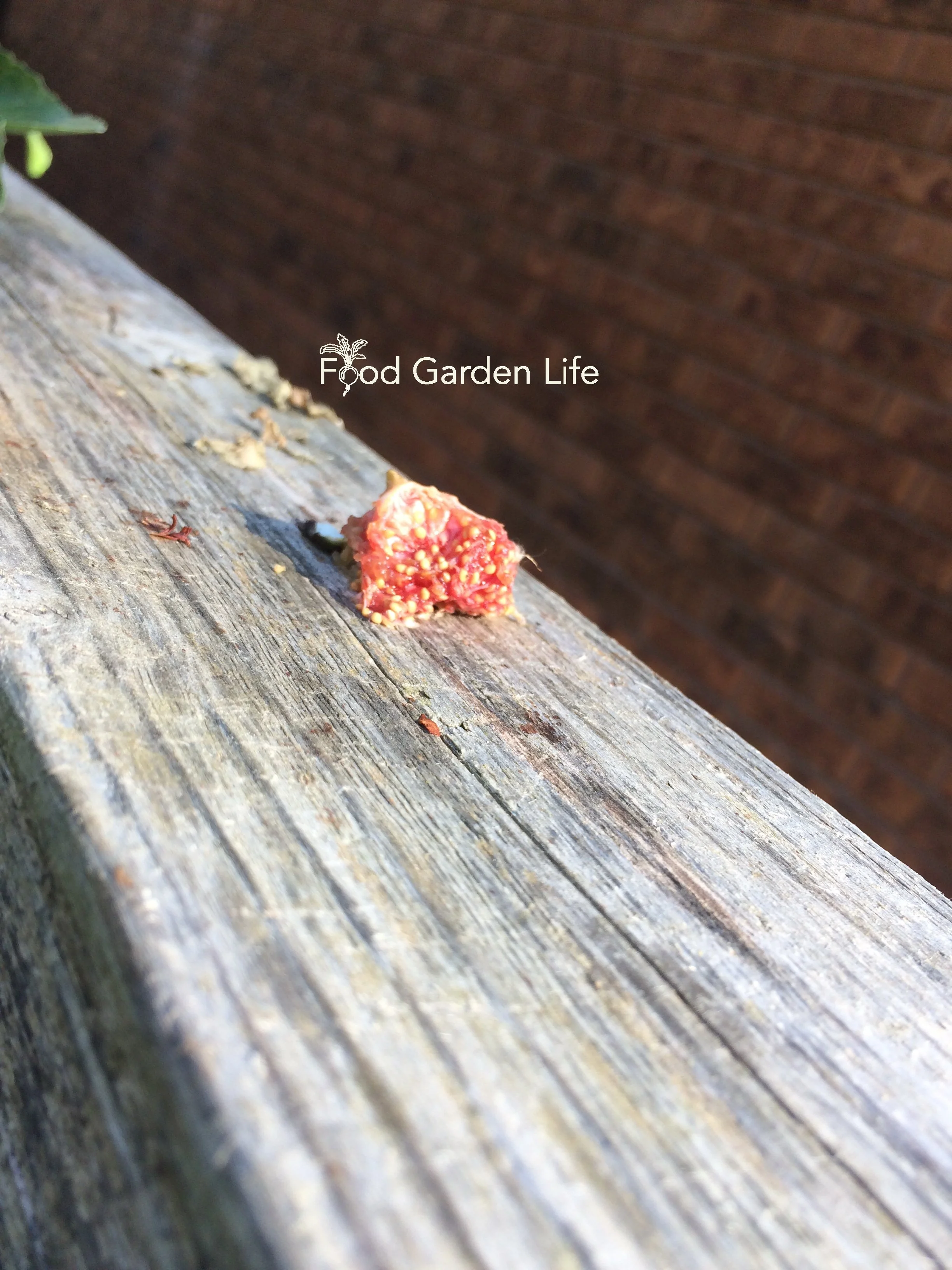
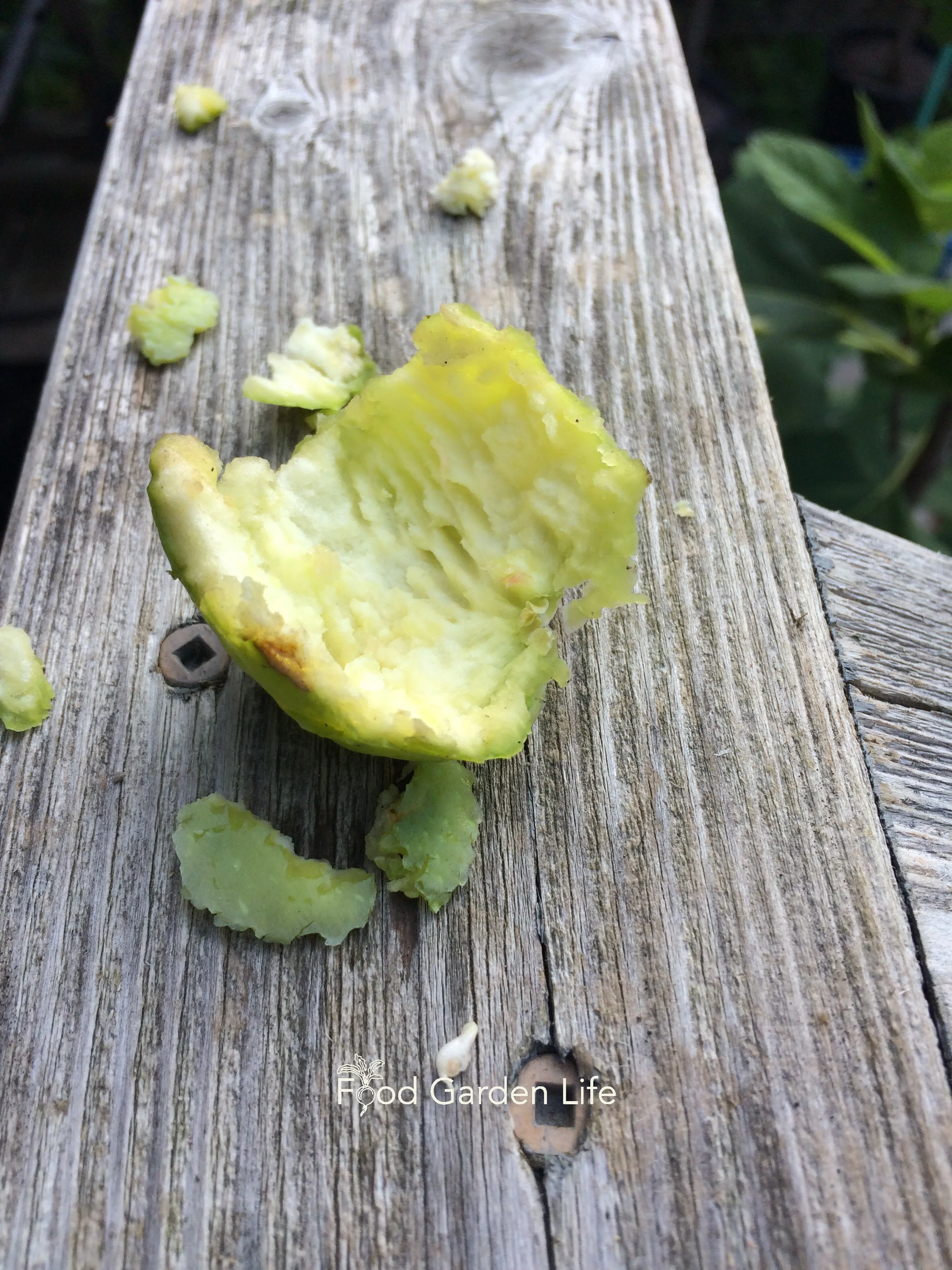
The pictures of squirrel-eaten figs below are worth 1,000 words.
It’s frustrating…because they don’t usually eat the entire fig, so some of it is wasted. And they leave those half-eaten figs right outside my kitchen window, on the deck railing, where it torments me!

Netting Fig Trees
I do not net my fig trees.
It’s a lot of work…both when you install the netting, and when you repeatedly peel it back to harvest figs.
But I’ve heard of people netting fig trees in much the same way that growers net grapes against birds and raccoons.
If you net a tree, use a fine mesh, pull it taut, and secure the edges so squirrels can’t get underneath. Check it regularly to make sure birds or other animals haven’t become tangled. A simple frame can hold the netting away from the leaves and fruit.
Organza Bags
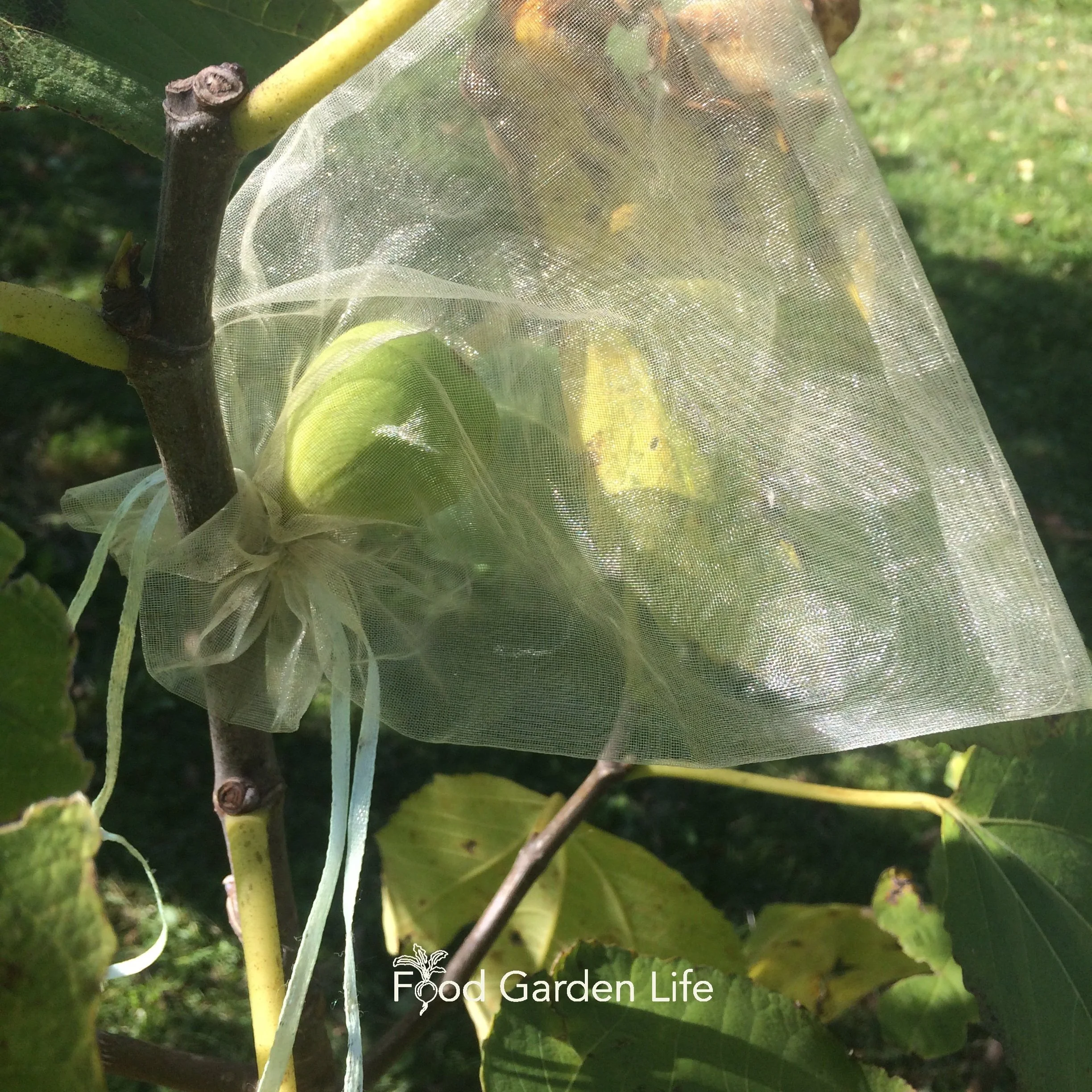
An organza bag as a squirrel deterrent for individual figs.
Small organza bags—the fabric mesh bags often used for wedding favours—can discourage squirrels from sampling individual figs.
A determined squirrel might chew through one, so this isn’t absolute protection. But for a small tree with a few special figs you’re determined to taste, it’s worth trying.
(I don’t do this with figs, but it’s how I manage to harvest pawpaw fruit in my squirrel- and raccoon-infested yard.)
Harvest Promptly
Once fig season begins, check ripening fruit at least once a day. A nearly ripe fig might escape notice, but a fully ripe fig is difficult for a squirrel to overlook.
Don’t pick figs before they’re ripe in hopes that they’ll finish indoors. Unlike tomatoes, figs don’t continue ripening properly after harvest. The trick is to pick them as soon as they’re ready—before the squirrels begin breakfast.
Other Fig Tree Squirrel Deterrents
Natural Predators

Foxes: an all-natural squirrel deterrent!
I remember asking my fig mentor, Adriano, how he prevented squirrels from eating his figs.
“Get a cat,” he said.
I don’t have a cat, but one year foxes made a den nearby.
Those squirrels that survived a litter of six hungry fox kits stayed high up in the big maple tree. I didn’t have squirrels eating my figs that summer.
That isn’t a squirrel-deterrent strategy most gardeners can arrange—but it was fascinating to see how quickly a nearby predator changed squirrel behaviour.
Fig Colour
I love dark figs.
And so, it seems, do the birds and squirrels.
I haven’t seen research to support this, but in my garden, green figs seem to fly under the radar. They blend in amongst the leaves, while dark figs stand out.
Fig Tree Baffles
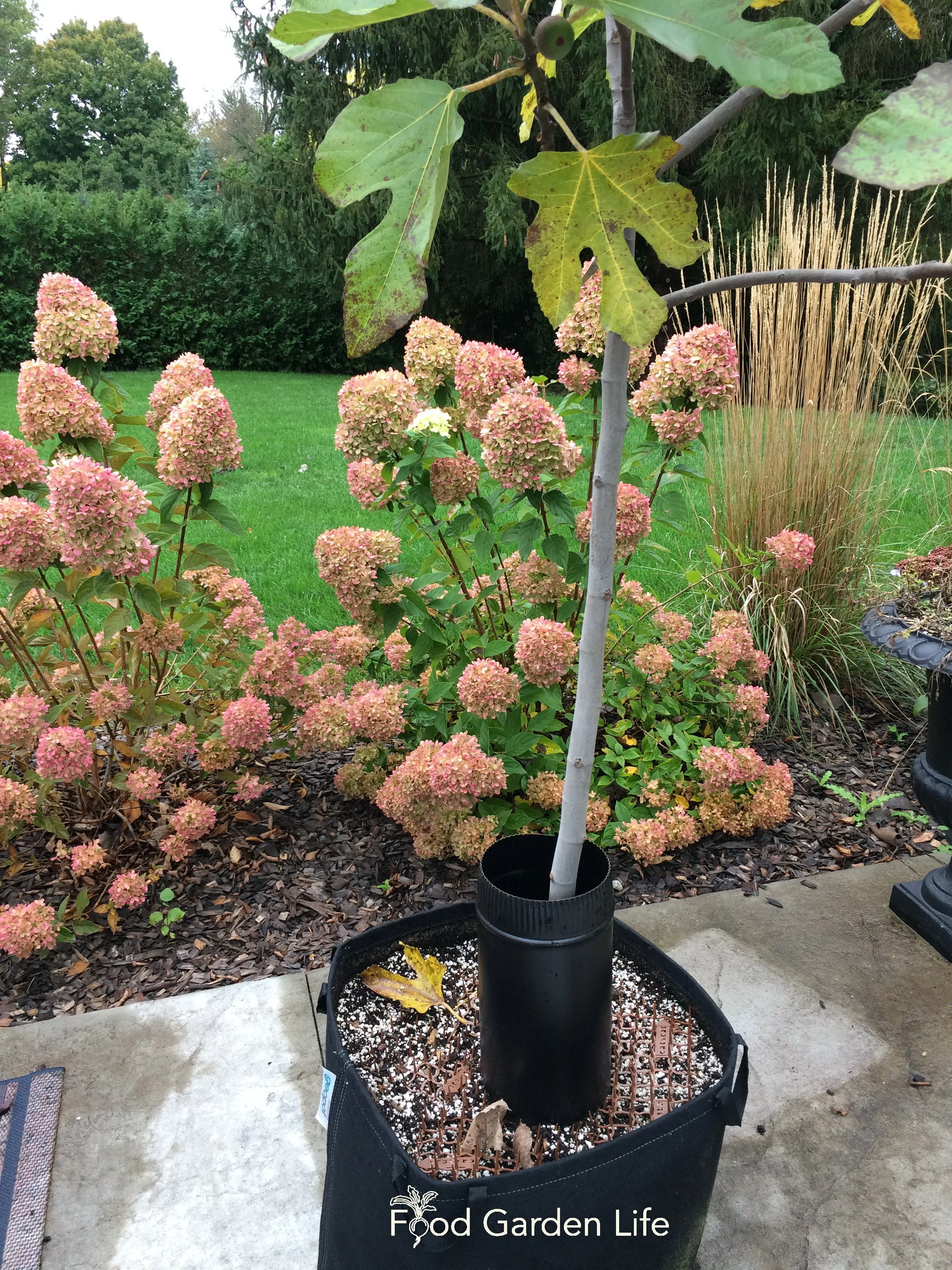
This squirrel baffle didn’t help at all! Squirrels jump—so they must be well above the ground and beyond where squirrels can jump from neighbouring objects.
If you’re thinking of trying tree baffles for squirrels, the main thing to remember is that squirrels jump.
They jump quite well.
I don’t use baffles on my fig trees because there are too many nearby launch points from which they could successfully jump into my fig trees.
But if you had a standalone fig tree, with a tall, single-stem trunk to which you could attach a baffle—it could work.
(I do use squirrel baffles on my bird feeder poles in the winter: the key to success is having the baffle high enough off the ground, and having the feeder far enough away from anything a squirrel could jump from.)
A friend tried the baffle pictured here, and the squirrel effortlessly hopped onto the stem above.
Do Scent Deterrents Work?
I haven’t had success with commercial scent deterrents. Powdered coyote urine certainly didn’t discourage the squirrels in the attic of a house I once rented.
(What finally solved the attic problem? Exclusion: installing a one-way exit and making sure there was no way back in.)
Hot-pepper spray can make fruit less appealing, but you must reapply it after rain. Physical exclusion is more dependable.
This year I’m trying something different: organza bags filled with dry, granulated hen-manure fertilizer, hung away from the fruit in a few fig trees. I’m comparing them with untreated trees. It’s an experiment, not yet a recommendation.
Squirrels helping themselves elsewhere in the garden? See my broader guide to keeping squirrels away from vegetables, fruit, seeds, and containers.
Keep Growing Figs
Growing figs where winters are cold takes a bit of creative thinking.
In Fig Camp and the self-paced Fig Masterclass, I explain how to grow figs in pots or in the ground, extend the growing season, ripen more fruit, and protect your trees through winter.
Explore Fig Camp and Fig Masterclass
Looking for more cold-climate fig-growing ideas? Visit the fig home page to browse articles about varieties, pruning, propagation, ripening, winter protection, and more.
My revised and expanded fig book is a practical guide to growing figs in pots and cold climates—from choosing varieties and pruning to ripening fruit and conquering winter.
Find This Helpful?
Enjoy not being bombarded by annoying ads? Appreciate the absence of junky affiliate links for products you don’t need?
This site is reader supported. If it has helped you in your food-gardening journey, you can give us a high-five below. Any amount is welcome.
Intro to Growing Figs in Cold Climates
Get started growing figs in cold climates by understanding some of the basics about how the plants grow.
By Steven Biggs
Can You Grow Figs in a Cold Climate?
Yes. You can grow figs in places with cold winters, even where fig trees are not reliably winter-hardy.
The trick is choosing a growing method, variety, location, and winter-protection strategy that suit your climate, your garden, and how much effort you want to invest.
You can grow figs in pots and store the dormant plants somewhere protected over winter. You can grow figs in the ground and protect them. And in milder areas, you might be able to grow an in-ground fig with little or no winter protection.
You don’t need a greenhouse.
If you have a sunny growing space for summer and a way to protect a dormant fig through winter, there's a good chance you have what you need to grow figs.
Cold-Climate Fig Primer
I often hear from fig lovers who travel to places where figs are so prolific that they grow from cracks in walls and pavement.
Big fig trees. Loaded with figs.
Then they come home and wonder:
Can I grow a fig tree here?
Can I keep it small?
What do I do with it in winter?
Will I actually get ripe figs?
The answer to the first question is usually yes. The rest depends on how you decide to grow it.
Here are some basics.
Fig Tree Size
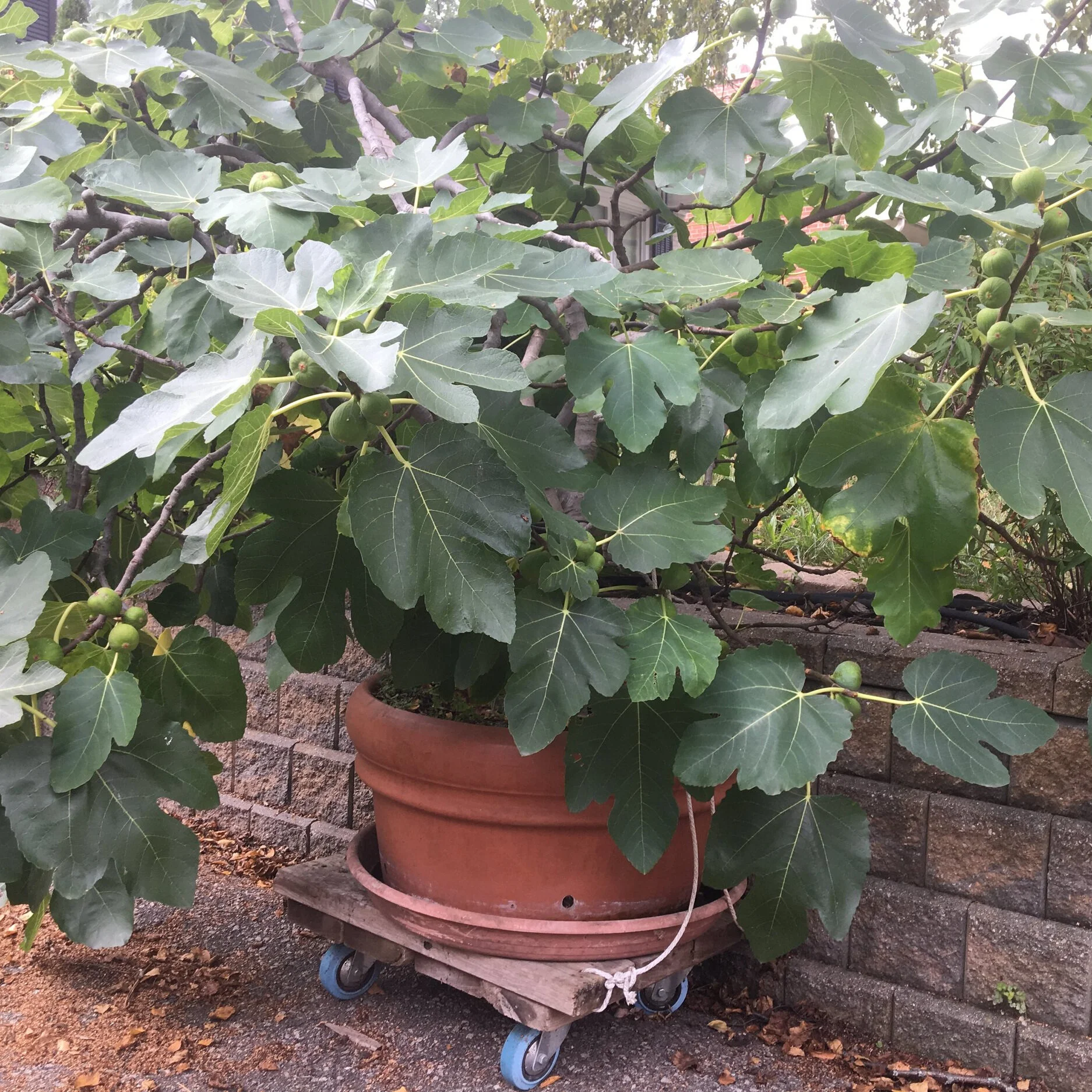
The gardener chooses how big the fig plant gets. This is my neighbour Natalie’s potted fig plant.
Where climate permits, fig plants can grow to about 9 metres (30 feet) high.
But don't worry.
You control the size of your fig tree with pruning.
I keep my potted fig trees small enough that I can move them into protected storage for winter. I also keep my in-ground figs short enough that I can harvest without a ladder.
If a potted fig has to go through a doorway on its way to winter storage, your life will be easier if you keep the tree small enough to carry through it.
Fig plants naturally grow as bushes with multiple stems, but you can also train them into tree forms, fans, cordons, and other shapes.
Find out how to prune in this Cold-Climate Guide to How to Prune a Fig Tree.
Do Fig Trees Survive Cold Winters?
Sometimes. But don't get hung up on a single temperature or hardiness zone.
For established, dormant fig trees growing in the ground, -10°C (14°F) is a good ballpark for cold tolerance. Sometimes they survive colder temperatures. Sometimes damage occurs at warmer temperatures.
That's because fig hardiness is not an exact number.
Cold tolerance depends on things such as:
The age of the tree
The variety
Whether the tree is fully dormant
How long the cold lasts
Whether temperatures dropped gradually or suddenly
How sheltered or exposed the site is
Young trees are more tender than mature ones. New growth and fruit are damaged before older woody stems. And a dormant fig tolerates cold better than one that is actively growing.
Even when winter kills the top growth of an in-ground fig, the roots can survive and send up new shoots.
Potted figs need more protection than in-ground figs because their roots are above ground and experience greater temperature swings.
So instead of asking, "What temperature can a fig survive?" I find it more useful to ask, "How can I moderate winter conditions around this fig?"
Fig Trees Go Dormant
Dormancy is one of the reasons figs are so useful to gardeners in colder climates.
As temperatures fall and days shorten, fig trees drop their leaves and go dormant.
Once dormant, they don't need light. And they don't need much heat.
That means you don’t need a sunny window or heated greenhouse to overwinter a potted fig.
A cold cellar, shed, garage, cool attic, minimally heated greenhouse, or other protected space can work. Ideally, keep dormant potted figs somewhere around 0–7°C (32–45°F).
The goal is not to keep the tree warm. The goal is to keep it dormant.
If the storage space is too warm, the fig can wake up early and begin making weak growth in poor winter light.
Figs Can Produce Two Crops
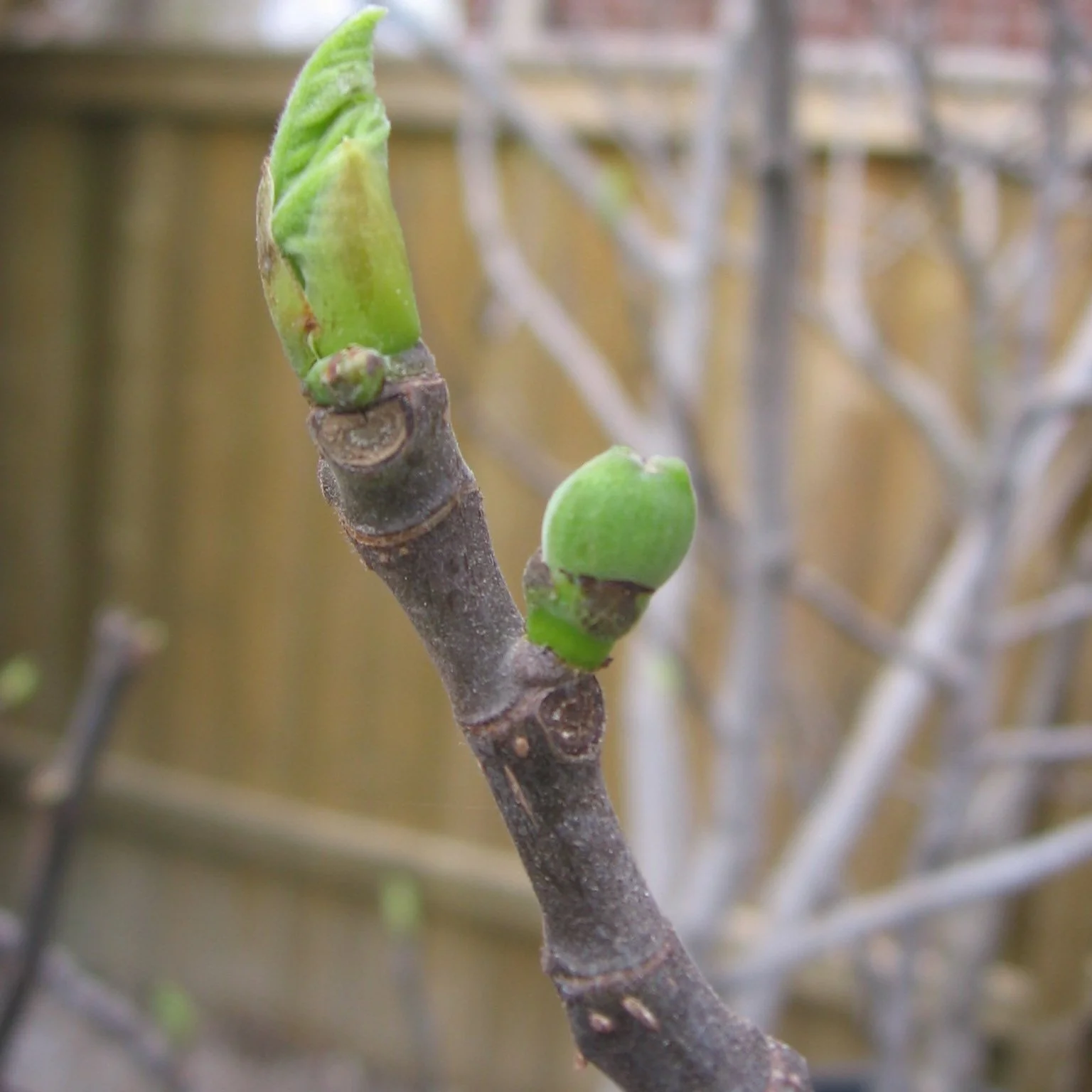
The “breba” crop grows on wood from the previous year.
Depending on the variety, a fig tree can produce two crops.
Breba crop: Figs that form on wood that grew the previous year. These ripen earlier.
Main crop: Figs that form on the current year's new growth. These ripen later.
You might also see two useful terms when shopping for fig varieties:
Biferous: Produces both breba and main-crop figs.
Uniferous: Produces only a main crop.
Not all biferous varieties produce a worthwhile breba crop. Some produce only a handful.
In a climate with a short or cool growing season, I like to think of brebas as fig insurance. Because they form the previous year and ripen earlier, a variety with a good breba crop gives you another route to a harvest if the main crop runs out of summer.
If you're relying on main-crop figs, choose a variety known to ripen early. One of my perennial favourites for an early main crop is 'Ronde de Bordeaux'.
Where Should You Plant a Fig Tree?
Give your fig as much sun and heat as your garden can provide.
In a short growing season, warmth isn't simply about keeping the plant happy. It helps figs ripen sooner.
Look for warm microclimates such as:
The south side of a house
Beside a brick or stone wall that absorbs and radiates heat
A sunny driveway
A hot rooftop
A south-facing slope
Avoid low-lying areas if you have another choice. They can be slower to warm in spring, and cold air can collect there.
Full sun is best, but don't let an imperfect garden stop you. Figs can grow in partial sun, although fruit may ripen more slowly.
My rule is simple: Don't put a fig in full shade. But if partial sun is all you've got, give it a try.
Get Your Fig Trees Through Winter—and Harvest Figs
Growing figs where winters are cold takes a bit of creative thinking.
In Fig Camp and the self-paced Fig Masterclass, I explain how to grow figs in pots or in the ground, extend the growing season, ripen more fruit, and protect your trees through winter.
What Are the Best Fig Varieties for Cold Climates?
Pin this post!
There isn't one "best" cold-climate fig.
Choose a variety according to how you're going to grow it and what limits fig production in your climate.
Ask:
Will the tree remain outdoors in the ground all winter? If so, cold tolerance matters.
Does the variety produce a good breba crop?
Does the main crop ripen early?
Is the fruit prone to splitting?
And, not incidentally, do you like eating it?
Cold hardiness matters much less if you're growing a fig in a pot and moving it to protected winter storage.
For in-ground figs, 'Chicago Hardy' and 'Longue d'Août' are two well-known cold-tolerant varieties.
For an early main crop, 'Ronde de Bordeaux' is one of my favourites.
And if summers are cool or short, consider including a variety known for a substantial breba crop.
Do Fig Trees Need a Greenhouse?
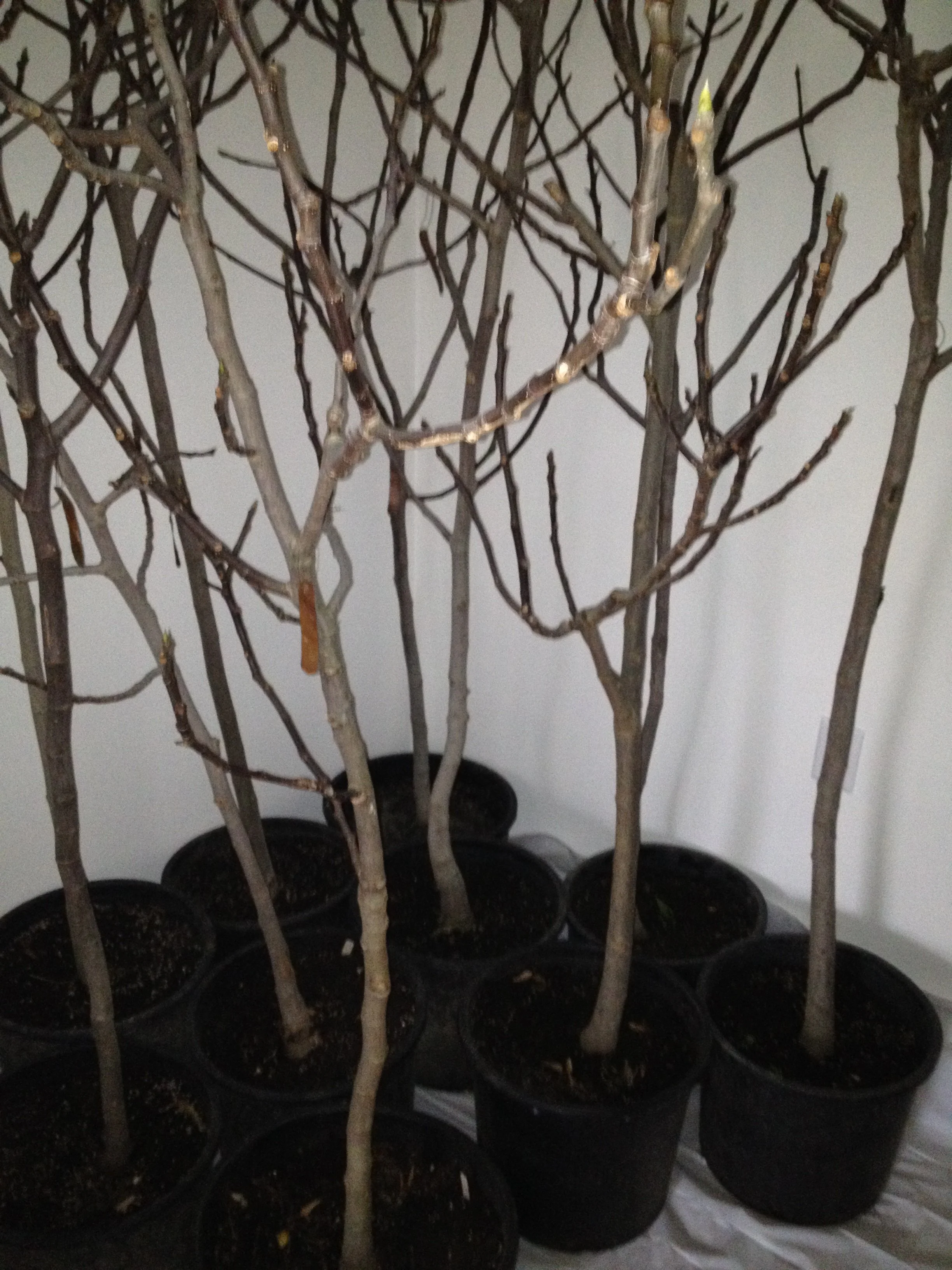
Because fig trees go dormant, there are many winter storage options. These are potted dormant fig trees that I store in my garage over the winter.
No.
This is one of the most useful things to understand about growing figs in colder climates.
Because figs go dormant, potted plants can spend winter somewhere cool and dark. A garage, shed, root cellar, cold basement, or minimally heated greenhouse might all work.
For in-ground figs, gardeners use many different winter-protection techniques. They bend trees to the ground and insulate them, wrap them, build temporary enclosures around them, or take advantage of protected microclimates.
There is no single best method.
The best overwintering method is the one that suits your winter, your property, your fig tree—and the amount of lifting, wrapping, bending, dragging, and schlepping you're willing to do every autumn.
How Many Figs Can You Harvest?
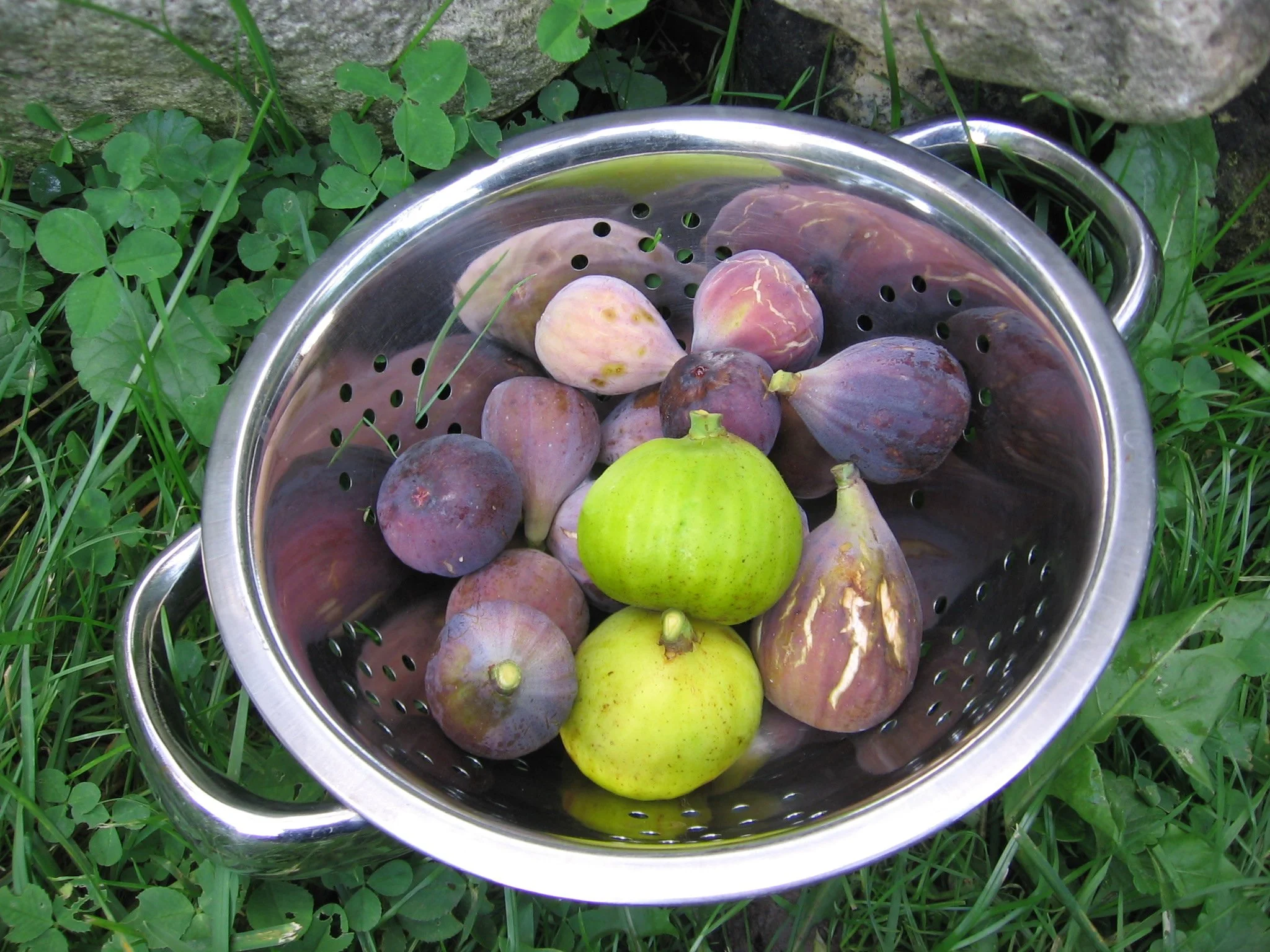
The size of the fig harvest you can expect in a cold climate depends on the variety, plant size, growing conditions, and season length.
There isn't a useful one-size-fits-all answer.
Your harvest depends on:
Variety
Plant size
Growing conditions
Season length
Whether you're harvesting breba figs, main-crop figs, or both
How early the plant gets growing in spring
How quickly temperatures cool in fall
This last point is especially important in short-season areas.
A fig tree can be covered with fruit and still give a disappointing harvest if cold autumn weather arrives before those figs ripen.
That's why I focus less on the number of figs a tree can produce and more on helping it produce figs that actually ripen.
Cold-Climate Fig Growing: The Short Version
If you're new to figs, start with these principles:
Give your fig sun and heat. A warm microclimate helps fruit ripen sooner.
Choose your variety for your conditions. Cold tolerance, breba production, and early main-crop ripening matter.
Decide how you'll handle winter. Pots make winter storage straightforward; in-ground trees may need protection.
Use dormancy to your advantage. A dormant potted fig doesn't need a greenhouse or winter sunshine.
Think about season length, not just winter cold. Getting a fig tree through winter is only half the puzzle. You still need enough warmth and time to ripen the crop.
Figs are surprisingly forgiving plants. You don't need perfect conditions.
You need a plan.
Frequently Asked Questions About Growing Figs in Cold Climates
Can fig trees grow in Canada and other cold climates?
Yes. You can grow fig trees even where they aren’t reliably winter-hardy. Grow them in pots and store them dormant in a protected place, or grow them in the ground and provide winter protection where necessary.
How cold can a fig tree survive?
There is no exact temperature. For many established, dormant in-ground figs, about -10°C (14°F) is in the ballpark. Variety, plant age, dormancy, exposure, duration of cold, and sudden temperature changes all affect cold tolerance.
Can I grow a fig tree in a pot?
Yes. Container growing is one of the easiest ways to grow figs where winters are cold because you can move the dormant plant to protected winter storage.
Do fig trees need a greenhouse in winter?
No. Dormant fig trees don't need light and require very little heat. You can overwinter potted figs in a cool garage, shed, root cellar, cold basement, or similar protected location.
What temperature should dormant potted figs be stored at?
Aim for approximately 0–7°C (32–45°F). The important thing is to keep the tree dormant without allowing the root ball to freeze hard.
What is a breba fig?
A breba is an early fig crop that develops on wood produced the previous year. The later main crop develops on the current season's new growth.
What is the best fig variety for a cold climate?
There is no single best variety. If an in-ground tree remains outside all winter, cold tolerance can be important. Where summers are short or cool, look for varieties with an early-ripening main crop or a substantial breba crop.
How much sun does a fig tree need?
Full sun is best, especially where the growing season is short. A warm location can speed fruit ripening. Figs can tolerate partial sun, but ripening may be slower.
Will a fig tree come back if winter kills the branches?
Often, yes. The roots of an established in-ground fig can survive even when cold kills the above-ground growth, and new shoots can emerge from the roots in spring.
Keep Growing Figs
Looking for more cold-climate fig-growing ideas? Visit the fig home page to browse articles about varieties, pruning, propagation, ripening, winter protection, and more.
Grow Figs Where You Think You Can’t
My revised and expanded fig book is a practical guide to growing figs in pots and cold climates—from choosing varieties and pruning to ripening fruit and conquering winter.
Find This Helpful?
Enjoy not being bombarded by annoying ads? Appreciate the absence of junky affiliate links for products you don’t need?
This site is reader supported. If it has helped you in your food-gardening journey, you can give us a high-five below. Any amount is welcome.
Everyday Fig Loaf: A Nourishing Seed & Nut Bread You’ll Crave

This dense, sliceable, flavour-packed fig loaf is made entirely from good stuff: dried figs, seeds, nuts, olive oil, and a touch of honey. It’s nourishing—and indulgent too!
This recipe comes from my friend and co-author, Signe Langford. As we test out recipes for our upcoming book about growing and cooking olives, lemons, and figs, we’re sharing little glimpses on Instagram at @oliveslemonsfigs—finished recipes and behind-the-scenes testing as the book takes shape.
Why This Fig Loaf Is So Good
Naturally wholesome ingredients
This isn’t your typical flour-heavy quick bread. Instead, it leans on almond flour, seeds, and psyllium to create structure. This gives it a rich, satisfying texture. It feels substantial without being heavy.
A smart way to use dried figs
Dried figs give sweetness and a deep, caramel-like flavour. They pair beautifully with the nuttiness of sunflower and pumpkin seeds.
Flexible and forgiving
You can easily swap in and out other dried fruit (currants, raisins, cranberries) or the fat (olive oil, butter, ghee, or coconut oil). It’s a forgiving recipe that adapts to what you have on hand.
What Does Fig Loaf Taste Like?

Think of this as somewhere between a bread and an energy bar. But I’d say it’s better than both. Signe served it to me straight out of the toaster, smeared with butter. Delicious! It’s:
Slightly sweet, thanks to figs and honey
Nutty and rich from seeds and almond flour
Moist, dense, and sliceable
Perfect toasted or plain
A slice in the morning with coffee is a great start to the day.
Tips for Success
Let it rest: The 4-hour (or overnight) rest is key. It allows the psyllium and chia to absorb water and bind everything together.
Line your pan generously: The parchment overhang makes removing the loaf much easier.
Cool completely before slicing: This loaf firms up as it cools—cut too early and it may crumble.
Measure oil first: A small trick that makes measuring honey much easier (it won’t stick).
Get Your Fig Trees Through Winter—and Harvest Figs
Growing figs where winters are cold takes a bit of creative thinking.
In Fig Camp and the self-paced Fig Masterclass, I explain how to grow figs in pots or in the ground, extend the growing season, ripen more fruit, and protect your trees through winter.
Recipe: Every Day Fig Loaf
Prep time: 10 minutes (+ 4 hours or overnight rest)
Bake time: 50 minutes
Makes: 1 loaf
Ingredients
1 cup coarsely chopped dried figs
1 cup raw sunflower seeds
½ cup ground flax seeds (flaxmeal)
½ cup raw pumpkin seeds
½ cup currants, raisins, or dried cranberries
1 cup almond flour
2 Tbsp. chia seeds
4 Tbsp. psyllium powder
1 tsp fine sea salt
3 Tbsp. olive oil, melted butter or ghee, or melted coconut fat
1 Tbsp. runny honey or maple syrup
1 ½ cups water
Directions for baking fig loaf
Line a loaf pan with parchment, making sure to use more than needed so there is overhang; set aside.
Add all ingredients to the bowl of a stand mixer or large bowl; stir until well combined and a sticky batter has formed.
Transfer batter to prepared loaf pan; spread and press down the mixture. Use the back of a spoon or spatula for this.
Cover with a damp tea towel or cutting board and allow to rest on the counter for at least 4 hours; overnight is better.
When ready to bake, preheat oven to 350F.
Bake for 20 minutes, then retrieve from the oven, remove the loaf from the pan by gripping the parchment paper, then place the parchment-wrapped loaf back into the oven, directly on the oven wrack. Bake for a further 30 minutes.
Allow to cool completely before slicing.
How to Serve Fig Loaf

Every day fig loaf. Photo: Signe Langford.
This fig loaf (of fig bread, if you prefer) is incredibly versatile. Try it:
Toasted with a smear of butter or cream cheese
With a drizzle of honey or extra olive oil
Alongside cheese (especially goat cheese or aged cheddar)
As a satisfying snack on its own
It also travels well, making it perfect for lunches or hikes.
If you’re looking for more fig recipes, visit our library of fig recipes.
A Recipe from Our Cookbook Kitchen
This recipe reflects exactly what we love about cooking with figs: simple ingredients, rich flavour, and recipes that fit into everyday life.
Signe Langford brings the culinary creativity, and I bring the plant perspective—together, we keep coming back to ingredients like figs, olives, and lemons that are both timeless and full of possibility.
If you enjoyed this recipe, you can follow along as we develop the cookbook over at @oliveslemonsfigs on Instagram. We’re sharing recipes, ideas, and inspiration centered around some of our favourite ingredients. We’ve been sharing early recipes and ideas there first…
About
We're Signe Langford and Steven Biggs. Signe is a chef, recipe developer, culinary instructor, and food writer. Steven is a horticulturist and horticulture teacher specializing in edible gardens and food plants. We both love olives, lemons, and figs. We’re sharing recipes and growing tips here as we work on the book. Thanks for joining us on this journey.
Keep Growing Figs
Looking for more cold-climate fig-growing ideas? Visit the fig home page to browse articles about varieties, pruning, propagation, ripening, winter protection, and more.
Grow Figs Where You Think You Can’t
My revised and expanded fig book is a practical guide to growing figs in pots and cold climates—from choosing varieties and pruning to ripening fruit and conquering winter.
Find This Helpful?
Enjoy not being bombarded by annoying ads? Appreciate the absence of junky affiliate links for products you don’t need?
This site is reader supported. If it has helped you in your food-gardening journey, you can give us a high-five below. Any amount is welcome.
Guide to Cold-Climate Fig Varieties
This fig variety guide talks about fig varieties that do well in cold climates.
By Steven Biggs
How to Choose a Fig Variety for a Cold Climate

For cold climates, look for figs that ripen early and suit your winter conditions.
There’s a fig for almost every taste. But in a cold climate, flavour doesn’t matter much if the fruit never ripens.
Start with these three considerations:
Pollination requirements: Choose a variety that ripens fruit without the fig wasp, which isn’t present in most cold-climate growing areas. Most cold-climate growers choose common figs, which produce a main crop without pollination. Some San Pedro figs, such as Desert King, produce a breba crop without pollination, though the main crop requires pollination to ripen.
Ripening time: Look for varieties that ripen within your growing season. Early-ripening main-crop varieties are especially useful where summers are short. Breba figs can also give an early crop—but only if the previous year’s growth survives the winter.
Cold tolerance: Some varieties tolerate cold better than others. But “hardy” can mean different things: surviving with little damage, dying back and regrowing, or still producing a crop after winter damage. Your growing method and winter protection matter as much as the variety.
Once you’ve narrowed down varieties that suit your climate and growing method, think about the qualities you enjoy:
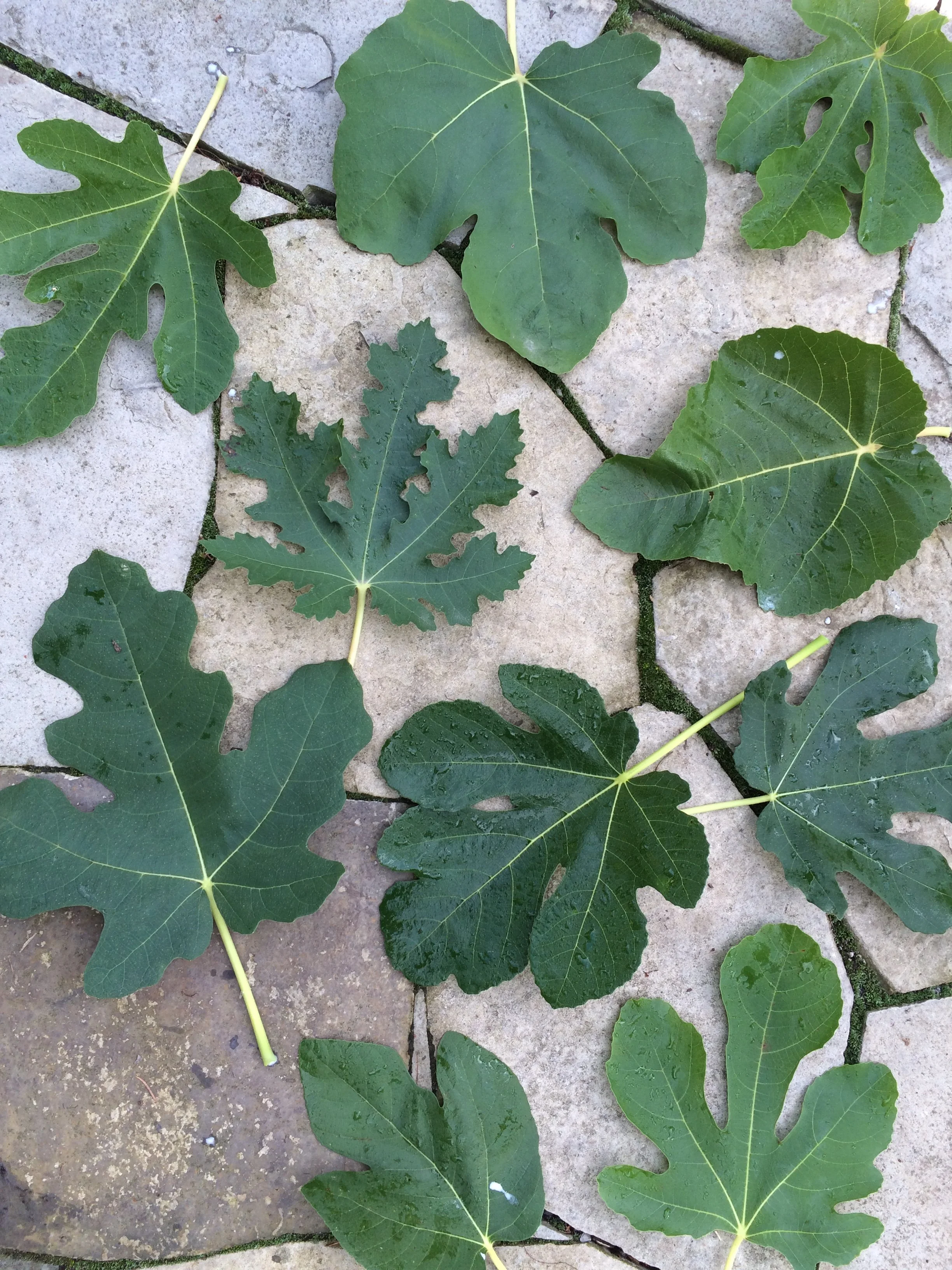
Fig leaf shape depends on the variety.
Flavour: Some figs taste berry-like; others have honey, caramel, or date-like flavours.
Colour: Skin ranges from very dark purple to green or yellow, while the flesh can be amber, pink, or deep red.
Size and shape: Figs range from teaspoon-sized to almost hand-sized, and can be round, oval, pear-shaped, or elongated.
Plant growth: Some varieties grow vigorously, while others remain more compact.
This article brings together variety recommendations from experienced cold-climate fig growers, followed by the varieties that perform well for me in Toronto.
A Note About Fig Variety Names
Fig variety names can get confusing. The same variety sometimes circulates under more than one name, while informal names such as “Black Greek” or “Italian Red” can refer to entirely different figs.
If you’re building a collection, names and provenance matter. If you simply want a productive fig tree, focus on a variety that performs well in conditions like yours. A locally proven unnamed fig can be more useful than a famous variety that ripens too late.
What is a Breba Fig?
Some fig varieties can produce two crops.
The breba crop develops in spring on growth from the previous year and usually ripens in summer. The main crop develops on new growth and ripens later in summer or fall.
Breba-producing varieties can be useful in cool climates because the fruit ripens earlier. There’s a catch: the previous year’s branches must survive the winter. If the tree dies back to the ground, you lose the breba crop even if the plant regrows.
Some varieties, including Desert King, are grown mainly for the breba crop.
Find out more about breba figs.
Well-Known Fig Varieties for Cold Climates
These varieties often appear in cold-climate collections and may be available from specialist nurseries or other fig growers:

Ronde de Bordeaux, top left and centre.
Improved Celeste: Small, early-ripening figs with pink flesh. The light-brown skin becomes violet-brown as the fruit ripens.
Desert King: A San Pedro-type fig known for its large crop of green-skinned breba figs with strawberry-coloured flesh. The breba crop doesn’t require pollination, but the main crop does. In areas without the fig wasp, grow Desert King for its breba crop.
Excel: Medium-sized, sweet yellow figs with amber flesh. A reliable light-coloured fig in my garden.
Hardy Chicago: Small, dark figs with red flesh. This variety is valued for its cold tolerance and its ability to produce a main crop on new growth after winter dieback.
Lattarula: Medium-sized, very sweet yellow-green figs with light-coloured flesh. It can produce a useful breba crop where the previous year’s growth survives winter.
Ronde de Bordeaux: An early-ripening main-crop fig with purple skin, red flesh, and a rich berry flavour. It’s one of the most consistently useful varieties in short-season climates.
Cold-Climate Fig Recommendations from Experienced Growers
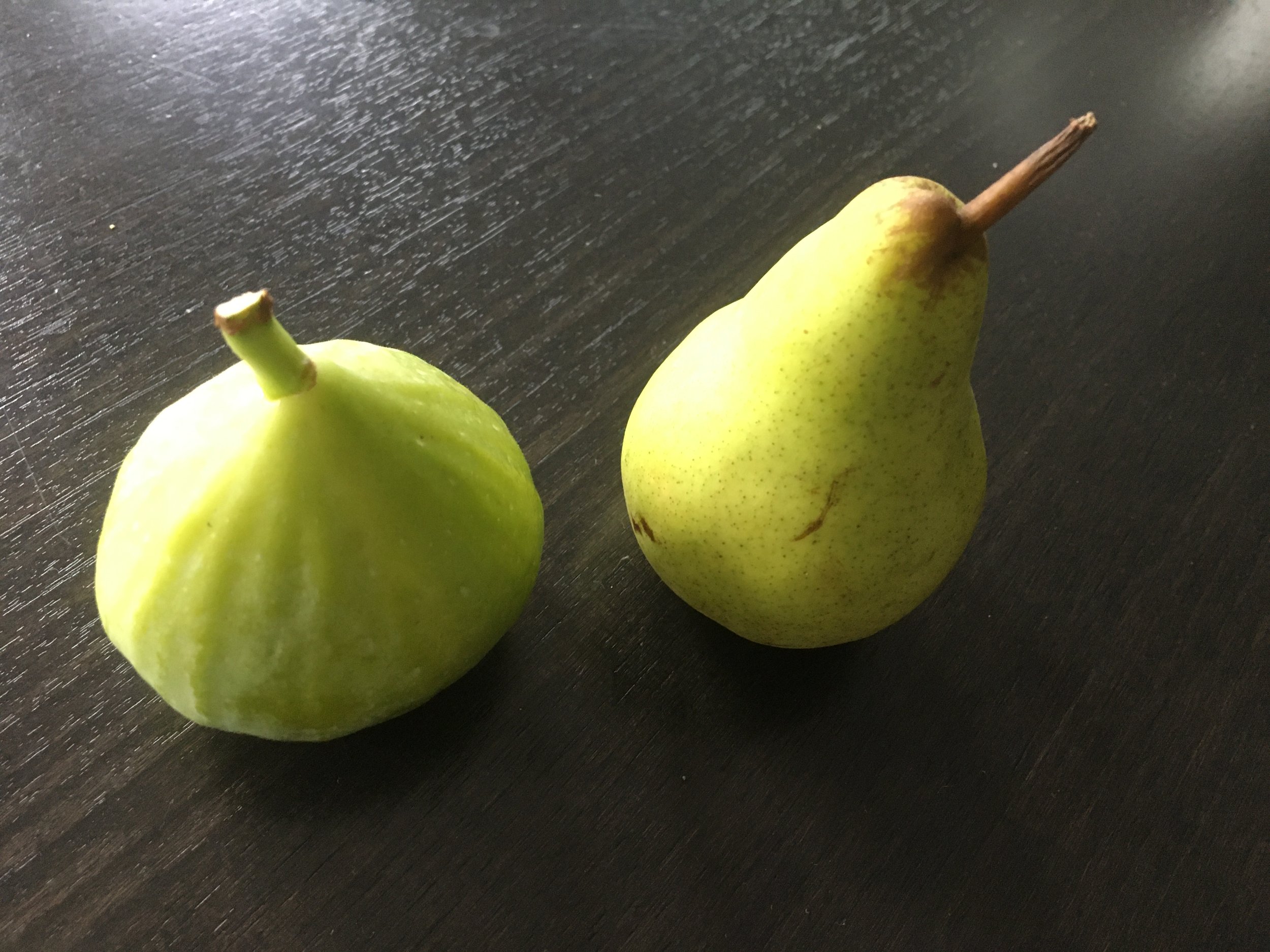
We cut this one into five, so that everybody in the house could enjoy a sliver!
I’ve asked experienced fig growers in Canada and the United States which varieties perform best for them. Their answers vary because “cold climate” can mean a short summer, a very cold winter, a cool coastal climate—or some combination of the three.
Use these recommendations as starting points, not universal rankings. Pay particular attention to growers whose climate and growing method resemble yours.
Adriano Ferreira - Oakville, Ontario
My fig mentor, Adriano, grew a very large collection in Oakville, Ontario. When I asked him about top varieties, he suggested:
Celeste
Desert King. “The best to grow in a northern climate.”
Lattarula. “A super fig.”
Nelson Esteves - Mississauga, Ontario

I connected with Nelson when I wrote about figs for Garden Making magazine. He told me about his Mississauga, Ontario, collection, with more than 100 varieties. “There are lots of good ones that are ‘unknowns,’” he told me. In general, he finds that small to medium-sized dark figs perform best for him and don’t need as much heat to ripen as light-coloured figs. He suggested:
A dark fig he got from Colasanti Farms in Ruthven—an unnamed variety, he says, that was simply labelled “Italian Fig.”
Hardy Chicago
Paul Khong - Chilliwack, British Columbia
I also chatted with Paul when I wrote about figs for Garden Making magazine. He’s a collector in Chilliwack, B.C., with more than 100 varieties. He can leave his plants (except for young, tender ones) outside over the winter. He recommended:
Desert King
Osborn’s Prolific
Lattarula
Bob Duncan - North Saanich, British Columbia
The late Bob Duncan and his wife, Verna, created Fruit Trees and More near Victoria, B.C. When I visited their nursery, I came home with a suitcase full of plants.
Bob recommended San Pedro-type figs for the Pacific Northwest, where cool summers can make main-crop figs difficult to ripen. Read more about San Pedro figs and breba crops.
Desert King
Grantham’s Royal
Talking about Grantham’s Royal, Bob says, “It’s one of the largest figs out there.”
Following Bob’s death, Verna is closing the nursery. Their videos remain a valuable record of their remarkable work.
Learn how Bob ripened main-crop figs in the cool Pacific Northwest.
Ross Raddi - Philadelphia, Pennsylvania
Ross Raddi grows figs in Philadelphia, Pennsylvania. He’s joined me several times to talk about growing figs in cold climates. His favourites include:
Improved Celeste
Hardy Chicago
Florea
Longue d’Août
Violette de Bordeaux
Pastilière
Jonathan Bates - Finger Lakes, New York
Jonathan Bates grows figs at Food Forest Farm in the Finger Lakes region of New York State. Instead of testing dozens of varieties yourself, he recommends finding experienced fig growers in your area and learning what performs well for them.
St. Rita: Bigger and earlier than Hardy Chicago.
Florea: His earliest fig.
Improved Celeste
Ronde de Bordeaux: Early, hardy, and quick growing.
Bill Lauris - Lancaster, Pennsylvania
Bill grows in Lancaster, Pennsylvania, where he runs Off the Beaten Path Nursery. His recommendations include:
Teramo. His earliest main-crop fig.
Florea
Longue d’Août. Big and early.
Maurice - Quebec City, Quebec
I’ve corresponded with Maurice in Quebec City over the years. His conditions are challenging: a short growing season, a balcony, and only partial sun. Yet he harvests figs.
After testing several varieties, he narrowed his collection to two favourites:
Ronde de Bordeaux. His best-performing variety.
Pastilière. Another good performer.
Bob - Michigan
Bob, a fig collector in Michigan, points out that northern growers need more than winter hardiness. The fruit must also ripen before the first fall frost.
For in-ground trees in USDA Zone 5b, he recommends Danny’s Delight and Sal’s EL:
“If you’re planning on planting figs in ground, in USDA zone 5b, I suggest Danny’s Delight and Sal’s EL for main crop figs. Those two will easily give as many as 200 or more figs per year, even in the north. They can not only take cool summers and still remain sweet, they can also take the rain while they are ripening.”
Ben Nguyen - Seattle, Washington
Ben Nguyen grows figs in Seattle, Washington, and shares his experiences at Seattle Garden & Fruit Adventures. Cool Pacific Northwest summers can make main-crop figs difficult to ripen, so his recommendations are especially useful for growers interested in breba-producing varieties.
Vincenzo. Both its breba and main crops ripen for him.
Pelegrino. Produces very large, flavourful figs.
Tony - West Virginia
Tony, the grower behind Mountain Figs, grows in West Virginia. His recommendations include:
Hardy Chicago: Not his earliest variety, but it can produce ripe figs on new growth after winter topkill.
Ronde de Bordeaux: His prettiest and earliest.
Florea: Reliable and early.
Improved Celeste: His earliest to begin ripening.
Brooklyn White: A good light-coloured fig.
Michael Bostock - Vancouver, British Columbia
Michael Bostock grows figs in Vancouver, British Columbia. After more than two decades of trials, he settled on five varieties that consistently ripen fruit in his cool, temperate climate.
During the winters of 2022 and 2023, temperatures fell to approximately -14°C (7°F). The resulting dieback gave Michael an opportunity to compare the cold tolerance of these varieties.
Here’s what he observed:
Desert King. The Pacific Northwest favourite, great taste, and a large crop of brebas. Jammy flavour. Basically unaffected by the winters of 2022 and 2023.
Dauphine (Grantham’s Royal). Another breba fig, honey flavour, slightly fewer but larger breba figs than Desert King. Took the winter of 2022 OK but must have been weakened, since the winter of 2023 killed off all top growth. There are some minor suckers growing from low down on the main trunk but very slowly. This was trained to a standard. If it comes back, I will probably try more of a bush form; I suspect this may be hardier based on my Desert King experience.
Ronde de Bordeaux. Early ripening main-crop fig, great jammy taste. Every once in a while (once in 5-10 years), it produces a large breba crop. My tree was trained to a vase shape. First cold winter (2022) was fine. In 2023, half the tree was fine; the other half had top growth killed but vigorous suckers near the base of the corresponding limbs.
Florea. Earliest ripening main crop, big, honeyish, good fig to have in the few days before Improved Celeste and Ronde de Bordeaux start to ripen, as they are better tasting and ripen more rapidly once they start. Always has fungal dieback on the youngest branches even in mild winters but always comes back in good form. It has reportedly survived temperatures down to -20°C in drier climates.
Improved Celeste. Early ripening main-crop fig, very nice honey fig, ripens at around the same time as Ronde de Bordeaux. Like Dauphine, mine was trained as a standard. It suffered visibly in the first cold winter; half the upper growth was killed. In 2023, it died back almost to the base of the trunk, where some weak attempts at budding have started. This looks to be the weakest of the bunch despite the fact that one of its parents (Celeste) is supposed to be among the hardier figs.
Get Your Fig Trees Through Winter—and Harvest Figs
Growing figs where winters are cold takes a bit of creative thinking.
In Fig Camp and the self-paced Fig Masterclass, I explain how to grow figs in pots or in the ground, extend the growing season, ripen more fruit, and protect your trees through winter.
My Favourite Fig Varieties for Toronto

It’s a race to see who gets to the ripe Sultane figs first in our household.
To wrap things up, here are the varieties that perform well for me in my Toronto garden. I grow in Canadian Zone 6—roughly USDA Zone 5—with a growing season moderated by Lake Ontario. I protect or store my fig trees over winter, depending on how I grow them.
Sultane: Great flavour. The challenge is getting to the ripe figs before the rest of my family does.
Ronde de Bordeaux: Consistently early, with an excellent berry-like flavour. It’s one of my best all-round varieties for a short growing season.
Capelas: A two-crop fig that I received from my mentor, Adriano Ferreira. Its main-crop figs ripen reliably in my garden—and I think of Adriano whenever I harvest them.
Niagara Black: Produces very large, delicious breba figs. My neighbour John gave me this variety, and I love it.
Excel: A reliable light-coloured fig that consistently produces fruit for me.
Desert King: If you can preserve last year’s growth, every cold-climate fig collection needs a Desert King. Enough said.
If you’re choosing your first fig for a short growing season, Ronde de Bordeaux is an excellent place to start. But local experience matters. A variety already producing well in a nearby garden is often a better bet than one with an impressive reputation elsewhere.
Keep Growing Figs
Looking for more cold-climate fig-growing ideas? Visit the fig home page to browse articles about varieties, pruning, propagation, ripening, winter protection, and more.
Grow Figs Where You Think You Can’t
My revised and expanded fig book is a practical guide to growing figs in pots and cold climates—from choosing varieties and pruning to ripening fruit and conquering winter.
Find This Helpful?
Enjoy not being bombarded by annoying ads? Appreciate the absence of junky affiliate links for products you don’t need?
This site is reader supported. If it has helped you in your food-gardening journey, you can give us a high-five below. Any amount is welcome.
Fig Nursery List: Where to Find Fig Trees for Sale
Where to find fig trees for sale
Where to Buy a Fig Tree
I often hear from people wondering where to buy fig trees and cuttings, especially varieties suited to cold climates.
This directory focuses on nurseries, garden centres, and specialist fig growers in Canada and the northern United States, with a short international section.
Availability, shipping policies, and nursery operations change, so check directly with the seller before ordering. This list isn’t an endorsement of every seller or plant listed.
Last reviewed: August 2026
Know another reliable source? Contact me and tell me about it.
Use the links below to jump directly to the nursery lists—or keep reading for tips about buying and shipping fig trees.
Fig Tree Nurseries - Canada
Fig Tree Nurseries - USA
Fig Tree Nurseries - Around the World
Tips for Buying a Fig Tree
Before ordering, confirm exactly what you’re buying: a dormant cutting, a rooted cutting, a bare-root plant, or a potted tree. The price, shipping method, and care required after arrival can differ greatly.
Choose a Variety That Suits Your Conditions
Don’t choose on flavour alone. Ask whether the variety:
Produces fruit without pollination
Ripens early enough for your growing season
Produces a worthwhile breba crop
Has performed well for growers in a climate similar to yours
Suits your planned growing method—in a pot, in the ground, or under winter protection
Not sure which variety to choose? See this Guide to Cold-Climate Fig Varieties.
Confirm the Variety Name
Fig names can be unreliable. The same variety sometimes circulates under different names, and informal names such as “Italian fig” can refer to many unrelated plants.
Ask the seller where the plant material came from, especially if you’re paying a premium for a rare variety. For your first fig, a locally proven plant is often a better choice than an expensive collector’s variety.
Compare Plants, Cuttings, and Shipping Costs
Potted plants are larger and easier for beginners, but they’re expensive to ship. Dormant cuttings cost less to mail, although you must root them yourself. Rooted cuttings fall somewhere in between.
If pickup is possible, you can often get a larger plant while avoiding shipping costs and damage in transit.
Ask When the Order Will Ship
Shipping seasons vary. Sellers may send dormant cuttings and bare-root plants during the fall, winter, or early spring, while potted plants usually ship after the risk of severe cold has passed.
Some nurseries accept advance orders for varieties they don’t keep continuously in stock. Ask whether you’re buying an in-stock plant or placing a preorder.
Check Cross-Border Requirements
Many plant sellers don’t ship out-of-country because live plants and cuttings may require permits, inspections, or phytosanitary certificates.
Before ordering from another country, check the import rules where you live. Ask the seller about documentation, additional costs, and possible delays. Don’t assume that a seller’s willingness to mail a plant means it can legally enter your country.
When Your Fig Tree Arrives
Unpack the shipment promptly and check the plant for damage, drying, or signs of pests. Photograph any problems before removing packaging, and contact the seller immediately if the plant arrived damaged.
Give a newly shipped plant time to recover before repotting unless it’s badly rootbound or the growing medium presents a problem. Keep new plants separate from the rest of your collection while you watch for pests.
Connect with Other Fig Growers
Nurseries aren’t the only source of interesting fig varieties. Online fig communities can help you meet growers, learn about varieties, and find cuttings that rarely appear in nursery catalogues.
FigFanatic
FigFanatic is an online community where fig growers discuss varieties, share growing advice, and connect with people offering or trading cuttings. It’s especially useful if you’re looking for an unusual variety—or want to learn from growers in conditions similar to yours.
Cuttings and trades are arranged between individuals, so check the grower’s reputation and location, ask about the provenance of the variety, and follow any rules governing the shipment of plant material.
On a personal note, this community has been generous in sharing my fig work and supporting the new edition of my book.
Fig Tree Nurseries - Canada
Fig Tree Nurseries - USA
Fig Tree Nurseries - Around the World
Canadian Fig Tree Suppliers
These Canadian nurseries, garden centres, marketplaces, and specialist growers have offered fig trees or cuttings. Some carry figs only seasonally, so check current availability before visiting or ordering. Ask whether plants are grown in Canada or imported if that matters to you.
Angelo’s Garden Centre
Vaughan, Ontario
This independent Vaughan garden centre usually carries potted fig trees in spring. Its greenhouse also contains a large in-ground fig tree planted by the late Angelo Amendolia.
Hear Carlo Amendolia tell the story of Angelo’s 19-foot-high fig tree.
Bunchberry Nursery
Upper Clements, Nova Scotia
Along with fruit trees and bushes, nuts, and figs, specializing in alpines, heaths and heathers, dwarf conifers, rhododendrons, grasses and perennials.
Tropico-Québec
St-Valérien de Milton, Québec
A Quebec specialist in tropical and subtropical plants, including brugmansias, citrus, and fig trees.
Canadian Figs
Mississauga, Ontario
A Mississauga-based specialist offering fig trees and cuttings, with more than 100 varieties in its collection. It also accepts requests to custom-grow varieties.
FigTrades
A Canadian marketplace where individual sellers offer fig trees, cuttings, and growing supplies. Listings come from independent sellers rather than a single nursery, so check seller details and variety provenance before ordering.
Fiesta Gardens
Toronto, Ontario
This Toronto garden centre, next to Fiesta Farms, often carries unusual edible plants, including potted fig trees during the growing season.
Grimo Nut Nursery
Niagara-on-the-Lake, Ontario
A Niagara-on-the-Lake nursery specializing in nut trees and other unusual edible plants, including fig trees. This was one of my first stops when I began collecting figs—I filled the trunk of my car.
Hear Ernie Grimo talk about growing nut trees in cold climates.
JCJ Acres
Vineland, Ontario
A Vineland fig specialist offering many varieties as plants and dormant cuttings. Owner Joe is a fellow cold-climate fig enthusiast.
La Vallée du Moulin
Melbourne, Quebec
A Quebec commercial fig grower offering potted fig trees in several varieties, along with fresh figs, spreads, and other fig products. Its figs are grown in energy-efficient greenhouses.
Hear owner Anne-Marie Proulx talk about what they do.
Metchosin Farm
Metchosin, British Columbia
A Vancouver Island farm offering Canadian-grown cuttings from fig trees adapted to the coastal Pacific Northwest.
Nutcracker Nursery
Maskinongé, Quebec
A Maskinongé, Quebec, nursery specializing in hardy fruit and nut trees, including fig trees. I’ve ordered plums and damsons from Nutcracker Nursery and was pleased with the plants.
Pépeinière Ancestrale
St-Julien, Quebec
A Saint-Julien, Quebec, nursery offering fig trees along with fruit and nut trees, berries, and other edible plants. This is also where I got my first cherry-plum bushes.
Phoenix Perennials
Richmond, British Columbia
A Richmond, British Columbia, nursery with a large selection of unusual plants, including fig trees. It offers both local pickup and seasonal mail order within Canada.
RK Figs
Toronto, Ontario
A Toronto fig specialist offering rooted trees, cuttings, and propagation supplies. The current catalogue includes both well-known cold-climate varieties and collector varieties.
Richters Herbs
Goodwood, Ontario
A long-established mail-order nursery in Goodwood, Ontario, offering herbs, unusual edibles, and fig plants. Richters ships plants across Canada and the United States.
Watch the talk I gave at Richters about growing figs in cold climates.
Sage Garden Greenhouses
Winnipeg, Manitoba
A Winnipeg greenhouse offering figs and other unusual edible plants, with live-plant availability changing seasonally. Owner Dave Hanson is a knowledgeable cold-climate grower who has taught with me about exotic edibles and Mediterranean plants.
Silvercreek Nursery
Wellesley, Ontario
A Wellesley, Ontario, nursery with a mail-order selection of bare-root fig trees and many other edible plants. Some of my apple trees came from Silver Creek, and I took an excellent grafting workshop there.
Tropic of Canada
Rodney, Ontario
A Rodney, Ontario, nursery specializing in tropical and subtropical food plants suited to container growing in Canada, including fig trees. Plants are available for pickup and, depending on size and season, shipping within Canada.
Whiffletree Farm and Nursery
Elora, Ontario
An Elora, Ontario, mail-order nursery specializing in bare-root fruit trees and other edible plants, including figs. Orders are generally placed in advance for spring delivery.
Get Your Fig Trees Through Winter—and Harvest Figs
Growing figs where winters are cold takes a bit of creative thinking.
In Fig Camp and the self-paced Fig Masterclass, I explain how to grow figs in pots or in the ground, extend the growing season, ripen more fruit, and protect your trees through winter.
USA Fig Tree Suppliers
These U.S. nurseries offer fig trees, rooted plants, or cuttings. Some specialize in figs, while others carry a broader selection of unusual edible plants. Check shipping restrictions and current availability before ordering.
Burnt Ridge Nursery
Onalaska, Washington
A family-owned nursery offering fruit and nut trees, including fig varieties selected for the Pacific Northwest.
Dancing Bear Farm
Leyden, Massachusetts
An organic farm growing figs in greenhouses and outdoors in the foothills of the Green Mountains. The farm has scaled back its other plant sales but continues to offer fig trees, generally beginning in mid-May.
Tune in for a chat with owners Trish and Tom.
Encanto Farms Nursery
San Diego, California
A specialist nursery propagating fig trees and banana plants from its own collection. It grows hundreds of fig varieties in small quantities and also maintains the extensive Figs4Fun variety database.
Explore the Figs4Fun fig variety database.
Logee’s
Danielson, Connecticut
A long-established nursery specializing in unusual fruiting, tropical, and container plants, with a good selection of fig varieties. Its retail greenhouses are also a destination for gardeners who enjoy unusual edibles.
Off the Beaten Path
Lancaster, Pennsylvania
A specialist nursery offering fig plants and an annual late-fall sale of dormant cuttings. Its catalogue groups figs by flavour profile and includes bundles selected for cold climates.
Hear Bill talk about figs in this podcast episode.
One Green World
Portland, Oregon
A nursery specializing in unusual fruiting plants, with an extensive selection of fig trees. Its catalogue includes varieties recommended for short growing seasons and cool coastal climates.
Peaceful Heritage Nursery
Stanford, Kentucky
A family nursery specializing in fruit trees, with a large selection of fig varieties tested in a Zone 6 climate. It offers both familiar cold-climate figs and harder-to-find collector varieties.
Raintree Nursery
Morton, Washington
A Pacific Northwest nursery specializing in fruiting plants, with fig varieties suited to containers, cool summers, and northern gardens.
Trees of Joy
Bethlehem, Pennsylvania
A specialist nursery offering a large collection of fig varieties along with pawpaws, persimmons, jujubes, and other unusual fruit trees. Many of its figs have performed well in the nursery’s cold climate.
Fig Nurseries Around the World
Import rules can make international plant orders complicated. Before ordering, confirm that the nursery ships to your country and check your country’s requirements for importing plants or cuttings.
Jurassicplants Nurseries
St Asaph, Wales, United Kingdom
A family nursery specializing in rare and unusual edible plants, including figs and pomegranates. It propagates its own plants and offers several varieties suited to UK growing conditions.
Pépinières Baud
Vaison-la-Romaine, France
A multigenerational family nursery specializing in fig and pomegranate trees, with a collection of more than 250 fig varieties. Pierre Baud is an internationally respected fig authority and the author of several books about figs.
Hear Pierre Baud discuss cold-hardy fig varieties.
Keep Growing Figs
Pin this post!
Looking for more cold-climate fig-growing ideas? Visit the fig home page to browse articles about varieties, pruning, propagation, ripening, winter protection, and more.
Grow Figs Where You Think You Can’t
My revised and expanded fig book is a practical guide to growing figs in pots and cold climates—from choosing varieties and pruning to ripening fruit and conquering winter.
Find This Helpful?
Enjoy not being bombarded by annoying ads? Appreciate the absence of junky affiliate links for products you don’t need?
This site is reader supported. If it has helped you in your food-gardening journey, you can give us a high-five below. Any amount is welcome.
Ripen Figs! 7 Tips to Boost Fig Tree Harvests in Cold Climates
7 tips to boost fig tree harvests in cold climates. Fig tree cold hardiness is one way to grow more figs. Here are 6 other things that will boost your fig harvest.
By Steven Biggs
Harvest Figs Earlier and get More Figs with these Tips
Ripen figs faster so you don't have lots of unripe fruit in the fall. Learn how to help figs ripen.
Not getting as many figs as you hoped for? Or stuck with too many unripe figs?
Fig tree cold-hardiness is only one part of getting a good fig harvest in colder climates.
If you want more ripe figs, here are other things to look at:
Grow early-ripening fig varieties
Prune your fig tree to get more figs
Wake up your fig tree early enough
Know when to pinch branches in the summer
Choosing the best spot for your fig tree
Extend your fall fig harvest
Keep reading if you want tips to get more figs and speed up the ripening process. Then you can harvest more ripe figs. Even if you're gardening where fig-growing is borderline—or where fig trees are not hardy and need winter protection.
7 Tips to Boost Your Cold-Climate Fig Harvest
Grow Cold-Hardy Fig Varieties
Some fig varieties tolerate more cold than others. That means that you’re less likely to have branches die back during cold weather. And a cold-hardy fig variety that loses fewer branches over the winter can grow you more figs!
Cold hardiness is especially helpful when you’re growing figs outdoors, where a plant gets exposed to more extreme temperatures. Having a cold-hardy fig variety becomes less important if you're growing potted figs that are stored somewhere protected.
A well-known hardy fig variety is ‘Chicago Hardy.'
Along with the cold hardiness of a variety, there are other things that affect how much cold a fig tree can withstand. Here's more on fig tree cold hardiness.
Find out some of the top cold-hardy fig varieties for cold climates.
2. Choose Fig Varieties that Ripen Early
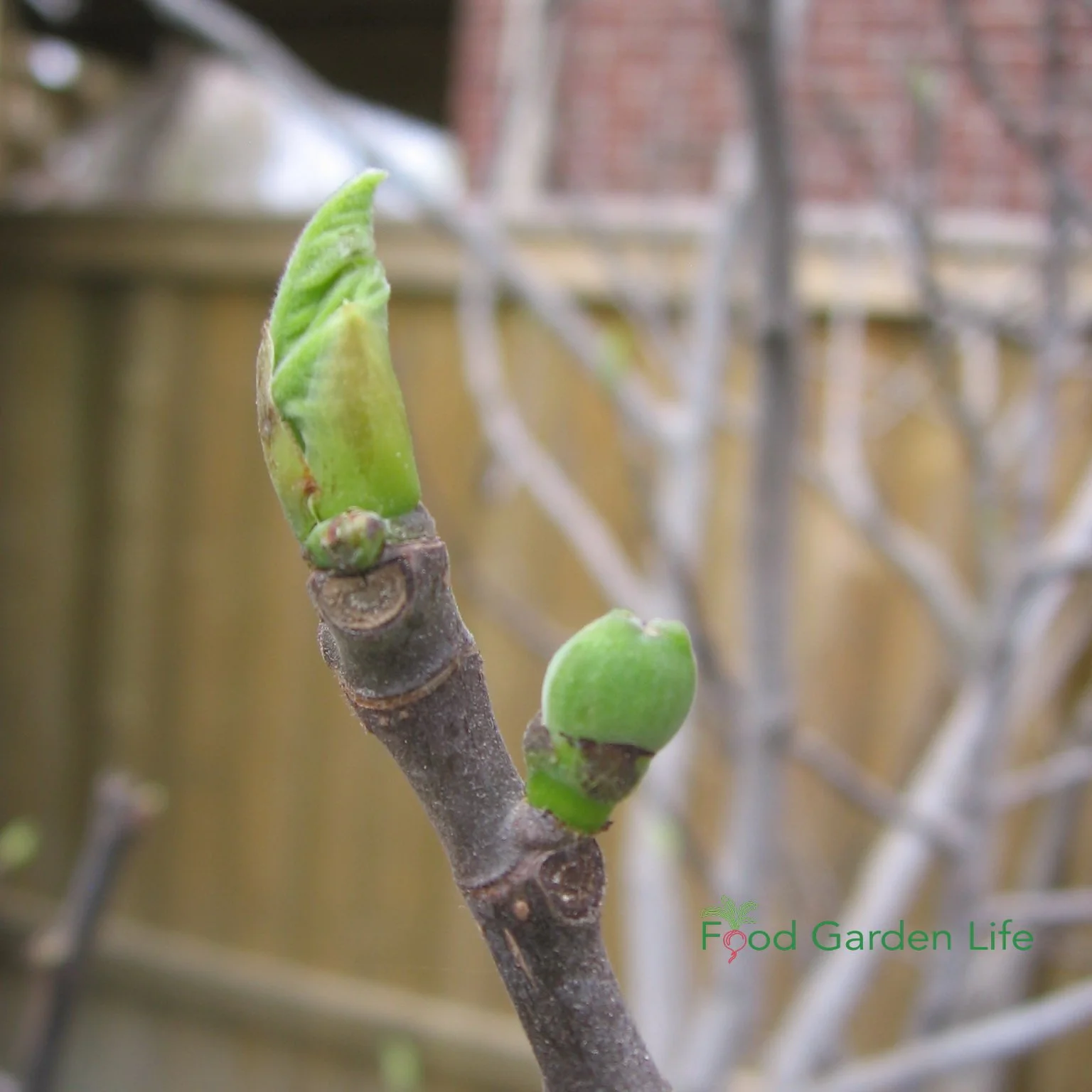
A breba fig, growing early in the season on wood from the previous season. Breba figs ripen much earlier than the “main crop” figs that ripen in late summer and fall.
If you're in a colder climate, chances are that the limiting factor to fig ripening is the season length. There's never enough time for figs to ripen...never enough ripe fruit.
So pick a fig variety that ripens early.
Here are 2 types of figs to consider as you look for early-ripening fig varieties:
Breba Figs
If you're in a cold climate, make sure you have a fig variety that produces “breba” figs – the figs that form mid-summer on growth from the previous season. (Some people call the breba crop the "first-crop figs" or "early crop.")
They're the earliest. Period.
Find out some of the top breba fig varieties for cold climates.
Early-Ripening Main Crop Figs
Look for fig varieties with a main crop that ripens early.
The “main crop” figs are the figs that form on wood from the current season.
My favourite main-crop fig variety is ‘Ronde de Bordeaux.’ There are many other early main-crop fig varieties. Find out some of the top early-ripening fig varieties for cold climates.
3. Grow a Fig Bush
A well-branched bush has more branches than a tree.
And more branches means more figs.
Plus, if you're in a cold climate, more branches is like having fig insurance…so if some die off over the winter, you're more likely to have a few left to give you figs.
Besides, what are you going to do with a huge fig tree over the winter? A compact fig bush is easier to protect, whether you're wrapping it or tipping it over to cover.
Here's more information about what to do with fig trees over the winter in cooler climates.
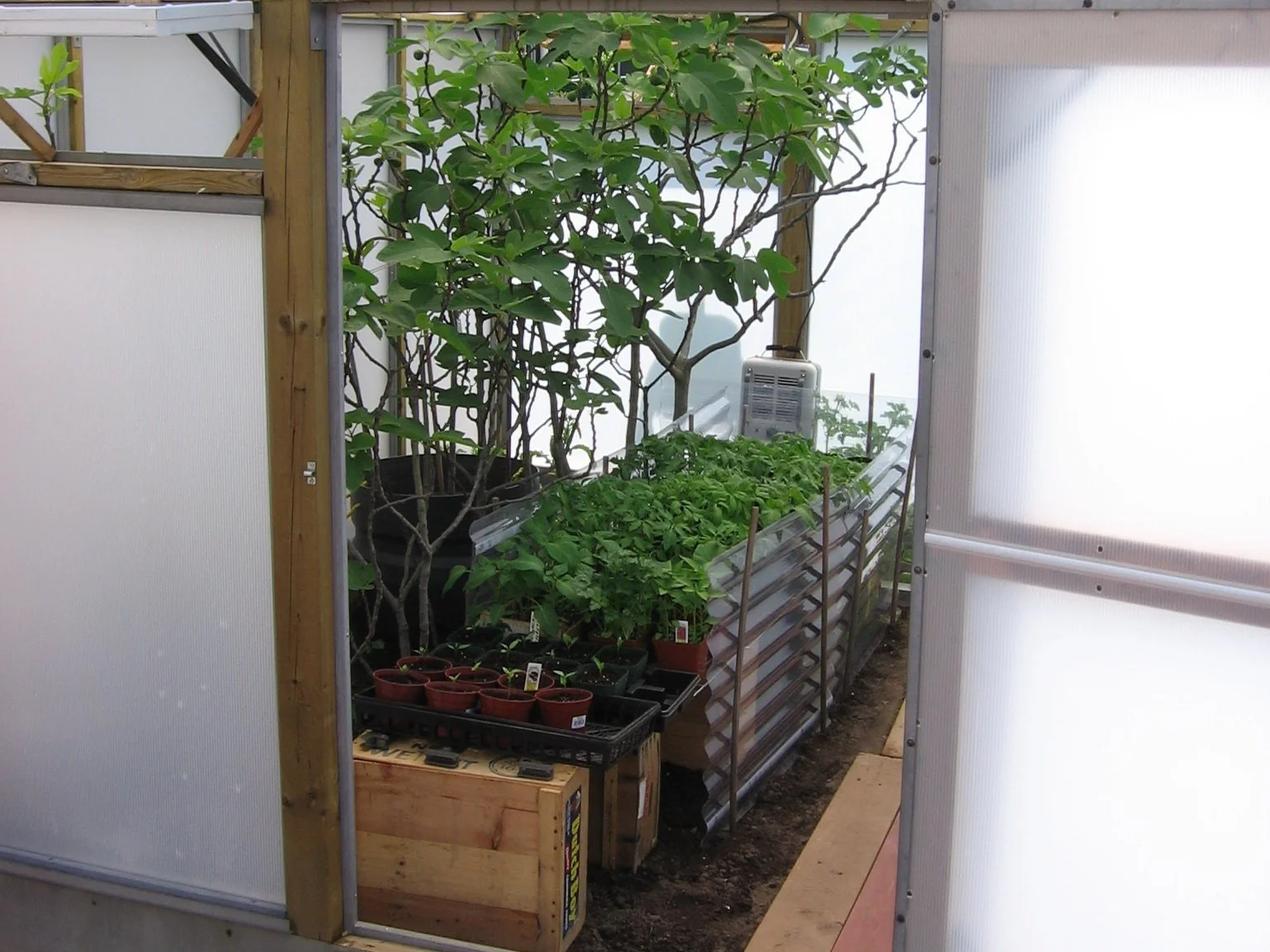
Growing fig trees in a greenhouse. These fig trees are waking up early. They're getting an early start with tomato seedlings.
4. Wake Up Fig Trees Early
Because season length is a limiting factor to fruit ripening, waking up fig trees early in the spring can give you more ripe figs in the fall. You're just giving them a longer growing season and more time to ripen figs.
The challenge for a lot of cold-climate fig growers in the spring is finding a spot that's protected. You need a protected spot to guard against cold winds and frost because once your fig trees come out of dormancy, the new tender growth is easily damaged.
One solutions is to create a temporary shelter for an early wake-up. Like a hoop house or lean-to covered with clear plastic. Or maybe you have a sun room or some sort of protected space.
Or, if you are growing potted figs, bring them outside on warm days to help them wake up. But put them back into a protected spot when it gets cold. (I call this the springtime “fig shuffle.”)
5. Pinch Fig Shoot Tips
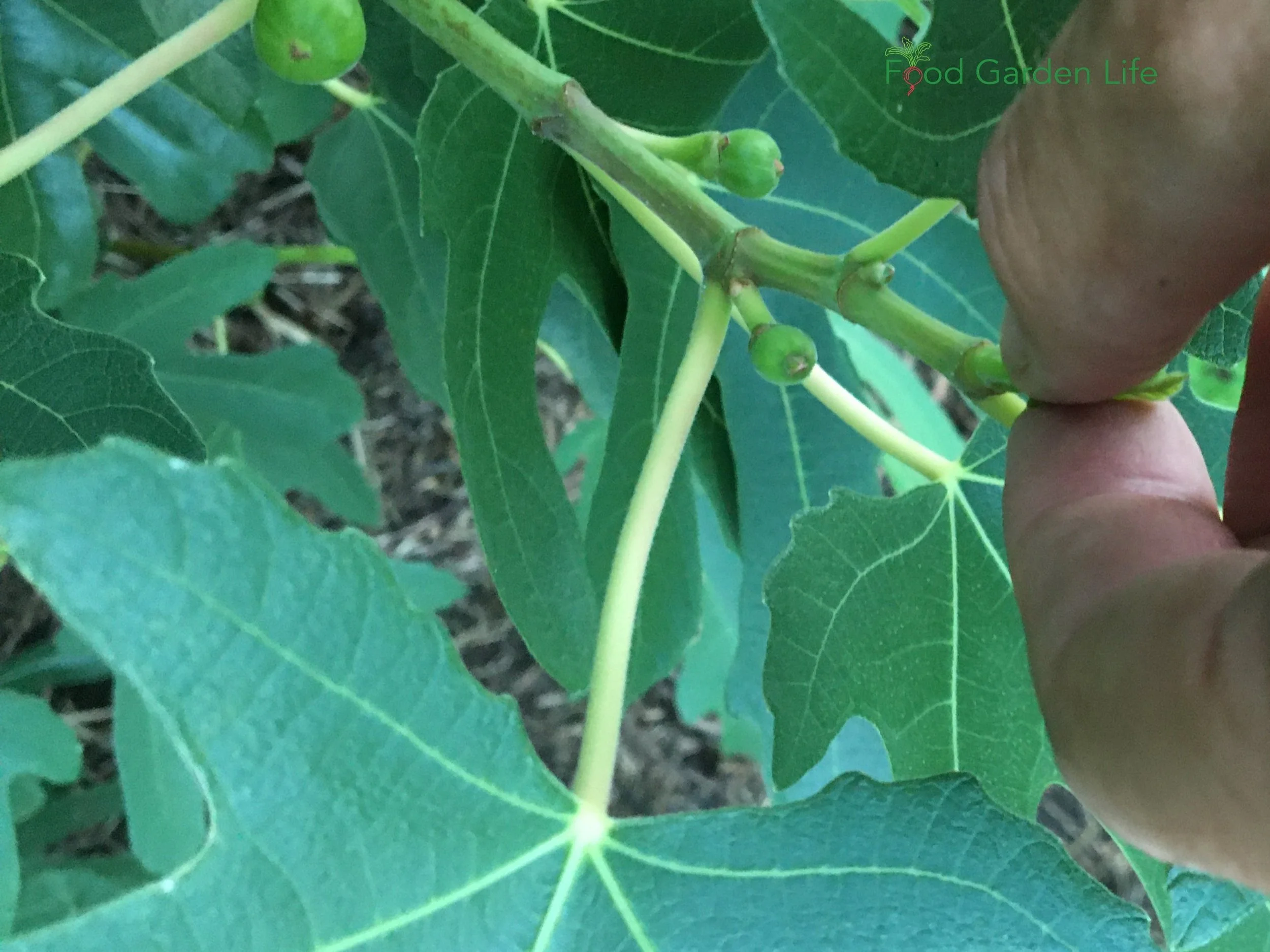
Pinch fig shoot tips after 4 or 5 main-crop figs have formed.
The new branches on your fig tree keep getting longer all summer, with more and more little main-crop figs forming. But, realistically, only the first few main-crop figs will ripen in a cold climate.
So after 4 or 5 little main-crop figs are growing on a branch, pinch the shoot tip to slow down branch growth. Otherwise, when fall arrives, you'll have long branches full of unripe figs.
This pinching favours the development of those 4 or 5 fruit.
Get Your Fig Trees Through Winter—and Harvest Figs
Growing figs where winters are cold takes a bit of creative thinking.
In Fig Camp and the self-paced Fig Masterclass, I explain how to grow figs in pots or in the ground, extend the growing season, ripen more fruit, and protect your trees through winter.
6. Turn up the Heat to Ripen Faster
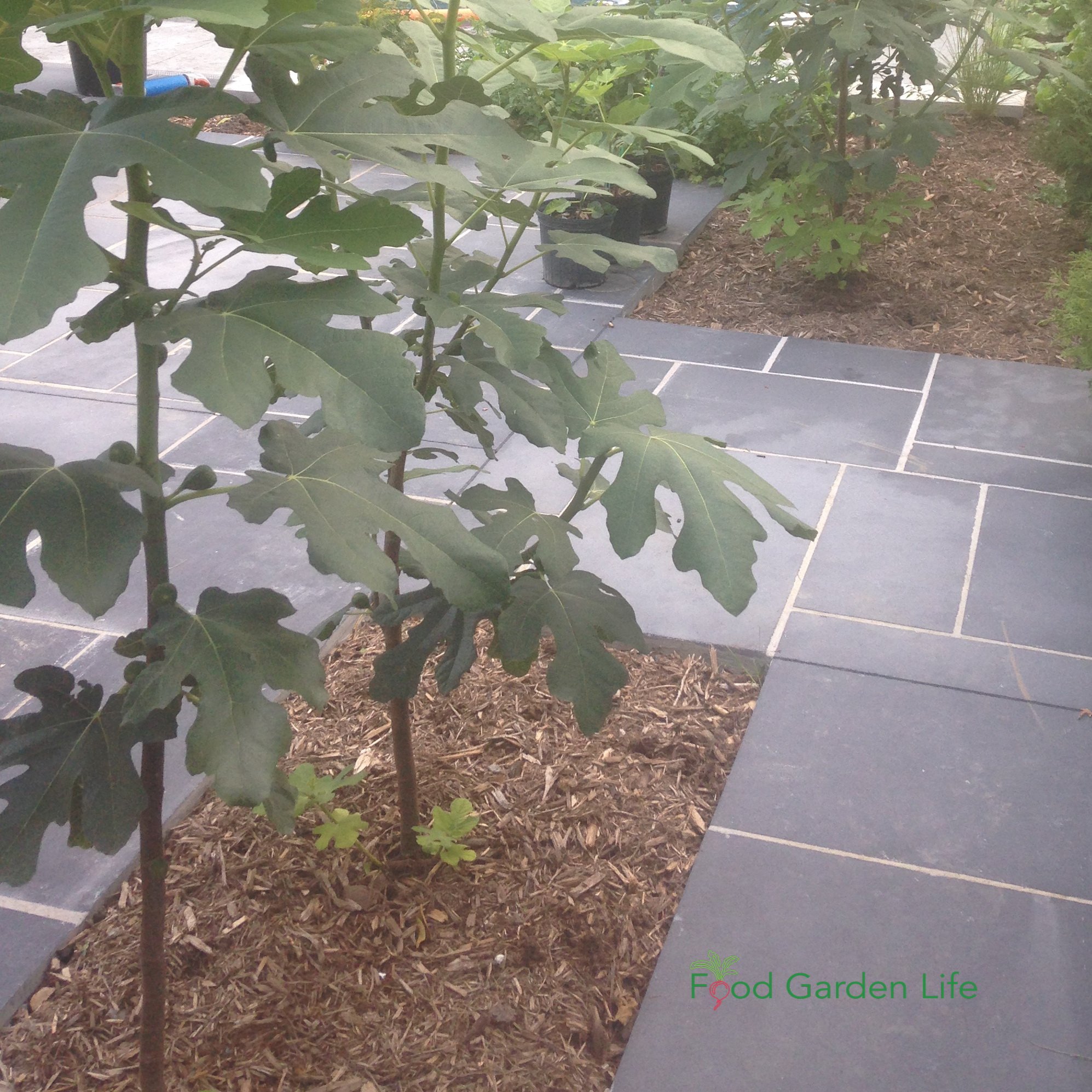
Ripen figs faster! Paving materials take up heat by day and release it as temperatures cool in the evening, giving extra heat for the ripening process.
Choose a warm location. More heat means more figs ripening in your short season.
If you're growing potted figs, place them somewhere warm:
On a dark-coloured driveway or patio
Next to a brick wall or stone wall that captures and releases heat from sunlight
When planting fig trees in the ground, look for somewhere warm:
A south-facing exposure next to a stone wall
Next to a sunny driveway
You can also provide more heat to ripen figs with a simple structure such as a greenhouse with no walls. (Here's how one fig grower in the cool-summered Pacific Northwest boosts summer heat to ripen main-crop figs.)
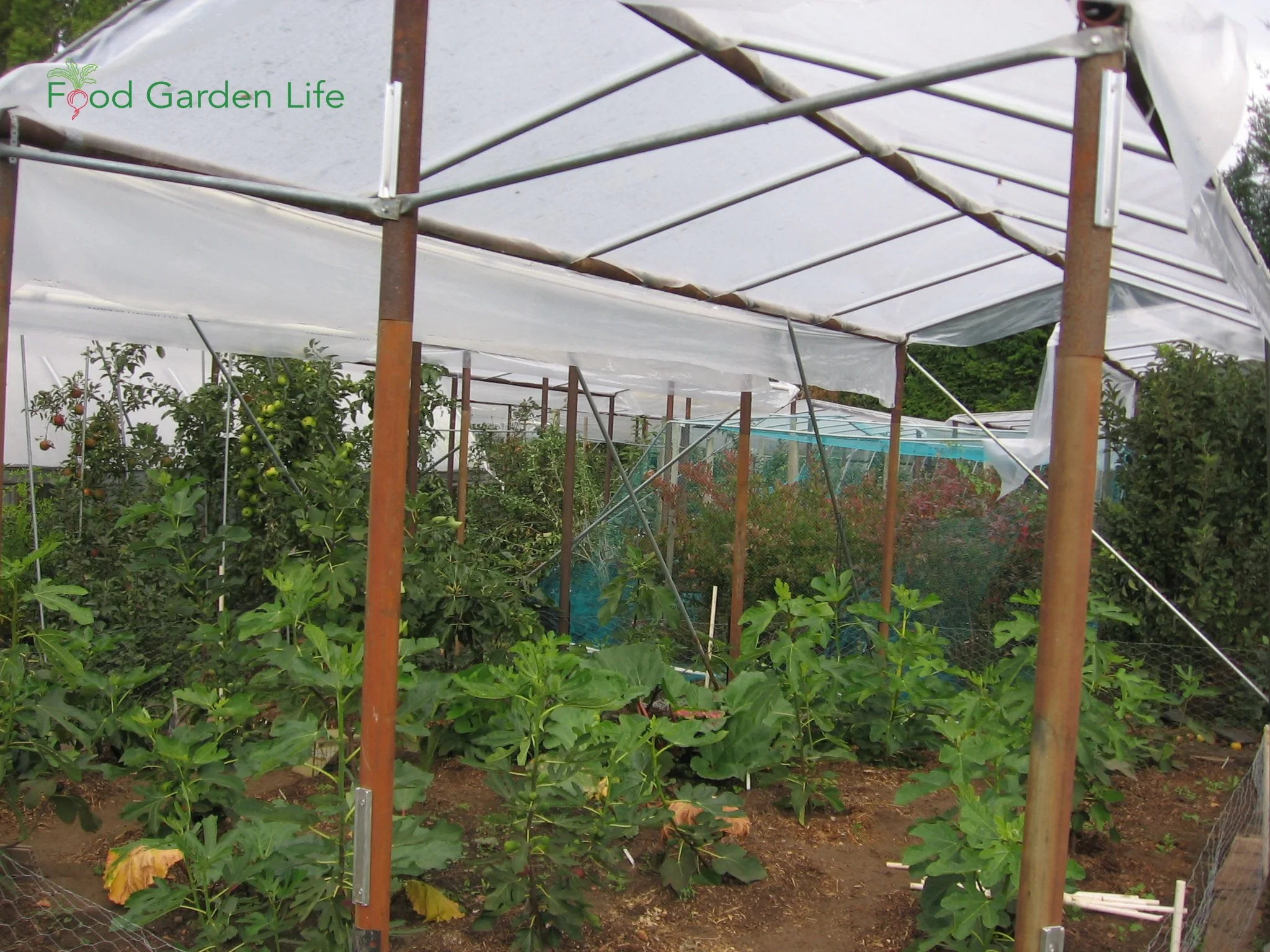
Here's an innovative way to ripen figs in the Pacific Northwest, where summers are cool: A greenhouse that has no walls. This greenhouse is not for winter protection—just to pump up the temperature in the summer to help ripen main-crop figs.
7. Extend the Fall Fig-Ripening Window
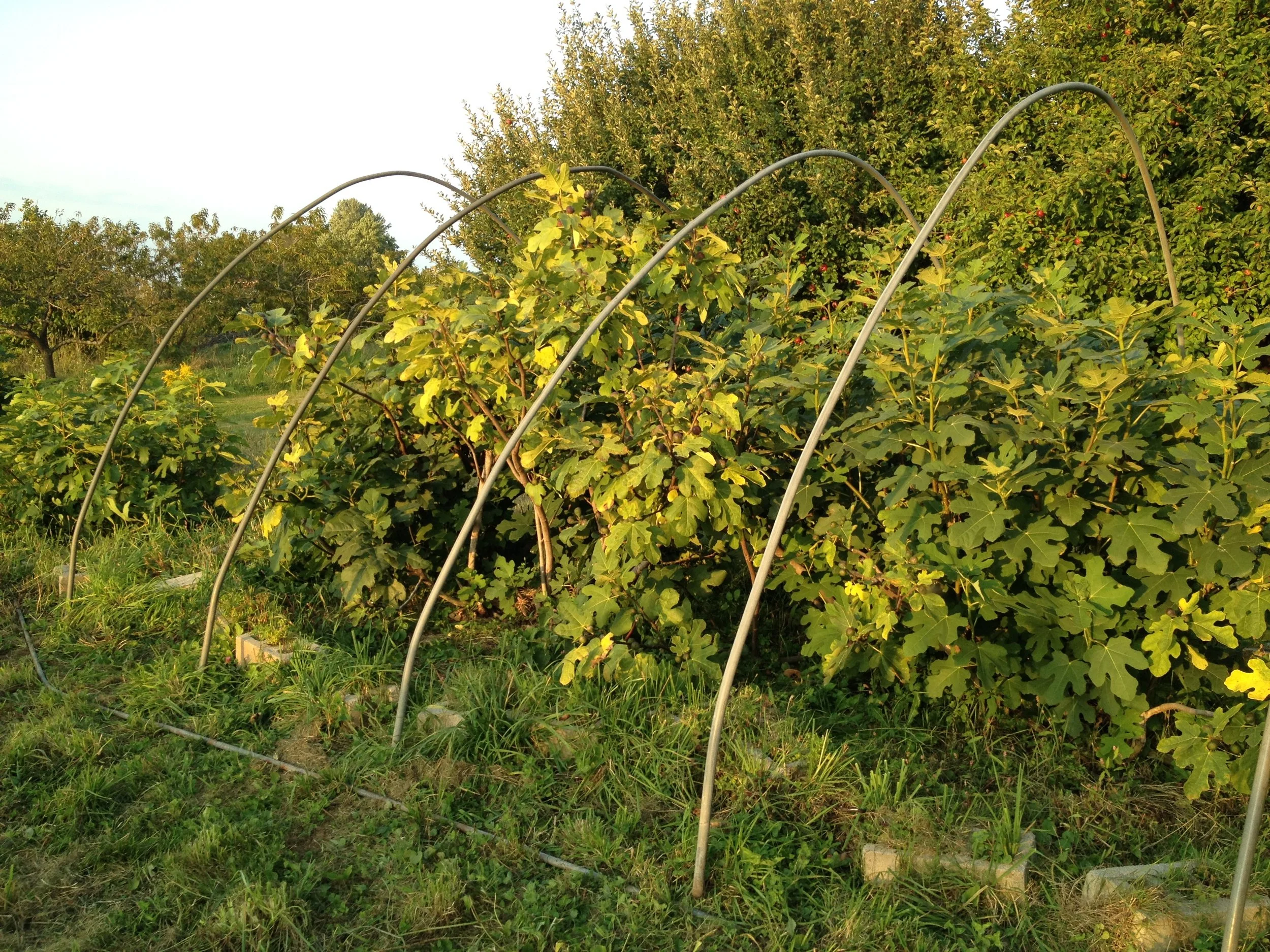
Here's what my friend Joe does to ripen figs in the fall: As cool weather arrives, he covers the hoops with clear plastic to extend the fig harvest for a few weeks. Ripe figs keep coming!
If you want more ripe figs before your fig trees go dormant for the winter, delay dormancy to keep the ripening process going. Fig season doesn't have to end with the first fall frost.
You can delay dormancy by keeping your fig plants warm during cold spells. Cover in-ground fig plants with a temporary structure, or move potted plants into a protected location.
A hoop house is a low-tech temporary structure. I’ve also seen people make a temporary lean-to against a building, covered with clear plastic.
FAQ: Ripe Figs
I've heard that some fig growers put a drop of olive oil over the "eye" of the fig to speed up the ripening time. Is that true?

Pin this post about how to ripen figs!
Yes. Putting a drop of olive oil over the eye of fully sized unripe figs is a traditional method to speed up the ripening process.
I don't use olive oil. Simply too many other things to do in the garden. But the idea has merit because putting olive oil over the eye of the fig fruit helps to hold in ethylene gas, which is involved in the ripening process.
How can you determine fig ripeness?
Good question. Try to harvest at peak ripeness, because once picked, an unripe fig won't ripen any further. If you pick a fig and see white, milky sap, it’s not fully ripe.
A fully ripe fig is slightly soft. If you gently press on it, it might retain your fingerprint.
The neck of ripe figs bends, so the ripe fruit hangs downwards.
Ripe figs sometimes, but not always, have a drop of liquid coming out of the eye of the fruit.
What can I do with unripe figs?
There are a number of ways of preserving figs, including unripe figs. If you still have green figs and there's a frost warning, pick figs.
Here are ideas for preserving figs. (And for using fig leaves, fig sap, and fig wood to create delicious fig recipes!)
Videos to Help You Ripen More Figs
Here's a video that tackles what to do about unripe figs.
Here's a video with more tips about waking up your fig trees early, so that you're not stuck with lots of unripe fruit at the end of the season.
Keep Growing Figs
Looking for more cold-climate fig-growing ideas? Visit the fig home page to browse articles about varieties, pruning, propagation, ripening, winter protection, and more.
Grow Figs Where You Think You Can’t
My revised and expanded fig book is a practical guide to growing figs in pots and cold climates—from choosing varieties and pruning to ripening fruit and conquering winter.
Find This Helpful?
Enjoy not being bombarded by annoying ads? Appreciate the absence of junky affiliate links for products you don’t need?
This site is reader supported. If it has helped you in your food-gardening journey, you can give us a high-five below. Any amount is welcome.
Early Figs? Harvest a Breba Crop of Figs Mid-Summer
The difference between breba and main-crop figs.
By Steven Biggs
Some Fig Varieties Produce a Breba Crop—an Early Crop
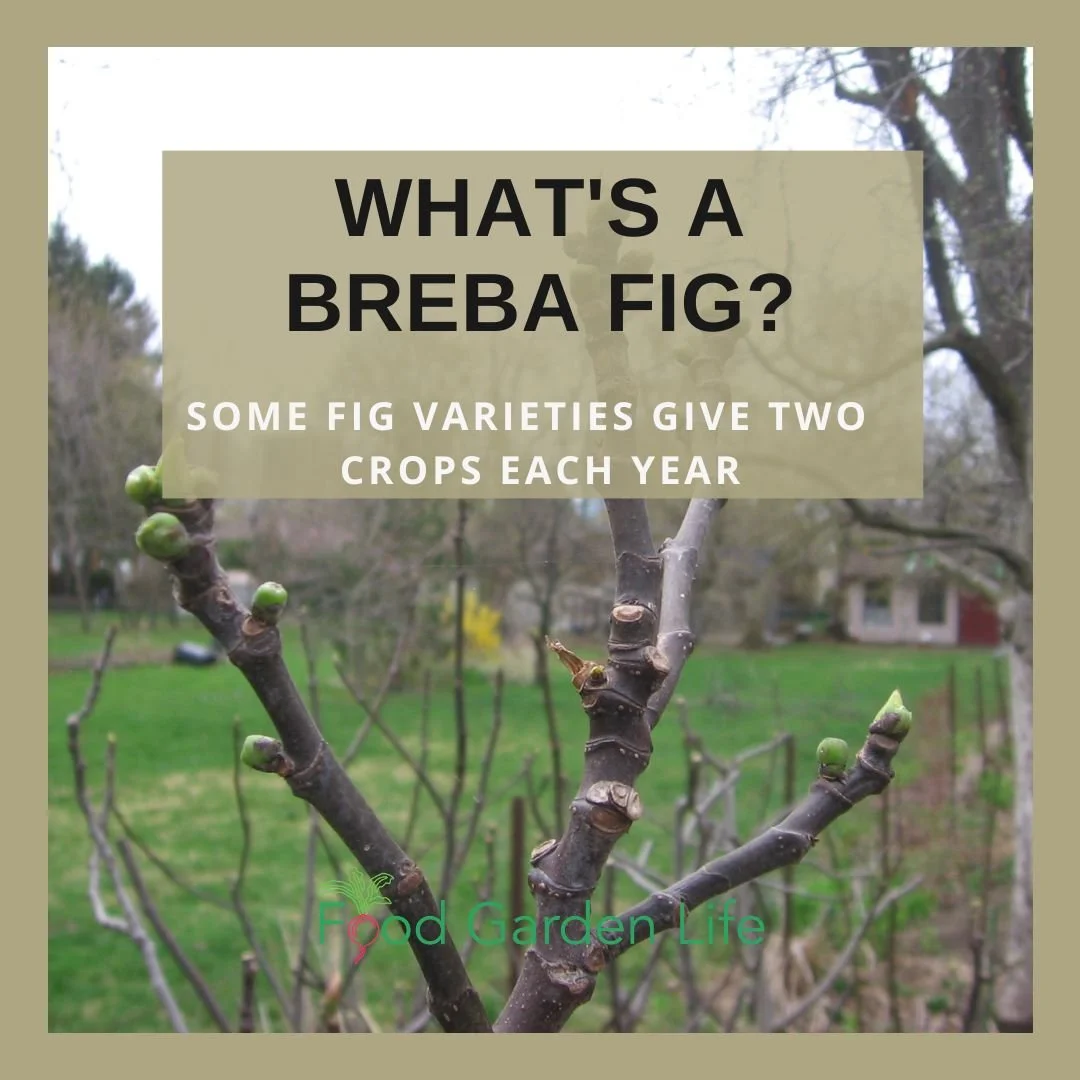
Wondering why some fig trees have ripe fruit mid summer, while other only have ripe figs in the fall?
That’s because some fig tree varieties produce two crops each year:
The “breba” crop grows on wood from the previous year, and it’s the first to ripen
The “main crop” grows on wood from the current year, and it ripens later
Here in Toronto, my breba figs starts to ripen some time in July.
And the main crop figs are usually ready starting in late September.
If you want to know more about breba figs, and how to benefit from this early crop, keep reading.
Breba, Main Crop, or Both…it Depends on the Variety
Some fig varieties produce both breba and main-crop figs (called “biferous” fig varieties)
Some varieties have no breba figs—only main-crop figs (called uniferous” varieties)
Some varieties only give a breba crop in cold climates (there’s a story here…see below about San Pedro figs)
San Pedro Figs
The fig varieties that ripen only a breba crop in cold climates do grow a second, main crop.
But that main crop doesn’t mature.
That’s because the second crop of San Pedro fig varieties requires a pollinator (a little wasp that’s found in warmer, commercial fig-producing regions.)
An example of a San Pedro fig is the variety Desert King (see below.)
Grow a Breba Crop to get Early Figs in Cold Climates
If you're growing figs in a cold climate, you don’t have to wait for main-crop varieties to ripen in late summer.
To get an earlier, mid-summer fig harvest, grow a fig variety that gives a reliable breba crop.
The photo below shows a fig breba crop forming in the spring, before any leaves are out!
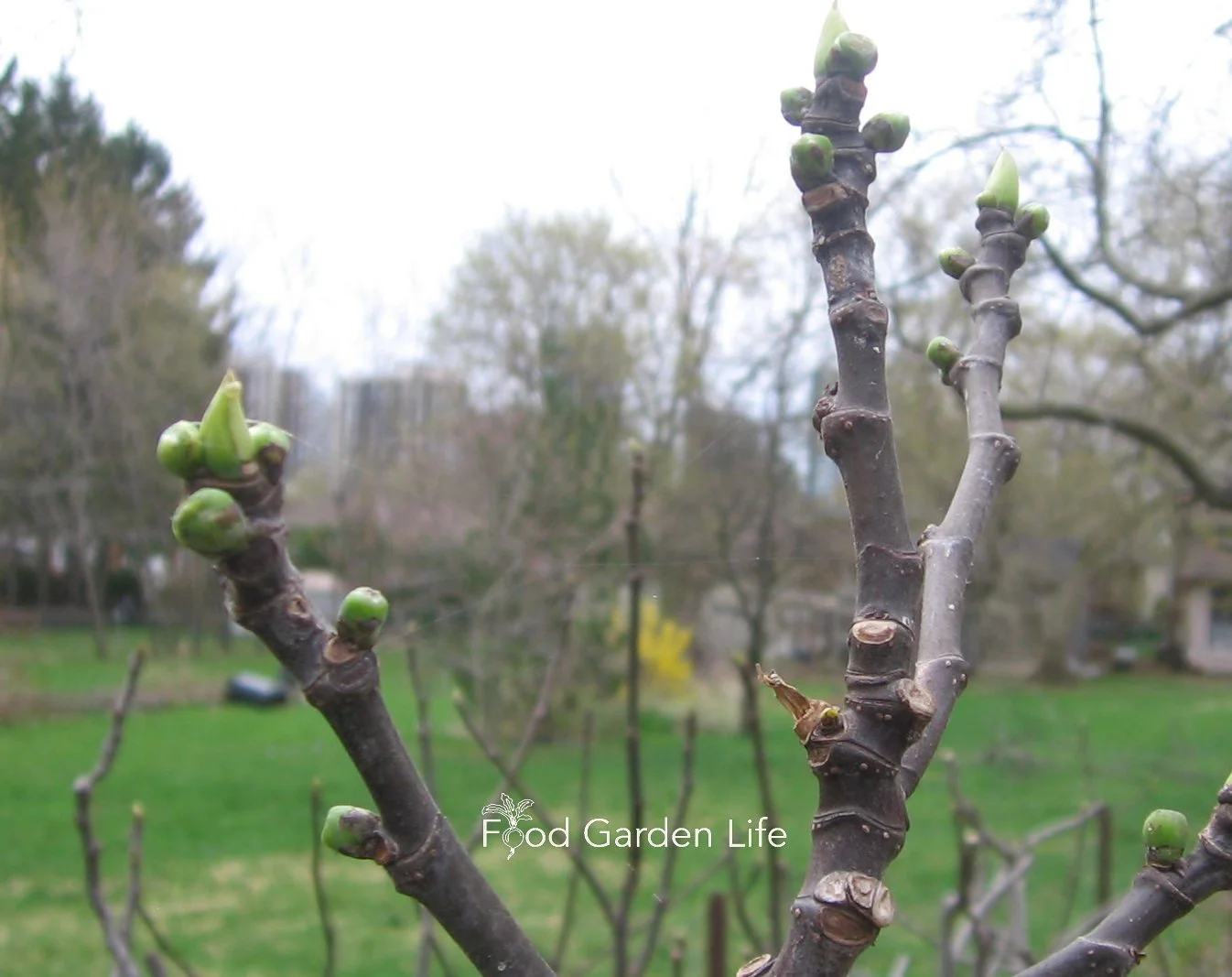
Fig breba crop starting to grow even before any leaves have emerged.
Do You Get Cool Summers?
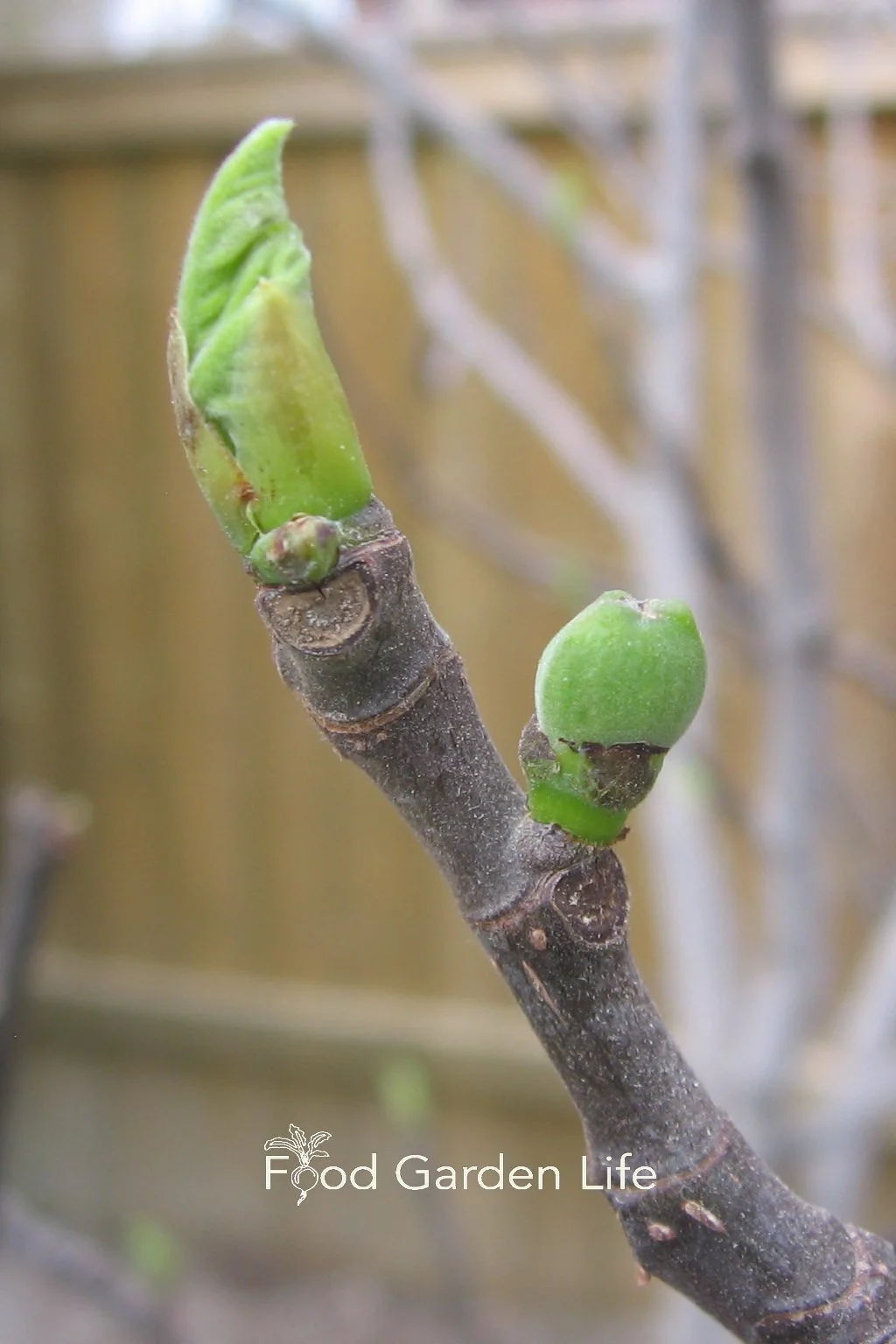
Protect branches from winter dieback to get a good production of breba figs.
Here in Toronto the winters can get cold—but summers are usually hot. So my main-crop figs ripen.
But I still like to have fig varieties that produce a heavy breba crop. Here’s why:
I grow fig varieties with a good breba crop for an early harvest
I grow other varieties for main-crop figs later in the season.
But in areas with cool summers, there might not be enough heat to ripen main-crop figs.
For example, gardeners in the Pacific Northwest rely on varieties with a heavy breba crop because there is not always have enough summer heat to ripen main-crop figs.
Find out how gardeners in areas with cool summers can ripen figs.
Get Your Fig Trees Through Winter—and Harvest Figs
Growing figs where winters are cold takes a bit of creative thinking.
In Fig Camp and the self-paced Fig Masterclass, I explain how to grow figs in pots or in the ground, extend the growing season, ripen more fruit, and protect your trees through winter.
Maximize Breba Fig Yield
Remember Breba Figs as You Prune
Things to think about as you prune for a good breba crop:
Prune back some of the 2-year-old branches when the fig tree is dormant
These 2-year-old branches made breba figs the previous season…and if you leave them they’ll still make breba figs, but now those breba figs will be on the new growth, up high and out of your reach (where the birds can get them!)
Cut these 2-year-old branches back, leaving about an inch of the branch remaining where they meet a larger branch (then there’s a nub of wood from which a replacement will grow for the following year.)
Leave lots of one-year-old branches as these are the ones that will give you breba fruit
Find out more about how to prune a fig tree.
Minimize Dieback of Branches
Pin this post!
In cold areas unprotected branches can die back when exposed to cold temperatures. Plants regrow from the base…but it’s the branches from the previous year that grow the breba figs.
If you want breba figs, minimize winter dieback by moving potted plants indoors, or protecting in-ground plants.
Here are ideas to protect fig trees in winter.
FAQ Fig Breba Crop
What’s a good fig variety for a breba crop?
I’m a big fan of ‘Desert King.’ I grow a large Desert King in the ground here in Toronto. I tip it over and lay it flat to the ground every winter. It’s absolutely prolific.
There are other excellent fig varieties for the breba crop. Find out about more breba figs.
Do breba figs look the same as main-crop figs?
Not always. The breba figs might look very different from the main-crop figs of the same variety. They can differ in:
Colour
Shape
Size
Taste
Keep Growing Figs
Looking for more cold-climate fig-growing ideas? Visit the fig home page to browse articles about varieties, pruning, propagation, ripening, winter protection, and more.
Grow Figs Where You Think You Can’t
My revised and expanded fig book is a practical guide to growing figs in pots and cold climates—from choosing varieties and pruning to ripening fruit and conquering winter.
Find This Helpful?
Enjoy not being bombarded by annoying ads? Appreciate the absence of junky affiliate links for products you don’t need?
This site is reader supported. If it has helped you in your food-gardening journey, you can give us a high-five below. Any amount is welcome.
Wake Up! Caring for Fig Trees in Spring
How to care for potted fig trees in the spring, as they come out of dormancy.
By Steven Biggs
How to Care for Potted Fig Trees in Spring
Care for a fig tree in spring. Waking up and caring for potted fig trees in the spring.
It happens every spring: The weather is warm so I move my potted fig plants out of the garage and onto my driveway. It’s time to wake up!
Then…we get a frost warning or cold winds. So I haul my fig plants back into the garage.
I call it the springtime fig shuffle. Some people call it the dance of the figs.
Whatever you call it, it’s heavy work.
But there’s a good reason for the shuffle: Even though dormant fig trees withstand frost, fig trees that are waking up are damaged by frost.
If you’re wondering what to do with your potted fig trees in the spring, when to uncover fig trees, and when fig trees come out of dormancy, keep reading for tips and ideas.
Why Wake up Fig Trees if There’s Still a Risk of Frost?
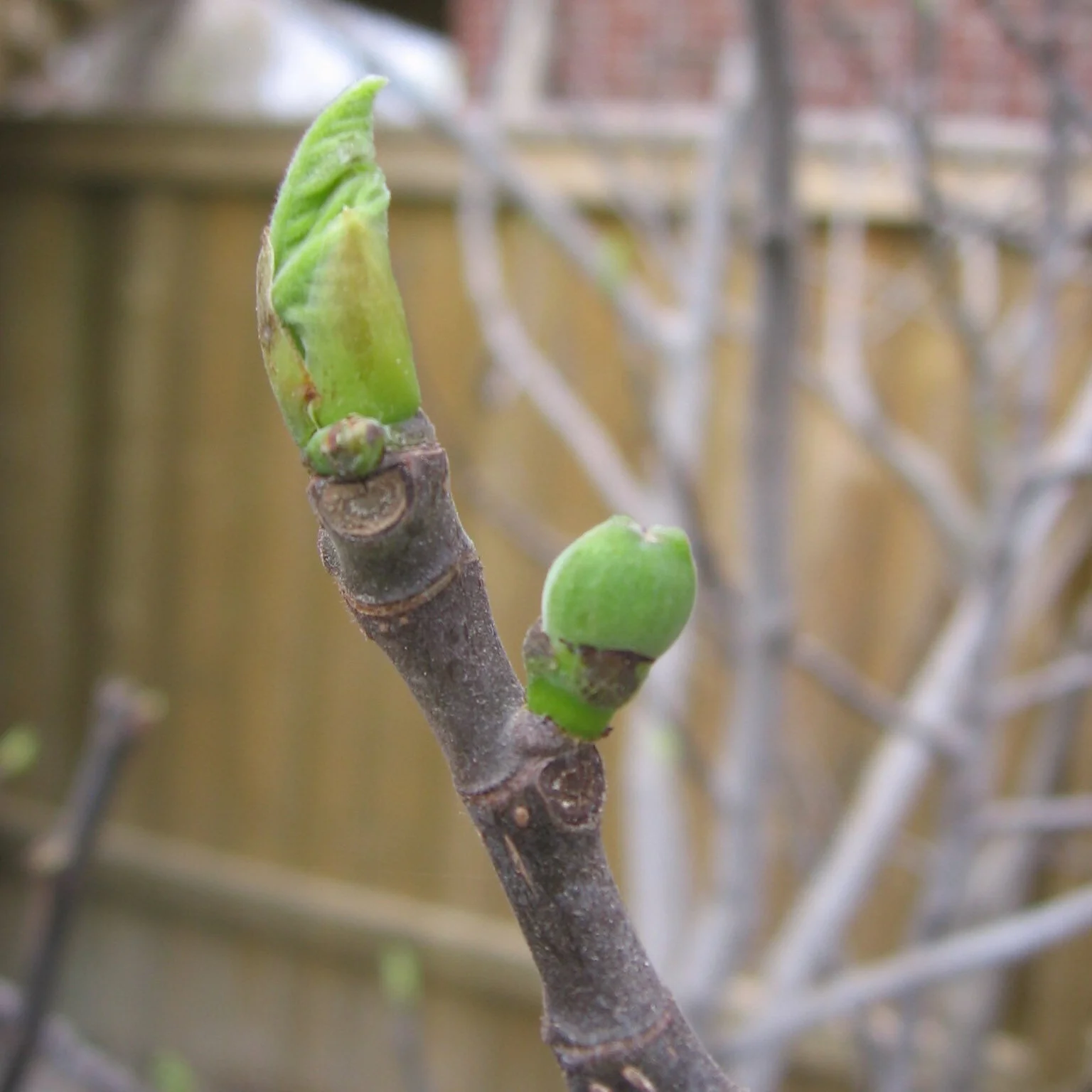
The weather is warm so I move my potted fig plants out of the garage and onto my driveway. It’s time to wake up!
It would be easier to wait for frost-free weather before moving potted fig plants outdoors. Here’s why not to wait:
Earlier Harvest. Season length limits fig harvests in cold climates. An early start gives more time for figs to ripen before the season is over.
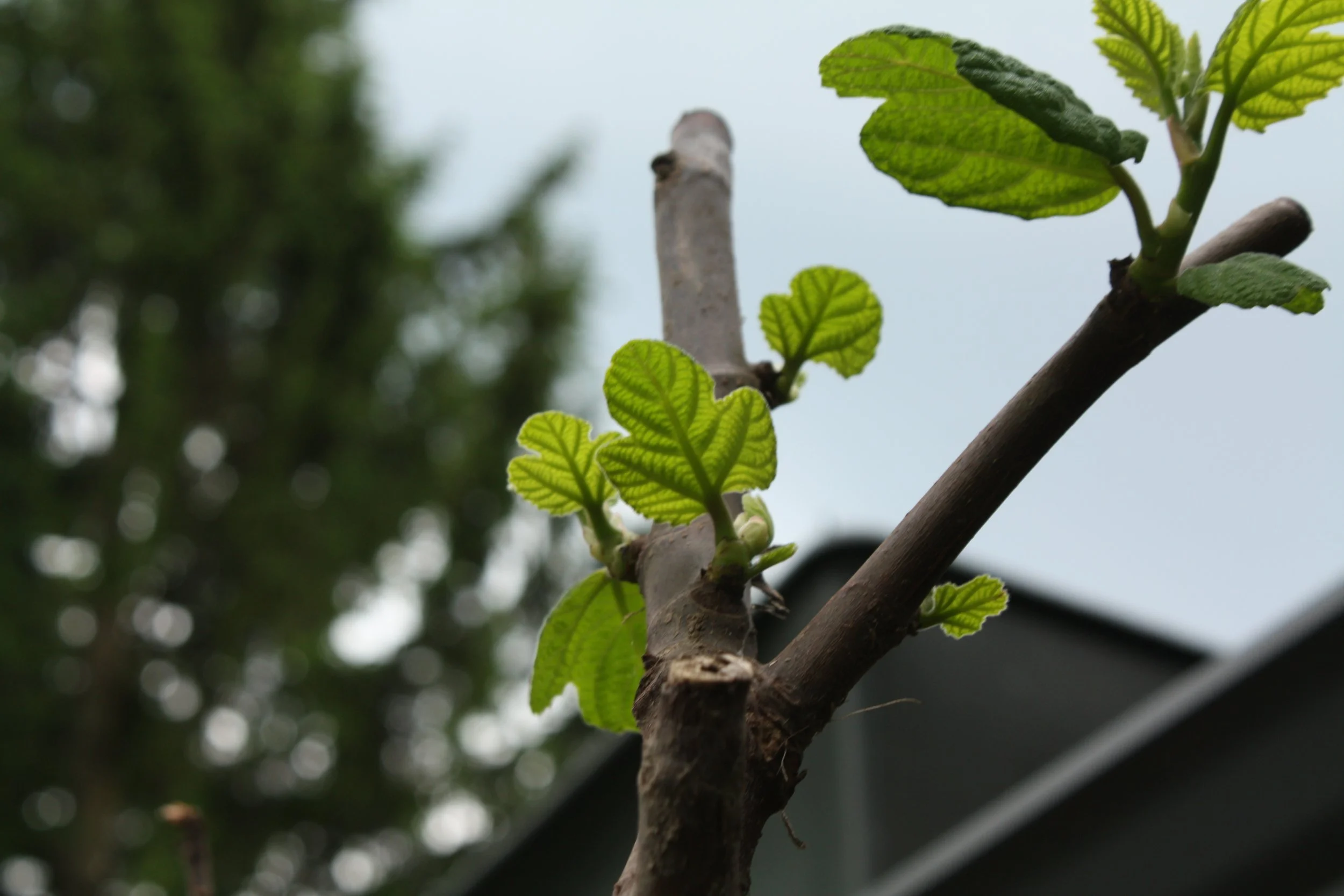
Good Growth. Sometimes fig plants wake up early and start to grow indoors, in dim light. That gives lanky growth. But the bright light outdoors gives compact growth.
Did your fig tree wake up too early and you’re wondering what to do now? Here are tips for caring for fig trees that wake up early.
Top Tip: Spring Fig Care
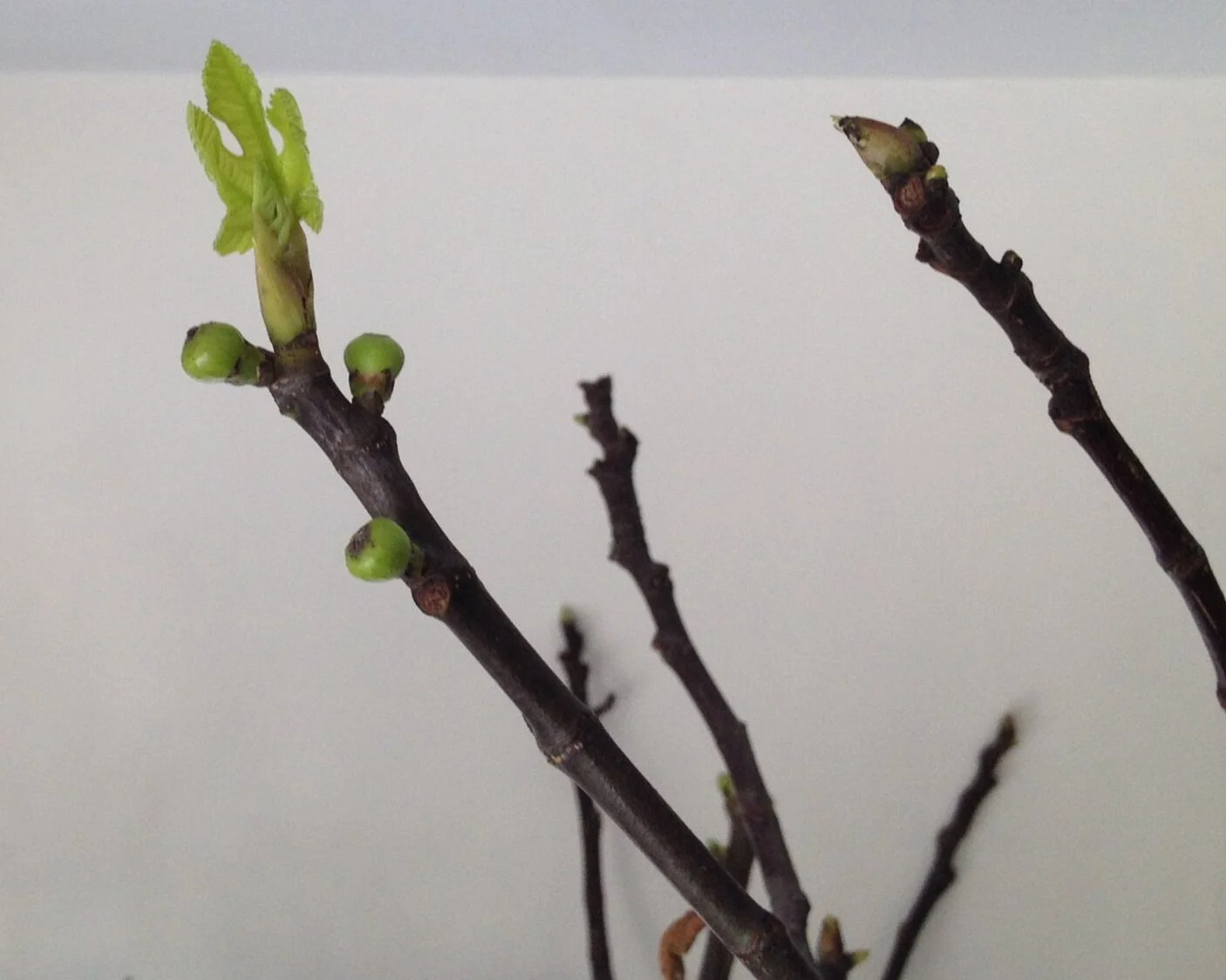
Sometimes fig plants wake up early and start to grow indoors, in dim light. That gives lanky growth. But the bright light outdoors gives compact growth.
Treat your fig plants like tender annuals once they begin to come out of dormancy and buds start to swell. Protect them from frost and cold wind.
That’s because their cold tolerance decreases as they wake up.
How Early to Wake Up Figs?
An early start is always good – as long as it suits you, and your style of gardening.
Do what works in your situation. If you’ll be away in the spring and can’t do the dance of the figs when there’s a frost warning, it might be better to wait.
Waking up Your Figs
When your dormant fig trees get warmth and light, they start to wake up and grow.
To start waking up my figs while they’re still in the garage, I raise the temperature. Then, as buds start to swell, and as we get warm, bright days, I take them out of the garage and onto my driveway.
I wake up my potted fig trees about a month before our frost-free weather arrives. Some cold-climate fig growers do it earlier (some even set up artificial lighting to give their figs trees a very early start).
An early wake-up is especially useful when growing varieties that ripen late in the season.
A Protected Space Helps
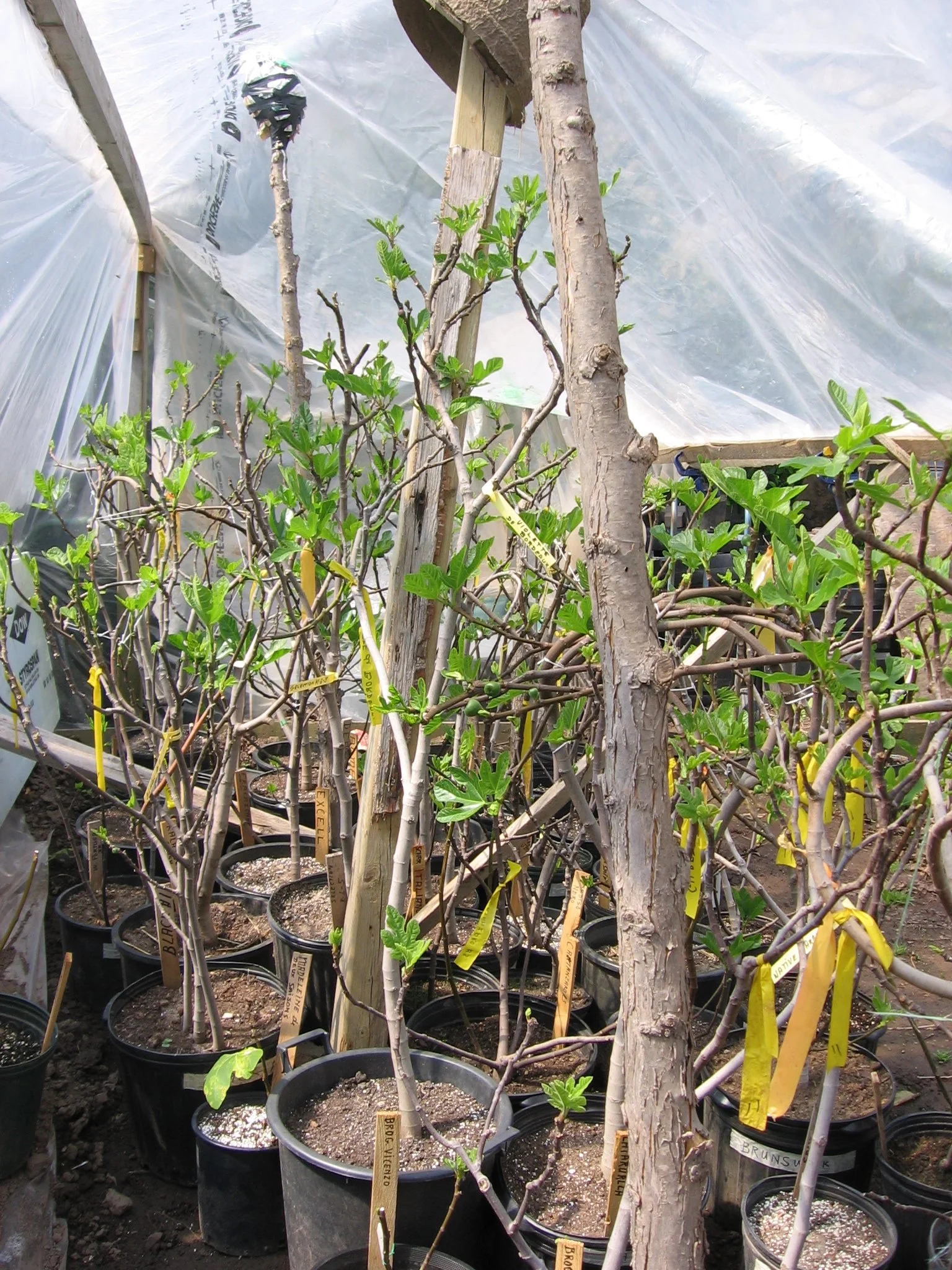
A bright, protected space like this temporary greenhouse can save you shuffling around potted fig plants on cold nights.
If you want to wake up your fig plants early but want less work, a bright, protected space can save you shuffling around potted fig plants on cold nights.
That bright, protected space could be a three-season sun porch. Sun porches often freeze over the winter, but in the spring they provide figs bright conditions and usually stay above freezing.
A protected space could also be something temporary, such as a hoop house, lean-to, or temporary greenhouse.
But if you don’t have this sort of protected space, you just do the dance of the figs.
What if there is a Risk of Frost?
When the forecast is for freezing temperatures, I move my potted fig plants back into the protection of the garage.
But what if the forecast is for a temperature that will be a couple of degrees above freezing? In that case I drape a blanket or sheet over my fig plants…just in case the forecast is wrong.
And remember: Some parts of your property might have a “microclimate” and be slightly warmer than others.
Get Your Fig Trees Through Winter—and Harvest Figs
Growing figs where winters are cold takes a bit of creative thinking.
In Fig Camp and the self-paced Fig Masterclass, I explain how to grow figs in pots or in the ground, extend the growing season, ripen more fruit, and protect your trees through winter.
Harden Off Figs that Start Growing Indoors
Even if you supply artificial light to your fig plants indoors, they should be “hardened off” before placing them in full sunlight outdoors.
Hardening off just means gradually getting the plant used to bright sunlight, cooler temperatures, and wind.
If you have a shaded spot, that’s a great place to start hardening off your fig plants. I have an overhang off of my garage, and the area underneath it gets a couple of hours of morning sun. That’s where I harden off any figs that have started to grow indoors. Their tender buds and little leaves won’t get scalded by strong sun or cold wind.
If your fig plants are still dormant when you move them outdoors, they are less fragile than plants with small leaves.
FAQ: Fig Plants in Spring
Prevent scalding of new growth on fig plants by hardening off the plants in a shaded, protected protected space.
Is there an easier way to move around potted fig plants?
Put your potted figs on dollies!
Do I need to wake up the fig plants early if it’s just for the breba crop?
Good question. No. If you wake them up later, your breba crop will be a bit later…but still well before fall frosts arrive. So there’s no downside to waking up your breba-producing fig plants later.
But…if you want to get both a breba and a main crop figs from the plants, an early start gives more time for those main-crop figs to ripen at the end of the summer.
Looking for breba fig varieties? Check out the Guide to Cold-Climate Fig Varieties.
What about in-ground figs that are wrapped or buried?
Pin this post!
An early wake-up helps extend the growing season for in-ground figs too. The only thing to remember is that you can’t easily move them inside if there’s a cold spell.
For the fig trees I lay flat and bury, I start to remove the mulch early to allow the soil to warm up – but I don’t stand up the tree early. That way, if I need to protect it, I can throw a bit of mulch back over the top of it.
Should I feed my fig as I’m waking it up?
No, not yet. Feed once it’s actively growing.
How moist should I keep the soil?
While potted fig trees are dormant, keep the soil on the dry side of moist. But as they begin to grow, I give them a bit more water.
The little leaves and figs on my plant fell off. What happened?
Could be cold wind or cold temperatures. To prevent this, harden off your fig plant, starting in a protected space.
What about pruning in spring?
Check out the Cold-Climate Guide to How to Prune a Fig Tree
Summary
In cold climates, it can be useful to wake up some fig trees early because a short growing season limits fig production. An earlier start means a longer growing season.
How early you should wake up your fig trees depends on your setup. Trees waking up early indoors should have good light. Trees waking up early outdoors will probably need protection from cold snaps.
Keep Growing Figs
Looking for more cold-climate fig-growing ideas? Visit the fig home page to browse articles about varieties, pruning, propagation, ripening, winter protection, and more.
Grow Figs Where You Think You Can’t
My revised and expanded fig book is a practical guide to growing figs in pots and cold climates—from choosing varieties and pruning to ripening fruit and conquering winter.
Find This Helpful?
Enjoy not being bombarded by annoying ads? Appreciate the absence of junky affiliate links for products you don’t need?
This site is reader supported. If it has helped you in your food-gardening journey, you can give us a high-five below. Any amount is welcome.
Best Soil for Fig Trees in Pots (What to Know + What to Avoid)
Find out about potting soils, potting soil ingredients, and potting soil recipes for fig trees. Choose the best soil for fig trees in pots!
by Steven Biggs
How to Choose a Soil for Fig Trees

Growing potted figs? Thinking of repotting fig trees?
There are lots of potting mixes to choose from.
When I worked at a fig nursery, we used a loam-based potting mix. (I explain below.)
Since then, many fig growers have told me about their fig potting soils.
They’re all different.
That’s the thing about soil…it’s a bit like tomato sauce recipes. Ask 10 people for a recipe, chances are you’ll get 10 different ones.
But that doesn’t mean anything goes.
The right potting mix recipe for your fig tree depends on your watering habits, how you feed, tree size, and the type of container.
This article looks at potting soils and potting soil ingredients so that you can choose one that’s a good fit for your fig tree.
(And you’ll also find out something I recommend you avoid.)
What a Soil Mixture Does
Soil is what the fig roots grow in; it’s like an anchor.
But it will also:
Retain moisture
Hold nutrients
Some soils also supply nutrients too
Good Potting Soil Has…
Good soil also has lots of air space.
That’s because roots need air too.
So we actually want a soil that holds moisture—but has air pockets.
About Commercially Prepared Soil
They're Soilless
In North America, most commercial potting soils don’t contain any “real” soil—sometimes called loam. Part of the reason for this is that soil is heavy…and weight is money.
So commercial “potting soils” are soilless—hence the alias “soilless mix.” In the UK, the name “compost” is sometimes used to describe potting mixes.
What's in Them
Commercial soils often contain a combination of the following:
Commercial potting soil
Organic portion. This might be peat moss, coir (a.k.a coco coir), or some sort of composted forestry waste (e.g. composted sawdust).
Aggregate. There’s often a light-weight aggregate such as perlite or vermiculite.
Lime. Peat-based mixes are acidic, so lime is often added.
Fertilizer. Some soils have added fertilizer.
Other Ingredients
Here are other common ingredients in commercial potting mixes:
Bark chips. Bark chips are sometimes added to soils for larger plants because the hunks of bark hold moisture.
Compost. Could be composted municipal green waste, animal manures, forestry waste—or even composted peat. (When I don’t know what it is, I don’t buy it.)
More Ingredients
There are many more things that we can use when blending our own potting soils. Not all of them are commonly used in commercial soil mixes.
Here are a few ideas:
Composted seafood waste. This commercially prepared soil amendment is what’s left over at seafood processing plants, composted together with peat or forestry waste. (Here in Ontario, I find “shrimp compost,” while in Western Canada, I see a product called “Sea Soil.”) It’s added to potting soil to help feed the plant. (I chalk up one of my best container tomato harvests to a soil mix that included some shrimp compost.)
Composted animal manures. My fig mentor, Adriano, used composted manure in his soil. (And his preferred manure was rabbit manure.) Manure is added to help feed the plant.
Sand. Because of the weight, sand isn’t common in commercial mixes. But this aggregate is a traditional addition to potting soils. It’s added for weight and drainage.
Poultry grit. It’s just another type of aggregate. Bigger than sand. You’ll find this at farm-supply stores. Around here I find silica grit—which is a good choice because it’s inert. Added for weight and drainage. Note: Granite and silica grit are OK; but avoid grit made from clam or oyster shells—it might be too alkaline.
Alfalfa is a forage crop that also dried and ground into a meal that can be incorporated into your fig tree soil.
Baked clay cat litter. It drains well…yet holds moisture. (If you’re into bonsai, you’ve probably come across this already.) Added for weight and drainage.
Plant-based amendments: Alfalfa meal, soybean meal, cottonseed meal: These can be added to provide nutrients and to stimulate microbial activity. By the way, if you can’t get alfalfa meal, some people just add a handful or rabbit pellets (yes, they’re made with alfalfa) to a mix.
Worm compost. A.k.a. vermicompost. Fancy name for worm poo—or worm castings. Added for the nutrients and the microbial activity it adds to a soil.
Looking Beyond Peat Moss: Here’s an Idea
Hoping to use less peat moss? I am. By harvesting peat we harvest carbon that’s been stored long-term in a peat bog. But I’m not crazy about the common alternative—coir. Coir is coconut husk fibres…and the byproduct of a crop growing half way around the world on what was once rain forest. Seems like greenwashing to me.
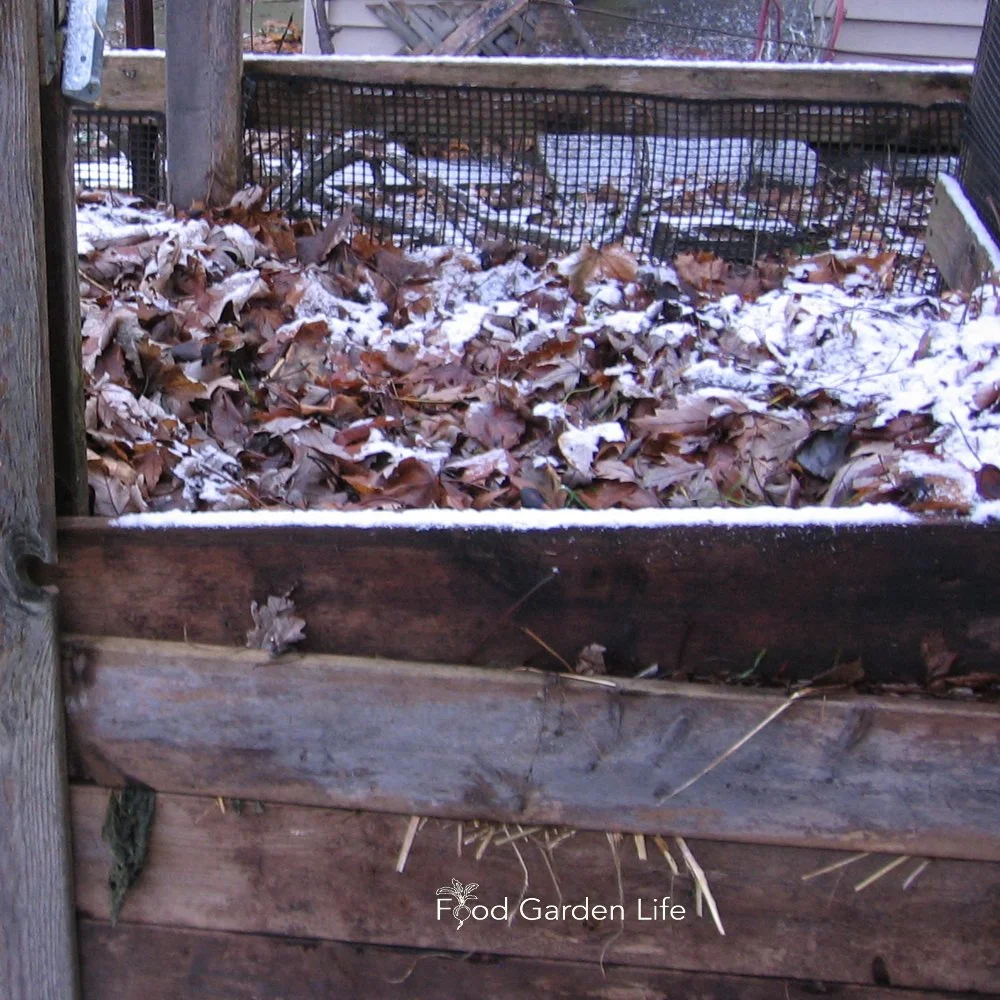
Composting leaves to make leaf mould, an excellent addition to soil for figs.
So I looked up soil recipes in old horticultural texts. Recipes from before peat-based soils became the standby in the horticulture industry.
Guess what? A common base is something many gardeners can make at home: Leaf mould. Which is just leaves, composted into a crumbly dark compost.
Keep in mind that leaf mould breaks down more quickly than coir or peat—so you adjust your fig tree repotting schedule accordingly.
(Something I’m experimenting with in veggie crops is using straw. I do strawbale gardening—but have also used straw as a growing medium. Haven’t tried straw or composted straw yet with figs…stay tuned.)
Find out more about straw-bale gardening.
More on Manure and Compost
Many commercial peat- and coir-based soils contain no nutrients.
Adding composted materials into a mix helps feed your fig plant. So your soil is part of your feeding regime. Remember that different manures bring different amounts of nutrients.
Don’t Do This
If you’re making your own fig tree potting mix using peat moss, there’s something important to know.
Not all peat moss is equal.
Some makes excellent soil; some not.
Here’s why:
Peat at the bottom of a peat bog is more highly decomposed, and has shorter fibres. It’s darker in colour. The peat that’s higher up in the bog has a lighter colour and longer fibres. It’s called “blond” peat. The blond peat gives a soil with more air pores, but at the same time, it holds water well.
The dark peat? It packs down.
Yet…it’s the dark peat that’s most often for sale at garden centres—because it’s less expensive, and is used as a garden soil amendment.
It’s like dollar-store phone chargers. Yeah, they kinda look like the higher quality ones…but you soon realize they suck. Same with dark peat for soils.
You might be wondering what to do if you can’t get blond peat? Get a high-quality commercial potting soil (they’re made with blond peat) and then tweak it to fit your recipe. See the next section, Top Tip, on buying high quality soil.
Get Your Fig Trees Through Winter—and Harvest Figs
Growing figs where winters are cold takes a bit of creative thinking.
In Fig Camp and the self-paced Fig Masterclass, I explain how to grow figs in pots or in the ground, extend the growing season, ripen more fruit, and protect your trees through winter.
Top Tip: Shopping for Soil
Ever seen “contractor-grade” products at the hardware store? Companies market the good stuff to contractors. Contractors know what’s poor quality.
Same in horticulture.
It’s buyer beware with small, homeowner-sized bags of soil. (Especially if you buy them from discount retailers!)
But the contractors in the world of horticulture—the commercial nursery and greenhouse growers—they know good soil.
And that’s why I buy soil packaged for commercial growers: The quality is consistently good.
Look for “bales” of commercial soil. It’s compressed, into 3.8 cubic foot bales (107 litres.)
Soil Choice and Plant Size
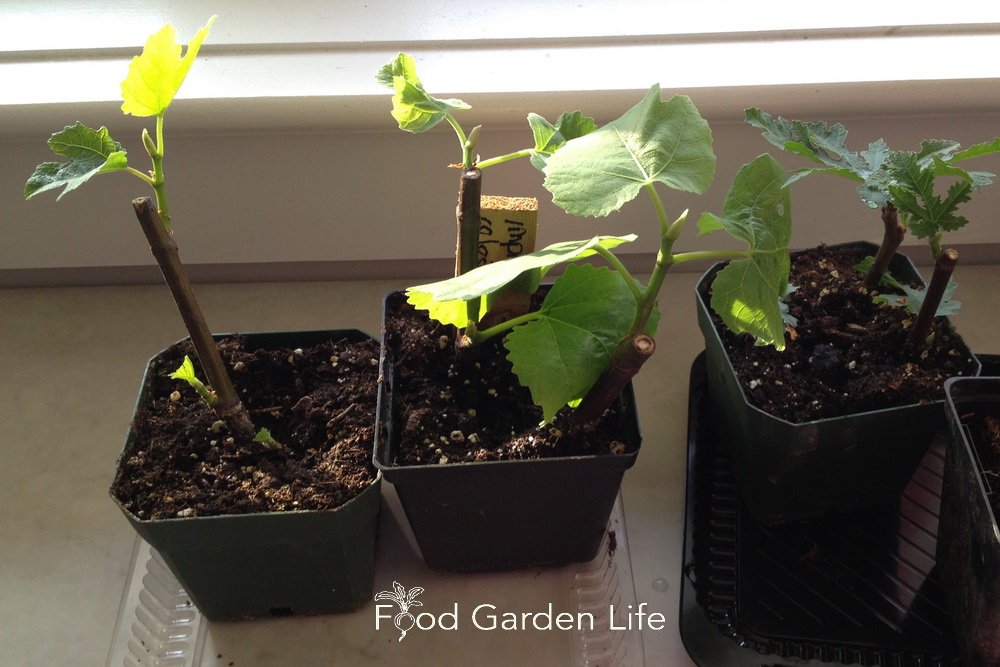
Young fig trees growing in simple potting soil.
I use different soils for my small and large fig plants. Here’s what I do:
Young Fig Trees. I use straight commercial soil for young fig trees and rooted cuttings. It’s quick and easy, and I repot frequently until the fig trees reach the size I want.
Mature Fig Trees. Once my fig trees are the size I want, I use a soil that holds more moisture, is heavy enough so they don’t tip over in the wind, and can buffer–meaning less chance of nutrients getting out of whack. (See soil recipe below.)
Should I Add Loam Soil?
First, let’s unpack the term “loam.” For soil scientists, it’s the soil with a desirable mix of sand, silt, and clay. With the right percentage of each, a soil can achieve “loam” status. It’s what most gardeners and farmers only wish they had…
For home gardeners, forget percentages: We’re just talking about a crumbly garden soil that doesn’t have so much clay that it’s sticky when it’s wet.
Loam—and for home gardeners, that means garden soil—has properties that make it useful in soil mixes:
Weight. Weight can be good! (Fig trees won’t tip in the wind!)
Insurance. Buffering effect (Meaning less chance of nutrient snafus)
Reservoir. Water holding (Clay holds water well!)
BUT we don’t use straight loam. Ever. It packs down too much in a pot. Great way to get root rot.
More on Loam
In case you’re wondering…commercial loam production entails stacking turf (think of sod) and letting it break down into a crumbly soil. The decomposed turf leaves and roots add organic matter to the soil.
Fig Tree Potting Soil Recipes
My Basic Fig Tree Potting Mix Recipe
Here’s what I use when I repot a mature fig tree in a larger pot. I want a long-term soil mix that retains more moisture, and is heavy enough so the fig tree doesn't tip in the wind.
1 part garden loam
2 parts soilless potting mix (a commercial-grade soilless potting mix)
1 part sand
1 tbsp. lime per gallon of mix
1 tbsp. bone meal per gallon of mix
John Innes Soil Mix

Pin this post!
Here’s the recipe for John Innes Soil mix. This is used more commonly in the UK—and it’s the blend we used when I worked at a fig tree nursery in the UK.
7 parts sterilized loam*
3 parts peat (or peat substitute)
2 parts coarse sand**
Plus fertilizer***
*I don’t sterilize loam…I don’t see a need for sterile except when it comes to seed-starting and cuttings. But if root-knot nematodes are an issue in your area, either sterilize or don’t use loam.
**Coarse sand: As compared to beach sand (or play sand) where the granules are rounded—but, instead, the sand particles are irregularly shaped and of varying sizes. In North America, you might look for “builders” sand.
***In old texts, you’ll see recommendations for a fertilizer mix that includes hoof, horn, and blood meals. There are other options now...use a slow-release feed for container plants.
Adriano’s Fig Tree Soil Mix
I mentioned that my fig mentor, Adriano, used rabbit manure in his preferred soil for fig trees.
Here’s Adriano’s Fig Tree Soil recipe:
1 part peat-based potting mix
1 part composted manure (rabbit when possible!)
1 part compost
Plus added perlite, dolomitic limestone, and vermiculite
Sterilizing Loam
As I mention above, I don’t sterilize loam. No need here.
But if you’re curious how a home gardener could sterilize soil for a fig tree soil mix, here’s how:
“The last soil sterilization method I shall discuss is surely a home method, for it involves the oven of your kitchen stove. Small quantities of soil put in the oven and held at 180°F for 30 minutes will be found to be ideal for starting seeds, not only because the disease organisms will have been destroyed, but because all weed seeds will have been killed too.”
Taken from: Greenhouse Gardening as a Hobby, James Underwood Crockett, 1961
I know my wife would leave me if I started cooking garden soil in the oven. Ain’t happening here in the Biggs household.
But here’s an idea: I’ve had students use the BBQ.
Not Sure Where to Begin with a Fig Tree Soil?
At this point we’ve looked at what makes a good soil, talked about a number of common ingredients, including what not to use. You have 3 fig tree soil recipes.
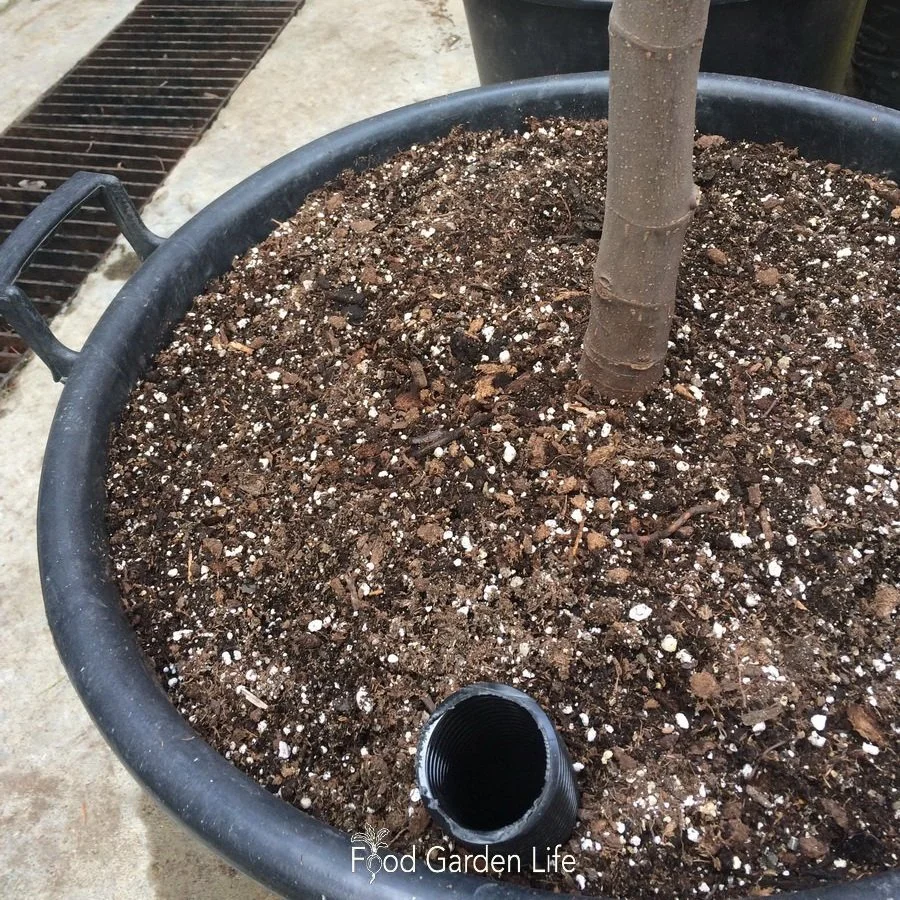
Fig tree growing in a sub-irrigated pot. A potting soil with good wicking properties is essential.
If you’re scratching your head wondering, “What should I do?” don’t be overwhelmed by options.
Start with one of the fig tree soil recipes I’ve given you.
Over time, experiment with different ingredients. Choose what works well with your fig trees, and what’s good value.
The art of making soil isn’t just for your fig trees—this is something you can use for all of your potted crops.
FAQ: Fig Tree Soil
What soil should I use for propagating fig trees?
I use a commercial peat-based mix.
There are other options too. Find out how to pre-root your fig cuttings.
Can I grow figs in a sub-irrigated pot? What soil should I use for fig trees in sub-irrigated pots?
It's important to have a soil with good wicking properties. Think of the blond peat moss I talk about above.
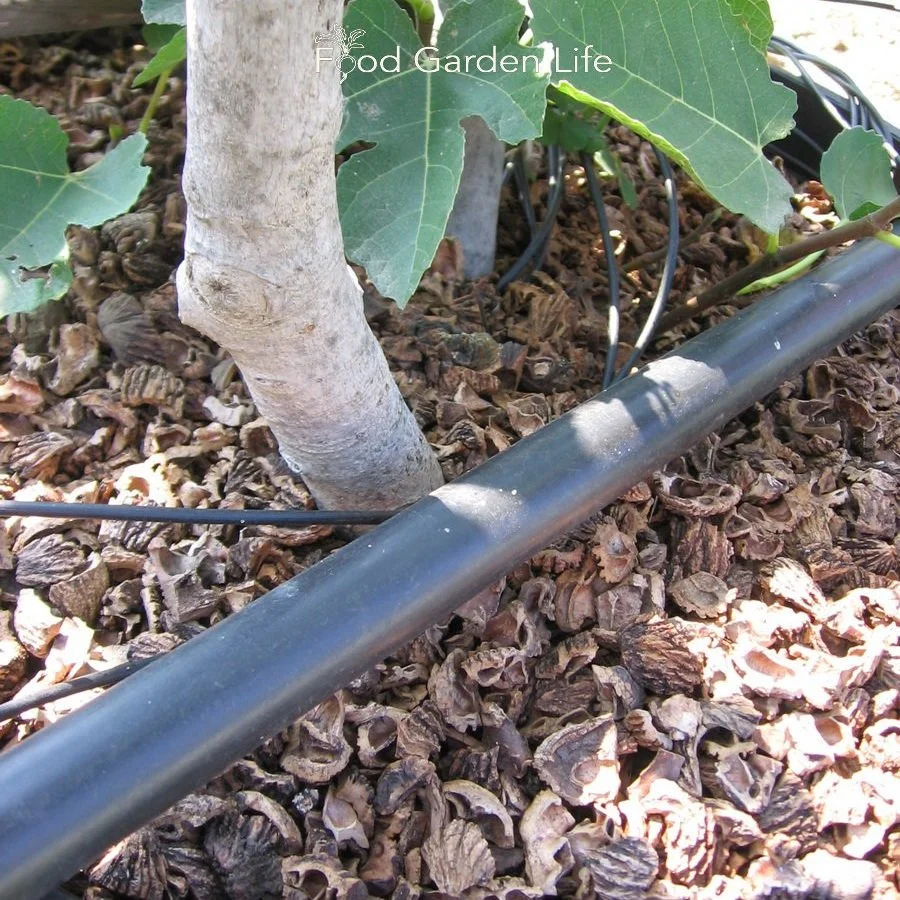
Mulch covering the potting soil, to reduce water loss to evaporation.
Find out more about how to make a sub-irrigated pot for your fig trees.
Can I add mulch to my potted fig trees?
Yes. A layer of mulch on top of the soil holds in soil moisture.
(The most interesting mulch I've seen was crushed walnut shells, at a nut nursery!)
My fig trees need frequent watering, what can I do?
You'll get the best growth when the soil is consistently moist. Add ingredients to retains moisture. And if that's not enough, consider a sub-irrigated pot.
Keep Growing Figs
Looking for more cold-climate fig-growing ideas? Visit the fig home page to browse articles about varieties, pruning, propagation, ripening, winter protection, and more.
Grow Figs Where You Think You Can’t
My revised and expanded fig book is a practical guide to growing figs in pots and cold climates—from choosing varieties and pruning to ripening fruit and conquering winter.
Find This Helpful?
Enjoy not being bombarded by annoying ads? Appreciate the absence of junky affiliate links for products you don’t need?
This site is reader supported. If it has helped you in your food-gardening journey, you can give us a high-five below. Any amount is welcome.
Propagating Figs? Air Layering Fig Trees is Simple, Here’s How it’s Done
Find out how to air layer a fig tree. It’s easy to do, and you don’t have to buy special supplies.
By Steven Biggs

Propagating Fig Trees Made Easy
A common way to make more fig trees is with cuttings.
Fig cuttings are fairly easy to root. But they do regular care.
If you’re too busy to coddle your fig cuttings, air layering is a simple way to propagate your fig tree.
It’s a simple, hands-off way for home gardeners to propagate fig trees.
And you might already have the supplies you need around the house.
Keep reading to find out how to air layer a fig tree, and what supplies you do (and don’t) need.
What is Air Layering?
Air layering is when we coax roots to grow from a branch that’s still attached to a plant.
The roots grow where we wrap the branch with a moist covering. Think of a tree-sized bandage with extra thick and moist padding underneath.
Air layering works for many types of plants. It is particularly easy with figs because figs root easily.
(There’s also what simply called “layering,” which refers to taking a low-lying branch and bending it down into contact with the soil.)
Why Air Layer?
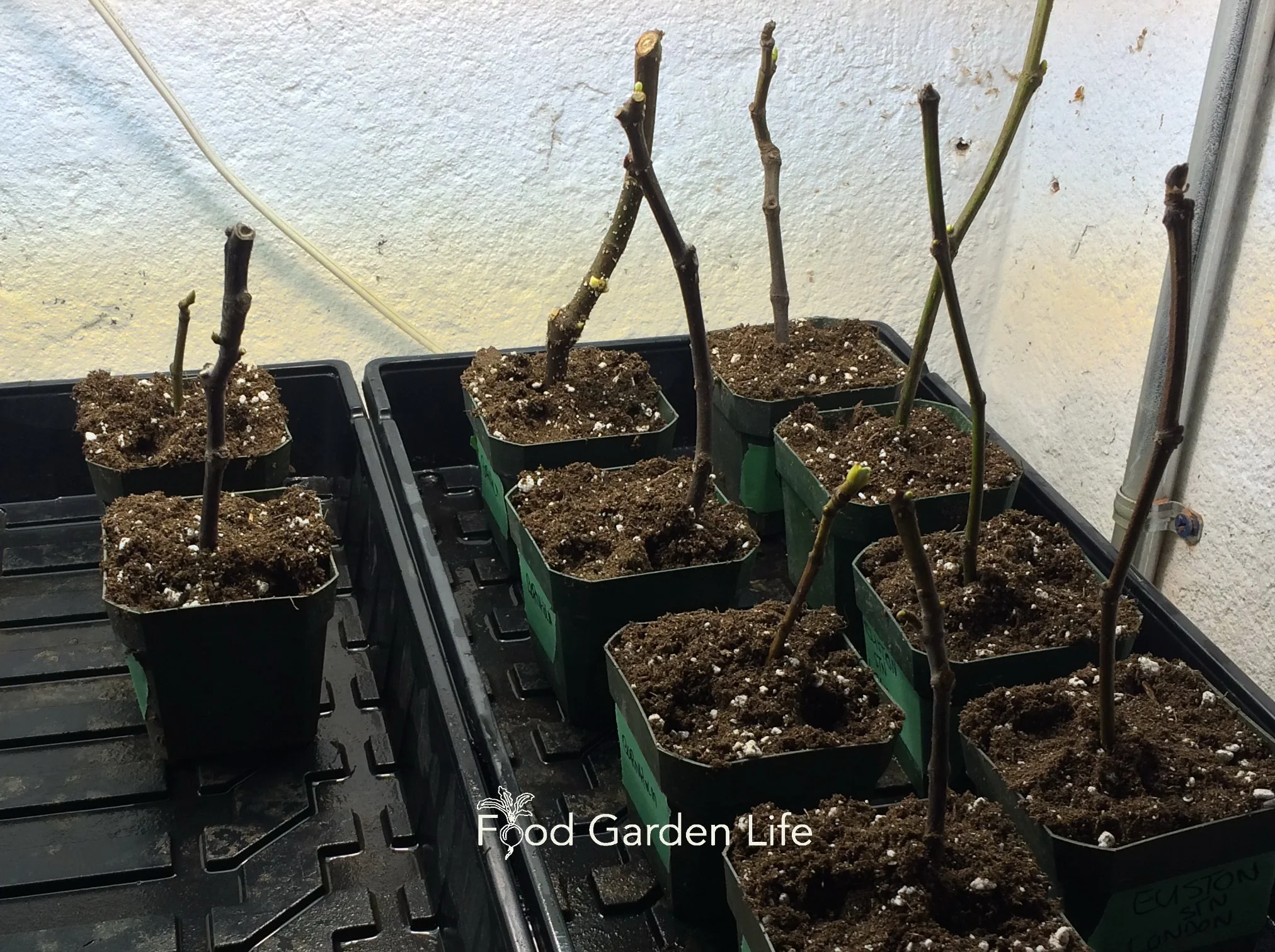
Rooting cuttings is a good way to make lots of fig plants, but fig cuttings need regular attention.
On a commercial scale, propagating fig trees is usually done with cuttings. That’s because:
You can make more trees from a limited amount of wood
It doesn’t take as much space
Cuttings are also a useful way to share fig varieties: Little branch bits are easy to send by mail, so you can swap fig varieties with other fig growers.
But cuttings need regular attention.
So if you’re looking for a foolproof fig propagation method that doesn’t need regular monitoring, air layering is an excellent option.
(You can also use air layering to reshape an older tree, see below.)
Find out how to root fig cuttings.
When to Air Layer
Start air layering fig trees in the spring or early summer, when the fig tree is actively growing.
It can take 6-8 weeks for a branch to root, so an early start means you can detach your newly rooted fig plant in late summer, and then pot it up before the fig tree goes dormant in the fall.
If you start an air layer later in the summer, it might not be ready to cut off and pot up before fall. It’s not the end of the world if it’s not ready to cut off…but any tender little roots that have started forming are fragile, so there’s more chance of them being damaged if they’re still bandaged up for the winter. (The temperature in the air layer will swing back and forth more quickly than the soil in a pot or the ground.)
Branches to Air Layer
You’ll get the fastest root growth on year-old branches. (Branches from the previous year that are a bit woody).
Older branches will root too, but it can take a bit longer.
Don’t use green growth from the current year—it’s more likely to rot.
Supplies: What You Need to Air Layer a Fig Tree
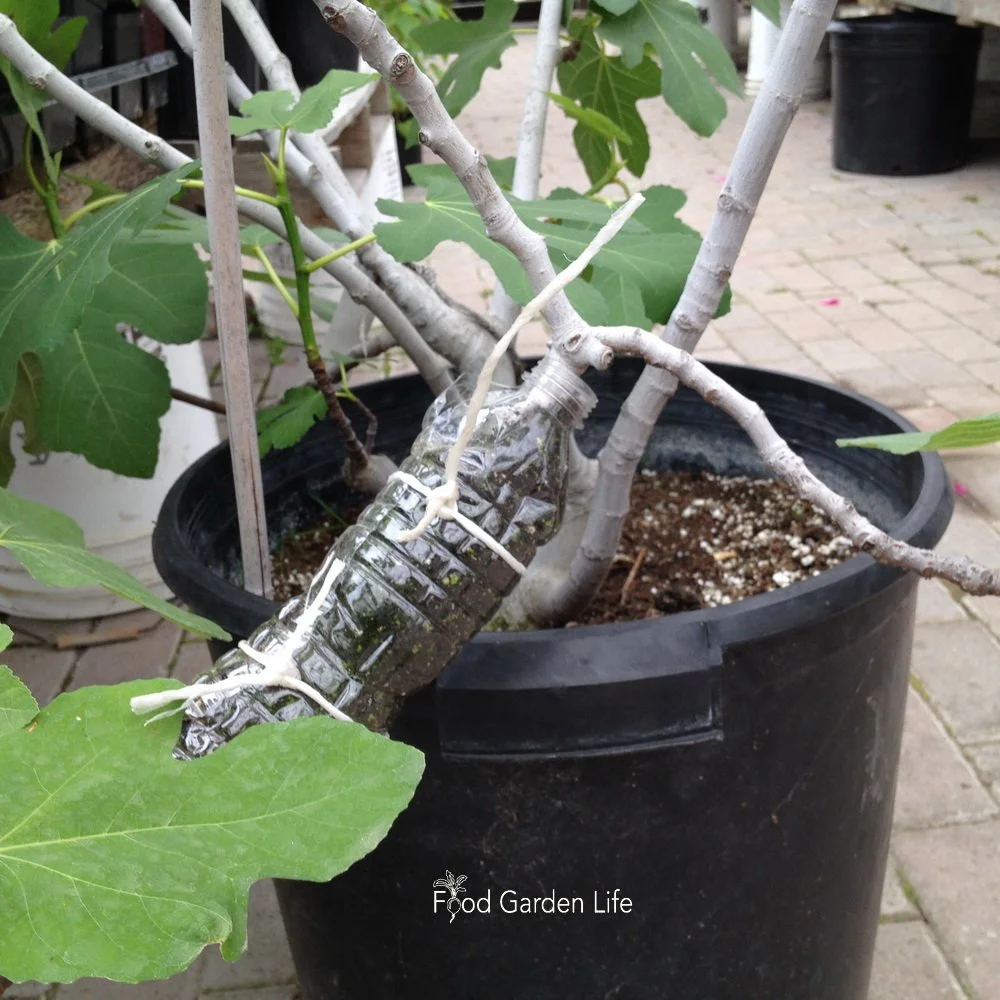
A fig air layer made using a clear plastic water bottle, twine, and potting soil.
Rooting Medium – The Filling to Go Inside the Bandage
Pack the inside of the bandage with something that holds moisture and is loose enough to allow roots to grow. Moistened sphagnum moss, coir, and potting soil all work well.
The rooting medium should be moist—but not sopping wet.
The Covering
The rooting medium is held in place by a covering (the bandage!)
Here are ideas:
Sandwich bag
Water bottle split lengthwise
Plastic cling wrap
Be creative, there are lots of other things you can use.
(There are even purpose-made gizmos for air layering, but they cost an arm and a leg.)
Fastener
Next you need something to hold the covering in place.
Depending on the covering you’ve chosen, you might use twine, zip ties, or electrical tape. (I like electrical tape because it’s stretchy, so you can pull it tight, and it holds up well outdoors.)
Optional
Many people use rooting hormone when air layering.
Rooting hormone can speed up root development. For some types of plants rooting hormone is a must…but frankly, for figs, don’t waste your money. They root well without it.
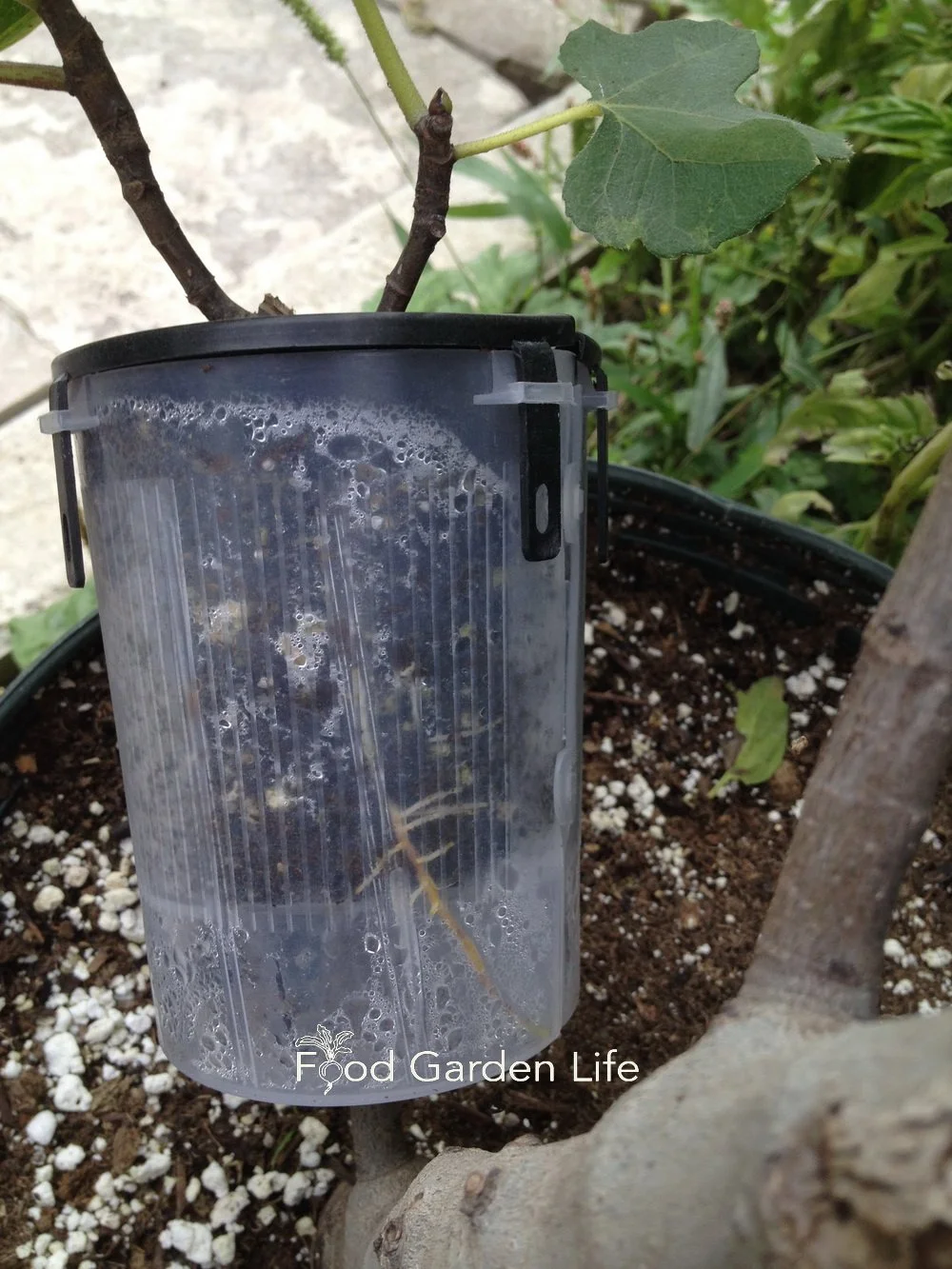
Healthy fig roots visible in this purpose made gadget for air layering.
Get Your Fig Trees Through Winter—and Harvest Figs
Growing figs where winters are cold takes a bit of creative thinking.
In Fig Camp and the self-paced Fig Masterclass, I explain how to grow figs in pots or in the ground, extend the growing season, ripen more fruit, and protect your trees through winter.
Air Layering Steps
Choose a straight branch to air layer. The wrapping is easier on a straight branch.
Choose where on the branch to make the air layer. It should be on year-old wood—not green growth from the current year.
Remove leaves that will be in the way of the air layer.
Remove figs above the air layer. (Seems a pity…but this branch has a higher purpose—a new fig tree!)
Position your covering, and fill it with rooting medium.
Now close it up tightly with your fastener so that the medium stays moist. (You don’t want to have to open up the covering to re-moisten the medium).
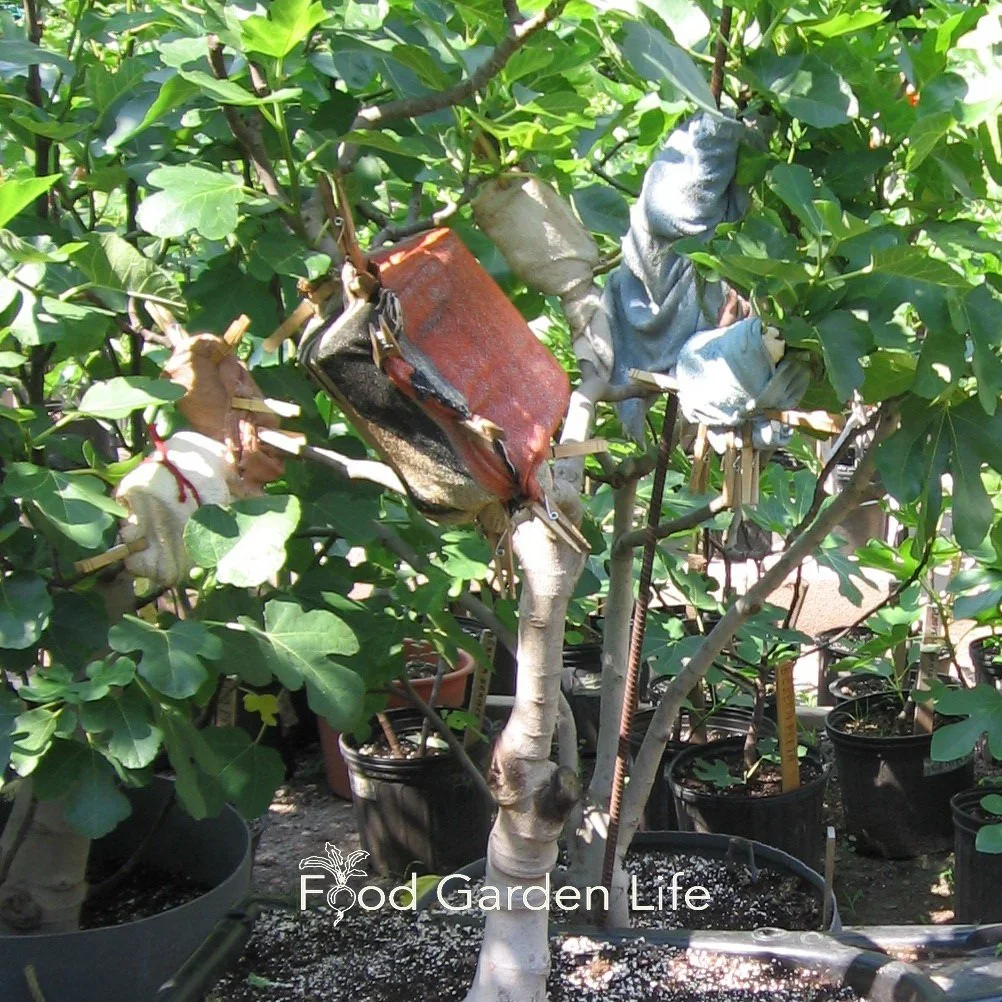
Do a few air layers at once! The more fig trees the better…then you can share with friends!
Do a few air layers at once! The more fig trees the better…then you can share with friends!
Air Layering Optional Steps
Wounding and applying rooting hormone are two optional steps when air layering a fig. They are both traditional air layering steps that can help to stimulate root formation.
But I skip both of steps with figs.
That’s because fig branches are like chia pets waiting to sprout. Once you give them the right conditions, there’s no holding back the roots.
Wound the Branch - Optional
Creating a wound at the site of an air layer is a common practice that, for some plants, is very helpful in stimulating root growth.
Here are a couple ways to wound a branch for air layering.
Slanting cut. A common step is to make an inch-long upwards-slanting cut—a slightly angled cut towards the tip of the branch. It’s a bit like a tongue. The cut is often held open with something small, such as a toothpick.
Girdle. Another variation on wounding is simply to girdle the branch.
Apply Rooting Hormone - Optional
Rooting hormone is often used along with the wounding techniques above.
How to Know Air Layering is Complete
If you’re using a clear plastic bottle, clear bag, or other clear materials as your covering, you can watch the fig roots develop.
When your fig air layer is well rooted (meaning that the medium has a nice spaghetti-like jumble of roots) you can cut off the rooted air layer from the branch.
How to Remove an Air Layer
Just cut off the branch below the air layer.
Remove the covering, and pot up your new fig plant.
Under good growing conditions, fig air layers started in early summer take 6-8 weeks until they’ve grown enough roots to snip off and become stand-alone plants.
What to do Next…
Your newly air-layered fig tree has roots…but you’ve just stressed it by cutting it from the parent plant.
So grow it in a shaded location for a couple of weeks.
FAQ: Air Layer Figs
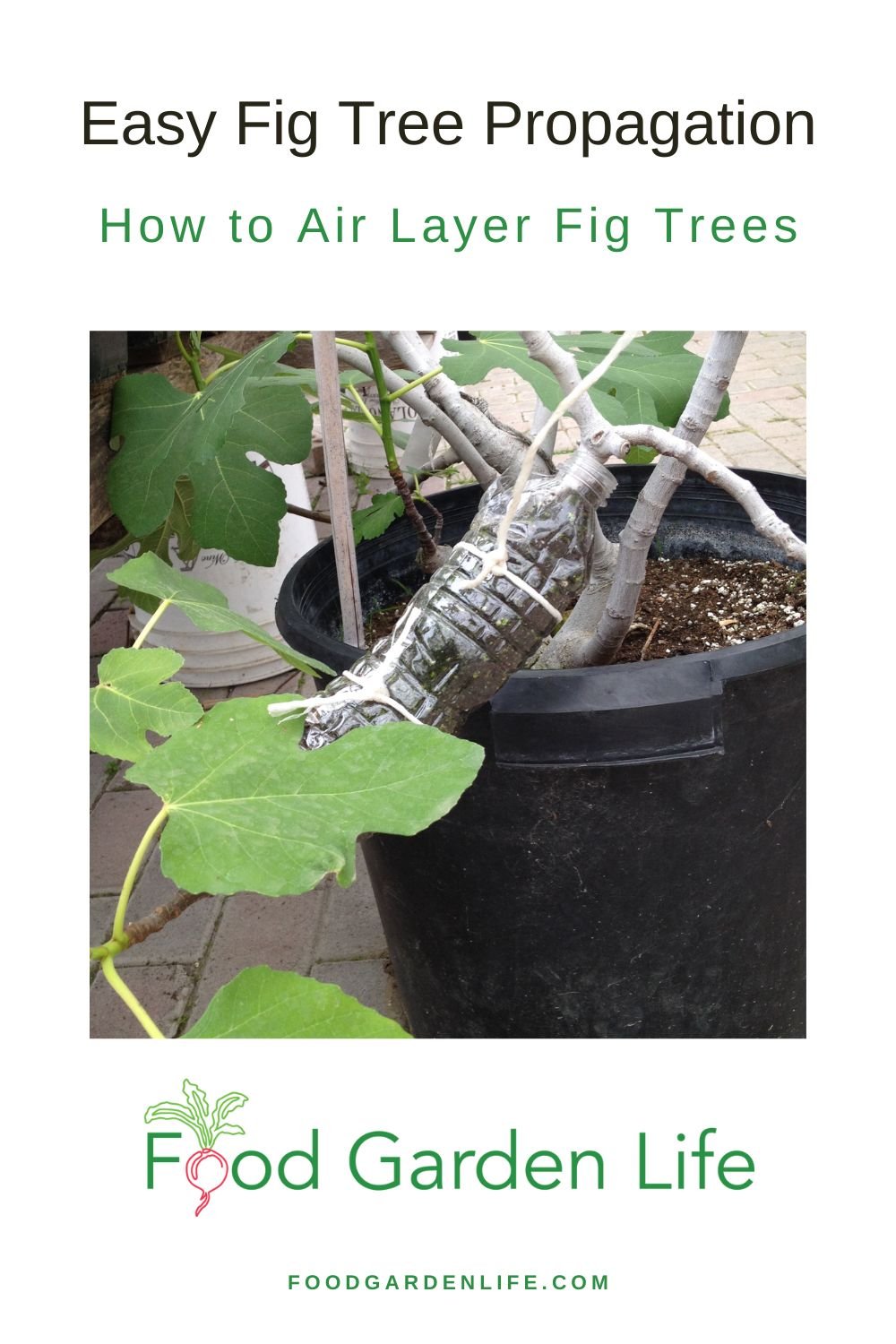
Pin this post!
What about larger branches?
In addition to air layering year-old branches, you can air layer older wood too. Young wood tends to root faster than older wood—so it might take a bit longer.
The bigger the branch, the bigger the bandage. But it can be worth the effort, especially if you’re looking to reshape a larger tree, and don’t want to waste the big branches. With air layering, you can root them before cutting them off!
Here’s an idea: I’ve seen multi-stemmed fig bushes air layered near ground level. There’s no need to fasten anything to the stem if you make the air layer just above ground level, by placing a pot filled with potting soil around the stem. Cut the bottom out of the pot, and then slit it lengthwise so that you can just wrap the pot around the stem. (Black nursery pots are easier to cut than smaller, thick-walled pots.) Then fill with potting soil and keep well watered.
Why is my air layer taking so long?
Roots form faster in warmer weather, when tree is actively growing. Younger wood roots more quickly than older wood.
Do you need to water an air layer?
If the moistened potting soil is fully covered, and the covering is fastened tightly, it will probably stay moist until it's time to remove it.
Keep Growing Figs
Looking for more cold-climate fig-growing ideas? Visit the fig home page to browse articles about varieties, pruning, propagation, ripening, winter protection, and more.
Grow Figs Where You Think You Can’t
My revised and expanded fig book is a practical guide to growing figs in pots and cold climates—from choosing varieties and pruning to ripening fruit and conquering winter.
Find This Helpful?
Enjoy not being bombarded by annoying ads? Appreciate the absence of junky affiliate links for products you don’t need?
This site is reader supported. If it has helped you in your food-gardening journey, you can give us a high-five below. Any amount is welcome.
These Espaliered Fig Trees Make Winter Protection Easy
Here's a way to grow figs that makes it easy to protect them for the winter in cold climates.
By Steven Biggs
Diminutive Fig Low Cordons for Easier Overwintering

Fig low-cordon espalier, an easier way to grow an in-ground fig tree in a cold climate.
Francesco had a fig tree in his Toronto yard. And every year, in what became a community event, he and some neighbours wrapped it up in burlap and tarps, then wrestled it down to a horizontal position, into a trough they’d dug for it. Then they covered it up for the winter. Each spring, they’d reverse the process.
When the tree got too tall to be tipped, they built a temporary enclosure around it, and put a space heater inside. It’s a fun story, and you can hear about it here.
It’s also heavy work. (I tip some of my fig trees, but I keep them much smaller than Francesco’s…so I don’t need to invite over the neighbourhood! See how I tip my fig trees.)
If tipping trees isn’t your cup of tea, there’s an easier way to grow an in-ground fig tree in a cold climate.
In this post I’ll tell you about growing a low-to-the-ground fig espalier that’s pruned right back in the fall.
No tipping. No wrapping. No lugging potted figs to a protected spot. Just cover the ground-level stem.
Keep reading and I’ll explain how to make yourself a simple-to-cover fig low-cordon espalier.
What is Espalier?
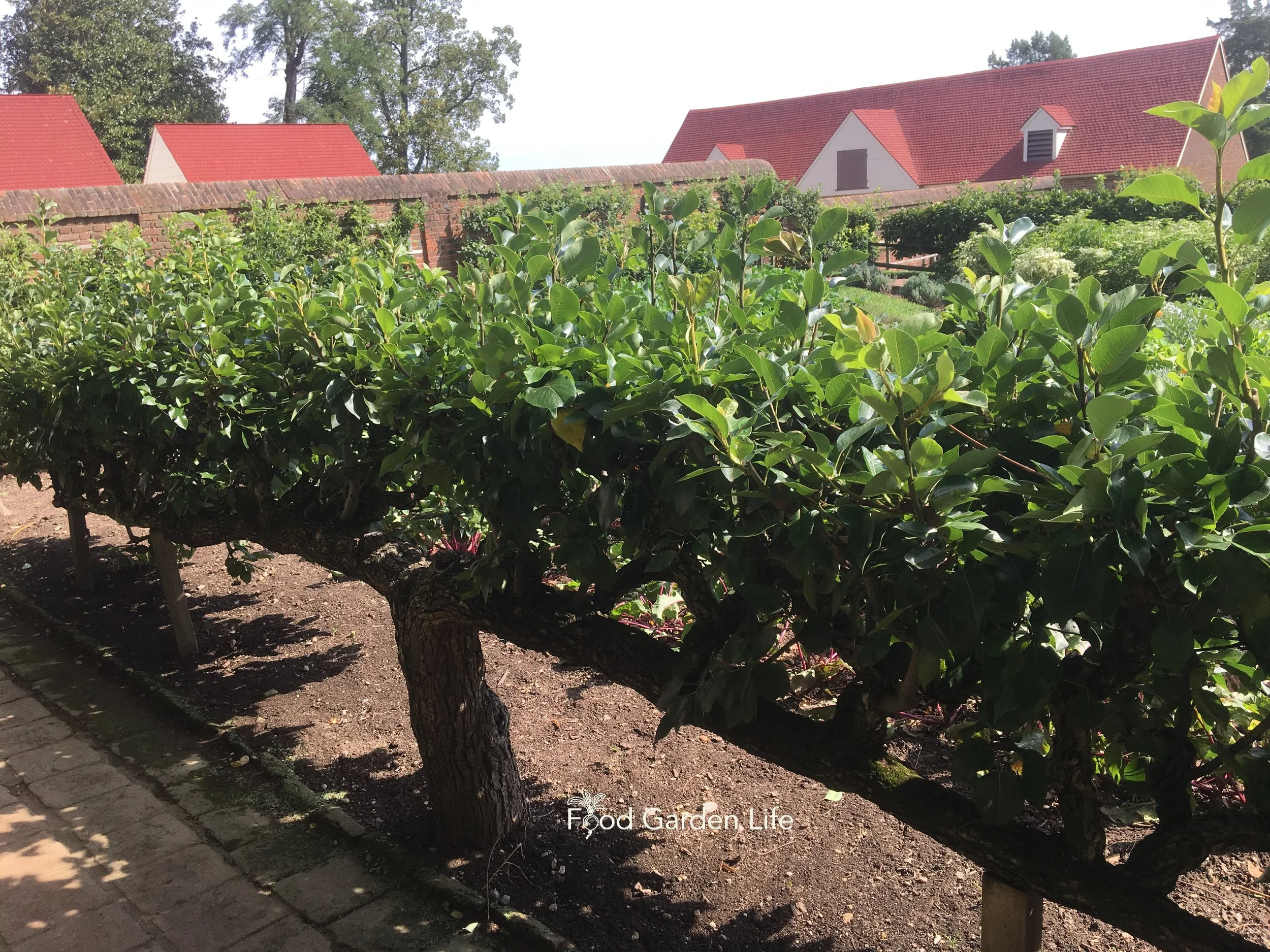
Espaliered pear trees at Mount Vernon.
Espalier is when we prune a tree so that it’s flat: It’s a two-dimensional tree.
In borderline fruit-growing areas such as northern Europe, there’s a long history of growing espaliered fruit trees against stone and brick walls. The walls warm up in the sun, and the flat fruit tree is nestled up against the warmed walls. The extra little bit of heat protects flowers from frost damage and speeds up ripening.
Along with extra heat, espalier is also a great technique to fit fruit trees into small spaces. I grow espaliered apples along a fence where there’s not enough space for a wider tree.
While espalier can be practical, it’s also be an art form. At Mount Vernon, George Washington’s estate (open to the public and well worth a visit) there are espaliered pear trees that frame the plots in the kitchen garden.
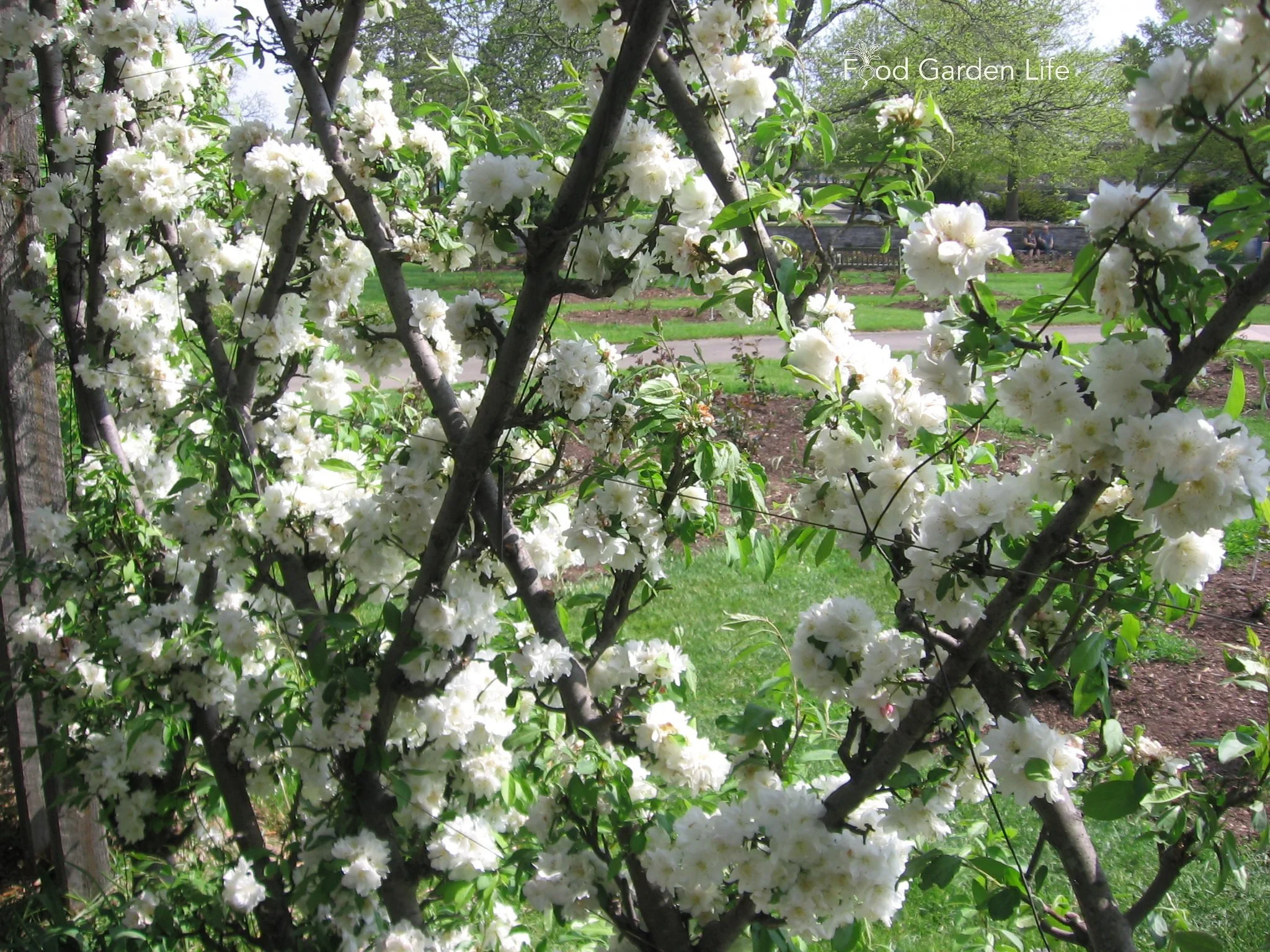
A Belgian fence is like a living wall!
Another beautiful espalier is the Belgian fence. A Belgian fence is like a living wall, with trees pruned to grow in a lattice-like pattern. (There’s are nice examples at Royal Botanical Gardens in Hamilton, Ontario, made from crab apple and serviceberry.)
There are many other espalier forms worth investigating if you like making the garden an artistic creation as well as a food-bearing one. Here are three of them:
Candelabra: U-shaped main stems that reach out horizontally, before bending upwards
Fans: As the name says, fan shaped
Step-over: A very low, horizontal main stem (called a “cordon”) that is close to the ground. (There’s a famed step-over apple tree in Monet’s garden…I’ve never seen it, but have seen pictures of it.)
Today, we’re taking our inspiration from Monet’s step-over apple tree. We’re using the step-over form—low cordons—to make overwintering fig trees in cold climates easier. I wonder what Francesco would think!
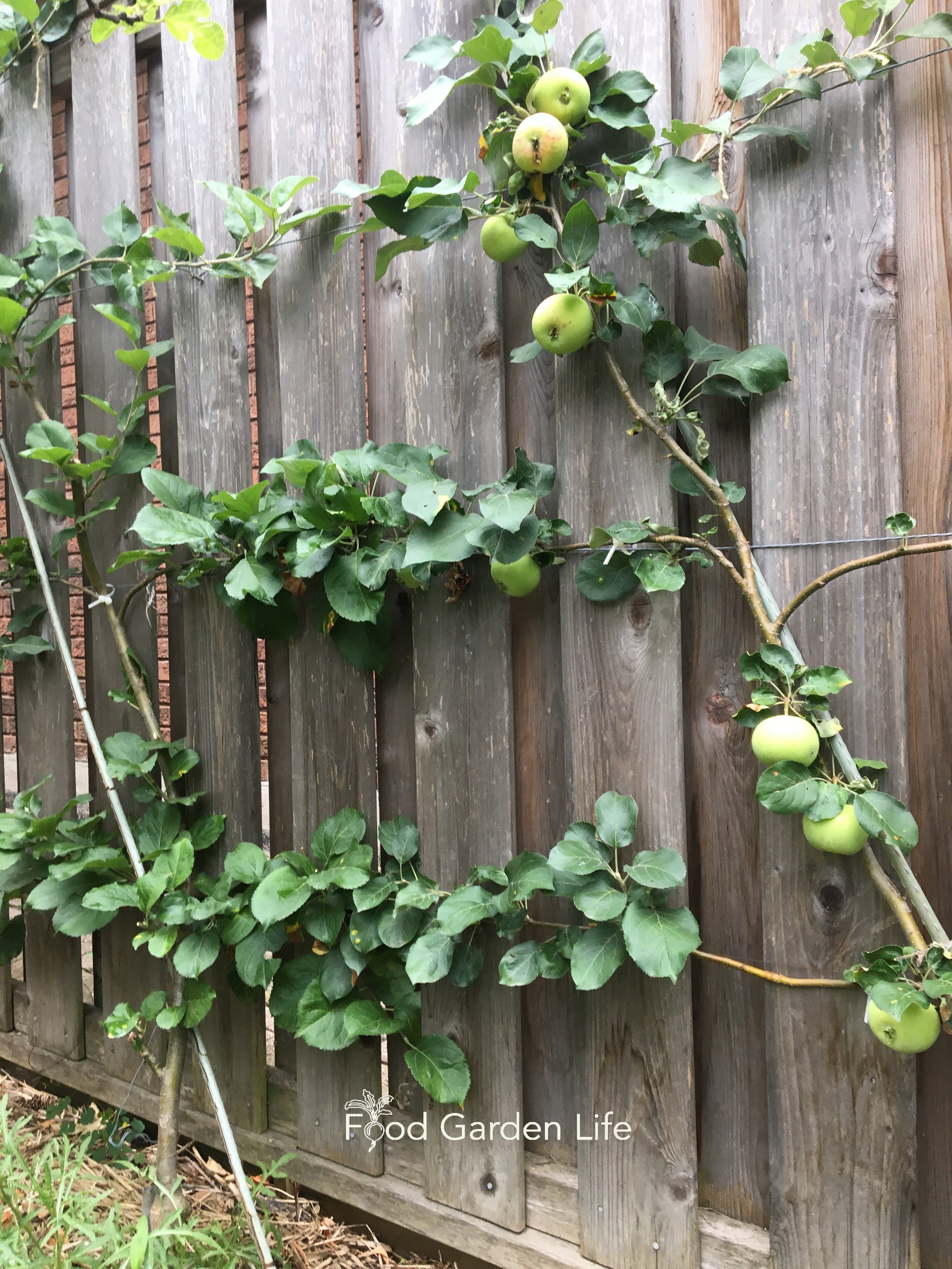
What’s a Fig Tree Espalier?
Before we unpack the idea of the fig low cordon, let’s quickly look at other forms of fig espalier.
It’s rare to find large fig trees for sale here in Toronto. Rarer still are unusual varieties. I never see fig espaliers.
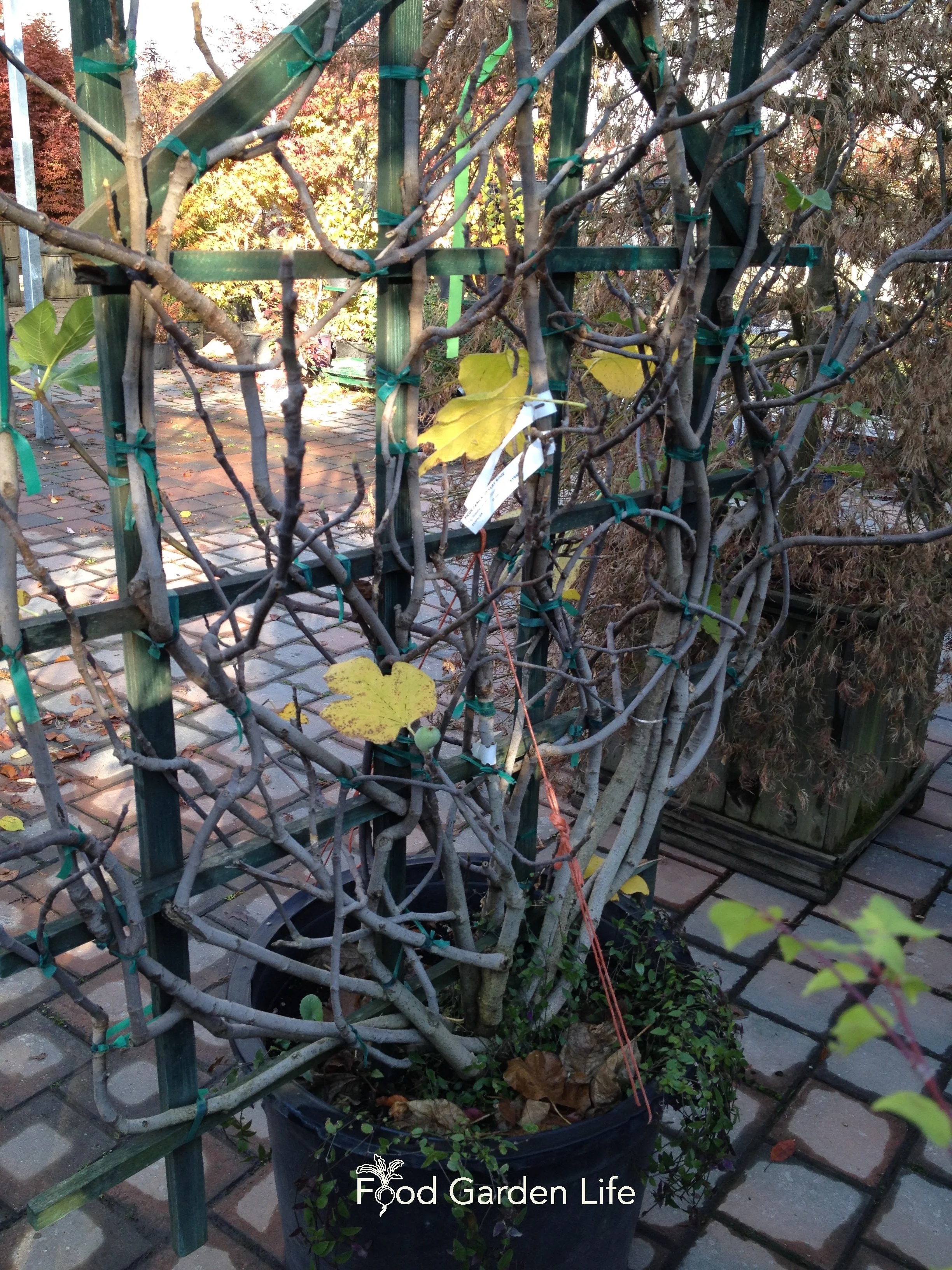
Espaliered fig tree in a pot. This one was rather dear…so I made my own instead!
Except once I did.
One day I came across a fig espalier at a nearby garden centre. As soon as I saw it, I pictured this potted fig espalier on my driveway, flat against my house. It was a bit of a tangled mess—but nothing a good pruning couldn’t fix.
Then I flipped over the tag to see the price. Gulp. $500.
So that fig espalier never made it home to my driveway.
Instead, I went home and looked through my potted figs to see if I had any with branching suited to creating an espalier. I did, and you can see the beginnings of my work in the picture below.
In a climate such as mine in Toronto, potted fig espaliers like this have a couple of benefits:
They look nice (imagine a patio surrounded by a living wall of figs)
Placed against a warm, south-facing wall, there is lots of heat to ripen the figs faster
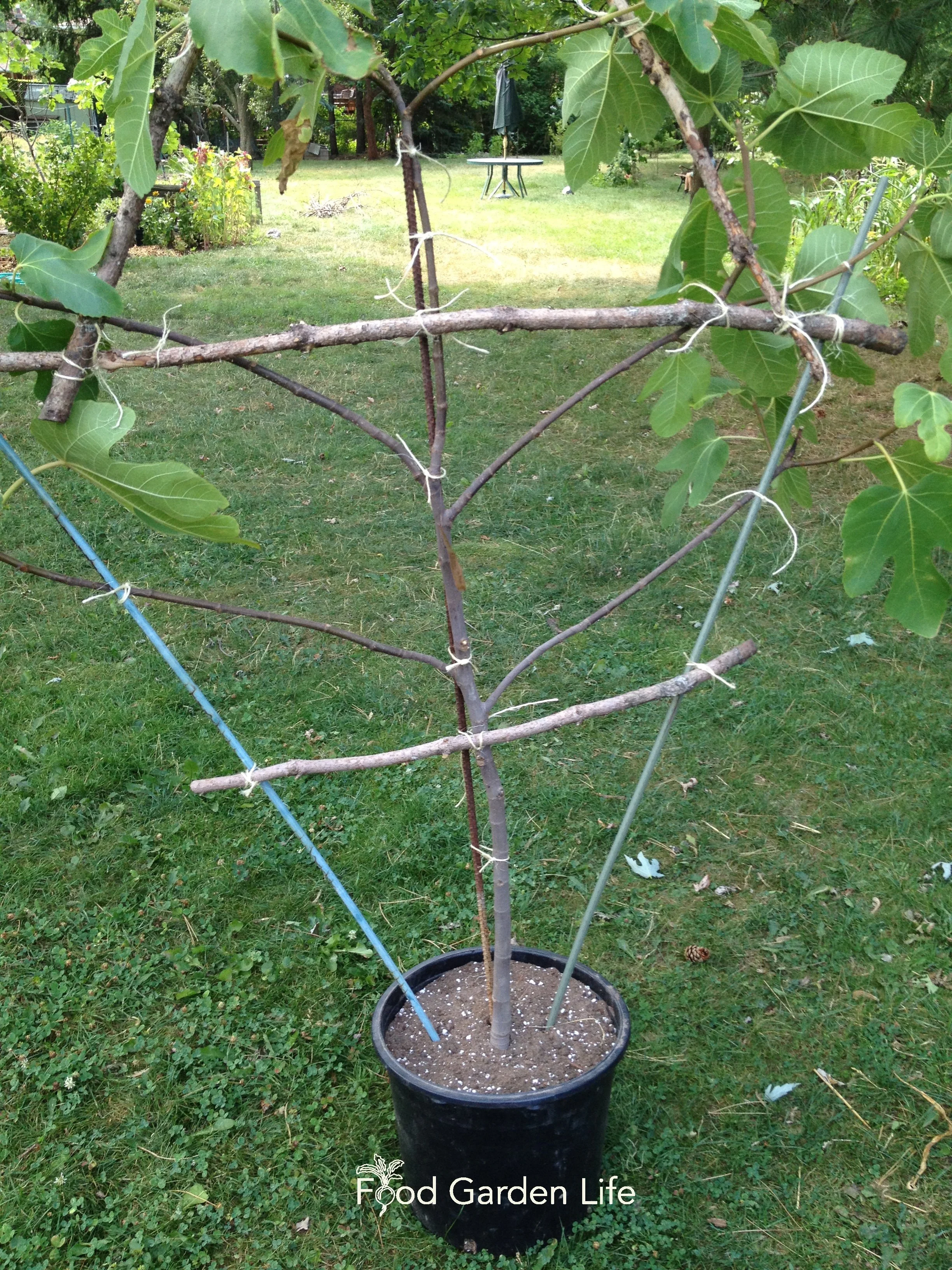
Pruning fig trees to make an espalier is something a home gardener can tackle. Here’s a fig espalier in the making.
But I think the form of espalier that has the most to offer cold-climate growers in areas such as my Canadian Plant Hardiness Zone 6 (USDA Zone 5) garden is the fig low cordon, a.k.a. the step-over fig.
The Fig Low Cordon Espalier
Like the other espalier forms, with a fig cordon we’re making a “flat” tree. But the main stem is horizontal—and it’s just above the ground level.
Think of those pear trees from George Washington’s garden. Now, imagine them hugging ground level.
Benefits of a Low Fig Tree Over Cold Winters
This step-over form makes overwintering of in-ground figs trees very easy. There’s no wrapping. No space heaters. No tipping.
It’s easy to prune. Before winter, all new growth is removed. It’s that straightforward.
That seemingly harsh pruning means that all that has to be protected for the winter is the horizontal cordon—and it’s so close to the ground that it’s a cinch. (We’ll talk about protection below.)
There’s something else we should touch on too: Why this drastic pruning method works with figs. It works because figs can form on new wood. (With many fruit trees, it’s the older wood that bears flowers and fruit.)
Note: this method won’t grow you any breba figs…none! Breba figs form on wood from the previous year—while main-crop figs grow on new wood. With the low-cordon espalier fig, all the fruiting wood each year is new wood, meaning all the figs are main-crop figs.
Where to Grow a Fig Low-Cordon Espalier
Location is very important. The first time I tried fig cordons, I planted them in a low-lying part of my property where the soil was slow to heat up in the spring. The fig trees survived, no problem. But because they were slow to wake up in the cooler location, the season wasn’t long enough for figs to ripen.
Here's what I recommend:
Full sun
South-facing, so the soil heats up
Even better if it’s beside a wall for extra heat capture
How to Make a Low Fig Cordon Espalier
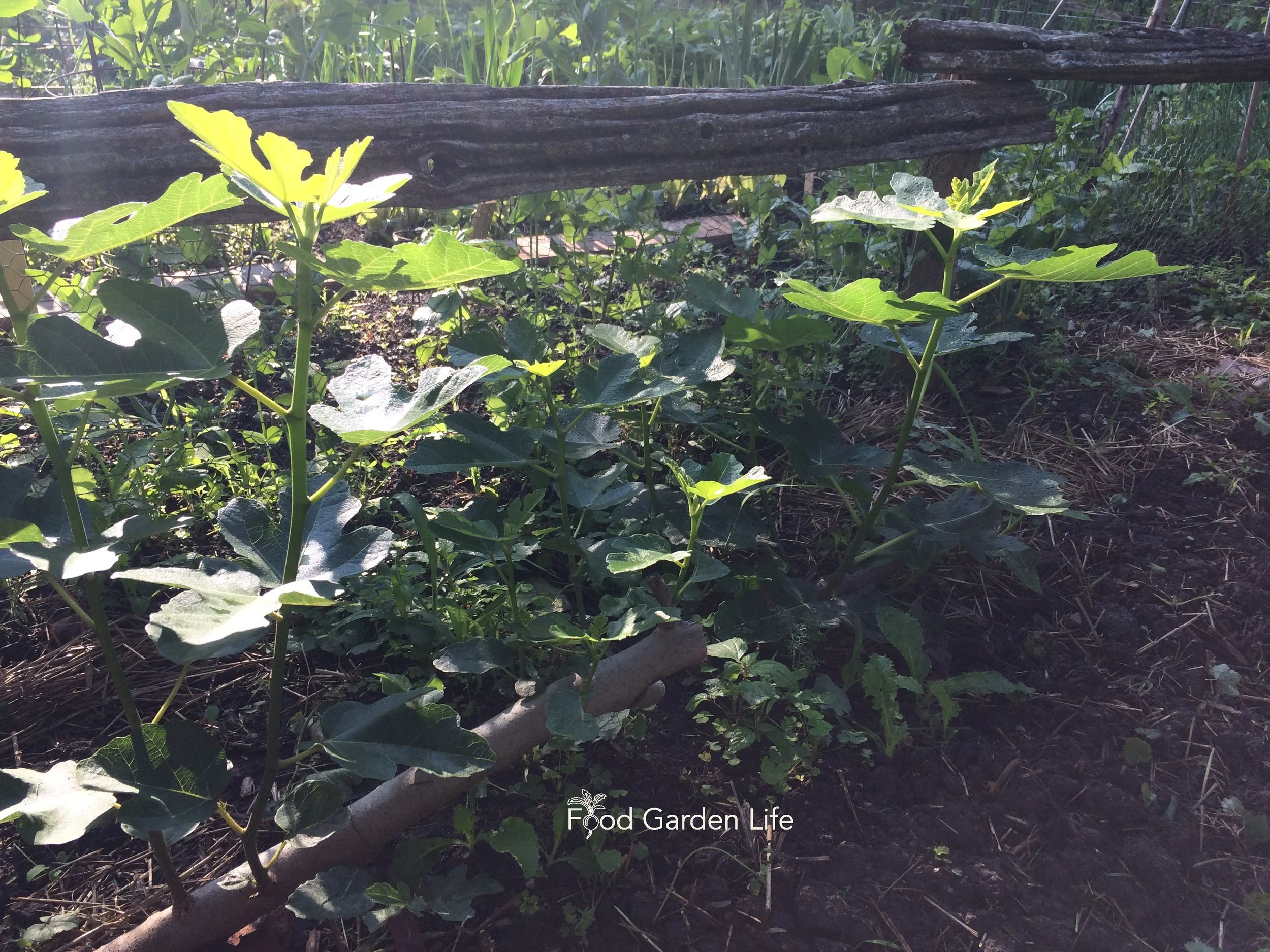
Fig low cordon that I made by lopping the top off of a mature fig trees, and them planting them so the trunk was almost horizontal, right above ground level.
The first time I made fig cordons I cheated. Instead of developing new branches, and training them horizontally, I took fig trees with long, straight trunks and planted them so that the trunks were almost horizontal. So if you want an instant step-over, low-cordon fig, that’s what I did.
But here’s a more traditional approach, starting with a small fig tree.
Year 1: In the first year, you create the cordons
Year 2: Then, the following year, you allow upright growth (and figs!) to form
Year 1, Scenario 1
Fig tree has a few branches coming from the base
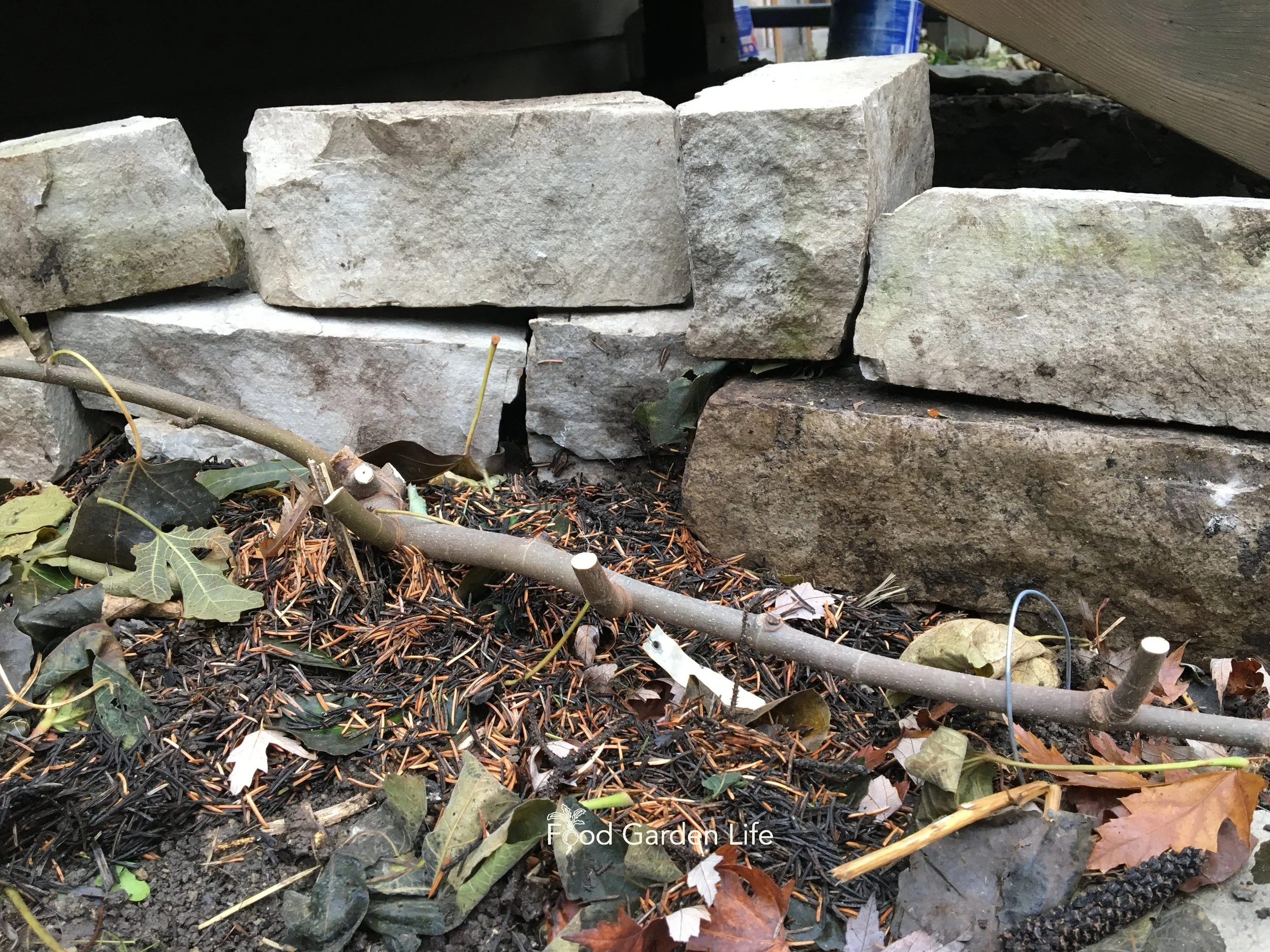
The goal in year 1 is to create the cordon, the low, horizontal branch that’s just above ground level. This is an example of a cordon.
If you have more than one branch, keep the two tallest branches (so you can have cordons going out in both directions from the base)
I grow branches at 45 degrees for the first year because they grow more quickly than if they’re horizontal. Tie them to bamboo stakes that are on 45° angle
At the end of the first year, gently bend over the 2 branches so that they’re horizontal
You will probably need to pin down the “cordon” at first (I use a wire hoop, see Hints and Tips below)
The bamboo on the cordon is temporary, remove it after a year, once the cordon has thickened and stays in place
Year 1, Scenario 2
Fig tree has only one branch
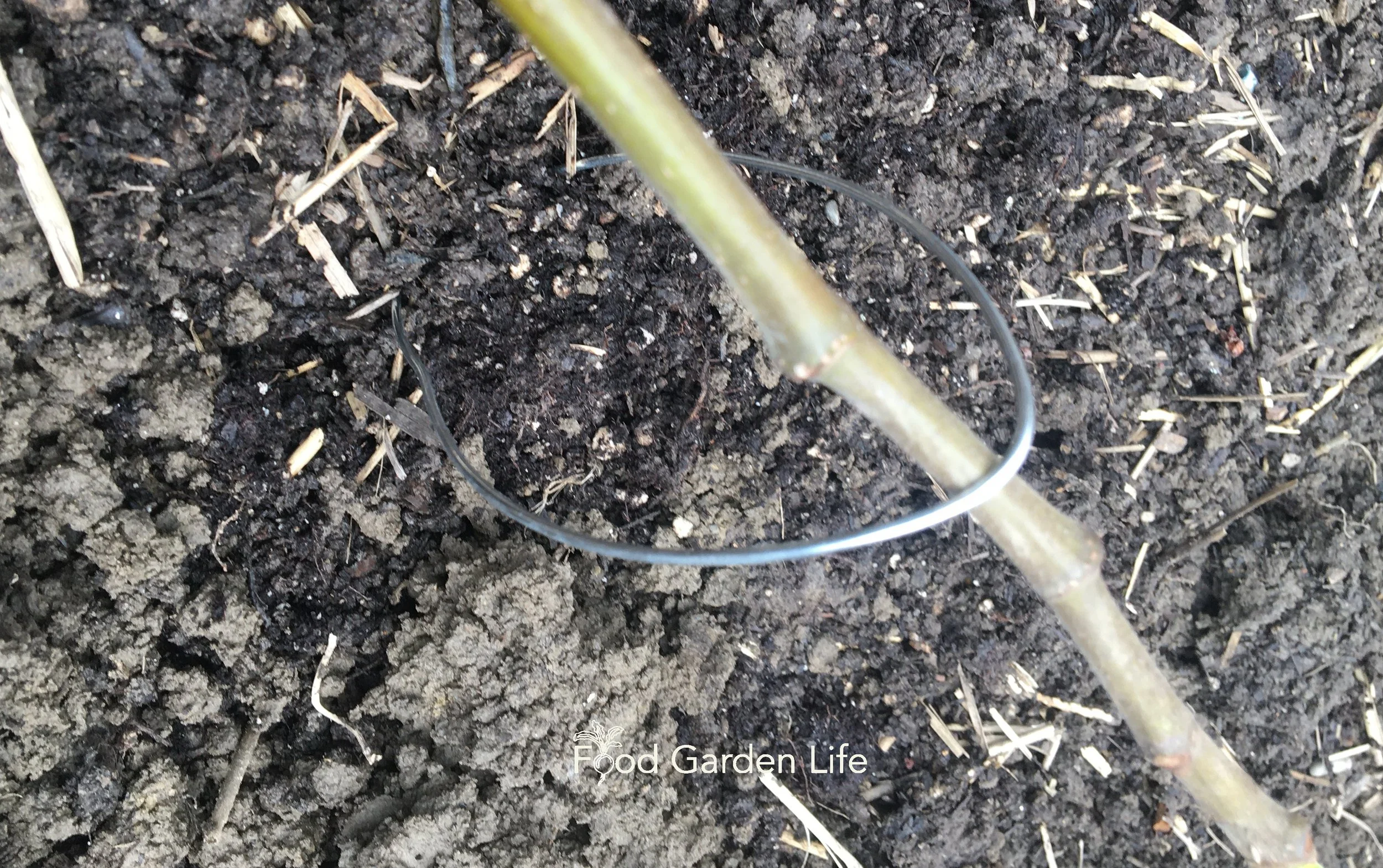
Pinning down the cordon after bending it to a horizontal position, using metal wire hoops.
If your fig tree has only one stem, decide if you want a cordon on just one side—or if you want cordons on each side
If you want a cordon on only one side, train the single stem as above
If you want 2 cordons, nip off the top of the stem at the height where you want cordons (this causes new shoots to grow)
Keep two new shoots for cordons—and treat as above
Year 2
In year two, with the horizontal cordons in place, upright shoots to grow.
Get Your Fig Trees Through Winter—and Harvest Figs
Growing figs where winters are cold takes a bit of creative thinking.
In Fig Camp and the self-paced Fig Masterclass, I explain how to grow figs in pots or in the ground, extend the growing season, ripen more fruit, and protect your trees through winter.
Pruning an Established Low-Cordon Fig Espalier
Spring Pruning
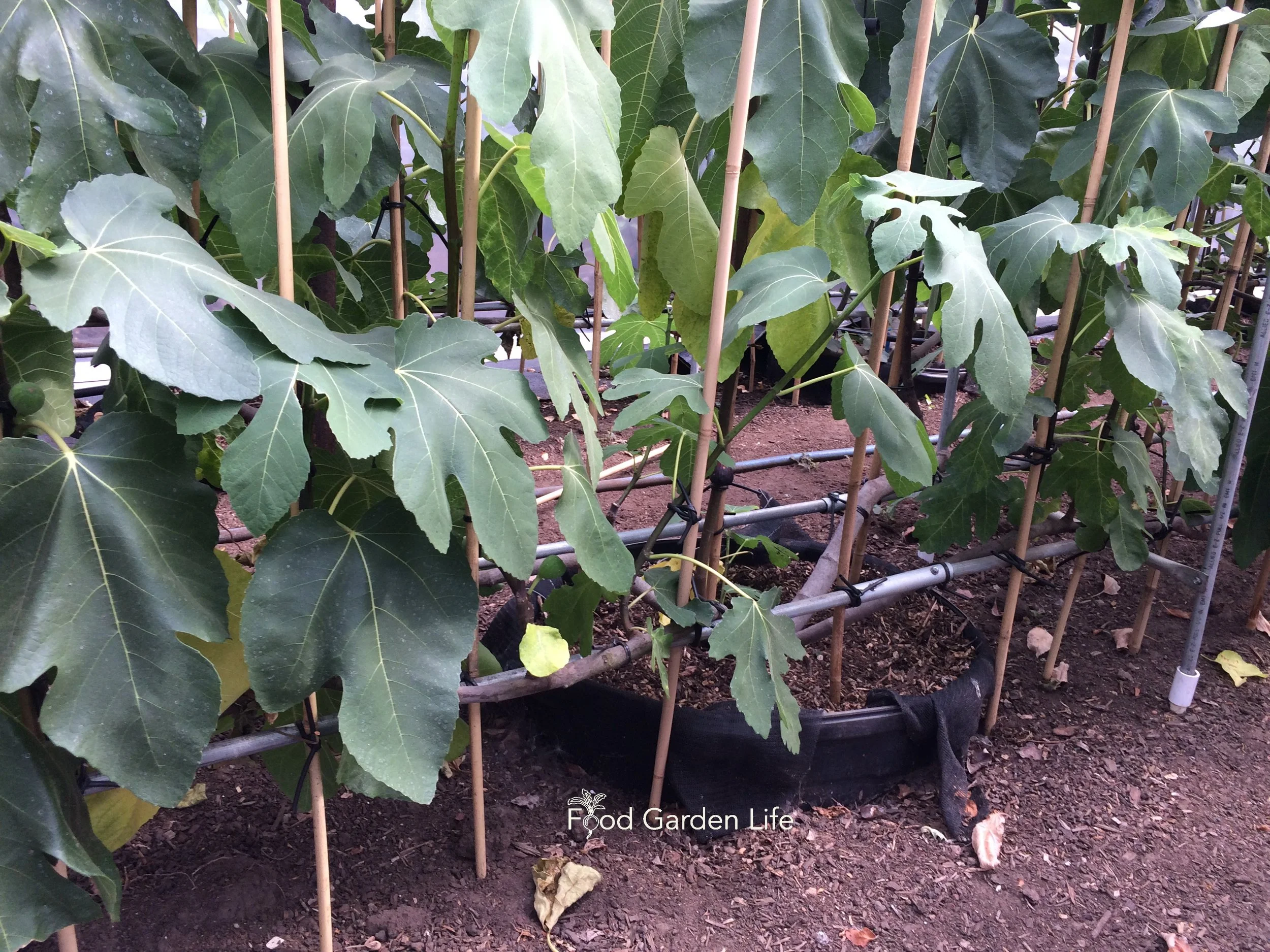
Fig cordons at Fruit Trees and More. Not the spacing and bamboo stakes. (These figs are in a moderate climate where winter protection is not needed—but this is a good method to grow figs in a small space and make them easy to harvest.
The fig tree might try to make more shoots than you need. Prune so they’re spaced 15-20 cm (6-8”) apart.
To grow them straight upwards, tie them to bamboo poles.
Fall Pruning
As the fig trees go dormant in the fall, cut back the vertical branches to within an inch of the cordon.
Leave a nub of branch, about 2 cm (1”). It’s from this that new branches arise in the spring.
If the ends of the cordons grew out over the summer, now is the time to shorten them back to your permanent framework.
Protecting a Fig Low-Cordon Espalier for the Winter
With the vertical branches removed, you’re left with only the cordon. And it’s just above the ground.
All you need to do is insulate it. Because it’s low to the ground and insulated, winter temperatures are moderated and stable.
The colder your winters, the more insulation you’ll need.
Here in Toronto, it’s enough for me to insulate with straw.
(I use straw for straw-bale gardening. Find out how to make a straw-bale garden.) If you don’t have straw, here are other ideas:
Bags of potting soil
Garbage bags filled with leaves (preferable to raking leaves over top because wet, matted leaves don’t insulate as well as dry leaves with air.)
Espalier Fig Spacing
You have a lot of leeway when choosing the spacing for your fig cordons. If you want longer cordons, obviously you’ll need fewer fig trees. If, like me, you have lots of fig varieties to fit into a small garden, you might opt for shorter cordons and more fig trees!
The tip of a cordon can reach it’s neighbour. No need to leave much of a gap in between.
Variations
Fig Trench
I also grow fig cordons in a trench. The idea of a trench is that it stays a bit warmer over the winter. In late fall, I cover the top of the trench with windows and bags of leaves. In spring, once I remove the bags of leaves, sun shines through the windows into the trench to warm things up.
The colder your zone, the more appealing a trench might make.
(There’s a rich history of trench cultivation! Here’s a fun article if you like this idea.)
Fig Trees in an X-Shape
Don’t be constrained by the 2-dimensional nature of espalier. You could make a low-to-the-ground fig growing out in an X pattern.
Early spring start
In cold climates, summer heat and season length are limiting factors to ripening fruit. If fig plants wake up in good time, the season is longer. Then there’s more chance of ripe figs.
Warm soil helps to wake up the fig tree. A south-facing location warms up more quickly than a location with less sun. If the location is next to a wall or something that catches the heat from the sun, the soil warms more quickly.
I have a low stone wall next to my cordon fig trees to capture heat. In the spring, I angle old windows against the wall, making a temporary low-tech mini greenhouse. The windows hold in heat to help the fig trees wake up earlier. They also protect them from late spring frosts.
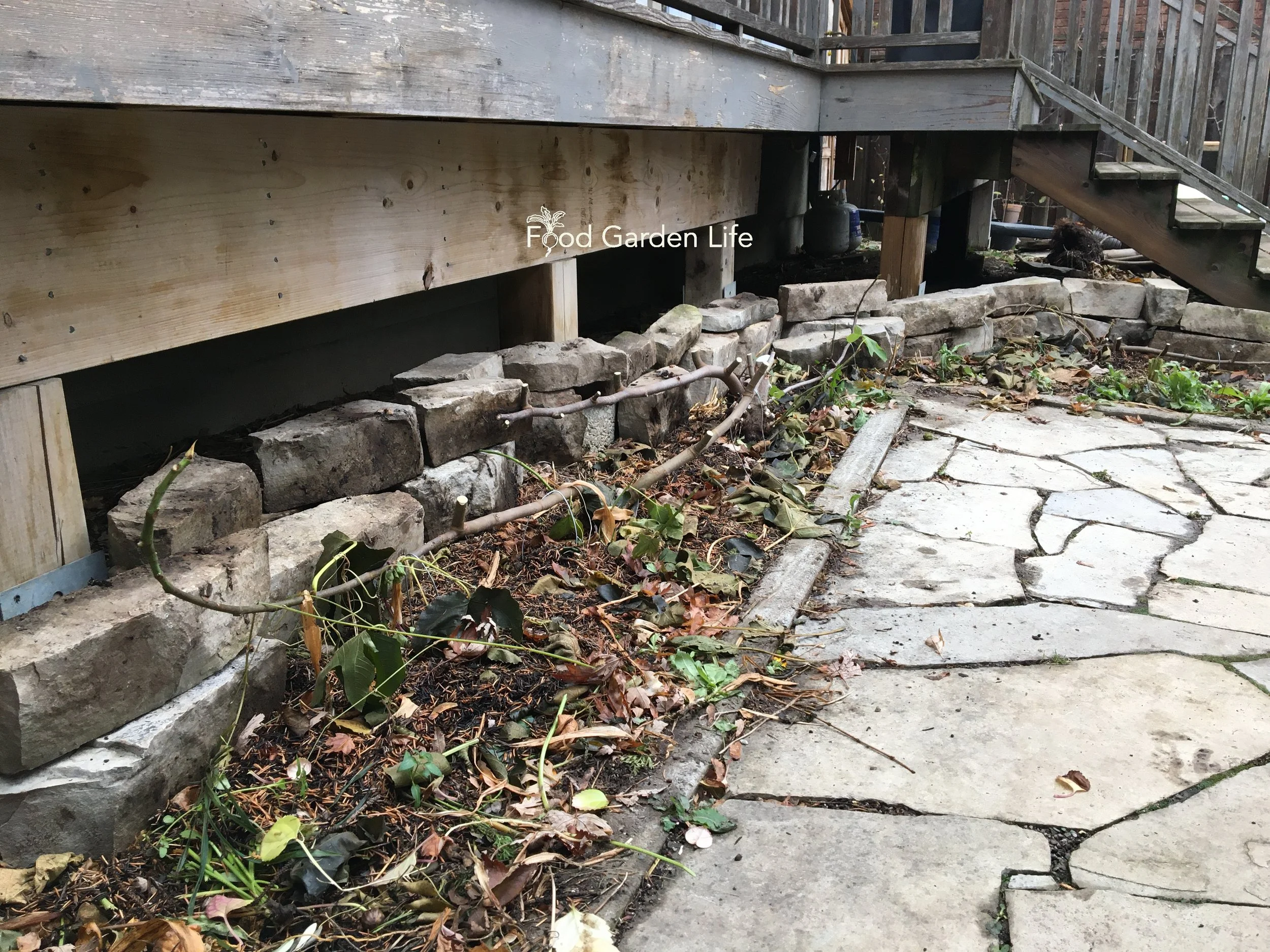
Low stone wall next to cordon fig trees.
Fig Varieties for Fig Espalier
Choosing the right fig variety is important for success with fig cordons in cold climates.
Here’s what we’re looking for a fig variety suited to low-cordon espalier:
A consistently heavy main crop
An early-ripening main crop
Tolerance of harsh pruning (my ‘Ronde de Bordeaux’ was not pleased about it)
I’m still experimenting with this, but my best results have been with the variety Natalina. Tune in to my chat with Jonathan Bates, below, to hear what he does with cordon figs. He has good results with the varieties ‘Florea’ and ‘St. Rita.’
(If you’re using this method and have a variety that does well, e-mail me—I’d love to hear about it.)
Hints and Tips
While you’re first forming the horizontal cordons, tie them to horizontal stakes so that they’re straight. I use bamboo stakes and sisal twine, which decomposes within a year.
If fig trees are growing quickly, the tie might constrict the branch—so check a couple of times over the summer to make sure the branch hasn’t outgrown the tie.
To pin down the cordon until it’s thickened and stays in place, use metal hoops. I make them from 14-gauge galvanized wire, the same wire that I used to create a framework for my espalier apples. Pieces of metal coat hanger work nicely too.
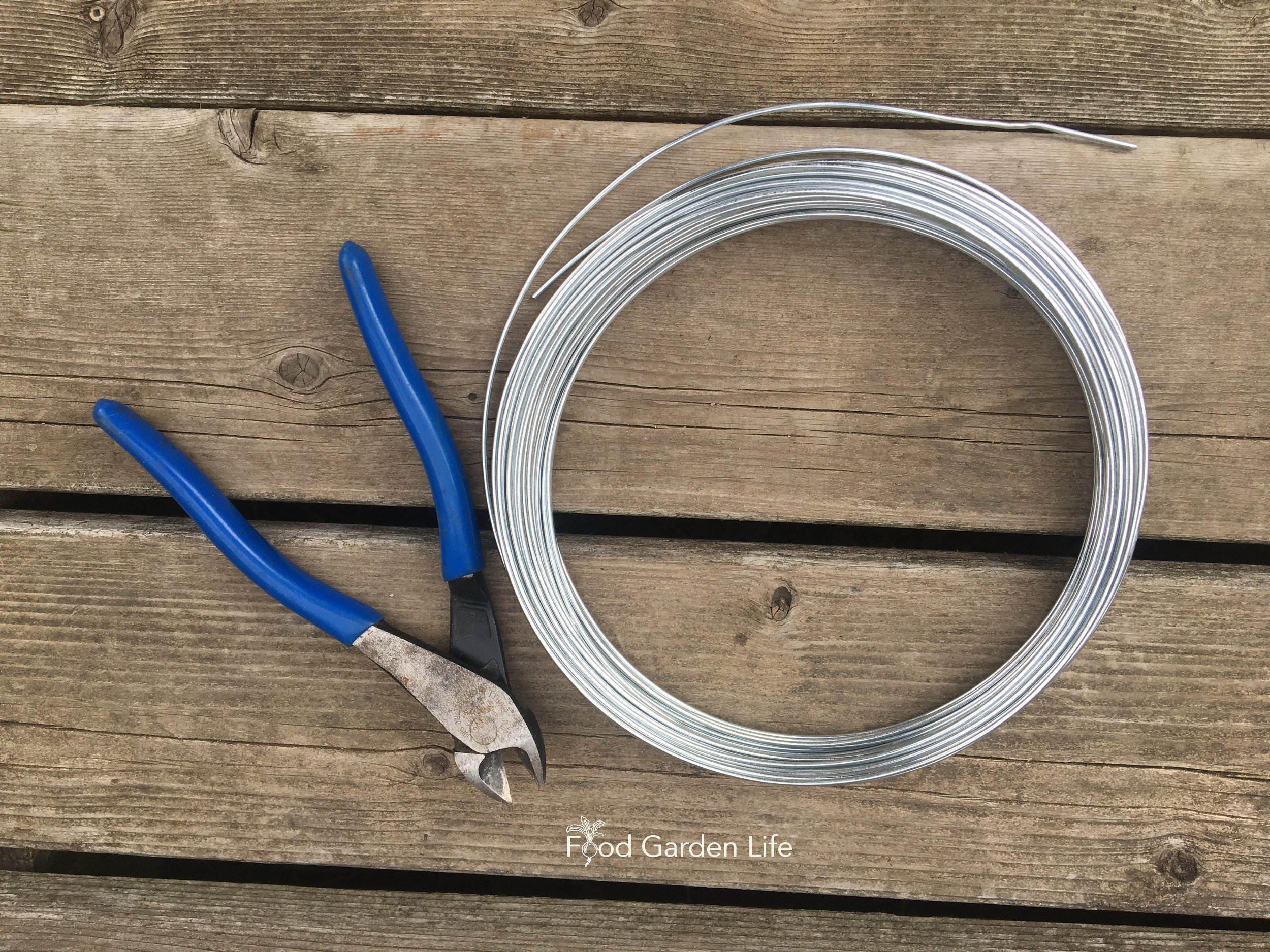
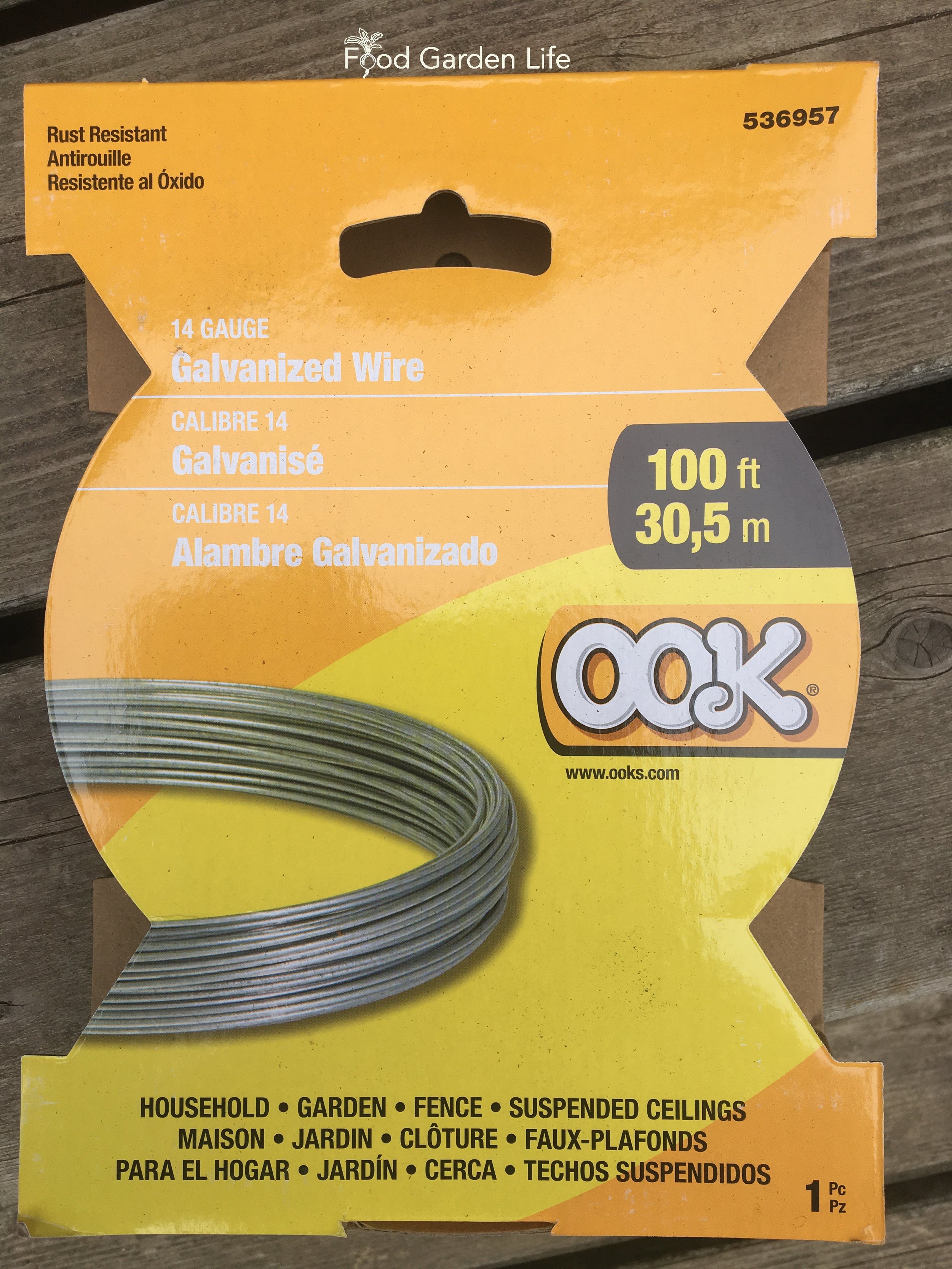
FAQ Fig Tree Espalier
Pin this post!
I accidentally broke a branch I was trying to bend. What should I do?
All art is recovery from the first stroke. And with pruning, we recover by encouraging and training new growth to do what we want. Be patient, and the fig will send out a replacement shoot that you can train to go where you want it to.
(one year the squirrels chewed off ALL the branches on my new apple espalier. I was furious! But the tree sent out new branches, and now you wouldn’t even know!)
Can I prune my fig tree even more, right back to the roots, so it's even more easy to cover for the winter?
That would sure make overwintering easy. That harsh a pruning is too much of a setback for a cold-climate fig tree. There probably won’t be enough time in a short season for new branches to ripen figs. (There will be new growth, and it will have figs…but they probably won’t ripen in a cold climate.) Retaining that horizontal fig cordon through winter means the pruning isn’t so much of a setback—and the new growth it sends out will produce figs that ripen.
Hear a Chat with a Greenhouse Grow who has Fig Cordons
Tune in to this chat with Jonathan Bates at Food Forest Farm in New York State. To grow figs in his cold growing zone, near the finger lakes, Bates grows horizontal cordons low to the ground, within a greenhouse.
Keep Growing Figs
Looking for more cold-climate fig-growing ideas? Visit the fig home page to browse articles about varieties, pruning, propagation, ripening, winter protection, and more.
Grow Figs Where You Think You Can’t
My revised and expanded fig book is a practical guide to growing figs in pots and cold climates—from choosing varieties and pruning to ripening fruit and conquering winter.
Find This Helpful?
Enjoy not being bombarded by annoying ads? Appreciate the absence of junky affiliate links for products you don’t need?
This site is reader supported. If it has helped you in your food-gardening journey, you can give us a high-five below. Any amount is welcome.
Fig Trees in Canada: Ontario Fig Collector Shares Top Tips
Ontario fig collector Adriano Ferreira’s top fig-growing tips.
By Steven Biggs

Tips for growing figs in Southern Ontario and beyond, from Adriano Ferreira.
Adriano’s Fig-Growing Tips
In 2009, I wrote an article for Edible Toronto magazine featuring two “fig fetishists” here in Southern Ontario, Adriano Ferreira and Peter Vicano.
In a follow-up chat with Adriano—my fig mentor—I asked him to give me his top fig-growing tips so I could share them here.
He said he’d only share if I spoke to him in Portuguese. I managed to say, “bom dia,” and that was about it! He graciously shared these tips.
If you’re wondering how to take care of a fig tree in Southern Ontario—in any cold climate—keep reading for Adriano’s tips.
Adriano Ferreira’s Top Tips
Soil for Fig Trees
Ferreira’s preferred soil for fig trees contains of one-third peat-based potting mix, one-third composted manure, and one-third compost, with some added perlite, dolomitic limestone, and vermiculite.
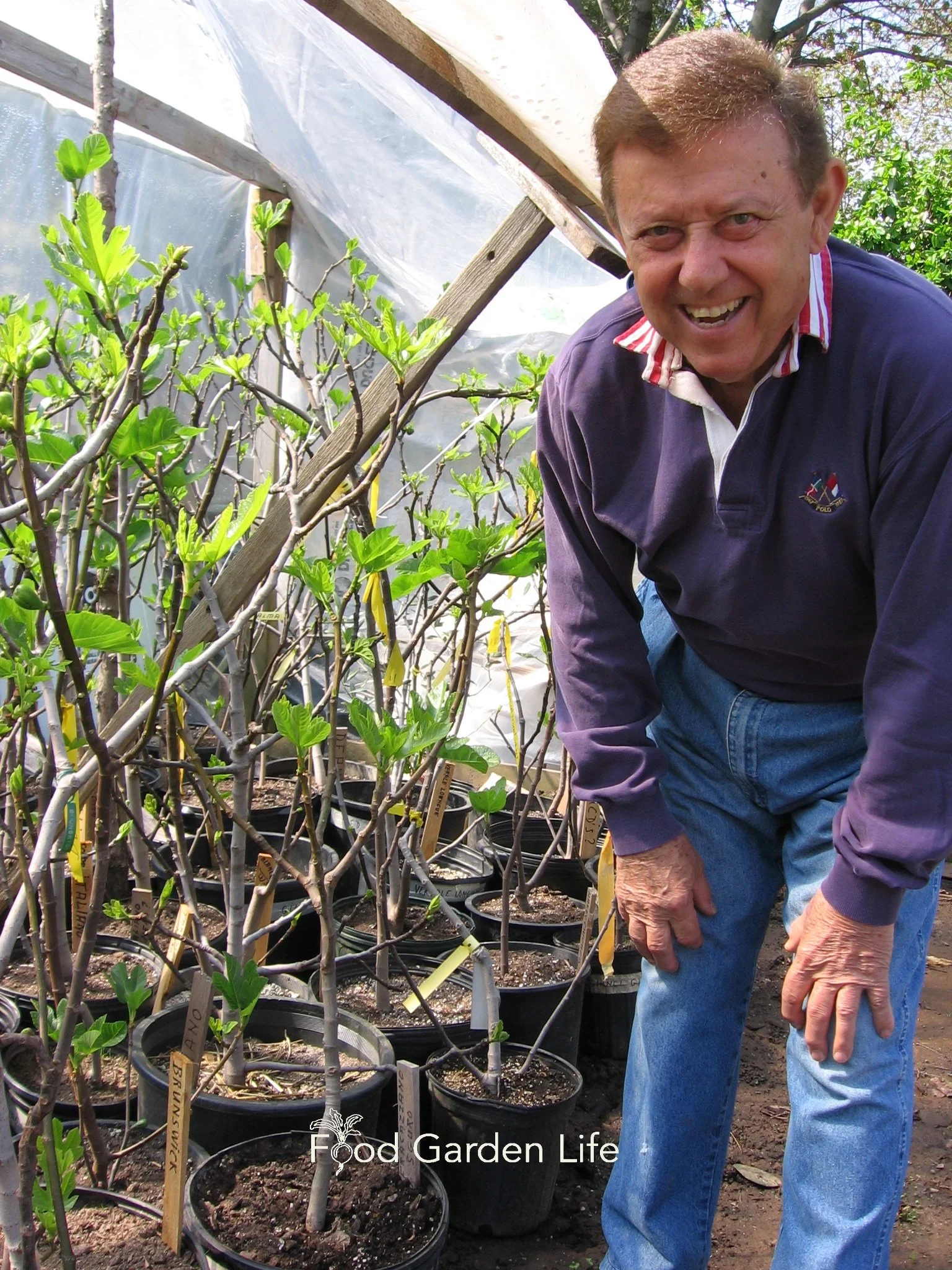
Adriano Ferreira shared his top fig-growing tips with me
Repotting Fig Trees
Repot fig trees every three to five years, drilling extra drainage holes along the bottom couple of inches of the pot.
Watering and Feeding Figs
During the summer, potted figs need lots of water, but when dormant or growing slowly, over-watering is the most common cause for fig trees dying.
If water doesn’t soak into a rootbound potted fig tree, insert a large nail into the soil, then fill the resulting hole with sand. This makes a channel for water to enter the root ball.
For feeding fig trees, Ferreira uses manure tea and fruit or tomato fertilizer.
Find out more about watering dormant potted fig trees.
Pruning Fig Trees
Train side shoots to grow horizontally, which encourages fruit formation.
Grow in the form of multi-stemmed fig bushes instead of trees for ease of maintenance and increased fruiting.
Get Your Fig Trees Through Winter—and Harvest Figs
Growing figs where winters are cold takes a bit of creative thinking.
In Fig Camp and the self-paced Fig Masterclass, I explain how to grow figs in pots or in the ground, extend the growing season, ripen more fruit, and protect your trees through winter.
Fig Ripening and Harvest
Embryonic figs are formed in late summer and carried through winter on dormant branches as bumps. These swell in spring with warm temperatures. Be careful of frost, which can damage the little figs once they begin to grow.
In September, remove fig fruit that are too small to ripen, redirecting energy to those that will.
Harvest when soft and the skin shows the impression of your fingerprint. Figs wilt at the neck and droop under their own weight. Splits and cracks often appear when ripe. If you pick figs too early you’ll see white sap.
Find out how to ripen figs faster in this this fig-ripening guide.
Overwintering Fig Trees
Pick off any fruit remaining after leaves drop off in the fall. These unripe figs will not ripen.
Bend down boughs of in-ground, multi-stemmed trees, then build an A-frame of wood and Styrofoam over the top. See a picture of Adriano’s A-frame in this article about fig tree winter protection.
For potted trees, lay pots on their side in wooden boxes (2-inch wide boards, forming a wall 12 to 18 inches high.) Cover the top with plywood, Styrofoam, and a tarp.
In partially heated area such as sunrooms, water only occasionally. Dormant figs don’t require light.
Keep Growing Figs
Looking for more cold-climate fig-growing ideas? Visit the fig home page to browse articles about varieties, pruning, propagation, ripening, winter protection, and more.
Grow Figs Where You Think You Can’t
My revised and expanded fig book is a practical guide to growing figs in pots and cold climates—from choosing varieties and pruning to ripening fruit and conquering winter.
Find This Helpful?
Enjoy not being bombarded by annoying ads? Appreciate the absence of junky affiliate links for products you don’t need?
This site is reader supported. If it has helped you in your food-gardening journey, you can give us a high-five below. Any amount is welcome.
How to Ripen Figs Faster in a Cold Climate
Got Unripe Figs? Find out How to Ripen Figs Faster in a Cold Climate
By Steven Biggs
Why Won’t My Figs Ripen?
Lots of Figs...Unripe Figs
“Help! I have lots of unripe figs. My figs aren’t ripening!” I start to get messages about figs not ripening in late summer.
After a summer of caring for a fig tree, people want more than bullet-hard green figs. There’s nothing more disheartening that frost arriving before you’ve tasted any of your homegrown ripe figs.
For gardeners in cold climates (and moderate maritime climates such as the Pacific Northwest) figs not ripening early enough is a common challenge.
Luckily, there are ways to get your figs to ripen earlier. Keep reading to find out how to ripen figs faster.
Reasons Figs Don’t Ripen in Cold Climates
There are a few reasons figs don’t ripen early enough in places with short summers or mild summers.
A late start in spring
Poor choice of fig varieties
Not enough heat
In this post, we’ll look at adding heat to speed up the ripening process, so you can enjoy fresh figs.
Get more fig-ripening ideas in my post 7 Tips to Boost Northern Fig Tree Harvests.
How to Ripen Figs
To Ripen Unripe Figs, Focus on Heat
In areas with short summers extra heat is one way to get figs to ripen faster—before winter arrives.
Extra heat is also helpful in areas that have cool summers, like the Pacific Northwest.
To give a fig tree extra heat there are a couple of simple things gardeners can do:
Grow the fig tree in the warmest possible location
Capture heat around the fig tree
Let’s first explore location—and then think about heat-capture season-by-season.
Choose a Warm Location
Choose a warm location. More heat means more figs ripening during a short season.
Place a potted fig plant somewhere warm, such as a surface that catches and releases heat from the sun:
On a dark-coloured driveway or paved area
Next to a brick or stone wall
When planting fig trees in the ground, pick somewhere warm:
A south-facing exposure next to a wall
Next to a sunny driveway
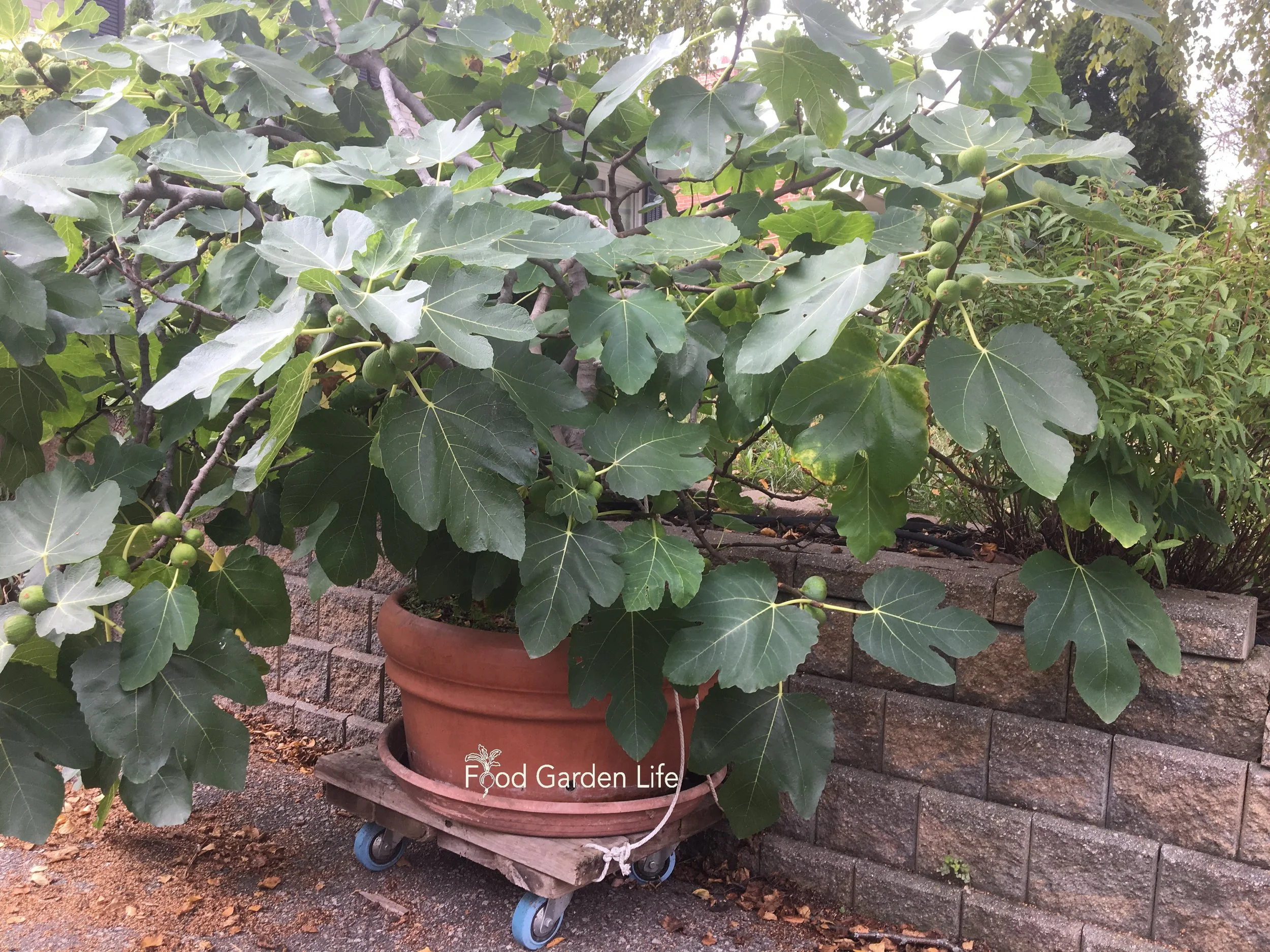
My neighbour Natalie has a fig tree on a driveway, next to a stone wall. This is a warm spot that speeds up ripening.
Extra Heat in Spring
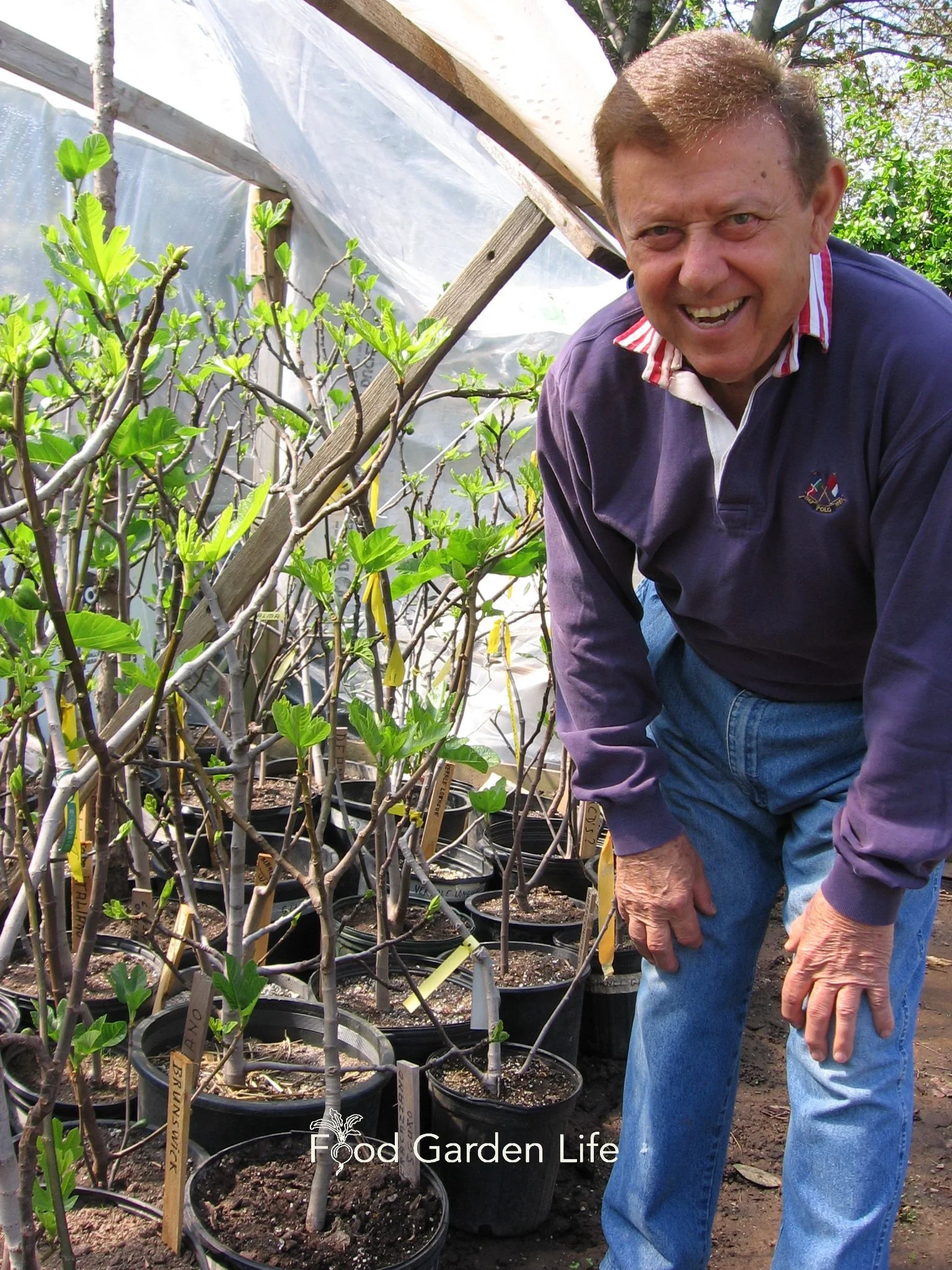
My fig mentor Adriano, next to the temporary greenhouse he used to get his potted fig trees growing earlier in the spring.
Extra heat in the spring helps to get your fig tree growing sooner…and that means it will produce figs sooner.
Getting fig trees growing early in the spring is always a balancing act. That’s because once they start to grow, the tender growth can be damaged by frost.
A greenhouse or temporary shelter is one way to provide extra heat in the spring to get dormant fig trees growing, while still sheltering them from frost.
Here are a couple of things I do in my garden to give fig trees extra heat in the spring:
I have some low-growing fig trees below ground level, in a trench. All I need to do to protect them for winter is cover the trench. I cover it with a clear sash—so as sunny spring days arrive, I can let light into the trench to warm things up earlier.
I have some fig trees shaped as ground-level cordons (one horizontal stem, a couple of inches above the ground). I can just pile leaves or straw over them for winter protection. Next to these cordons I have a low, south-facing stone wall. In spring, when I uncover these figs, I can lean an old glass door over top—with the stone wall at the back—to give the dormant step-over figs a warm space (The stone wall absorbs heat by day, releasing it by night.)
Boost Summer Heat
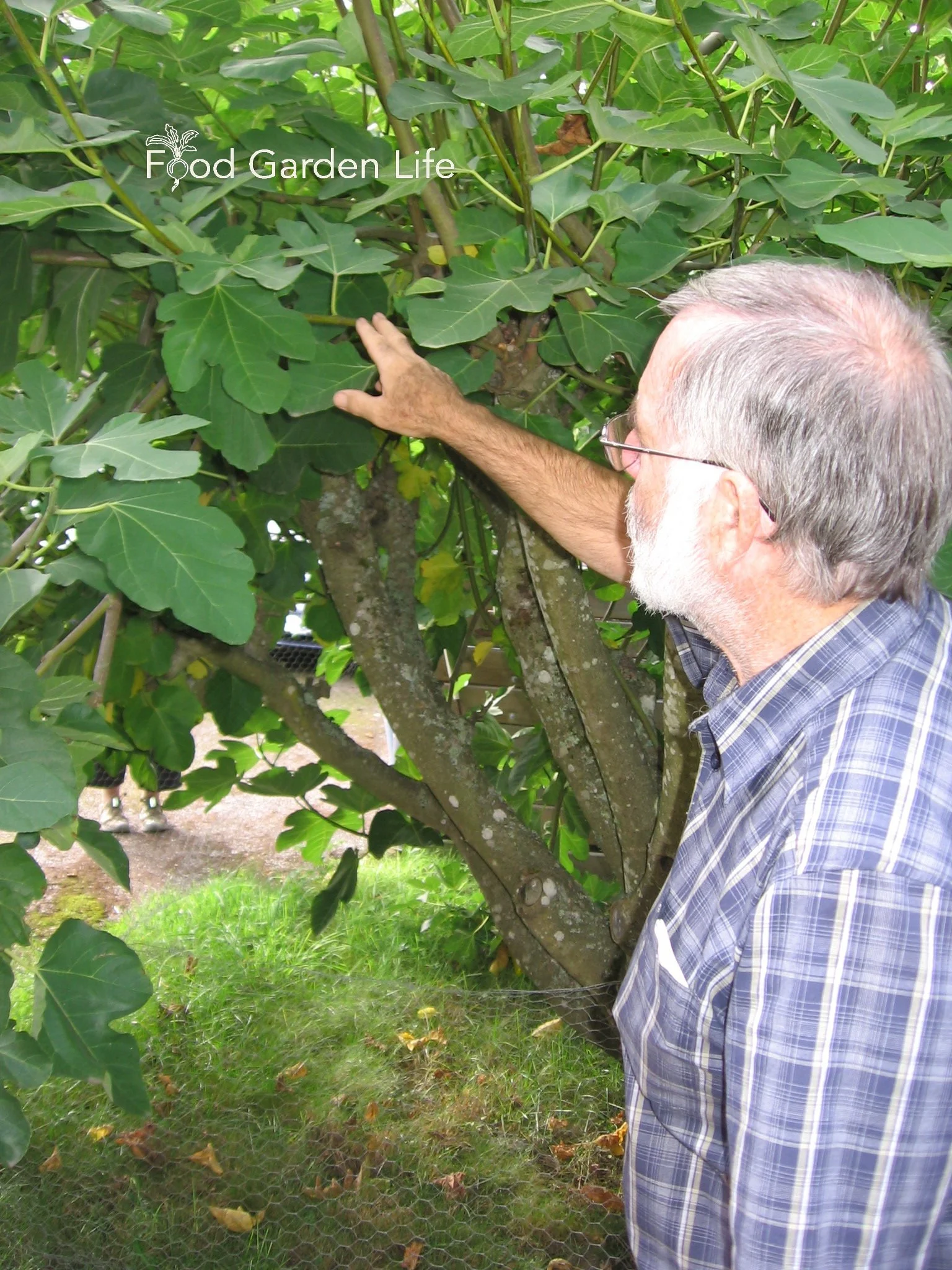
Bob Duncan pointing to a fig tree at his nursery. His climate is warm enough over the winter that fig trees don’t need protection…but cool summers mean main-crop figs don’t ripen well.
Here in Toronto I’m not worried about boosting summer heat. We have cold winters—but we also have hot summers.
It’s not like that everywhere.
Giving a fig tree extra heat over the summer is important in areas with cool summers, such as the Pacific Northwest, or other maritime climates.
Bob Duncan runs Fruit Trees and More nursery in Sidney B.C. He has mild winters, so his figs don’t need any protection over the winter. But he also has mild summers.
The mild summers mean that ripening main-crop figs (figs that form on wood from the current season) is challenging. Most fig growers in the Pacific Northwest, he says, focus on varieties the form a breba crop of figs (the early crop that forms on wood from the previous season.)
Find out more about breba figs.
Bob built a greenhouse with open sides to jack up summertime temperatures. The higher temperature within the greenhouse ripens main-crop figs.
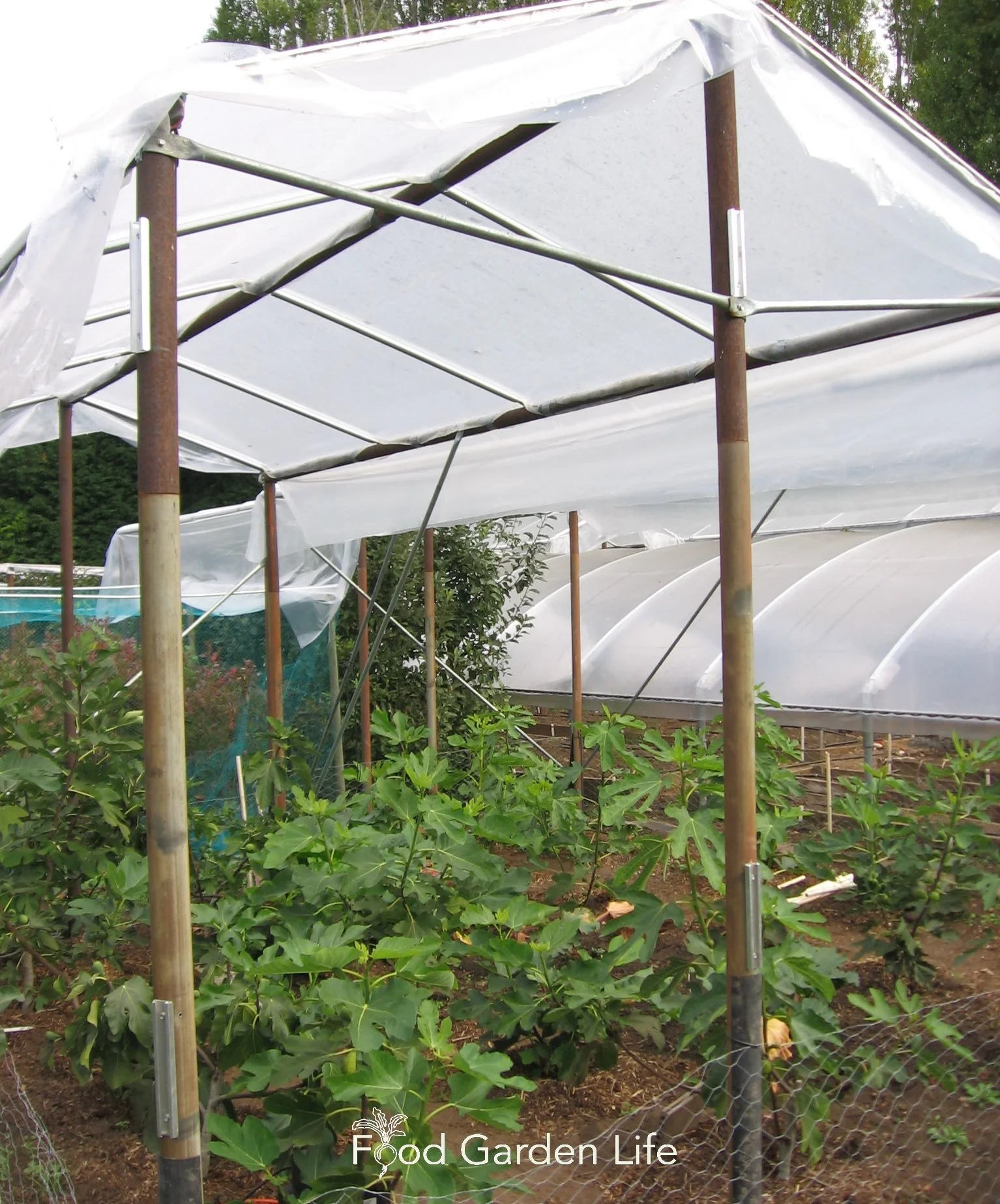
Open-sided greenhouse. It’s not for winter protection—it’s to make conditions warmer over the summer.
Get Your Fig Trees Through Winter—and Harvest Figs
Growing figs where winters are cold takes a bit of creative thinking.
In Fig Camp and the self-paced Fig Masterclass, I explain how to grow figs in pots or in the ground, extend the growing season, ripen more fruit, and protect your trees through winter.
Maintain Fall Heat
As fall arrives, nights are cooler and ripening slows.
Extra heat in the fall can speed up ripening of figs while also prolonging the ripening window.
To give a fig tree more heat in the fall, a temporary, unheated greenhouse works well. It also protects a fig tree from mild frosts and extends the harvest period by a couple of weeks.
Below, Joe from JCJ Acres has metal hoops over his figs, but only installs a tarp to protect the fig trees and ripen figs faster in the fall.
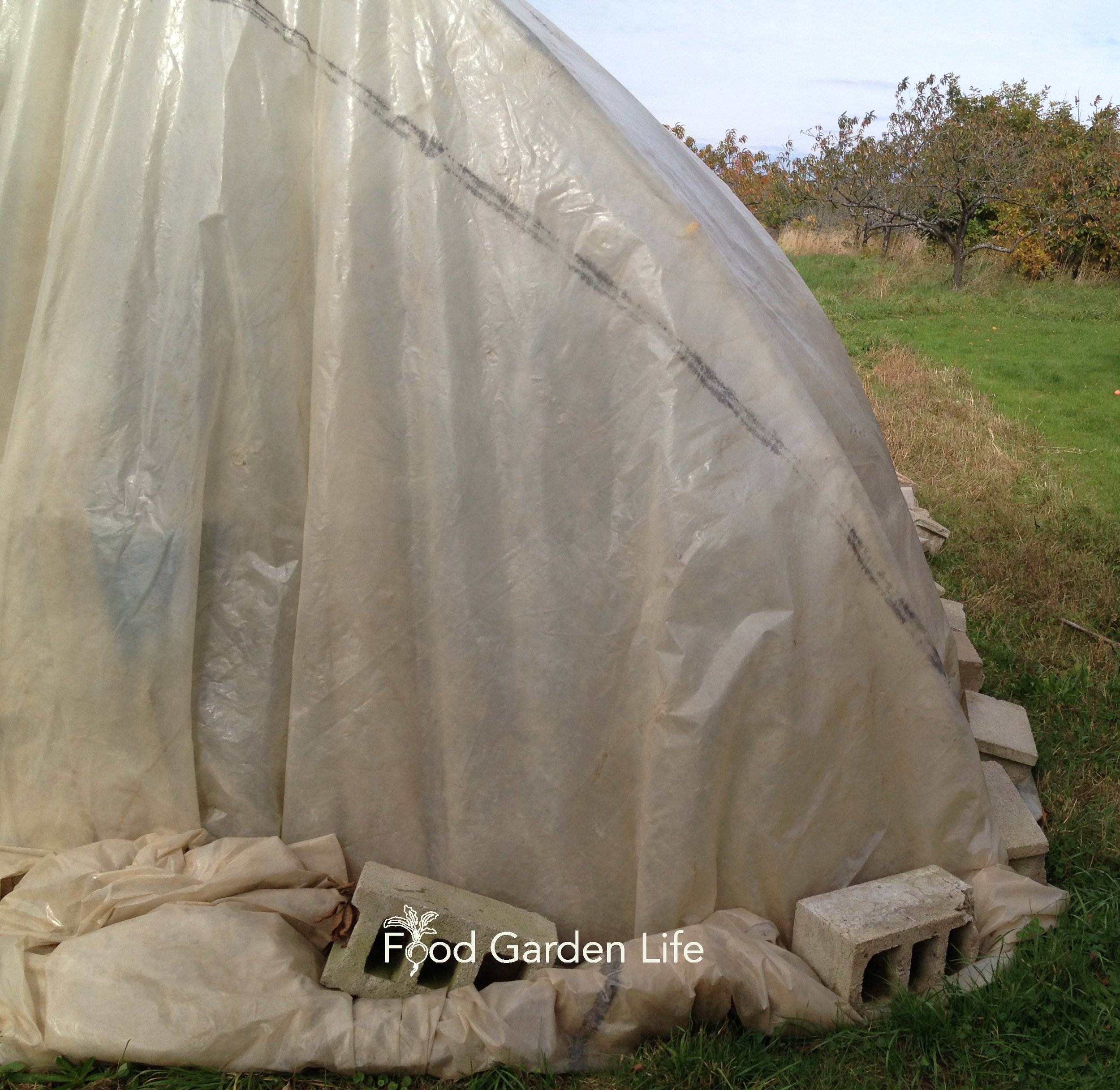
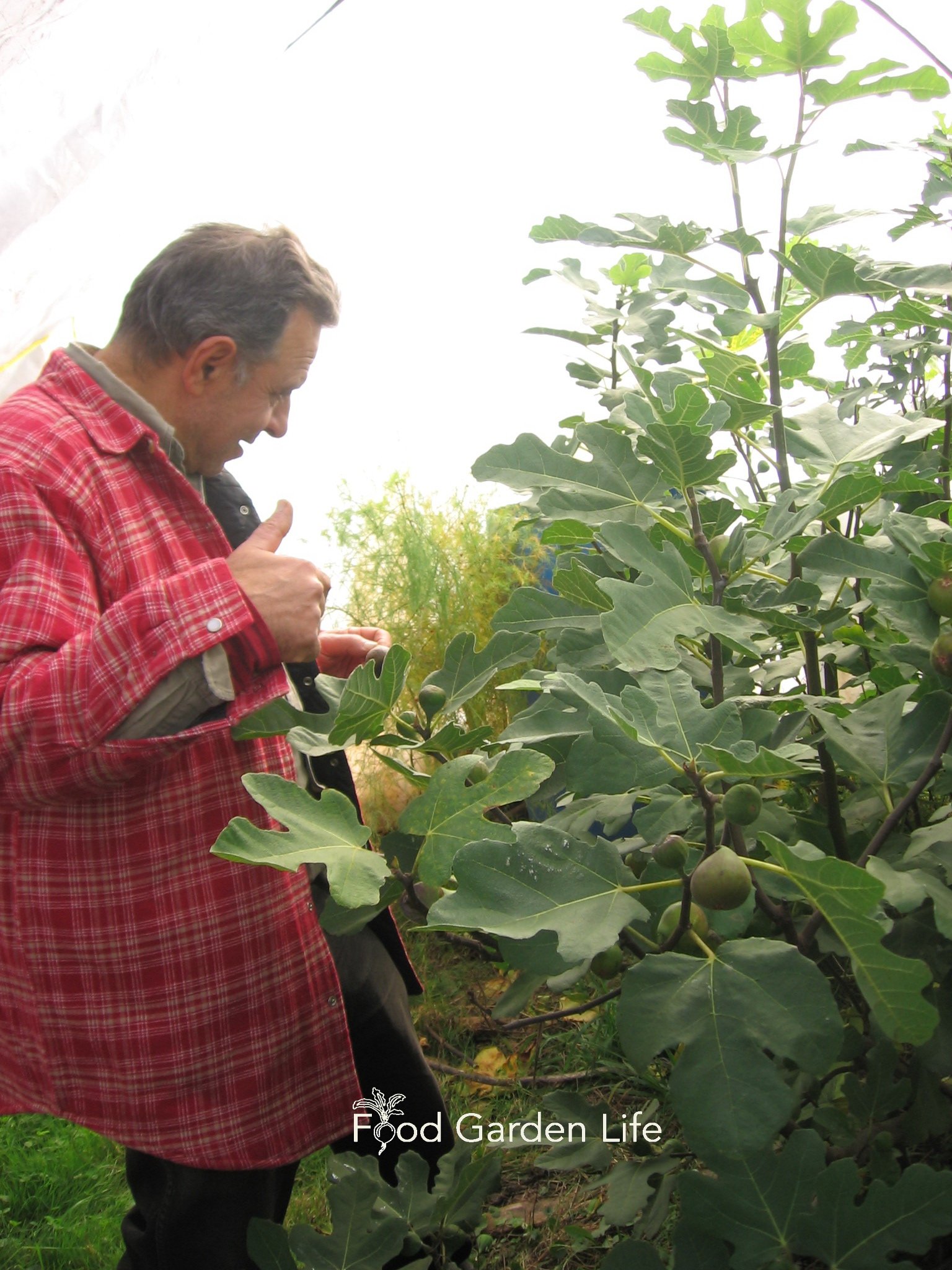
Other Ways to Ripen Figs Faster
Get more ideas to ripen figs faster in my post 7 Tips to Boost Northern Fig Tree Harvests.
FAQ: Ripen Figs Faster
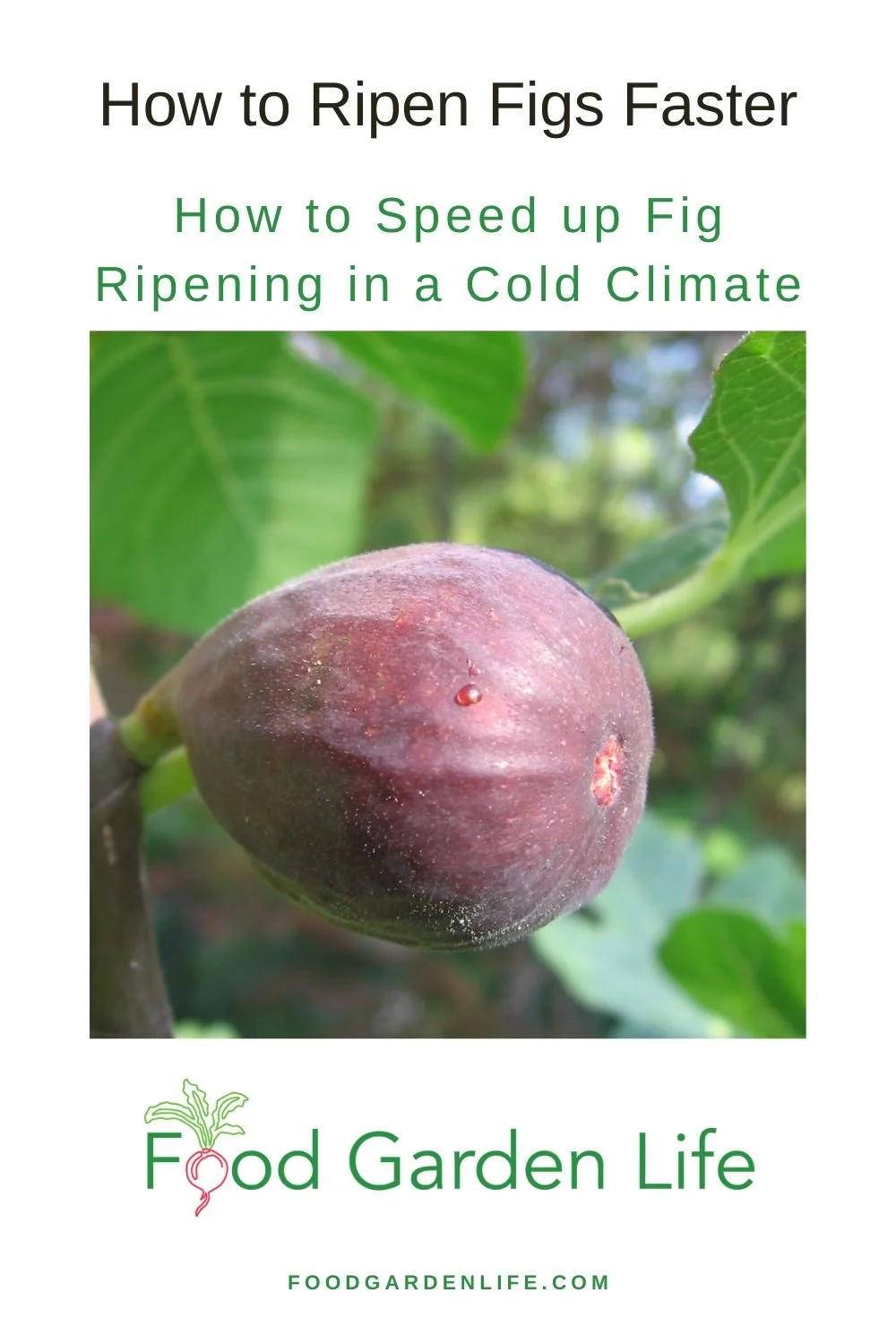
Pin this post!
Will figs ripen off the tree?
No. That’s why a perfectly ripe fig picked straight from the tree is better than a store-bought fresh fig. Commercially produced figs are picked before optimal ripeness—so that they have a longer storage life.
Which months do figs ripen?
Here in Toronto, my breba figs ripen in late July and August. The main-crop figs ripen August until the trees go dormant, usually late October.
But when your figs will ripen depends on where you are, the weather—and the variety you’re growing.
What do ripe figs look like? When are figs ripe?
Here are tips to help when harvesting figs. Tell-tale signs that a fig is ripe are:
A soft neck, causing the fruit to droop
The fig retains the impression of fingerprints when gently squeezed
A drop of liquid coming out of the “eye” of the fruit (but not with all varieties)
If you pick figs and see white sap, you haven't let them ripen fully.
What does an unripe fig taste like?
The unripe fruit is not as soft and silky as ripe fruit. And the unripe figs are not nearly as sweet.
Are ripe figs green?
Sometimes. But figs come in many colours.
Here’s a guide to fig varieties for cold climates.
What can you do with unripe figs?
You can’t ripen them. But if they’re nearly ripe, I like to roast them. Find out how I use unripe figs. (Delicious!)
Video on Ripening Figs Faster
Keep Growing Figs
Looking for more cold-climate fig-growing ideas? Visit the fig home page to browse articles about varieties, pruning, propagation, ripening, winter protection, and more.
Grow Figs Where You Think You Can’t
My revised and expanded fig book is a practical guide to growing figs in pots and cold climates—from choosing varieties and pruning to ripening fruit and conquering winter.
Find This Helpful?
Enjoy not being bombarded by annoying ads? Appreciate the absence of junky affiliate links for products you don’t need?
This site is reader supported. If it has helped you in your food-gardening journey, you can give us a high-five below. Any amount is welcome.
Guide to Rooting Fig Cuttings: Simple Steps to Propagate Fig Trees
Not sure how to root fig cuttings? Get these simple instructions to successfully propagate fig trees.
By Steven Biggs
How to Propagate a Fig Tree
Find out how to propagate a fig tree with cuttings.
My friend Dave recently asked me to help him find a home for a couple dozen potted fig trees. He had more plants than he needed…and not enough space in his garage to store them for the winter.
Dave’s like me: He needs another fig tree like he needs a hole in the head.
But, like me, he just can’t help rooting cuttings.
He grew all those extra fig plants from cuttings. From little sticks.
If you’re interested in growing figs, propagating fig trees from cuttings is a simple way to get more fig plants, and to share and trade great fig varieties.
This post gives you easy-to-follow tips for rooting fig cuttings.
Why Propagate Figs with Cuttings
How Difficult is it Rooting Figs?
All we’re doing is taking pieces of stem—cuttings—and helping those bits of stem grow roots to make a new fig tree.
Rooting fig cuttings is very doable for new gardeners. You don’t need a complicated setup or fancy accessories. (See Supplies to Root Fig Cuttings, below.)
Many people are familiar with how easy it is to grow watercress or mint from the grocery store. Put them in water to keep them fresh and, before you know it, they’ve made roots. Figs aren’t quite that easy to root, but rooting fig cuttings is much easier than most woody plants.
Limited Choice at Garden Centres
Another reason to propagate with fig tree cuttings is that the selection of fig varieties at garden centres is usually limited.
Once you figure out (sorry about the pun) how to grow fig tree cuttings, you have access to a lot of very delicious and early-ripening fig varieties.
Cuttings make it easy and inexpensive to shop (or trade) for great varieties.
Want to find a good fig tree variety for cold climates? Here’s a guide to cold-climate fig varieties.
When: Best Time to Root Fig Cuttings
I mostly root cuttings over the winter. In fall, I prune my dormant fig trees after they’ve dropped their leaves. I save the branches I’ve pruned off to make cuttings.
After I cut the branches into pieces to make cuttings, I store these cuttings somewhere cool until I’m ready to grow them. (See Fig Cutting Size, below.)
If you’re new to this, I suggest you start with cuttings you take from a dormant tree because they are woodier—and these woodier cuttings are a bit easier to deal with than tender green ones in summer (called “softwood” cuttings.)
Find out more about how to prune a fig tree.
Where to Root Fig Cuttings
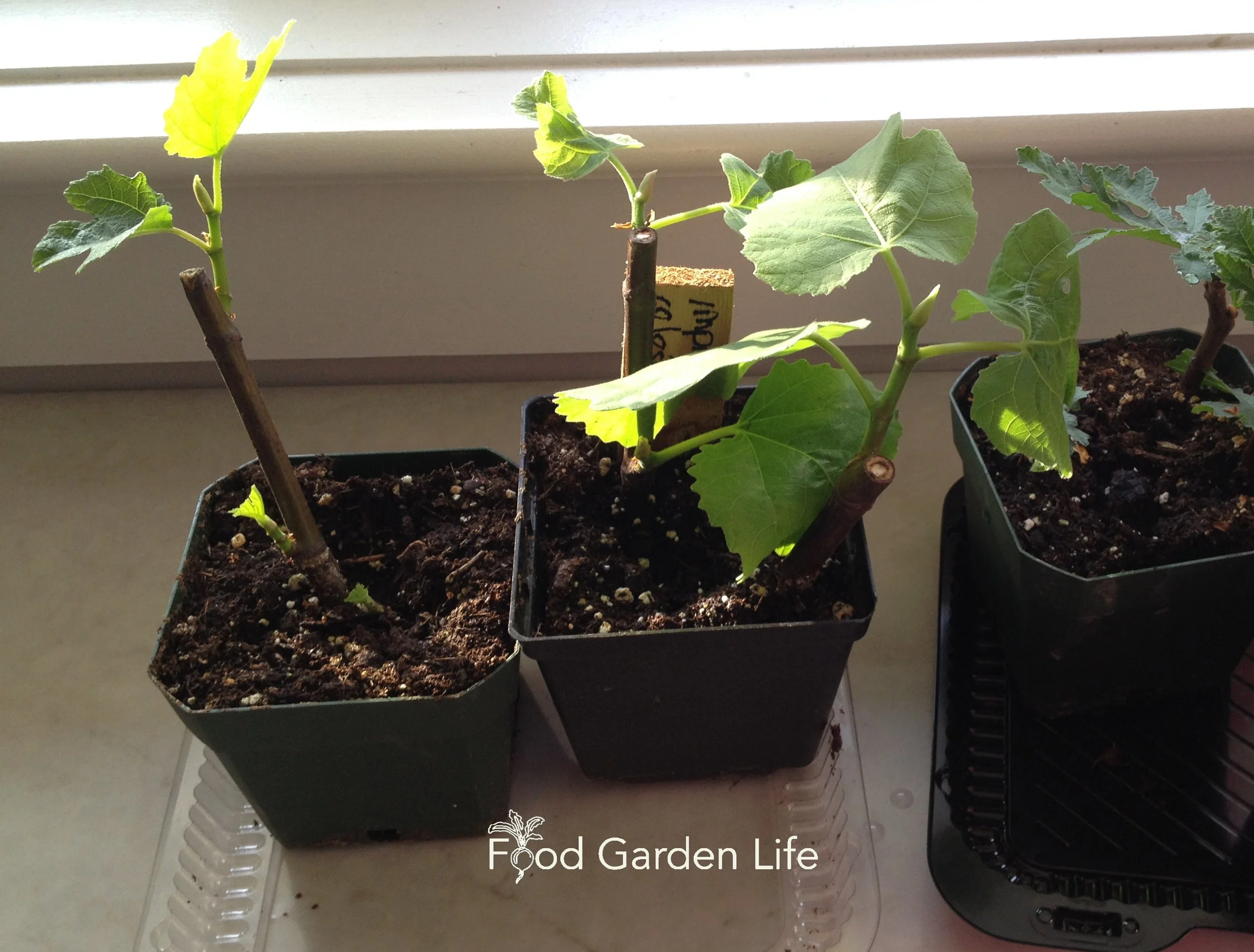
Pictured are young fig plants near my kitchen window. I rooted them from cuttings under artificial lights during the winter. (They would have rooted well beside a window, too.)
If you have a space set up for propagation, that’s great. But don’t feel you need an elaborate setup if you don’t.
When I started rooting figs, it was under my fluorescent lights that I use to start tomato seedlings.
I’ve rooted cuttings on my kitchen counter, in front of the window.
I’ve rooted them on my dining room floor—by the window. (My wife gave me a dirty look when I lined up a convoy of little pots in the dining room!)
I’ve rooted figs in a pot, under a bush.
When it comes to the “where,” you have options. Indoors. Outdoors. Living space. Utility area.
Let’s think about this in a bit more detail…
Indoors
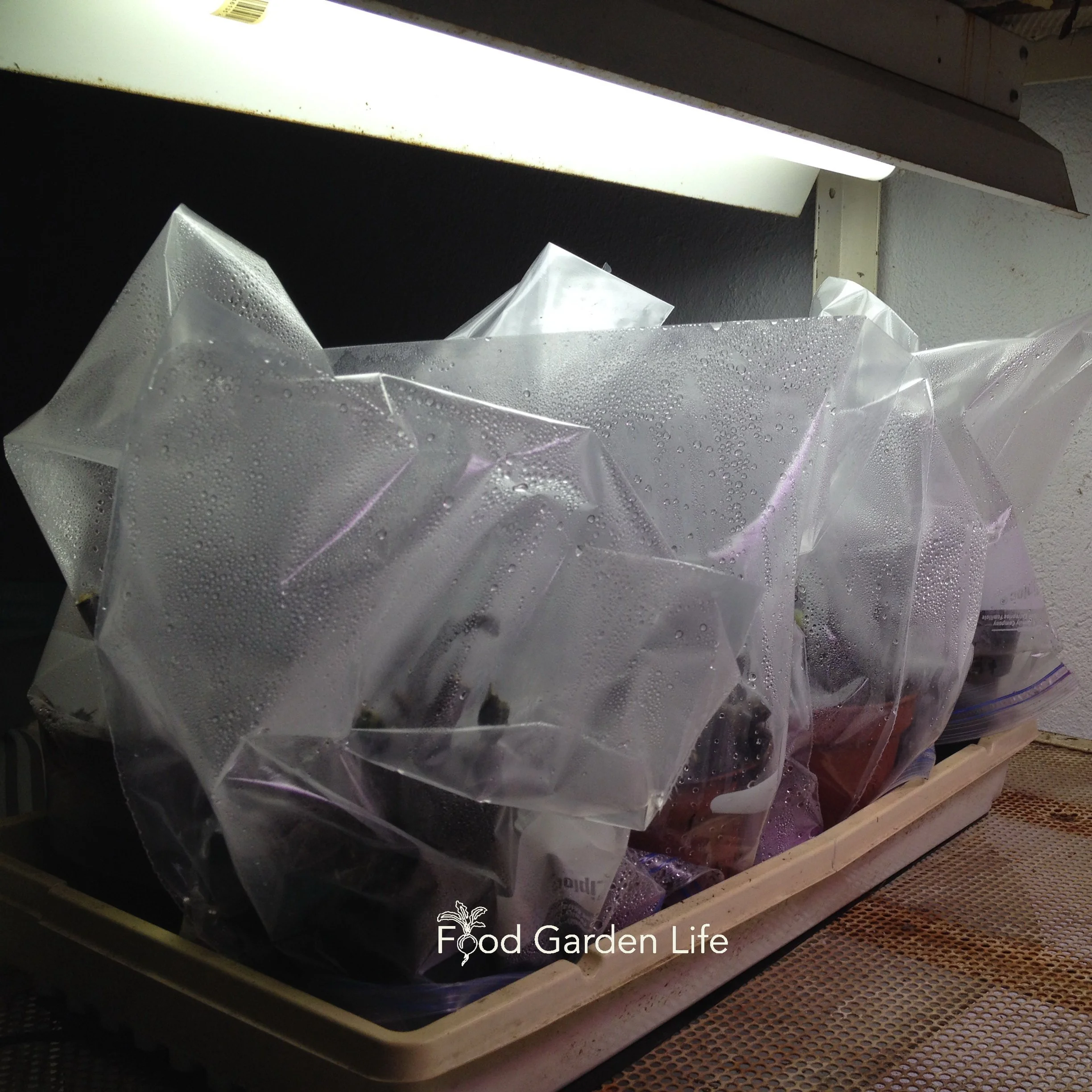
Lots of fig gardeners start cuttings indoors in the winter or early spring, using dormant cuttings. That’s because there’s frenzied trading and buying of dormant cuttings that goes on in the fall…and people can get started with fig propagation over the dormant season.
As I write this it’s late fall, and I have cuttings in my fridge.
These cuttings are shoots that I removed when I trimmed my dormant fig trees. I wrapped them in damp paper towels, then placed them in a sealed plastic bag.
When I fire up my grow lights in January, I’ll stick some of those cuttings in pots, and root them.
Thinking about where to start your cuttings, here are a couple of helpful things:
Root your cuttings somewhere you’ll see them and remember to check on them regularly
Choose a space with room temperature or warmer (the warmer, the faster!)
Outdoors
When you grow indoors, you can control the conditions and get a good success rate. Outdoors is different. You have less control…but it’s simple.
But that doesn’t mean you can’t grow cuttings outdoors. If I prune or accidentally break a branch in the summer, I’ll pot up the cutting and put it somewhere shady.
Even more simple is to stick cuttings straight into the garden.
(If you have leftover dormant cuttings in your fridge when spring arrives, instead of throwing them out, stick them somewhere protected, in the garden.)
Cuttings: Fig Cutting Size
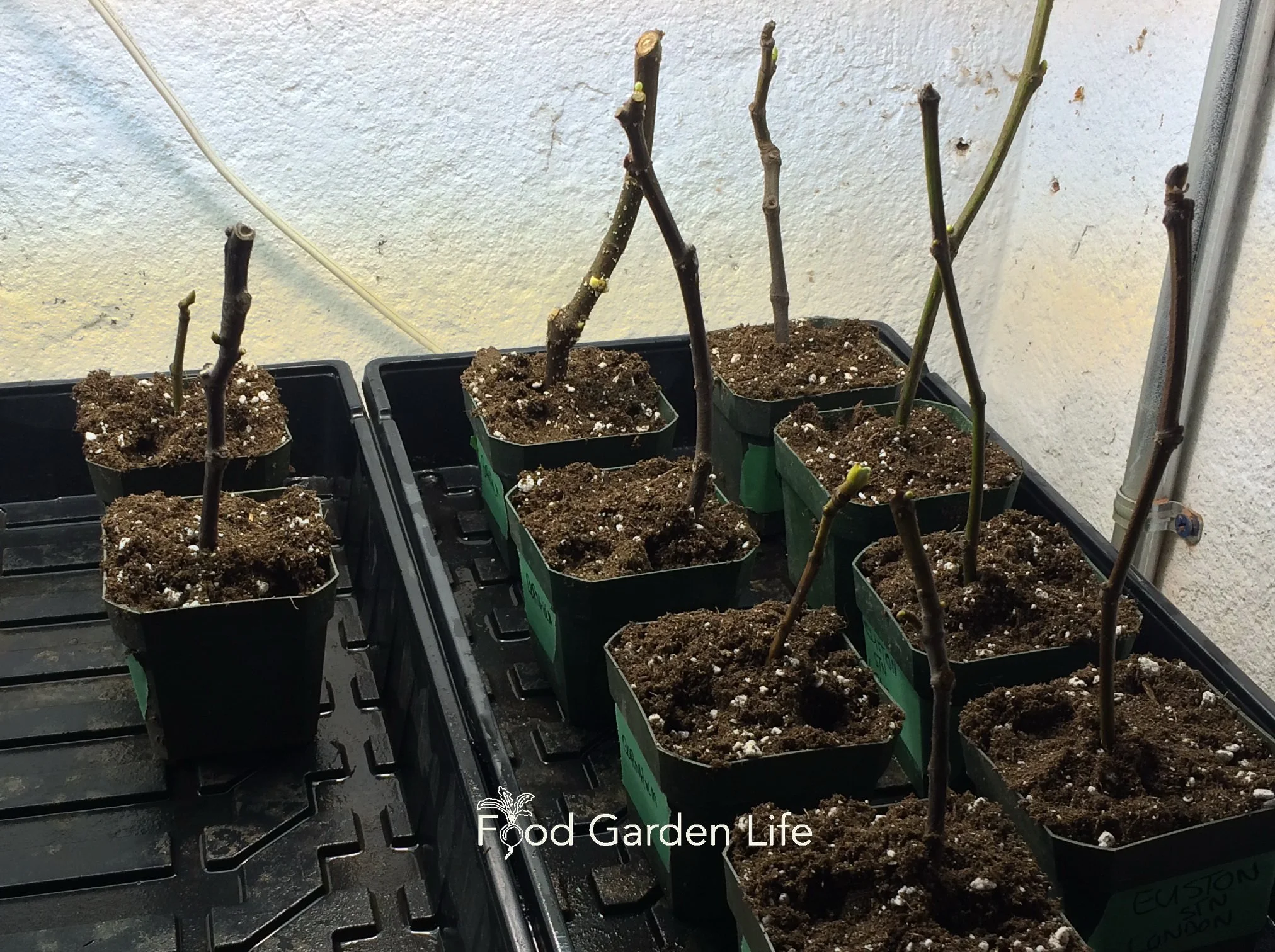
I aim for a cutting length of at least 6”
For starters, make a clean cut with pruning shears.
I usually make cuttings about 6” long, so that they contain at least 3 nodes (the bumps where the leaf was attached to the stem). But it’s not an exact science. Shorter or longer is usually fine.
The longer the cutting, the more stored energy it has to help it along the way
But if you have only one stem piece of a special variety, you’ll want to decide whether you should make one larger cutting—or two smaller ones (fig insurance!)
(I chatted with a fig collector who travelled a lot in Mediterranean countries. He was a non-smoker. But he’d always buy a packet of cigarettes in his travels. When he found a fig tree he liked, he’d make cuttings, and prune them to the size of a cigarette. Then he’d remove cigarettes and replace them with cuttings. So you can imagine that his cuttings were small. But that’s he got them through customs.)
What About Trimming Off Leaves?
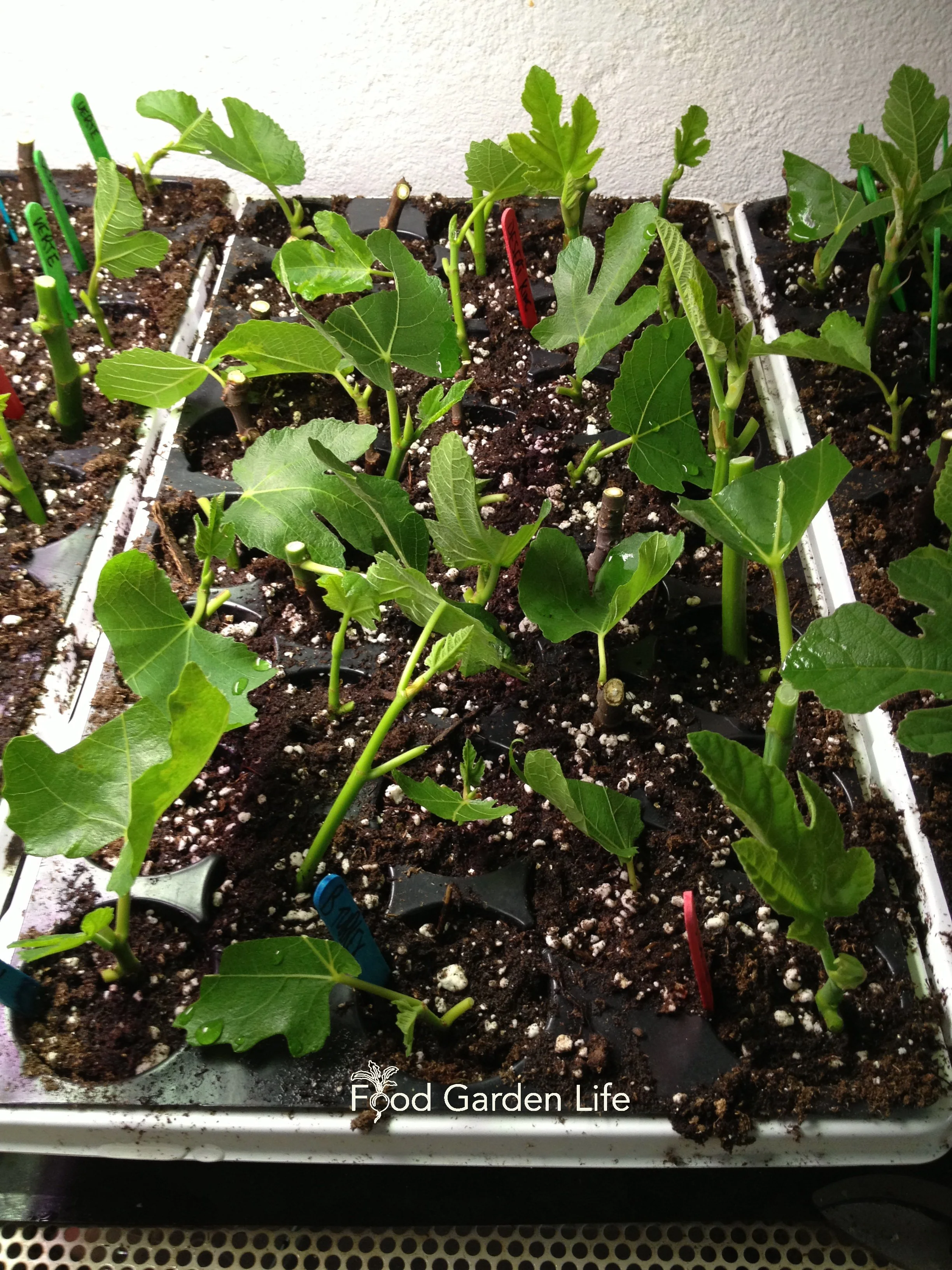
If you’re rooting actively growing branches in summer, you can prune off most of the leaves.
If it’s summer and you’re rooting a branch that’s growing and has leaves, you can leave a small leaf near the top of the cutting—but remove the rest. If you’ve left on a leaf and it falls off, don’t worry—more grow if the cutting roots and starts to grow.
What You Need
Fig Propagation Supplies
Fig Cutting. See Fig Cutting Size above.
Pot. I reuse 3” flower pots. You don’t need any special sort of pot.
Potting Soil. Get a good quality soil mixture. Peat moss or coir-based are what’s usually available commercially. (I don’t recommend using your own compost or garden soil. Garden soil packs down to much; and compost can contain fungus gnats (more on fungus gnats in 4 Tips to Boost Your Success with Fig Cuttings, below.)
Humidity. You’ve just stressed this little piece of branch by removing it from the tree. To help it recover and grow roots, put a clear plastic bag over it to keep humidity levels high around the cutting and help prevent it from drying out. In houses with forced-air heating, the air can get too dry for cuttings over the winter. Another option is to use tall clear domes to cover entire trays of plants.
Light. A bright window is fine. My artificial lights are a simple setup with T12 fluorescent tubes. You don’t need anything fancy.
Labels. Label your cuttings! There’s nothing more disheartening than rooting a cutting, only to forget what it is. (For cuttings, I like wooden tongue depressors, which I compost afterwards—or a bit of masking tape on the pot. But for mature plants, I use something more permanent, like a metal label.)
What You Don’t Need
Optional
Heat Mat. Keep fig cuttings warm. They root more quickly when the temperature is a bit above room temperature. But if you don’t have a heat mat, it’s optional. (Back to my dining room floor…I root cuttings there too because it’s a heated floor. If you have a hot-water radiator, maybe you could root cuttings on top of it.)
Rooting Hormone. It doesn’t hurt. But cuttings root well without it.
Wrap. Some fig-growers wrap the exposed end of cuttings with a stretchy, biodegradable film to keep in moisture. The film is instead of a clear plastic bag or dome. This is a slick method, as the plant can send out a bud right through the film. (It’s great for fruit tree grafting too.) The film is called Parafilm or buddy tape—and is often sold with fruit-tree grafting supplies. I think it’s great—but I don’t use it because plastic bags cost me nothing.
Don’t Waste Your Money
Fancy Grow Lights. Don’t worry about full-spectrum light systems or light-bulb technology. It doesn’t matter. A bright window or a fluorescent shop light is fine. (The fancy grow lights are for when you’re trying to give ideal light for getting flowers and fruit…like hydroponic tomatoes. You don’t need it for cuttings.)
Fertilizer for Cuttings. Don’t. The cuttings have no roots. They don’t need fertilizer yet. Even once root growth starts, don’t feed yet…the roots are still delicate.
Misting Systems. I’d love a misting system… But you can root fig cuttings well without one.
Extra Deep Pots. Nice if you have them, but you don’t need to buy them specially.
How: Fig Cutting Step-by-Step
Simplest Method
Below is my approach. There are many ways you can root cuttings—so you can adapt this to fit what’s practical for you.
Here’s What I Do
Fill the pot with moist potting soil.
Insert the cutting, bottom-end facing down.
Water well.
Cover with clear plastic bag or dome.
Place the pot in a bright warm location.
Ongoing Care
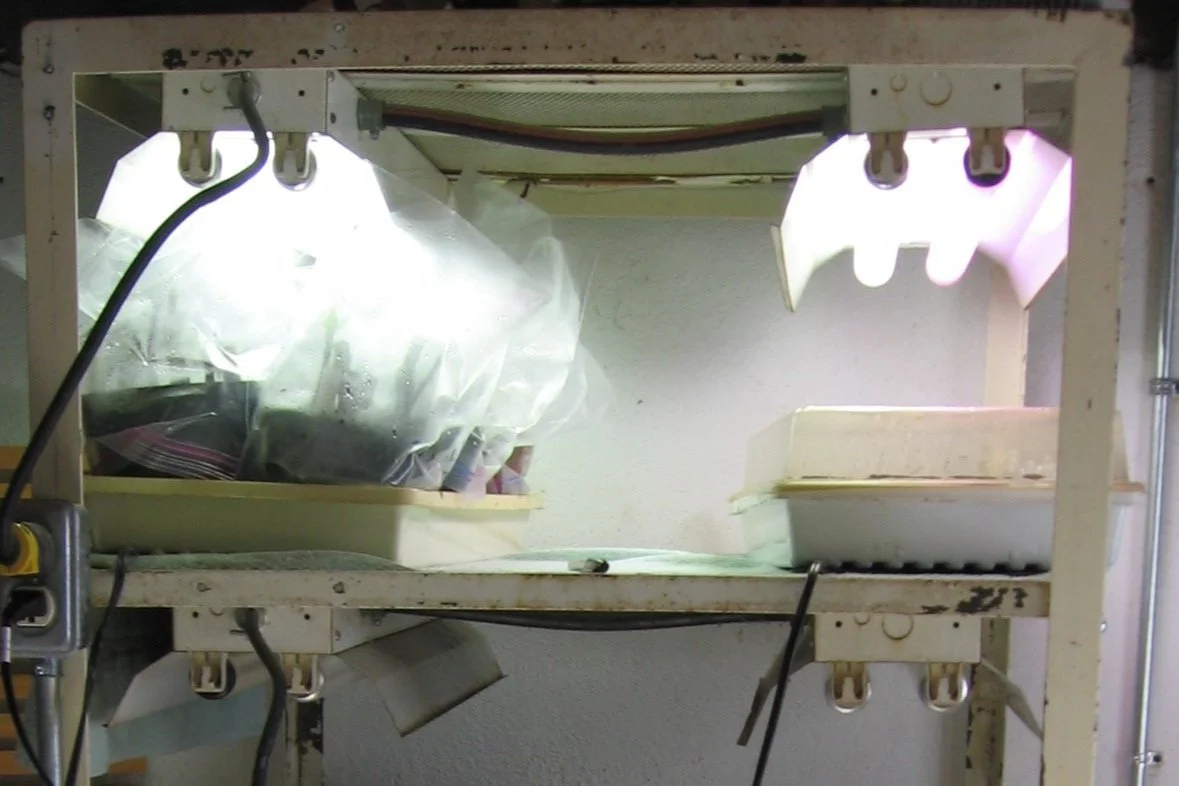
Simple fluorescent shop lights work well.
Keep the soil moist (not sopping wet).
As the cutting starts to grow, the bag doesn’t have to stay on…there might be too much humidity as leaves grow. So remove it—or lift it up part of the way to allow in some air. If you’re using a dome, set is askew for air circulation.
There are Other Fig Propagation Methods
Pre-Rooting Fig Cuttings Without Soil. More details below—but the idea is to get roots growing even before you put your fig cutting in soil!
Fig Cuttings in Water. I think this approach appeals to people because it’s familiar. My mom always rooting things in cups of water on the kitchen windowsill—slips of impatiens, coleus…or the avocado pit suspended with toothpicks. Yes, it can work; but you probably won’t have as many cuttings root than if you use the method above.
Bag Instead of Pot. Some growers like to insert a fig cutting into a plastic bag filled with moistened potting soil. After the fig cutting is inserted, the bag is sealed around the cutting to keep it moist inside. It’s a neat idea, because it deals with two things: watering and fungus gnats. (More on fungus gnats below.) This method of rooting cuttings is often called the “fig pop” method. In the deluxe version of this technique, you wrap the exposed end of the cutting with film.
Get Your Fig Trees Through Winter—and Harvest Figs
Growing figs where winters are cold takes a bit of creative thinking.
In Fig Camp and the self-paced Fig Masterclass, I explain how to grow figs in pots or in the ground, extend the growing season, ripen more fruit, and protect your trees through winter.
Pre-Root Fig Cuttings
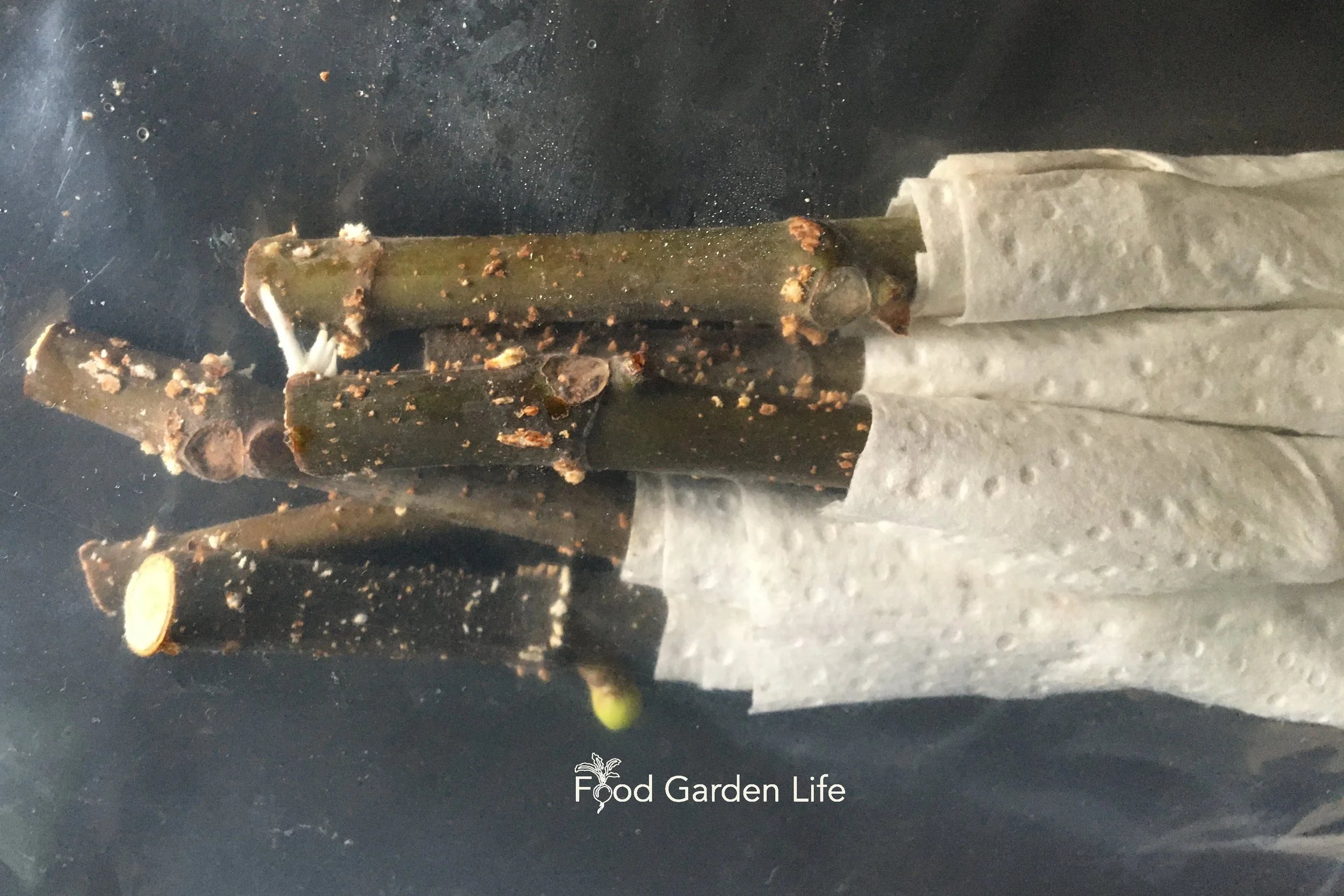
Pre-root cuttings somewhere warm. No light needed!
Woodier, dormant cuttings grow roots without soil if they’re in warm, moist conditions. No light needed! This means that you can “pre-root” them before potting them up.
A simple way to pre-root dormant cuttings is as follows:
Wrap cuttings in moist paper towel
Place towel-wrapped cuttings in a sealed plastic bag (use a clear bag, so you can watch what’s happening inside)
Place the bag somewhere warm—warmer than room temperature is best (for example, on a heated floor, or on top of a refrigerator)
TIP: I don’t wrap the bottom inch or so of the cutting with paper towel; it’s where I want roots—and then I can see how things are going.
The paper towel should be moist—but you don’t want water pooled anywhere in the bag, because there’s more chance of rot.
You’ll eventually see white flecks form on the cuttings. These are “callus.” It’s what grows before the roots. The callus means things are underway!
When roots have formed, pot up your cuttings—but remember that the small roots are delicate.
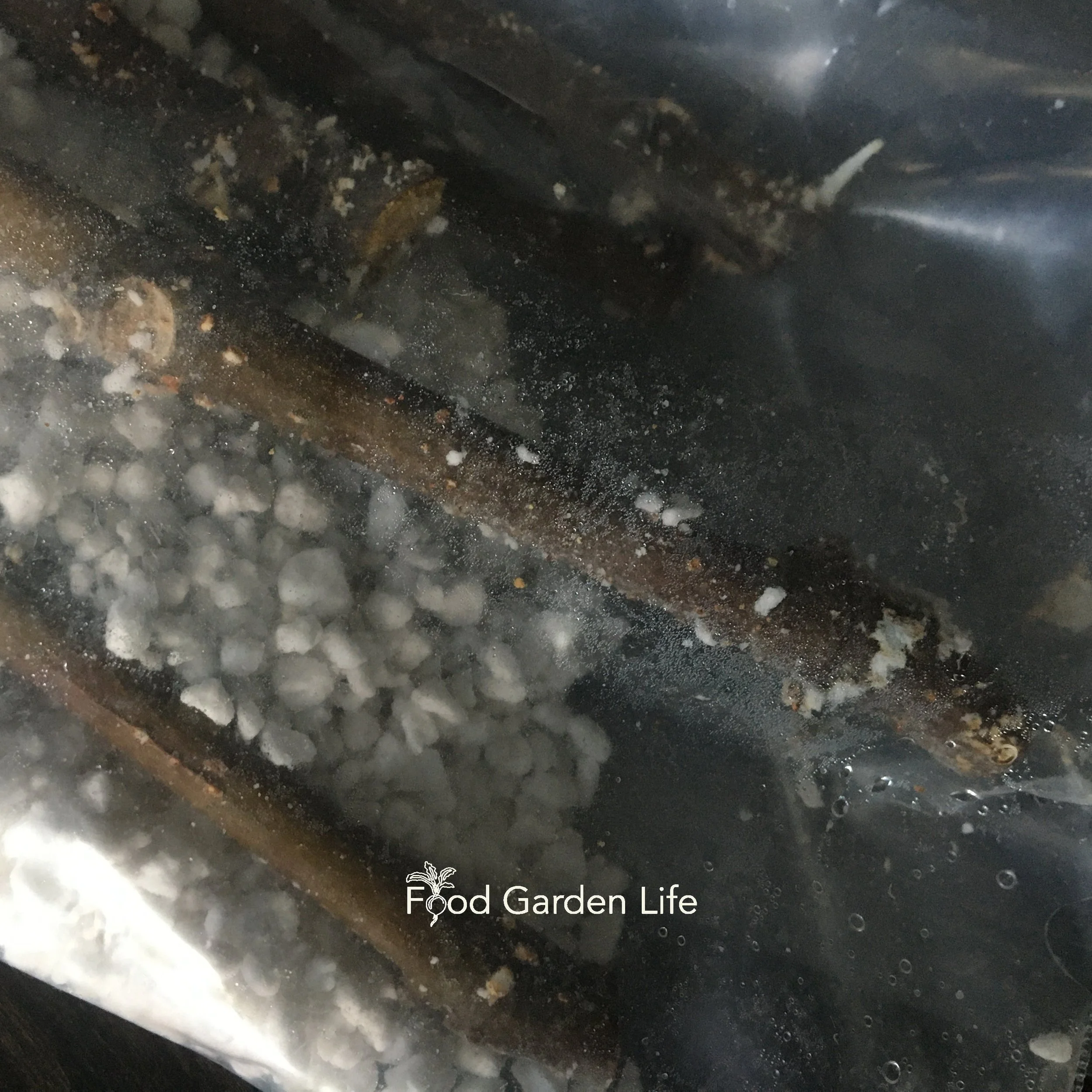
Pre-rooting in perlite.
A huge advantage to pre-rooting cuttings is that there is less of a window for fungus gnats to destroy the delicate roots of young fig plants.
VARIATION: I’ve also pre-rooted fig cuttings in damp perlite.
Time to Root Cuttings
How long does it take for a fig cutting to root?
How long it takes depends on the conditions.
If you put your cuttings in a warm spot, they’ll root more quickly.
Sometimes, roots grow before any leaves—and if you pick up the pot and look at the holes in the bottom, you might see wee white root tips poking out.
4 Tips That Boost Your Success with Fig Cuttings
Here are 4 tips that will help you successfully root cuttings:
1. Store Cuttings Properly
If the cuttings are not properly stored, they dry out. Then it’s game over.
After I prune my dormant fig trees, I store the cuttings in my basement beer fridge. The cool temperature allows me to store them for months. (And they’re in the beer fridge because my family doesn’t want to look at them every time they open the fridge in our kitchen.)
I wrap up the cuttings in damp paper towel, and then place them in a sealed plastic bag. (A zippered freezer bag works well. Some people use plastic cling wrap.)
TIP: The paper towel should be moist—not sopping wet. If it’s too wet, the cuttings might rot.
2. Heat
Heat really helps to speed up rooting. Above 20°C (68°F) is best.
When rooting cuttings in a cooler area (e.g. my basement) it’s easier and less expensive to heat the cuttings from underneath with a heat mat than to heat the whole room.
If you don't have a heat mat, placing cuttings on top of a hot water radiator or a heated floor can help.
3. Humidity for Unrooted Fig Cuttings
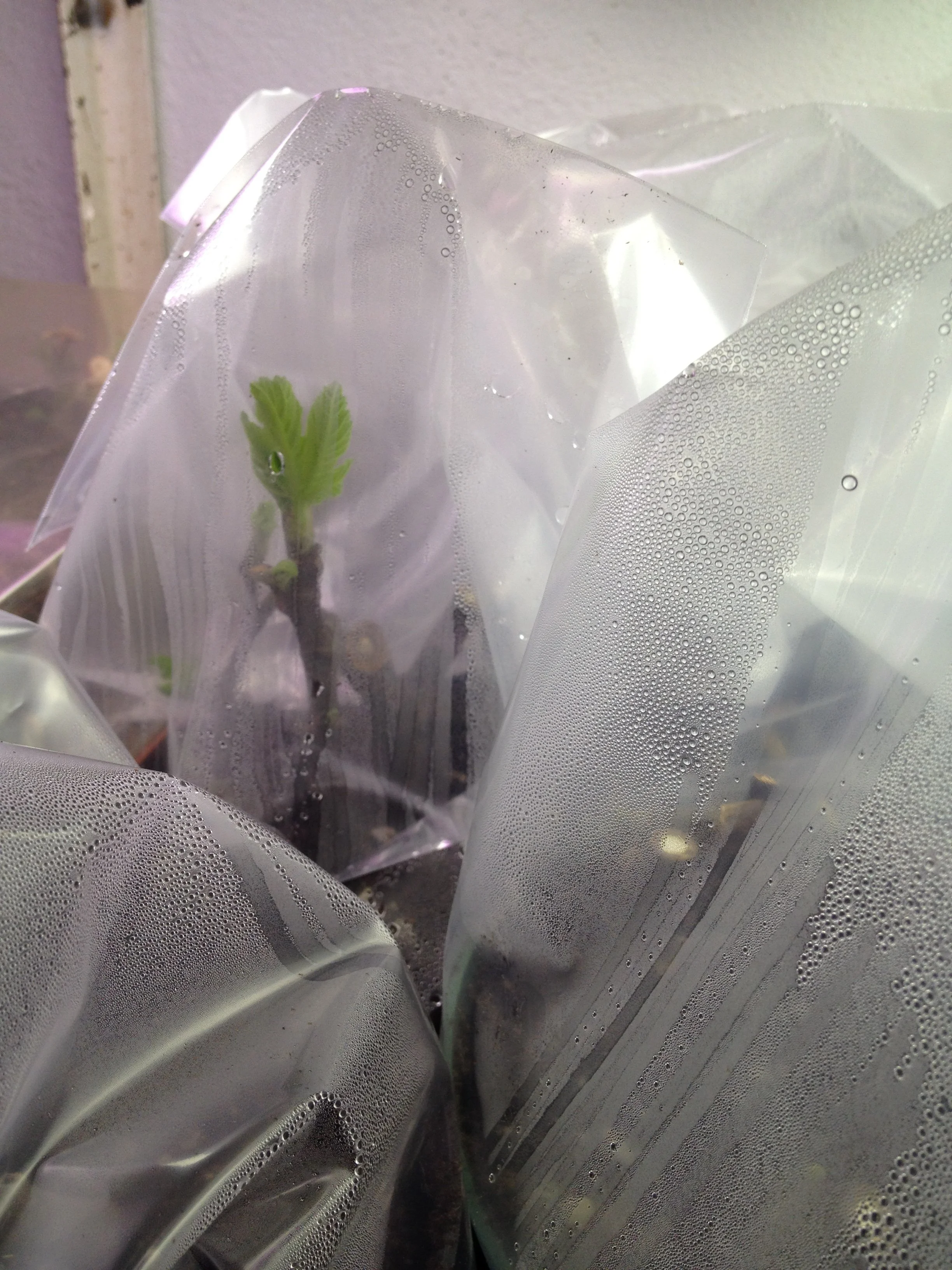
High humidity with a clear plastic bag.
Once potted up, cuttings can quickly dry out. Keep humidity higher until they’ve rooted and are growing leaves.
Here are ideas for keeping the humidity high:
Cover pots with a clear plastic bag
Cover pots with an inverted jar
Cover a tray of pots with a clear dome
I don’t often see the tall domes at local garden centres, but they are available through specialty horticultural suppliers and are worth the search if you plan to root a lot of cuttings.
4. Beware of Fungus Gnats
Fungus gnats (flying insects that look like fruit flies) can be a BIG problem. The worm-like juvenile stage lives in the soil. You won’t see it—but it eats roots…and loves fig roots. They can quickly kill newly formed roots on young cuttings.
Here’s how I avoid fungus gnats on fig cuttings:
Start with a clean potting mix. Fungus gnat eggs and larvae can be in a potting soil, so this isn’t a time to recycle potting soil that you’ve used elsewhere.
Isolate your cuttings from other plants that might have fungus gnats already living in the soil. (For most houseplants, they’re more of a nuisance than a threat.)
Find out everything you need to know about controlling fungus gnats in fig cuttings.
Where to Get Fig Cuttings
Connect with other fig enthusiasts to buy or trade cuttings.
As plants go dormant in fall and people prune, there’s a fig-trading frenzy as people mail each other cuttings. There are fig-focused groups on social media. Fig Fanatic is an online fig forum where you can connect with other fig enthusiasts.
Fig Cutting FAQ
What about scoring the cuttings?
Some people “score” the base of cuttings. It just means removing some of the bark to help with root formation. I’ve never found it necessary, but it won’t do any harm.
Can I leave the little figs on the cuttings?
Remove any little figs.
If it’s a dormant cutting with a fig that didn’t finish ripening during the growing season, that little fig would never ripen anyway.
If it’s a green cutting in summer, remove the fig so that no energy is wasted trying to ripen the fig.
And if you’re rooting a dormant cutting and it grows a new fig as it comes out of dormancy (a “breba” fig), take it off. The cutting doesn’t have the energy to grow and ripen it. At this point, your goal is roots…not figs!
Can I root green softwood fig cuttings?
Sure. They’re easy to root; maybe a bit more delicate than woodier cuttings from year-old wood.
How many of my cuttings will root?
So many things come into play that there’s no point trying to give a percentage that you can expect to root.
But it’s fair to say that as you get practice, you will consistently be able to get more than half of your cuttings to root. Or more!
Are there other ways to propagate fig trees?
Yes! Layering and air layering both work very well.
Pin this post!
You can also bud figs, though I’ve never seen the point in doing this as they grow so easily on their own roots. I guess if you wanted a fig tree with more than one variety it makes sense.
(Budding is when we take a bud—a little piece of a variety we want fruit from—and put it on another plant that provides the roots. It’s a way to make lots of plants from a small amount of wood, and is used to reproduce many types of fruit trees.)
We don’t usually grow figs (or apples or other fruit trees) from seed because it’s like buying a lottery ticket. You might get the prize of a variety with nice fruit; probably not. It probably won’t be like the fig it came from…and it might even be a variety that gives tough, leathery figs.
Can fig cuttings root in water?
It can work. But you’ll get better results with other methods—so unless you’re determined to try this method, I’d choose something else.
Do I need to wash or sanitize my cuttings?
Some people do. I don’t.
More: How to Propagate Fig Trees
Air layering is a simple way to propagate fig trees.
Keep Growing Figs
Looking for more cold-climate fig-growing ideas? Visit the fig home page to browse articles about varieties, pruning, propagation, ripening, winter protection, and more.
Grow Figs Where You Think You Can’t
My revised and expanded fig book is a practical guide to growing figs in pots and cold climates—from choosing varieties and pruning to ripening fruit and conquering winter.
Find This Helpful?
Enjoy not being bombarded by annoying ads? Appreciate the absence of junky affiliate links for products you don’t need?
This site is reader supported. If it has helped you in your food-gardening journey, you can give us a high-five below. Any amount is welcome.
Potted Figs Waking up Early? Here’s Why, and What You Can Do
Your potted figs are leafing out early... When fig trees come out of dormancy early, you need to know what to do next so that you can still harvest figs. Find out what to do—and how to avoid figs waking up early next year.
By Steven Biggs
What to Do When a Dormant Fig Tree Wakes Up Early
“HELP…my fig tree is growing already!”
I often see this sort of email subject line in late winter. If your dormant fig tree is sprouting in storage, you’re not alone.
The usual cause is simple: the storage space is too warm. Once the buds open and tender growth appears, you can’t keep the tree in dark, cool storage conditions.
If it’s still too cold to move the tree outdoors, put it in the brightest, coolest frost-free place you have. Bright light helps produce sturdier growth until outdoor conditions warm up.
In this guide, I’ll explain why potted fig trees wake up early, what to do with them now, and how to keep them dormant longer next winter.
Why Early Growth Is a Problem
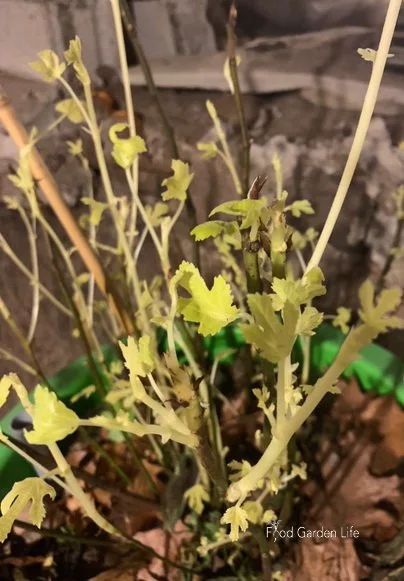
This fig tree woke in a dark crawl space. Without light, the new growth is pale and stretched.
In cold climates, we can overwinter dormant potted fig trees in cool, dark places. Because they have no leaves and aren’t actively growing, they need no light.
Once a tree begins growing, it needs light—but if your tree starts growing in a dim storage space, the light is probably too weak to give sturdy growth.
A fig tree growing in dim light produces:
Pale, stretched shoots
Large, thin leaves
Weak growth that flops over or scorches when moved outdoors
Breba figs that may drop off or fail to ripen
And if you’re thinking of just growing it as a houseplant once it wakes up, that’s not usually ideal. Growing a fig tree indoors as a houseplant can keep it alive, but it rarely produces the compact growth and strong harvest you’re after.
Why Fig Trees Wake up Early
When a dormant potted fig tree wakes early, it’s usually because the storage area is too warm. Warm temperatures trigger growth. That’s why a basement may work early in winter but become a problem later: the tree is ready to grow, and the space is warm enough for it to grow.
Modern, centrally heated basements are often too warm to keep fig trees dormant until spring.
It really depends on your house, though:
A friend had a century-old farmhouse with an uninsulated, unheated, earth-floored basement…fantastic for dormant figs. That’s the kind of space that keeps fig trees dormant.
My garage is minimally heated and is a perfect spot for overwintering dormant figs.
Some modern homes have a good root cellar—and the desirable temperatures for root cellaring also work well for keeping fig trees dormant.
Temperature Is the Main Thing to Watch
Shortening days and falling temperatures help a fig tree enter dormancy in autumn. Once it’s dormant, temperature is the most important factor you can control during winter storage.
Day length still plays a role as winter ends, but temperature usually determines how early your tree wakes up. My garage has windows that let in light, yet the potted figs don’t wake early, because the space stays consistently cool.
What to Do if Fig Trees Start Growing Early
What you do if your fig tree starts to grow early depends on how far the tree has progressed.
If the buds are only swelling: Move the tree to a colder—but protected—storage space. Cooler conditions may slow budbreak. Don’t expose swelling buds to a freeze.
If leaves or shoots have appeared: The tree is actively growing. Move it to the brightest, coolest frost-free place available.
If outdoor days are mild: You can move the tree outside temporarily for stronger light, but start in a sheltered, shaded location and bring it back under protection if there are cold winds or the temperature dips.
While it’s growing indoors: Water when the potting mix begins to dry, but don’t keep it sopping wet. Avoid heavy feeding, which encourages even more weak growth in limited light.
Here in Toronto—USDA Zone 5—it’s usually too cold in mid- to late winter to leave an actively growing fig tree outside. Tender new growth can’t tolerate the cold that a fully dormant tree can.
Once a fig tree has leafed out, don’t try to force it back into dormancy. Keep it growing in the best light you can provide until it’s safe to begin moving it outdoors.
Learn how to move a fig tree outdoors in spring.
These two real-life examples show how the best response depends on the growing space available.
Example 1:Figs Leafing Out Early
Here’s an example of a late-winter note that I received about potted figs sprouting early. Holly wrote:
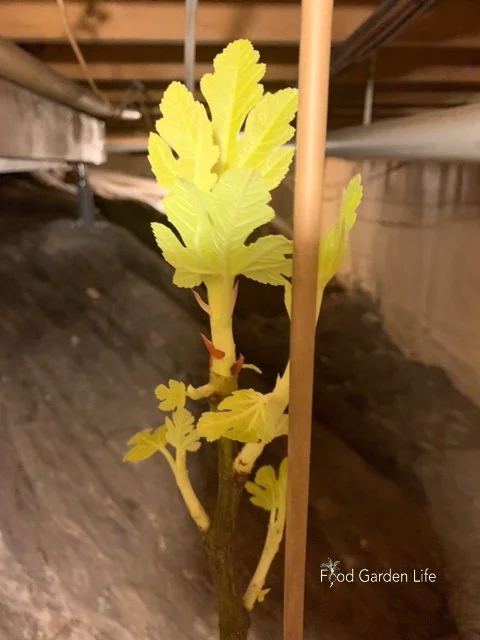
Darkness doesn’t guarantee dormancy. Warm conditions caused these stored fig trees to begin growing.
I brought my six fig trees inside and put them in my crawl space. They are in large containers with reservoirs in the bottom.
Anyway, it is dark but too warm, and they are sprouting small albino-pale leaves.
Now I don’t know what to do? Leave them? Move them to my cooler sunroom with light? Help!!!
Here is my response:
Sorry to hear about your fig dilemma! The crawl space is too warm, so the trees have come out of dormancy early. It’s difficult to return actively growing trees to dormancy. A cool sunroom with bright light is your best option—as long as the trees don’t freeze.
The Challenge
Holly’s crawl space is completely dark—but it’s warm enough to trigger growth. Without light, the emerging shoots are pale and stretched.
What to Do
Move the fig trees to a bright, cool, frost-free growing space. The brighter the light, the more compact the new growth will be.
Holly’s sunroom is the best option in this case because it’s both bright and cool.
Other possibilities include:
A bright, south-facing window
A cool greenhouse or enclosed porch that remains frost-free
Strong grow lights placed close enough to provide useful light
Artificial light isn’t necessarily inferior. A suitable grow-light setup can provide better light than a window during winter.
Avoid Early Sprouting Next Year
Holly is considering an insulated storage compartment inside her garage next winter. This can work well in a garage that occasionally becomes too cold for potted fig roots.
In an attached garage, build the compartment against the wall shared with the house, where temperatures usually fluctuate less than they do near the large garage door. Add a remote thermometer so you can monitor conditions inside.
Insulation slows heat loss but doesn’t create heat. If the garage becomes extremely cold, the compartment may still need a small, thermostatically controlled heat source.
Example 2: A Fig Tree with Breba Figs Wakes Early
Here’s another example of a late-winter enquiry I received about potted figs coming out of dormancy early:
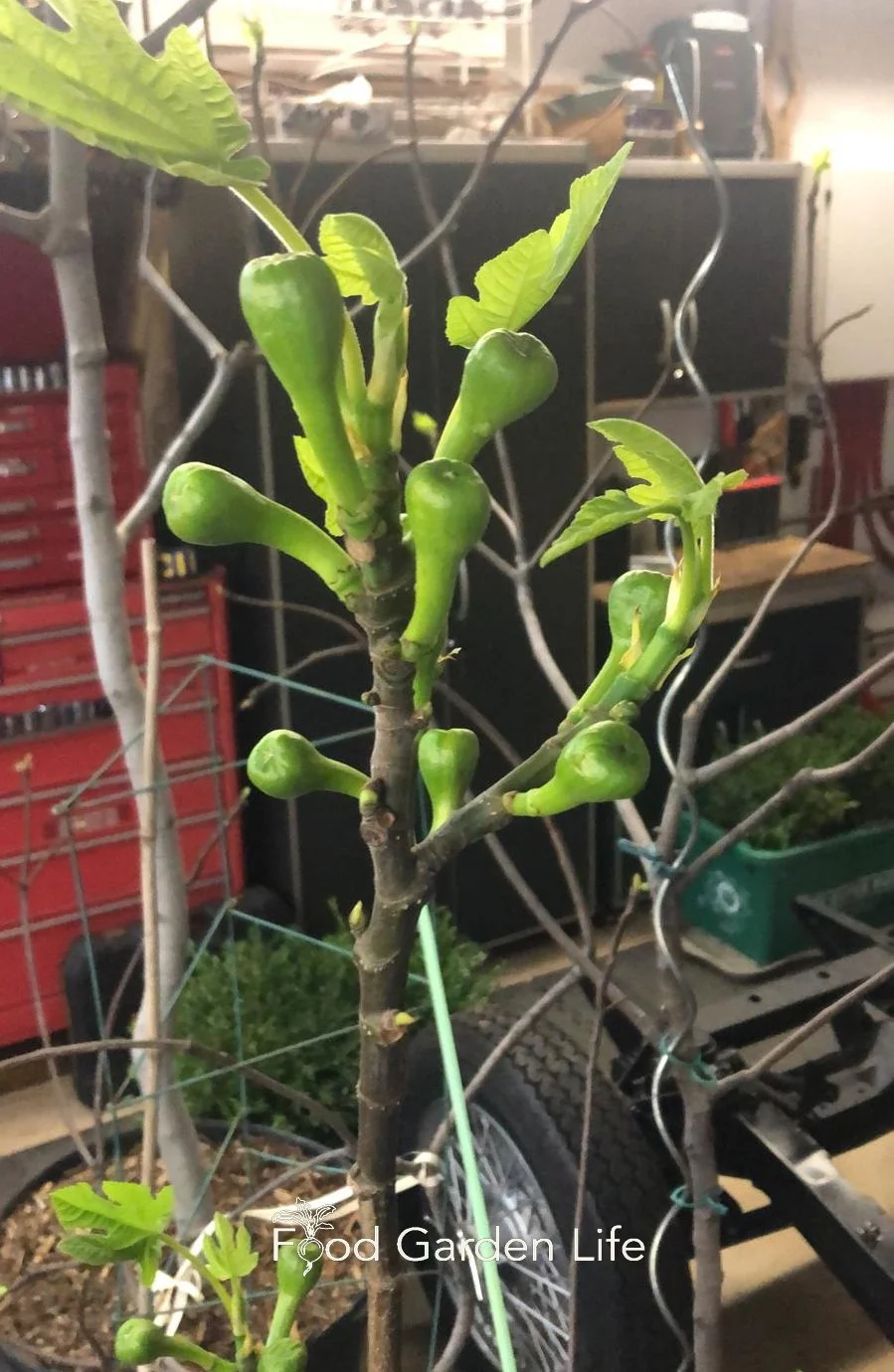
David’s potted fig tree woke early in his heated garage—and its branches were loaded with breba figs.
“My fig trees are growing, what should I do?” That was the question my neighbour David asked during a late-March phone call.
David grows his fig trees in pots on his patio during summer. He leaves them outdoors in autumn until they’re dormant, then stores them in his garage.
The garage is heated because David works on cars there during winter. It also has large windows. The warmth triggered early growth, while the window light wasn’t strong enough to produce compact shoots.
To complicate matters, the branches were carrying oodles of breba figs—a crop that develops on the previous season’s growth.
The Challenge
It was still too cold to move the actively growing trees outdoors. More freezes were likely, and they could damage the tender new growth.
But the light inside the garage wasn’t bright enough for sturdy growth.
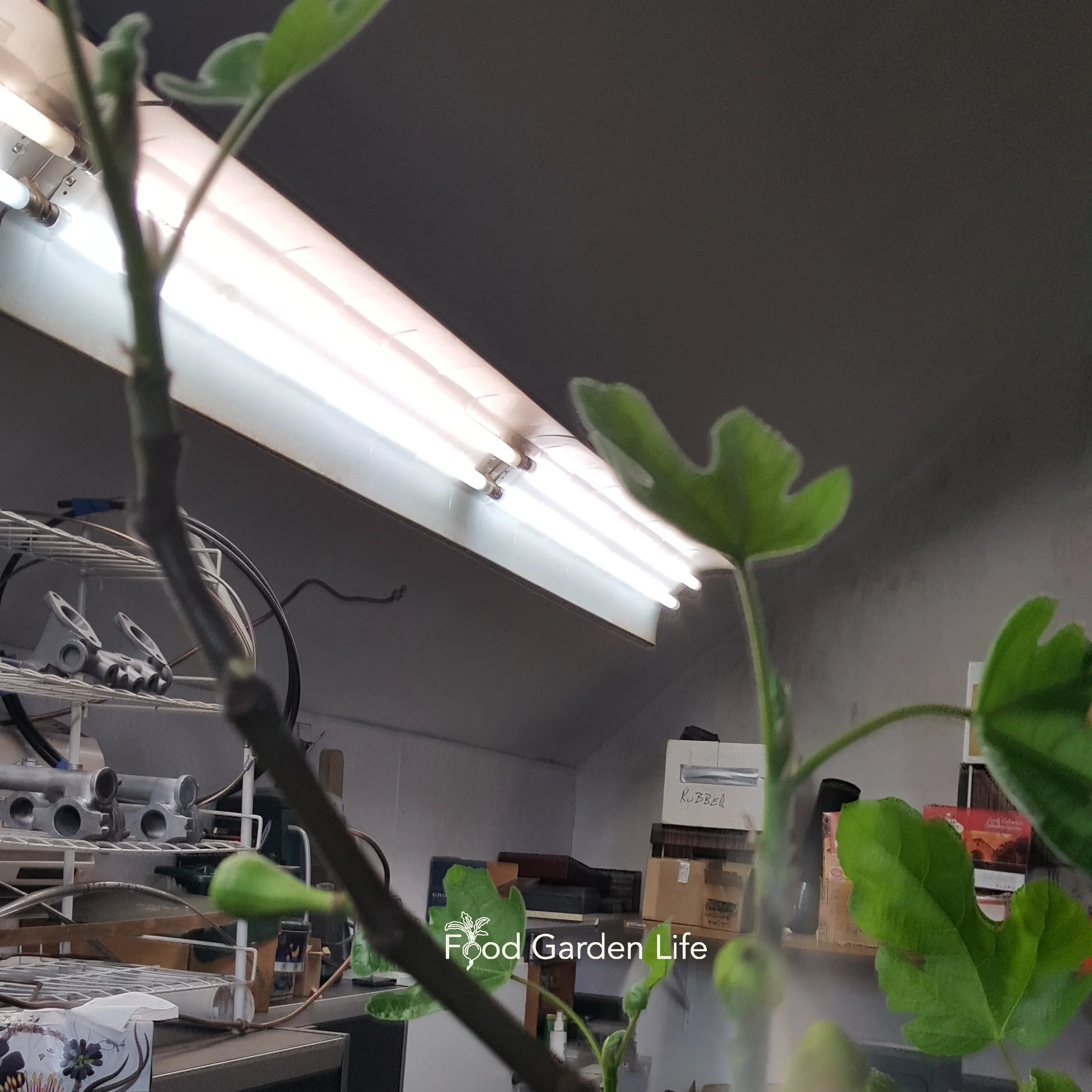
Potted fig tree making lanky growth beneath a shop light in David’s heated garage.
Give the Trees More Light
I suggested moving the trees to the brightest part of the garage until outdoor conditions improved.
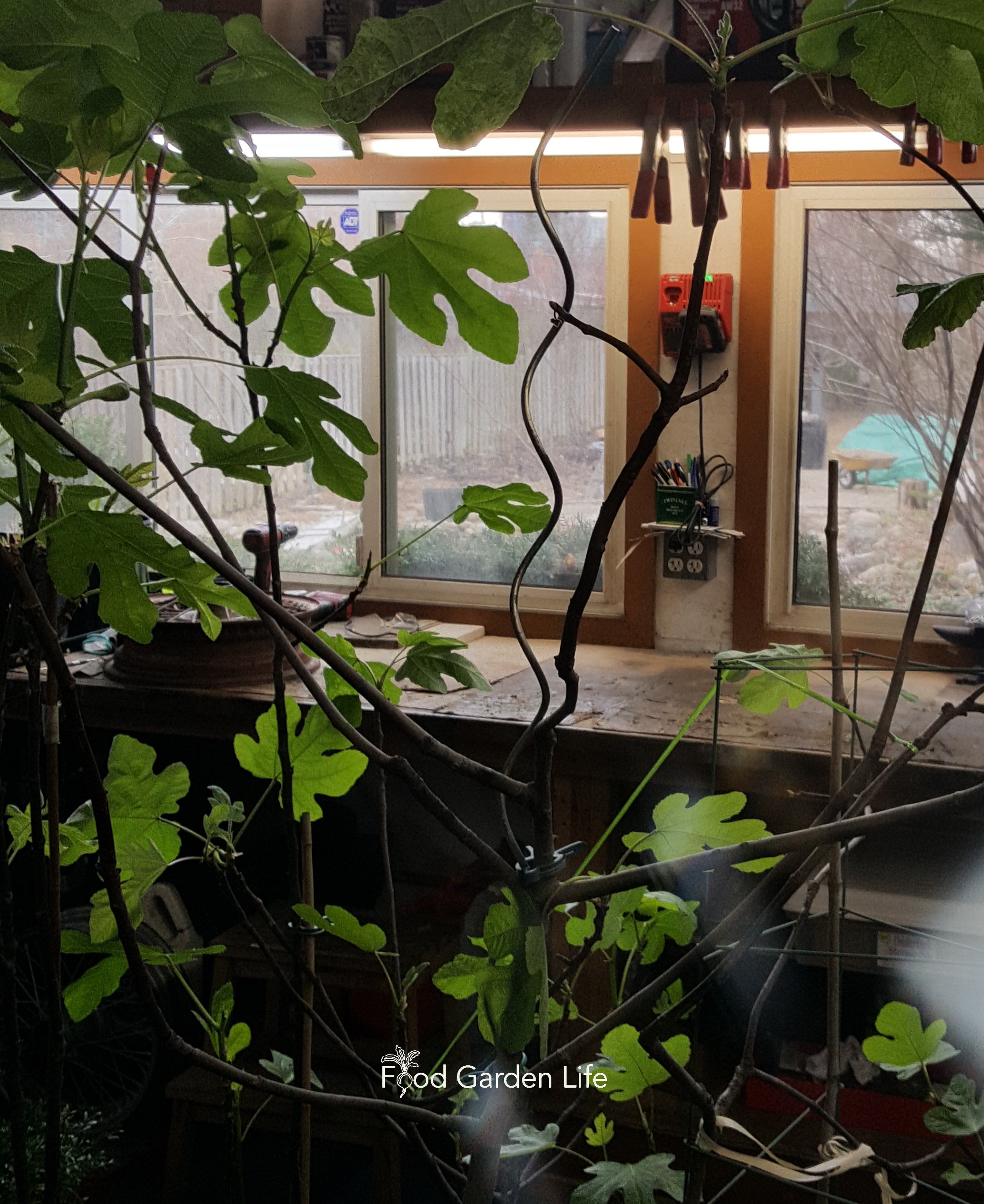
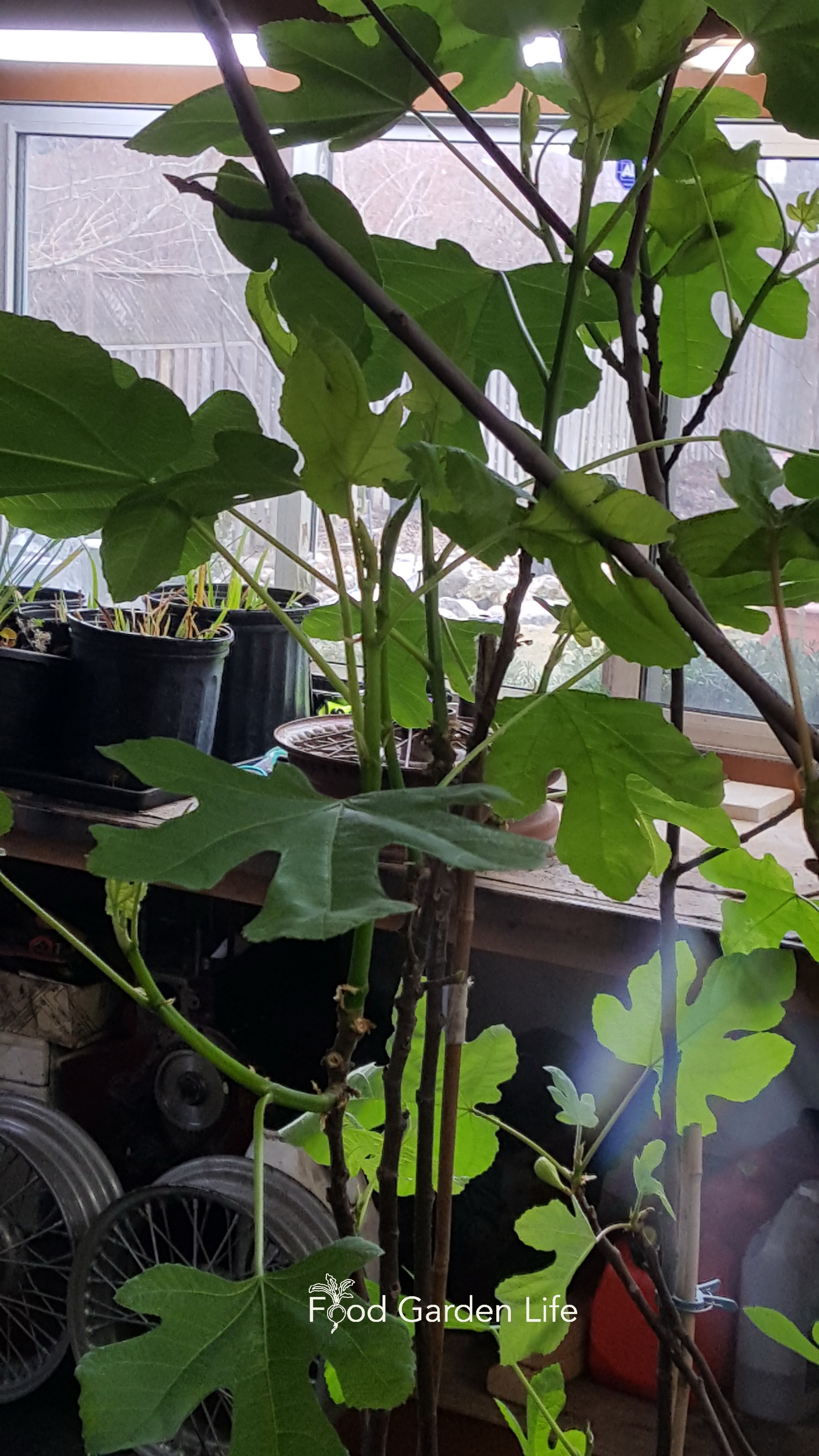
On mild days, David could move them outside for stronger light. He would need to start in a sheltered, shaded location, protect them from strong wind, and return them to the garage whenever frost threatened.
Another possibility was a simple temporary greenhouse against the garage. This could provide brighter light during the shoulder season while protecting the trees from cold nights.
A temporary greenhouse can heat up surprisingly quickly in sunshine, so it needs ventilation and temperature monitoring.
Avoid Figs Waking Up Early Next Year
The following winter, David could:
Keep the garage cooler
Build an insulated storage compartment within the garage
Store the trees in another consistently cold location
Overwinter the figs outdoors using a protected in-ground or trench method
If he walls off a corner of the garage, a remote thermometer will show whether the compartment remains cold enough for dormancy without reaching temperatures that could damage the potted roots.
Another option is to grow the trees in the ground and protect them by tipping and covering them, or to overwinter the pots outdoors in a protected trench.
Here are more ideas for overwintering figs in cold climates.
Important Tip for Fig Trees That Leaf Out Early
Pin this post!
There’s one more important thing to remember.
New leaves that develop indoors aren’t adapted to full outdoor sunlight or wind. If you move the tree directly from dim indoor conditions into full sun, the leaves can scorch badly.
I’ve fried my fig leaves more than once by moving the trees into full sun too quickly.
Start in a sheltered, shaded outdoor location. After a few days, introduce gentle morning sun, then gradually increase the amount of direct light over a week or two.
Watch the forecast throughout this process. Bring actively growing trees back under protection if freezing temperatures threaten.
Find out what to do with your fig tree in the spring.
FAQ: Fig Trees Waking Up Early
Why did my fig tree wake up early?
Warm storage conditions are the most common cause. Once the tree has been dormant for a while, warm conditions can trigger budbreak—even in complete darkness.
Will waking early kill my fig tree?
Usually not. The challenge is keeping the new growth healthy until outdoor conditions improve. Give the tree bright light, protect it from freezing temperatures, and don’t overwater it.
Can I make it go dormant again?
If the buds are only swelling, moving the tree to a colder protected space may slow them down. Once leaves and shoots have appeared, it’s difficult to return the tree to dormancy without damaging the new growth.
Should I grow it indoors now that it’s awake?
If it’s still too cold outdoors, yes. Put it in the brightest, coolest frost-free location available. Indoor growing isn’t ideal, but it’s safer than exposing tender shoots to freezing temperatures.
Does a dormant fig tree need light?
No. A fully dormant fig tree has no leaves and doesn’t need light. Holly’s trees began growing in complete darkness because the crawl space was warm.
Once growth begins, however, the tree needs bright light.
Can I put an actively growing fig tree outside?
You can put it outside on mild days, but begin in shade and shelter it from wind. Bring it back under protection before temperatures freeze. Gradually get it used to stronger sunlight.
Should I remove pale, lanky shoots?
It’s tempting, but pruning the branches may remove developing breba figs, while removing the new shoots can delay the main crop. Move the tree into brighter light first. Once it’s growing outdoors, you can assess whether weak shoots need pruning. It’s often better to accept less-than-perfect growth for the season, get some figs, and then prune back that lanky growth next year while the tree is dormant.
How can I help my potted fig enter dormancy in autumn?
Leave it outdoors as days shorten and temperatures fall. A few light frosts help encourage leaf drop and dormancy. Don’t move it into warm winter storage too early, but protect the pot from temperatures cold enough to damage the roots.
Get Your Fig Trees Through Winter—and Harvest Figs
Growing figs where winters are cold takes a bit of creative thinking.
In Fig Camp and the self-paced Fig Masterclass, I explain how to grow figs in pots or in the ground, extend the growing season, ripen more fruit, and protect your trees through winter.
Explore Fig Camp and Fig Masterclass
Keep Growing Figs
Looking for more cold-climate fig-growing ideas? Visit the fig home page to browse articles about varieties, pruning, propagation, ripening, winter protection, and more.
Grow Figs Where You Think You Can’t
My revised and expanded fig book is a practical guide to growing figs in pots and cold climates—from choosing varieties and pruning to ripening fruit and conquering winter.
Find This Helpful?
Enjoy not being bombarded by annoying ads? Appreciate the absence of junky affiliate links for products you don’t need?
This site is reader supported. If it has helped you in your food-gardening journey, you can give us a high-five below. Any amount is welcome.
Watering Dormant Potted Figs...and Getting it Right so They Survive Winter
Pointers on how often to water potted dormant figs over the winter.
By Steven Biggs
How Often to Water Dormant Figs
Once you protect your dormant, in-ground fig plants for the winter, there’s no need to think about watering them over the winter.
In the same way that you don’t need to water dormant landscape shrubs over the winter, you don’t need to water your dormant, in-ground fig trees.
But your potted fig plants might need water.
Or they might not.
It depends on the conditions where you’re storing them.
This post will help you figure out how often to water a dormant fig plant.
Don't Overwater…
When a dormant fig plant gets too much water, the roots might rot.
Knowing when —and whether — to water can be difficult to gauge for new growers.
Here’s how I judge: I stick my finger right into the soil—and if I feel moisture, I don’t water.
Explained another way: Keep the soil on the dry side of moist.
Not Too Dry Either…
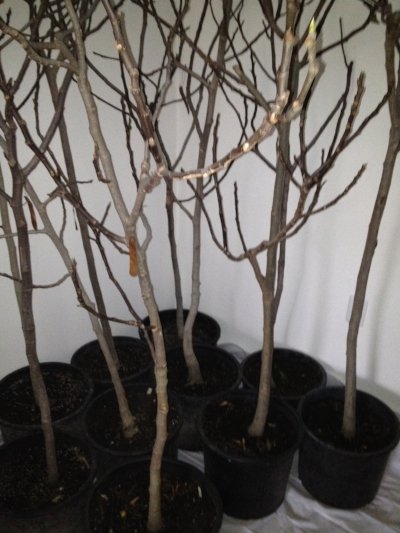
Not sure how often to water dormant fig trees? Keep them on the dry side of moist.
But if the soil becomes too dry while the fig plant is dormant, the plant can die.
If the soil feels extremely dry, it’s probably time to water.
Remember: Keep it on the dry side of moist—not bone dry.
You will know the soil is quite dry if it shrinks and is no longer in contact with the edge of the pot.
When potting soil shrinks like this, water goes down the side of the pot instead of soaking into the soil. So before watering, use your fingers to spread out the soil so there is no space for the water to go down the side of the pot.
Is There a Rule for How Often to Water?
No.
When dormant figs are stored somewhere with dry air (e.g. in a cold room in house with forced air heating) they might need occasional watering.
But they might not.
The figs in my garage, where the air is humid, often need no water all winter long.
Fig Trees Waking up Early?
Keep Growing Figs
Looking for more cold-climate fig-growing ideas? Visit the fig home page to browse articles about varieties, pruning, propagation, ripening, winter protection, and more.
Grow Figs Where You Think You Can’t
My revised and expanded fig book is a practical guide to growing figs in pots and cold climates—from choosing varieties and pruning to ripening fruit and conquering winter.
Find This Helpful?
Enjoy not being bombarded by annoying ads? Appreciate the absence of junky affiliate links for products you don’t need?
This site is reader supported. If it has helped you in your food-gardening journey, you can give us a high-five below. Any amount is welcome.
Figs Didn't Ripen? Try These Unripe Fig Recipes and Uses
Did your fig tree drop its leaves for winter…but is still loaded with unripe figs? Here are unripe fig recipes and other ideas for getting the most from your fig tree.
Unripe Figs Every Fall
It’s a frustrating sight for a cold-climate fig grower: A naked fig tree loaded with unripe figs.
As a fig tree goes dormant and drops all its leaves, the unripe figs remain—all the more noticeable because the tree is leafless.
Think of all the figs you didn’t get to eat…
(I won’t use the term “green figs” to refer to unripe figs—because there are lots of fig varieties that are green when they’re ripe.)
Once a fig tree is dormant, the unripe figs won’t ripen any more. Don’t leave them over the winter and hope they’ll ripen next year. They won’t.
But there are things you can do with unripe figs, and this article gives you an unripe fig recipe and more ideas.
Unripe Fig Recipe
Grilled Unripe Figs
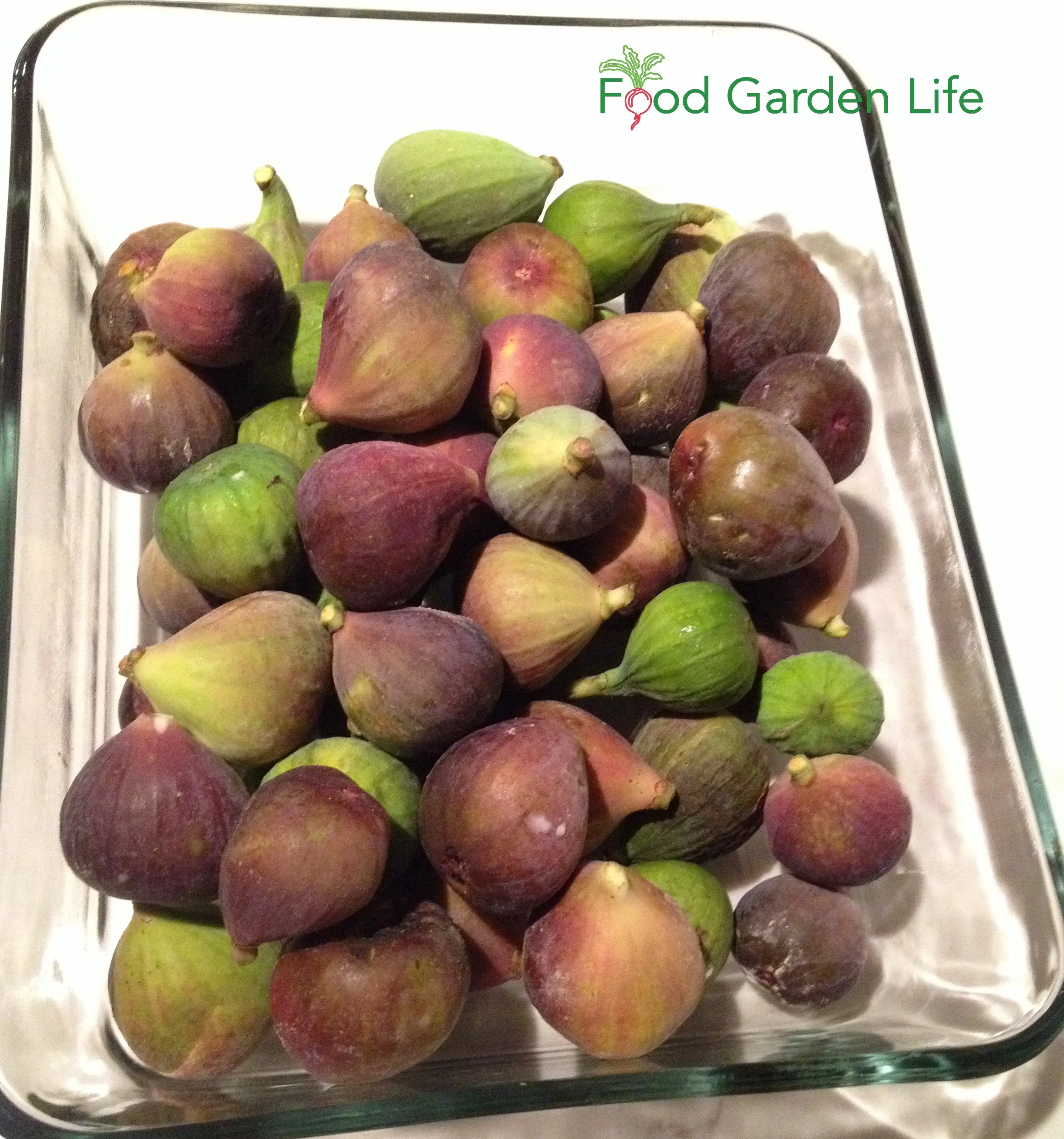
Recipe for unripe figs using “almost-ripe” figs that are a good size and starting to soften…but are not too sweet.
Here’s a recipe from my fig-growing friend Alberto. He says to use “almost-ripe” figs in this recipe.
These almost-ripe figs are ones you might be tempted not to eat because although they’ve reached a good size, and softened a bit…they’re not soft, and not very sweet.
Alberto grills these unripe figs on the barbecue. I cook mine in the oven in a baking dish. Both work well.
Here’s what to do:
Put the almost-ripe figs directly on the grill, or on foil (or a cookie sheet or baking dish if you’re cooking them in the oven)
Cook until they become soft and the inside starts to ooze out
Place in a dish and allow to cool
Mix with cinnamon, pine nuts, oregano, honey, and a touch of balsamic vinegar
Enjoy!
You’ll see that there are no amounts for the other ingredients—add them to suit your taste.
Alberto introduced me to his “door” method of overwintering figs.
Preserves with Unripe Figs
My friend Voula told me that her family in Greece makes “spoon sweets” using unripe figs.
Spoon sweets are unripe figs are cooked in syrup until soft.
I’ve never tried this—so I don’t have a recipe for you. But you’ll find recipes online.
Don’t Waste Dormant Branches You Prune Off

This flower arrangement, picked from the garden after it’s had frost, includes unripe figs on branches, a cardoon leaf, broom corn (sorghum), and stonecrop sedum.
Here in Toronto, I grow some of my fig trees in the ground. I lay the trees flat to the ground over the winter and insulate them. Find out more about how to overwinter fig trees in cold climates.
Before I tip over my fig trees, I prune back some of the taller branches (so that there’s less tree for me to cover.)
Flower Arrangements with Unripe Figs
When I prune off branches with unripe figs on them, I use them in flower arrangements. Thanks to Joanna at Arthur Greenhouses for this idea. She told me that she saw it when she worked in the cut-flower industry.
Fig Branches for Smoking Food
I usually smoke meat using apple, cherry, or plum wood. All of these fruit woods have a nice flavour, suited to smoking food.
Fig wood has a taste and smell that is very distinct from these other fruit woods. If ever I put a fig branch on the bonfire, I can smell it right away. It’s recognizable—and it’s nice.
Interested in smoking food? Here’s how I cook a turkey on a charcoal barbecue, and use branches to add a smoke flavour.
Fig Branches for Cuttings
Of course, some of the fig branches I prune end up as cuttings.
Find out how to grow fig plants from cuttings.
Other Cool Culinary Uses for Figs
Pin this post.
Fig Sap as a Coagulant
Fig sap can coagulate milk. I chatted with someone once who described a yogurt like food that his family makes in Greece, using fig sap to coagulate milk.
Flavouring Food with Fig Leaves
Fig leaves have a flavour I’d describe as a combination of coconut and toasted almond.
The leaf is not eaten—rather, the flavour is extracted from it.
Toronto chef David Salt introduced me to the culinary joys of fig leaves. I’ve sampled his fig-leaf cheese, fig-leaf ice cream—and fig-leaf grappa!
Here’s a delicious fig-leaf panna cotta recipe.
Find out more about using fig leaves in cooking.
(If you’re interested in cooking with fig leaves but don’t have time to do it in the fall, freeze some fig leaves.)
Keep Growing Figs
Looking for more cold-climate fig-growing ideas? Visit the fig home page to browse articles about varieties, pruning, propagation, ripening, winter protection, and more.
Grow Figs Where You Think You Can’t
My revised and expanded fig book is a practical guide to growing figs in pots and cold climates—from choosing varieties and pruning to ripening fruit and conquering winter.
Find This Helpful?
Enjoy not being bombarded by annoying ads? Appreciate the absence of junky affiliate links for products you don’t need?
This site is reader supported. If it has helped you in your food-gardening journey, you can give us a high-five below. Any amount is welcome.
Fig-Leaf Syrup Recipe
Capture the sweet smell of fig leaves with the fig-leaf syrup recipe.

The Flavour of Fig Leaves
Working in the garden next to my fig trees on a hot summer day, I often get wafts of a sweet, delicious smell.
It's the smell of fig leaves.
Often overlooked, those sweet-smelling fresh fig leaves can be used in many recipes. It's just one more reason to grow a fig tree!
When using fig leaves in cooking, the leaves are discarded once the flavour is pulled out of them.
I like to use fresh fig leaves. Some people use dried fig leaves to make fig-leaf tea. And if you want to enjoy fig leaves over the winter, just freeze some. I freeze fig leaves by stacking a few of them and then placing them in a freezer bag.
Keep reading to find out more about using figs leaves in cooking, and for a simple fig-leaf syrup recipe.
How to Use Fig Leaves
Here are a few ways to use fig leaves:
Fig-leaf ice cream
Fig-leaf granita
Fig-leaf panna cotta (a favourite in my family!)
Here's the recipe for fig-leaf panna cotta.
Here's a chef making fig-leaf grappa and fig-leaf cheese.
What do Fig Leaves Taste Like?
I describe fig leaves as having a flavour that combines toasted almond, coconut—and touch of herbaceous.
The fig-leaf flavour works well in desserts. The fig-leaf flavour also pairs nicely with savoury dishes. (I once had partridge served with a fig-leaf glaze!)
Find out how chef David Salt uses fig leaves.
Fig Leaf Syrup Recipe

Ingredients
4 fig leaves (fresh leaves in the summer, or frozen leaves in the winter)
1 ½ cups granulated sugar
500 mL water
Directions
Place fig leaves flat in a heat-proof bowl
Put sugar and water in saucepan and bring to a boil until sugar dissolves to make a sugar syrup
Pour the hot liquid over the fig leaves
Allow to steep until it cools to room temperature
Refrigerate overnight
Remove leaves and it's ready to use
What is fig syrup good for?
The delicate flavour of fig leaves pairs nicely with fruit such as strawberries and blueberries. But fig leaves also go well in savoury dishes, so try some fig-leaf syrup drizzled atop poultry or fish.
Keep Growing Figs
Looking for more cold-climate fig-growing ideas? Visit the fig home page to browse articles about varieties, pruning, propagation, ripening, winter protection, and more.
Grow Figs Where You Think You Can’t
My revised and expanded fig book is a practical guide to growing figs in pots and cold climates—from choosing varieties and pruning to ripening fruit and conquering winter.
Find This Helpful?
Enjoy not being bombarded by annoying ads? Appreciate the absence of junky affiliate links for products you don’t need?
This site is reader supported. If it has helped you in your food-gardening journey, you can give us a high-five below. Any amount is welcome.
Figs and Winter Temperatures
Find out what you need to know about fig hardiness and winter temperatures so you can figure out what sort of winter protection (if any) your fig trees need.
What’s the Hardiness of a Fig Tree in Winter?
Fig plants tolerate more cold than many people realize.
But just how cold can they get without damage?
It depends on a few different things.
This article tells you what you need to know about fig hardiness and winter temperatures so you can figure out what sort of winter protection (if any) your fig trees need.
(If you already have an idea of how hardy fig trees are in your area and just want ideas to get them through the winter, find out more here.)
Hardiness Isn’t Exact
Hardiness is never an exact thing.
That's because fig tree hardiness is affected by what's going on with the tree—and it's also affected by the conditions around the fig tree.
The cold hardiness of fig trees is affected by what's going on with the tree:
Young trees are more tender than mature trees
Fruit and new growth are affected by cold before older, woodier stems
If the fig tree is dormant, it can better withstand cold
Some fig varieties are more cold-tolerant than others
The conditions the fig tree is exposed to also affect cold hardiness:
The duration of cold temperatures
How sheltered or exposed the fig tree is
How many degrees the temperature drops
The timing of extreme cold (e.g., at the end of the night the plant might be soon warmed by sun)
So How Much Cold Can Fig Trees Take?
There is no magical number. Some fig plants can take temperatures as cold as -7 to -9°C (15-20°F).
Some colder.
Some not so cold…
If you want to think in terms of zones, you’ll often see the recommendation that figs are hardy into USDA Zone 8. But you can push the growing zone recommendations if you figure out a way to moderate temperature extremes around your fig plant over the winter.
Even if a cold winter causes the top of a fig tree to die back, the roots usually survive and send up new shoots.
Potted Figs: Remember the Root Ball
If you're growing fig trees in containers, it's good to remember that a potted fig tree can't tolerate as much cold as an in-ground fig tree.
That's because the root ball will freeze and thaw more often and more quickly than the soil in the ground.
The main trunk and branches probably have the same cold tolerance.
Things to Think About as you Plan Fig Tree Winter Protection
Here are things to think about as you consider what to do with your fig tree for the winter.
Your Zone: How much protection your fig tree needs over winter is affected by your plant hardiness zone.
Microclimate: Most gardens have some sort of protected area (called a “microclimate.”)
Your Storage Options: Each house and yard is different. I met a Toronto gardener with what he called a “fig cave”. This cave—and underground stairwell between his garage and his house—was a sheltered space he used to store dormant potted fig trees. In some areas, you might not need to store potted figs—and might only need to wrap in-ground fig trees during winter months.
Your Budget: There are lots of gadgets… I’ve met gardeners with thermostatically controlled space heaters. Other gardeners keep things simple, using insulating materials.
You: The way that you decide to protect your fig over the winter will depend on how much lifting and hauling you want to deal with.
Get Your Fig Trees Through Winter—and Harvest Figs
Growing figs where winters are cold takes a bit of creative thinking.
In Fig Camp and the self-paced Fig Masterclass, I explain how to grow figs in pots or in the ground, extend the growing season, ripen more fruit, and protect your trees through winter.
FAQ: Winter Fig Tree Hardiness
Do figs lose their leaves in winter?
Yes.
How do you take care of a fig tree indoors in the winter?
In a cold climate, it's easiest to let a potted fig tree go dormant, and then store it somewhere cool and dark for the winter. Find out more ways to overwinter figs in cold climates.
Do figs do well in pots?
The do very well in pots. Here's an article that gives more information about how fig trees grow.
Where is the best place to keep a fig tree in the winter?
There is no best place. It depends on how cold your zone is and what sort of spaces you have for winter protection.
Should I prune my fig before I store it for the winter?
It depends on a few things. Find out more in this Cold-Climate Guide to How to Prune a Fig Tree.
Video: Figs Waking Up Early
Keep Growing Figs
Looking for more cold-climate fig-growing ideas? Visit the fig home page to browse articles about varieties, pruning, propagation, ripening, winter protection, and more.
Grow Figs Where You Think You Can’t
My revised and expanded fig book is a practical guide to growing figs in pots and cold climates—from choosing varieties and pruning to ripening fruit and conquering winter.
Find This Helpful?
Enjoy not being bombarded by annoying ads? Appreciate the absence of junky affiliate links for products you don’t need?
This site is reader supported. If it has helped you in your food-gardening journey, you can give us a high-five below. Any amount is welcome.
Guide to Controlling Fungus Gnats on Fig Cuttings
Guide to controlling fungus gnats on fig cuttings.
Fungus Gnats and Fig Cuttings

It was during a Zoom meeting.
Right in front of my face.
It was so close I nearly inhaled it.
A fungus gnat. They’re back…and that’s bad news for my fig cuttings.
If you’ve had fig cuttings that looked healthy, but then died, a common cause is fungus gnats.
They’re small flying insects. Harmless for many houseplants…but a problem when propagating fig trees from cuttings.
Luckily, there are ways you can deal with them.
In this post, I’ll tell you what you need to know about fungus gnats and fig cuttings: How to prevent them, the life cycle, and how to control them.
What’s a Fungus Gnat?
It’s easy to mistake an adult fungus gnat for a fruit fly.

An adult fungus gnat.
The adults are small flies, about 4 mm (1/8th of an inch) long. Their little bodies are jacked up on long skinny legs, making them look top heavy.
Fungus gnats are weak fliers…anything but graceful. Their flight is bumbling at best, like the pigeons of the flying insect world.
If you have fungus gnats, you’re likely to see them flying around your houseplants. Others will be walking around the soil surface.
Fig Cuttings and Fungus Gnats
Here’s where fig cuttings come into this: If you see adult fungus gnats, then there are lots of larvae somewhere.
The larvae are small worms that live in the soil. They’re difficult to see with the naked eye. But if you’ve got adults, there are larvae around.
These larvae—these worms—eat decaying organic matter…AND roots.
Mature plants are not usually bothered by fungus gnats; they can take some root damage.
But fungus gnat larvae can mow down your fig cuttings. (OK, mow up…they’re munching on the newly forming roots.)
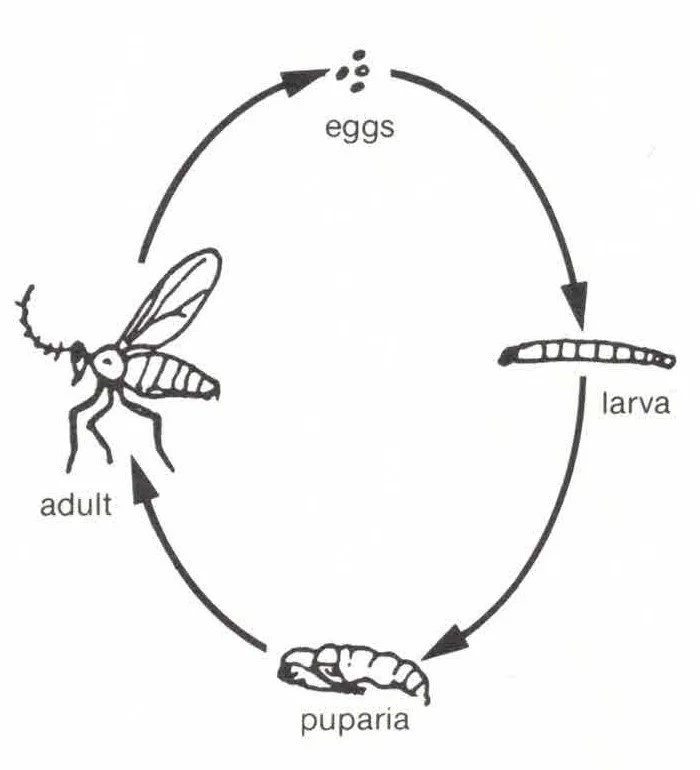
Fungus gnat life cycle
Fungus Gnat Life Cycle
Adult fungus gnats live for about a week. The female gnat lays a lot of eggs in that short time.
Eggs hatch into larvae
Larvae pupate
The cycle repeats
The full life cycle is about 21 days at 24°C (75°F). It takes longer at cooler temperatures.
Understanding this life cycle helps you managing fungus gnats.
You want to break the cycle. To do this, go after the fungus gnats at more than one stage.
Where Fungus Gnats Come From
Fungus gnats can arrive with the soil in new houseplants. They can also arrive with contaminated potting soil. Potting soils aren’t usually sterilized, so it’s possible to have fungus gnat eggs in potting soil.
Control Fungus Gnats on Fig Cuttings
The most common advice for controlling fungus gnats is to water less. That’s because the larvae need moist soil.
This advice works well with houseplants.
But when we’re rooting fig cuttings in potting soil, we want moist conditions so that the cutting does not dry out.
That means we need to use some other tactics to manage fungus gnats with fig cuttings.
Below are a few ways to control fungus gnats on fig cuttings. Use more than one tactic for the best results.
Start Fig Cuttings in Fungus-Gnat-Free Potting Soil
Fungus gnat eggs can come with a batch of potting soil. No big deal for most house plants…but with fig cuttings you don’t want fungus gnats.
So if there’s a chance your you have fungus gnat eggs in your potting soil, sterilize it.
(Commercial potting soil mixes aren’t usually sterilized. That’s fine because, there are often beneficial microbes in them. If you’re confident the soil you’re using is free from fungus gnats, no need to do this.)
On a home scale, you can use heat to sterilize potting soil. A temperature of 180°F (80°C) for half an hour does the trick (as well as destroying weed seeds and disease organisms.)
So you’re probably asking what it smells like if you put soil in your oven! It smells like…soil. And if that’s an issue, just do this on your BBQ.
Pre-Root Your Cuttings

Fig cuttings pre-rooted in a bag. This is a good way to give fig cuttings a head start so that’s there’s a shorter period of time when they’re very susceptible to fungus gnat damage.
It’s as they just begin to root that your fig cuttings are especially susceptible to fungus gnat damage. So one strategy is to pre-root your fig cuttings before you pot them up.
Wrap all but the bottom inch of your fig cuttings in damp paper towel, and then enclose them in a sealed clear plastic bag. (Clear, so that you can watch the progress.)
Then leave the bag at room temperature for root formation to begin.
First you’ll get white splotches forming on the bottom of the cuttings. These eventually turn into roots. And once you have roots formed, you can pot up your rooted cuttings.
(Some people use a similar technique, putting cuttings in a sealed bag with perlite.)
With roots already formed, your cuttings have a good head-start and are likely to outgrow any fungus gnat problems.
Grow Your Fig Cuttings Away from Potted Plants
Knowing that potted plants are often a source of fungus gnats, start your fig cuttings away from potted plants.
Get Your Fig Trees Through Winter—and Harvest Figs
Growing figs where winters are cold takes a bit of creative thinking.
In Fig Camp and the self-paced Fig Masterclass, I explain how to grow figs in pots or in the ground, extend the growing season, ripen more fruit, and protect your trees through winter.
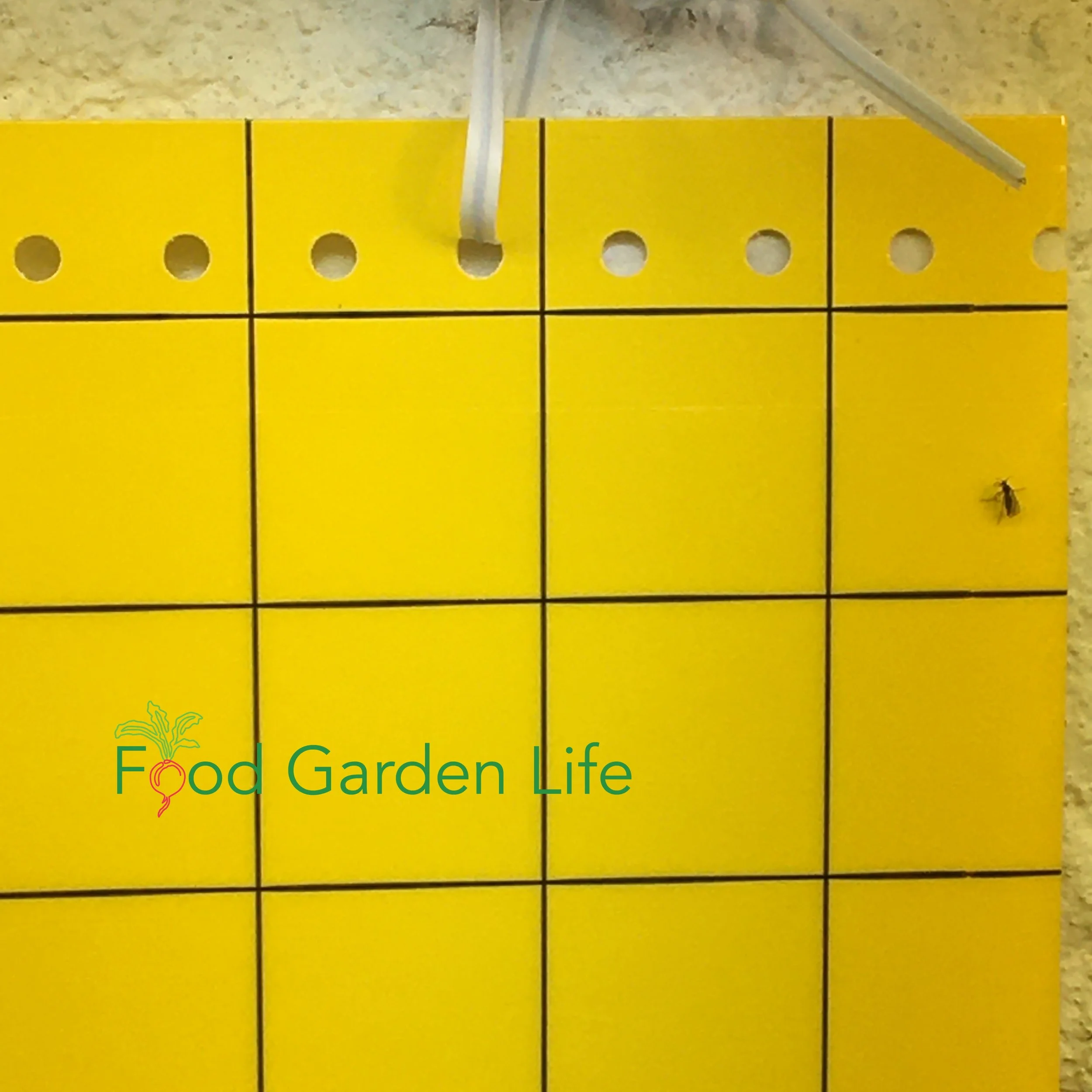
A fungus gnat caught on a yellow sticky trap.
Yellow Sticky Cards for Adult Fungus Gnats
Yellow sticky cards are helpful for monitoring for fungus gnats. They are placed around plants to catch adult fungus gnats.
But sticky traps alone don’t control fungus gnats.
Use sticky traps in conjunction with other fungus-gnat-control strategies.
Nematodes
Nematodes are microscopic worm-like creatures that kill the larval stage of fungus gnats. Buy them from suppliers of biological controls.
Nematodes are applied with water. When you receive them, you’ll mix them with water, and then water them onto the soil.
When using nematodes, keep the potting soil moist as they need a moist environment.

Steinernema feltiae nematodes, used to control fungus gnats.
There are many species of nematode, and some are used for biological control of garden pests such as white grubs.
The nematode for fungus gnat larvae is Steinernema feltiae.
Nematodes have no effect on adult fungus gnats.
More than one application is best. That way you get the larvae in the soil at the time of application, but also larvae that emerge later from eggs.
BT
BT (short for Bacillus thuringensis) is a naturally occurring bacterium.
If you recognize the name, it’s probably because it’s often used for mosquito management—and there is also a type that’s used for controlling caterpillars in the garden.
The BT for fungus gnats is Bti (Bacillus thuringensis israelensis).
Don’t buy Btk (Bacillus thuringensis kurstaki); it’s used for caterpillars.
Depending on the formulation, the BT can mixed with water and watered onto the soil, or incorporated into the potting soil.
The fungus gnat larvae ingest the BT and die.
Repeat weekly, 3 or 4 times so that you get the larvae in the soil at the time of application, but also larvae that emerge later from eggs.
Root Fig Cuttings in a Bag
Plant your fig cuttings in fungus-gnat free soil that’s isolated from fungus gnats in a plastic bag. The damp soil is in the bag, the bottom of the cutting is inserted into the soil, and the top of the cutting sticks out above.
Seal tightly so no fungus gnats can get to the soil.
If you use clear bags, you can see the progress of rooting.
Some people call this the “fig pop” method.
Fungus Gnats and Fig Cuttings: Putting it all Together

Pin this post!
Fungus gnats come with potting soil and house plants. Having them isn’t a sign that you’ve done anything wrong.
And normally they’re not a big deal.
Except they’re a very big problem if you have fig cuttings—because they damage the newly emerging roots.
When you’re managing fungus gnats:
Use more than one control strategy
Repeat treatments so that newly laid eggs or newly hatched larvae are controlled
Remember that one adult gnat flying around can lay lots of eggs…so be diligent.
Keep Growing Figs
Looking for more cold-climate fig-growing ideas? Visit the fig home page to browse articles about varieties, pruning, propagation, ripening, winter protection, and more.
Grow Figs Where You Think You Can’t
My revised and expanded fig book is a practical guide to growing figs in pots and cold climates—from choosing varieties and pruning to ripening fruit and conquering winter.
Find This Helpful?
Enjoy not being bombarded by annoying ads? Appreciate the absence of junky affiliate links for products you don’t need?
This site is reader supported. If it has helped you in your food-gardening journey, you can give us a high-five below. Any amount is welcome.

Hi, We’re Steve and Emma!
We help people grow food on balconies, in backyards, and beyond—whether it’s edible landscaping, a vegetable garden, container gardens, or a home orchard.
Fig Masterclass
This self-paced, virtual Fig Masterclass is hosted by Horticulturist and Cold-Climate Fig Expert Steven Biggs.