
The Fig Jungle Indoors: Meet Eddie Sleem
An indoor fig-growing enthusiast in Dallas, Texas

While researching the revised edition of Grow Figs Where You Think You Can't, I met some wonderfully inventive fig growers.
One of them is Eddie Sleem, in Dallas, Texas.
Eddie's indoor fig-growing adventure began almost by accident. What followed was a growing collection of trees, a lot of experimentation, and a determination to figure out what fig trees really need.
Here's Eddie's story, excerpted from the new book.
The Fig Jungle Indoors
A chat with Eddie Sleem, indoor fig obsessive in Dallas, TX
Eddie Sleem is a fig enthusiast in Dallas, Texas. Already obsessed with figs, he decided he needed a particular variety known for its exceptional flavour. He’d been bidding on it at online auctions—but kept losing. So he bid more aggressively and ended up with two plants of the same variety.
When the first plant arrived, he put it outside. But the weather was poor and it didn’t look so great. So when the next fig arrived a day later, he decided to keep it indoors for a while. It did well indoors. And within a short time, it was miles ahead of the plant outdoors.
So Eddie started researching indoor growing. “It’s not going to work,” people told him. That was a challenge—and the beginning of his indoor fig-growing obsession.
“The tree just kept growing and growing,” he says, adding that after a year it produced 170 figs, while the one he’d started off outdoors gave him 40.
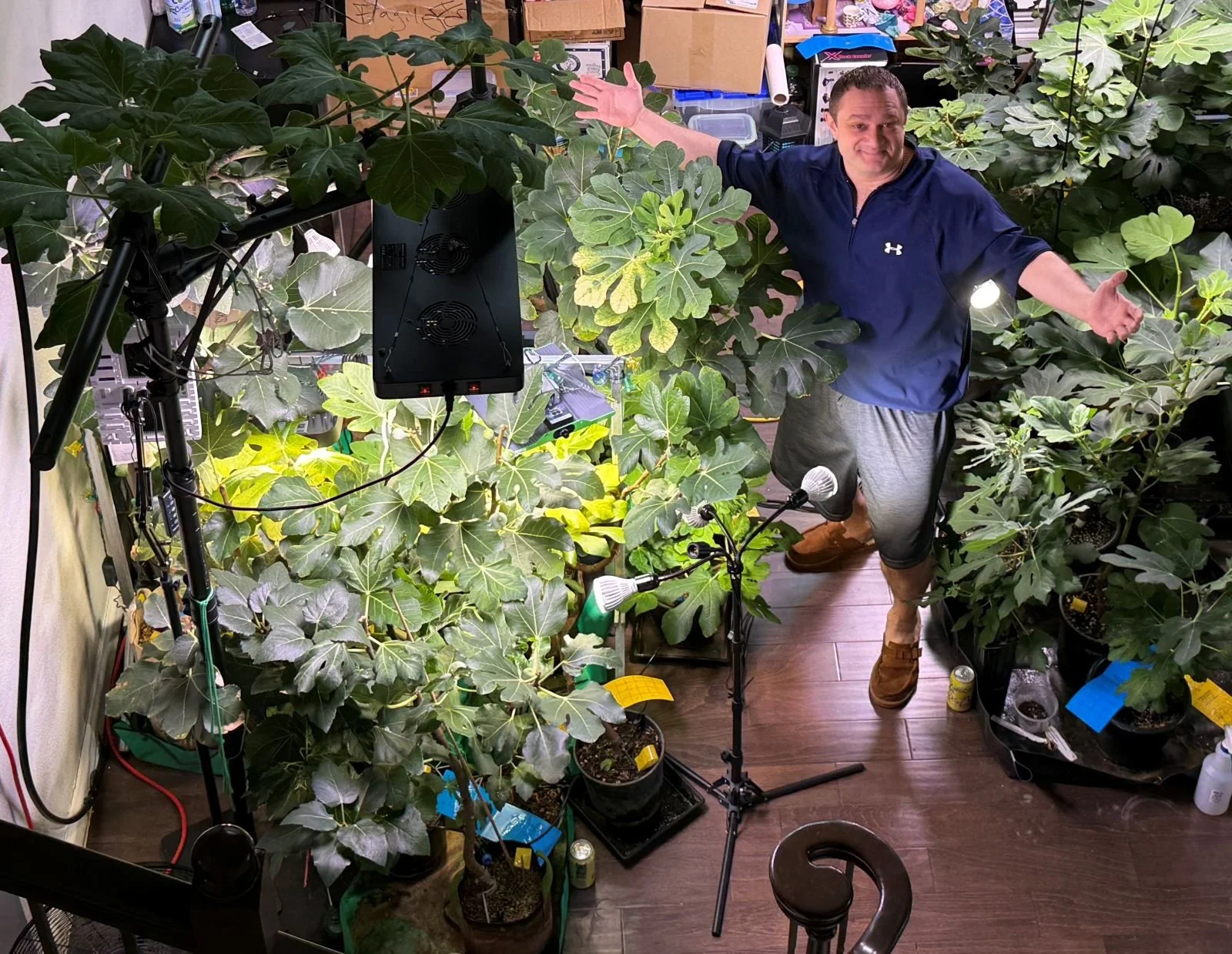
Eddie Sleem amongst his indoor fig trees in Dallas, Texas. Photo: Eddie Sleem.
As we speak, he tells me he’s cut back on his collection, but then counts the plants and realizes he hasn’t really. “Horrible problem,” he says, talking about how much he loves propagating his plants. He currently has about 40 sizable fig trees growing indoors. His setup includes irrigation lines, timers, and grow lights.
When I ask him for three tips for people considering growing figs indoors, he instead dives into his list of the 10 important considerations when growing indoors.
Eddie's 10 considerations for growing figs indoors
LIGHT. Good light is key. His own setup includes overhead lights hung from the ceiling, along with perimeter lights on stands. He uses a light meter to get an idea how much light he’s giving his plants.
HEAT. Warmth is the key for good growth. He considers 24° to 27°C (75° to 80°F) ideal, which his plants get through the winter when the furnace is on, though it’s a bit cooler through the summer. Heating pads and space heaters are simple ways to provide more heat.
SOIL. He blends a potting soil that is well aerated, using generous amounts of pumice and perlite.
FEED. He experiments with many feeds. The key point is that a good feeding program makes a difference.
PESTS. Thrips, spider mites, and fungus gnats can all live quite happily in an indoor setting. “Get a magnifying glass,” he advises.
WATER. Some of his trees guzzle a gallon a day. “Stay on top of it,” he advises, talking about consistent watering.
CONTAINERS. He’s a fan of fabric pots, which are inexpensive and also contribute to root pruning.
AIR QUALITY. Indoor growing spaces can become stagnant. Good airflow helps reduce disease pressure and creates sturdier growth.
CHILL DAYS. Some sources talk about the need for a cold period, but they’ll grow continuously in warm conditions indoors.
SPACE. Think about what sort of space you have. In his case, it’s a large, open space with a cathedral ceiling above, but it could be a smaller space such as a bedroom or office. Some people opt for an indoor tent system.
When it comes to what he wishes he’d known when he started growing figs, he says pruning. Many of his original trees don’t have the shape he’d like because he was too timid to prune. “Cut it!” he says, laughing at how timid he once was with pruning.
Connect with Eddie
YouTube: FiggyEd
FigFanatic.com handle: FiggyEd
More stories from the fig-growing world
Eddie is one of the many inventive fig growers I met while researching the revised edition of Grow Figs Where You Think You Can't.
The new edition brings together their experiences, along with practical advice for growing figs in cold climates, containers, and places where people don't expect figs to thrive.
Explore the new edition of Grow Figs Where You Think You Can't →