Growing Figs in Quebec: A Family’s Journey into Greenhouse Innovation
This episode is in French. English transcript below.
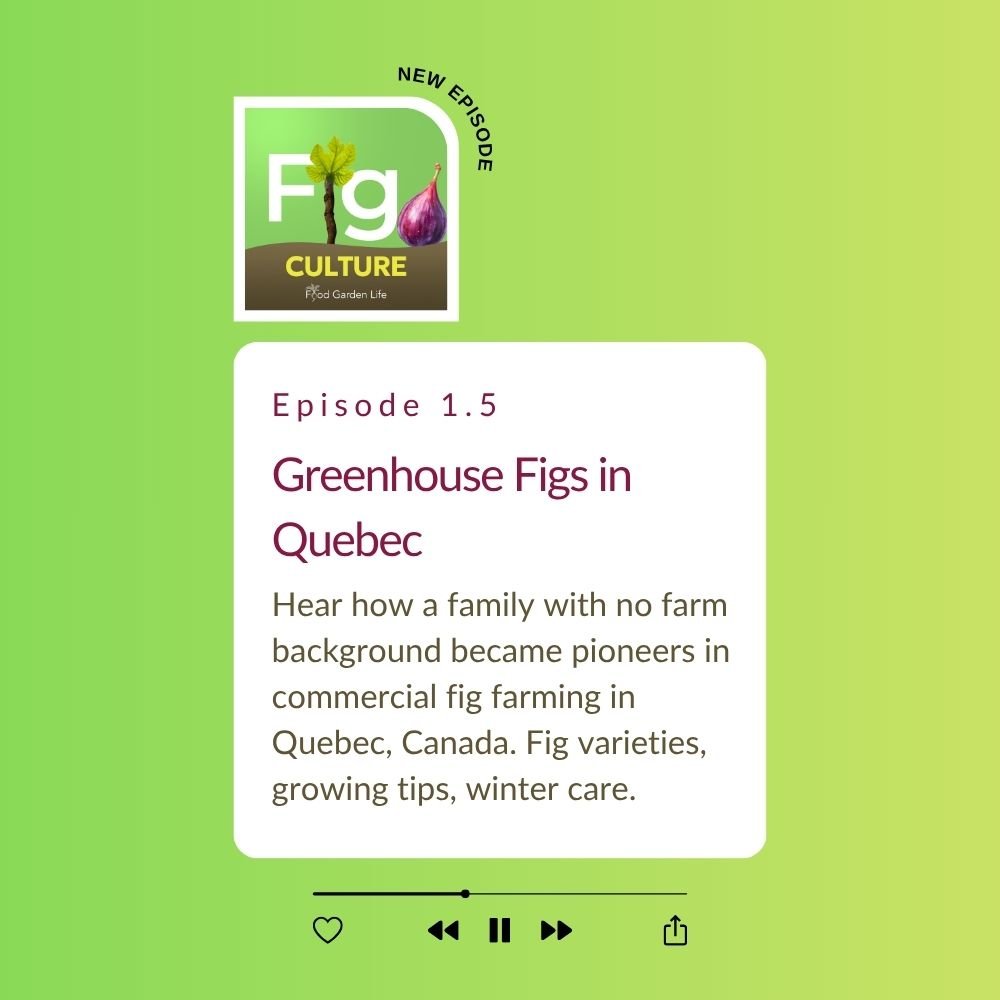
Fig Farming in Canada!
How do you go from curiosity to becoming a pioneer in commercial fig production?
In this episode, I speak with Anne-Marie Proulx of La Vallée du Moulin about how she and her family built a fig-growing operation from the ground up. What started as an interest turned into a passion—and eventually a business focused on producing figs where they’re not winter hardy. In Quebec!
Anne-Marie shares the story behind the operation, what it takes to grow figs commercially, and how their work changes throughout the seasons. We also get into her favourite fig varieties and practical advice for anyone interested in growing figs at home.
Whether you're a gardener, a small-scale farmer, or just curious about how niche crops become viable businesses, this episode offers a fascinating look into a unique agricultural journey. English transcript available below.
Cultiver des figues au Canada !
Comment passe-t-on de la curiosité à devenir un pionnier de la production commerciale de figues ?
Dans cet épisode, je m’entretiens avec Anne-Marie Proulx de La Vallée du Moulin à propos de la façon dont elle et sa famille ont bâti une exploitation de culture de figues à partir de zéro. Ce qui a commencé comme un simple intérêt s’est transformé en passion — puis en une entreprise axée sur la production de figues dans une région où elles ne sont normalement pas rustiques en hiver. Au Québec !
Anne-Marie partage l’histoire de leur exploitation, ce qu’il faut pour cultiver des figues à l’échelle commerciale, et comment leur travail évolue au fil des saisons. Nous abordons également ses variétés de figues préférées ainsi que des conseils pratiques pour toute personne souhaitant en cultiver à la maison.
Que vous soyez jardinier, petit producteur agricole ou simplement curieux de savoir comment des cultures de niche peuvent devenir des entreprises viables, cet épisode offre un regard fascinant sur un parcours agricole unique.
English Translation
This transcript has been translated from French and lightly edited for clarity.
Figs in Quebec? How did that Happen?
Steven Biggs:
Hi Anne-Marie, and welcome to the Fig Culture podcast! I’m really happy to have you with me today.
Anne-Marie:
Hi Steven, thank you so much for the invitation, I’m really happy to be here.
Steven Biggs:
To start, you somehow ended up producing figs commercially in Quebec, of all places.
Anne-Marie:
Yeah, actually, just to clarify something—it’s not just me. La Vallée du Moulin is really a big team. It’s actually my family—we started all of this together. There are five co-owners: my father, my two sisters, my brother, and me. And we also have a great team of seven employees, most of whom are seasonal. So it’s definitely not just me producing figs. To go back to your question—how did it start? At the very beginning, La Vallée du Moulin was primarily an electricity producer. We have two small hydroelectric power plants on our site. We’ve been producing electricity since the early 2000s, and then later on, around 2010, we started to produce honey and maple syrup, but on a small scale.
Around 2015, we decided to tackle a project that would bring everyone together, something the whole family could be involved in. And one of the big advantages of producing our own electricity is that it makes running greenhouses possible. So we thought about greenhouse crops. But we didn’t come from an agricultural background—no one in the family is an agronomist or anything like that—my father is an engineer by training, and I’m a math teacher. We wanted to do something different. We approached agriculture from a different perspective, and we saw figs as a business opportunity in Quebec.
The idea actually came from a trip my father took to France in 2015. He tasted a fresh fig for the first time in his life and completely fell in love with it. So when we were looking at greenhouse crop ideas, we thought about figs. We did a lot of research, because nobody was growing them commercially in Quebec before us, and eventually we decided to go for it.
In 2018, we bought 1,200 young fig plants that were grown in vitro, and then we officially launched the project with the construction of our greenhouses in 2019. So that’s really how it started.
And figs—Steven, I know you already know this—but they’re a “fruit” in quotation marks, since technically they’re not a true fruit, but they’re highly sought after in fine cuisine. We had also noticed that fig imports were increasing, and that there was growing interest in figs over the past few years. People are becoming more and more familiar with them. So that was part of the reason, but also the fact that figs stop ripening once they’re picked. So imported figs are often disappointing in terms of quality. We saw an opportunity to offer high-quality figs on the Quebec market.
And it’s also a crop that’s relatively resistant to diseases and pests—although, of course, in a greenhouse, there are still some challenges. But overall, those are the reasons why we decided to go into it.
Steven Biggs:
I find that really interesting. So your whole family comes from outside the agricultural industry?
Anne-Marie:
Yes, exactly.
Steven Biggs:
At the beginning, how did people around you react when you started growing figs?
Anne-Marie:
We didn’t have many people in our circle from the agricultural world. So the reactions were more like, “Oh yeah? Figs? Really?”
But when it came to people in horticulture—because we signed up for a lot of training and got in touch with people in the greenhouse industry in Quebec—I saw a lot of surprise, and I’d even say disbelief at the beginning. And we were complete beginners, so at first I didn’t really understand why people thought it was so strange to grow figs in greenhouses. But eventually I realized that in Quebec, greenhouse production is like… I’d say 95% cucumbers, tomatoes, and peppers. That’s really what you see most of the time.
So we were definitely doing something different.
Once we had built our greenhouses and started selling our first figs, our first real commercial season was in 2022—even though we bought the fig trees in 2018. We knew it would take five to seven years for them to reach maturity.
When people started to see that we were actually producing figs, that’s when we really felt a lot of excitement around the project, and a lot of support from people in the industry. From suppliers, people in agriculture, financial partners… We’ve been working with a consultant from the IQDHO since the very beginning—the Institut québécois du développement de l’horticulture ornementale. We’ve always surrounded ourselves with experts—not fig experts, because there aren’t any here—but agronomists and people with agricultural experience. And over time, there’s been a real enthusiasm for what we’re doing.
Sources of Fig-Growing Information
Steven Biggs:
So you really are pioneers of greenhouse fig production in Quebec. Have you found other sources of information?
Anne-Marie:
There really aren’t any resources specifically about growing figs in greenhouses in northern climates—we haven’t found any. If you know of any, Steven, we’d love to hear about them!
But what does exist are studies from places like Morocco, France, and Mexico. And there are books too—I saw that you’re writing one yourself about growing figs in northern climates. So we’ve tried to draw from all those sources, but only where they could apply to our situation, because a lot of it doesn’t translate directly to our conditions.
So we’ve relied heavily on experts, agronomists, and a lot of research and development. And honestly, we’re still doing R&D—it’s a huge part of what we do.
Because there are so many parameters that influence fig production in greenhouses. So it’s really about adjusting all those variables to try to get the best possible results.
Learning Along the Way
Steven Biggs:
Have you made a lot of mistakes along the way?
Anne-Marie:
Oh yes—lots of them. But we don’t really see them as mistakes. We see them as learning experiences. We’ve learned a huge amount over the years.
Between 2018 and 2022, while the trees were growing, it wasn’t as intense—we weren’t all working full-time on the project yet, and we weren’t harvesting fruit. But starting in 2022, that’s when the real learning began, because we were finally producing figs and bringing them to market.
So yes, we’ve had a lot of major learning moments—and it’s not over yet. What’s challenging is that everything works in cycles. When we test something in our R&D, it takes a full season to see the results. So a year goes by, then we say, “Okay, next year we’ll try it this way,” but we only see the outcome the following year. So it takes a long time to fine-tune everything and really optimize production.
We’re not at 100% yet. When people visit us, I tell them—we don’t call ourselves fig experts, because we’re still learning. But we’re starting to get pretty familiar with it.
Steven Biggs:
Yeah, I imagine it takes time—figs take longer than tomatoes, for example.
Anne-Marie:
Yes, the cycle is much longer.
Fig Varieties
Steven Biggs:
What varieties of figs are you growing now?
Anne-Marie:
We grow a lot of different varieties. The ones people are most familiar with on the market are usually… well, people call them “dark figs,” but often it’s Black Mission—that’s what you often see in imported figs. We always tell people: yes, we grow Black Mission, but it’s actually not our favourite.
We have around twenty varieties in our greenhouses, and I’d say about a dozen of those are grown in larger quantities. For example, Violette de Bordeaux is definitely one of our favourites. There’s Black Mission, like I mentioned, Brown Turkey, Chicago Hardy—we really like that one—Desert King, LSU, Lattarula… So those are the main ones we grow in larger volumes.
We also have other varieties in smaller quantities that we’re still testing, like Black Madeira, Galicia Negra, Gloria… And honestly, there are so many varieties—it’s hard to keep track. When people visit, we tell them there are hundreds, even thousands of fig varieties out there.
So our goal is really to find the ones that best fit our needs. Of course, we want to optimize production, so we’re looking for varieties that perform well in greenhouse conditions. But we also process some of our figs, so that influences our choices too. For example, Magnolia is a large fig—at least in our greenhouses—and it’s a bit less sweet. So it’s not as ideal for fresh sales, but it’s great for processing. We use it for our fig spread and fig paste. So that’s a variety we’ll definitely keep because it’s very productive for that purpose. Whereas for fresh figs, Violette de Bordeaux is excellent, and Chicago Hardy, which is smaller for us but very sweet. So we’ve started to really understand which varieties work best for fresh eating and which are better for processing.
Steven Biggs:
And do you have a personal favourite?
Anne-Marie:
Yes—mine is Chicago Hardy. Even within the same variety, figs can vary, but for us, they’re small, very, very sweet, and dark red inside.
I always tell people—when they buy our fresh fig baskets, they’re what we call a “chef’s selection,” so it’s a mix, not just one variety. But those little Chicago figs? They’re like candy. They’re my favourite. The Dorée is really, really good too. Honestly, they’re all good. When people ask me which one is best, I always say—we have several favourites. There isn’t a fig I don’t enjoy.
Steven Biggs:
I agree—they’re all good.
Anne-Marie:
Exactly.
The Fig-Growing Year
Steven Biggs:
What does a fig season look like for you?
Anne-Marie:
For us, the season actually starts as early as February.
Right now, we’re around March 20, and it’s already been about a month since we started increasing the temperature in the greenhouses, so we’ve begun waking the fig trees up. We turn on artificial lighting to extend the photoperiod, so the trees think it’s already the warm season and start growing. So it all begins at the end of February. That’s when we take cuttings.
Then very quickly, everything turns green in the greenhouses—within a month, the canopy is fully developed.
And we start seeing the first small figs appear.
Around May or June, we already have our first harvest, but it’s only about 5 to 10% of our total production.
It’s not the main crop—that’s the breba crop, which is more fragile. And depending on how we prune, we often sacrifice it anyway. So in May and June, we have small harvests—just enough to offer tastings, since we already start welcoming visitors at that time.
But the main season really begins around mid-July. Last year, it started around July 20. We had an amazing summer—very hot, very sunny—the perfect conditions for figs. So from mid-July onward, that’s when the real season begins, with the main crop. We harvest until the end of September, sometimes even mid-October.
Last year, because of all the sunshine, the harvest moved faster, so we actually finished closer to the end of September.
Then gradually, as production slows down, we lower the temperatures and stop using artificial lighting in the evenings. Around mid-November, the trees go dormant—they lose their leaves, and that’s when we start our winter maintenance and prepare for the next season.
Steven Biggs:
Fresh figs in May—that’s incredible.
Anne-Marie:
Yeah, last year we even ate one in April. That was exceptional. It was a tiny fig we had left on the tree from the previous season. We kept it through the winter, and it started growing again, so we ended up eating it in April.
But really, like I always tell visitors—if you want to be sure to leave with fresh figs, you should come around mid-July. Before that, it’s still a great place to visit—you can see the trees and everything—but the real harvest starts mid-July.
Customer Education
Steven Biggs:
Do you find there’s a lot of customer education involved?
Anne-Marie:
Oh yes, absolutely. It’s actually something we didn’t fully realize when we started growing figs. There’s a lot of education to do around figs in Quebec. I don’t know what it’s like in Ontario, but here, people are starting to become more familiar with fresh figs.
People from other countries—Europeans, for example—they know figs really well, and they’re excited to come and eat them here because it reminds them of their childhood. And people who have travelled—like someone who says, “I went to Greece and ate figs straight from the tree”—they understand what fresh figs are. But a lot of people still think figs are just dried figs.
And dried figs… honestly, I’m not a big fan. I’m sure some are good, but I always tell people—it has nothing to do with fresh figs. Just wait until you taste one at the end of the visit—you’ll see how different it is.
So yes, there’s a lot of education. We grow many different varieties, and they come in all kinds of colours. Some figs are green when they’re ripe, and people think those aren’t ready yet. But we explain that figs don’t ripen after being picked, so they have to be harvested ripe. That’s something we have to explain a lot. There are plenty of other things too, but what’s nice is that people are curious—they really want to learn when they visit.
Steven Biggs:
Yeah, it’s true—dried figs are completely different.
Anne-Marie:
Totally different.
And there’s another thing people often worry about—the whole fig wasp story.
They’re afraid of eating wasps in the figs. But we reassure them—we don’t have the blastophaga wasp here, and our varieties are self-fertile. But all of that fascinates people. Figs are actually one of the oldest cultivated fruits in the world, so they have a really long and rich history.
Steven Biggs:
That’s interesting—I hadn’t really thought about that.
Anne-Marie:
Yeah, we talk about it a lot here because people find it really intriguing.
Value-Added Fig Products
Steven Biggs:
What kinds of products do you make from your figs?
Anne-Marie:
I’d say our flagship product is still fresh figs. Last year, we had a really good harvest, but in previous years, our trees weren’t fully mature yet, so quantities were limited—and people were literally snapping them up. This year, we’re planning to triple our production compared to last year, so hopefully it’ll be another great season.
Besides fresh figs—which we also sell through a distributor to restaurants, since there’s a lot of demand—our main processed product is our fig spread. We call it a spread rather than a jam because it’s less sweet. We really developed it with cheese and charcuterie in mind. That’s the world we fit into, since cheese and charcuterie boards are so popular right now, and figs pair beautifully with cheese. So the fig spread is a great accompaniment. It’s basically our figs with a bit of cane sugar—and honestly, you can eat it straight with a spoon too.
We also make fig paste, which is another product our customers really love. It’s inspired by quince paste.
Again, it’s meant to go with cheese, but it’s a bit sweeter and firmer. We use agar in it, so you can slice it into thin pieces and serve it with cheese. So those are our main fig-based products.
We also use fig leaves. I don’t know if you’ve ever tried an infusion made from fig leaves, Steven?
Steven Biggs:
Yes—delicious.
Anne-Marie:
Right? We realized it’s something really worth developing. When you infuse fig leaves, the flavours I personally notice are coconut and a bit of vanilla. There’s still a green, herbal note—like a tea—but it’s really interesting.
So we make a fig leaf syrup, and we also have a fig leaf sorbet made for us by someone who specializes in that.
We’ve also developed teas and herbal infusions using our fig leaves.
So when you visit our shop, it’s really the whole world of figs. We try to have everything revolve around the fig and the fig tree as much as possible. There’s so much potential there, and people are really interested in fig-based products. And of course, we also sell young fig trees in our shop.
Steven Biggs:
That’s great. Fig leaves infused in vodka is good too!
Anne-Marie:
Oh yeah?
Steven Biggs:
Makes a great vodka.
Anne-Marie:
I can imagine! Or maybe in gin—but we’re not quite at the point of making our own gin yet.
Steven Biggs:
I even use it in panna cotta.
Anne-Marie:
Oh, I’m sure that’s amazing.
Ramping Up Production
Steven Biggs:
You mentioned that your production will triple this year.
Anne-Marie:
Yes, that’s the goal. Our fig trees were planted in 2018, and they were really small back then. We knew it would take five to seven years for them to reach maturity. So if you count forward, last year was about when they should have reached that stage.
That, combined with everything we’ve learned through our research and development, means we’re now in a position to increase production significantly. So this year, we’re aiming for three times last year’s output. And then the following year, we’re aiming to double that again. We’re not at full production capacity yet, but every year we want to increase until we get there. If we can get to a harvest of 10,000 kilos of figs from the greenhouses, we’ll be very, very happy.
Tips for Growing Figs at Home
Steven Biggs:
For someone just starting out with figs in the garden—what are your best tips?
Anne-Marie:
We get that question a lot, especially since we sell fig trees. People often ask us what kind of fertilizer we use.
But it’s hard for us to give a direct answer, because in our case, we use soluble fertilizers and custom recipes—it’s not something that easily translates to home growing. So we try to keep things simple for everyday gardeners.
The first thing I usually recommend—and even more so after reading your blog, Steven, which has a lot of really detailed and well-explained information—is to go online, read, and watch videos. There’s so much information available now. There are even Facebook groups for fig growers in Quebec, with tons of advice being shared.
Of course, you have to take some of it with a grain of salt—not everything you read online is accurate—but overall, there’s a lot to learn. We also have our own care guide on our website. When people buy a fig tree from us, they can scan a QR code to access it.
As for our main recommendations:
We recommend growing figs in containers, rather than planting them directly in the ground. Even though some people do plant them in the ground—like one Italian visitor we met who would actually dig a trench and bury his trees for the winter—it’s much more complicated. So containers are easier, ideally made of breathable fabric like geotextile, which allows the roots to get air.
We also recommend using well-draining soil, with materials like coconut fibre, to prevent compaction.
For fertilizer, a simple organic granular fertilizer from a garden centre works well.
And sunlight is absolutely key—fig trees love full sun, you can’t really give them too much.
Watering should be adjusted based on sunlight and the type of container, and you should let the soil dry out a bit between waterings.
But the most important thing, by far, is wintering.
Fig Trees Over the Winter
The most important point—the one we spend the most time explaining—is wintering. Because fig trees in Quebec obviously can’t survive winter outdoors on their own. You have to do something to protect them. There are some hardier varieties that can tolerate temperatures down to around -5°C—I think Chicago Hardy is one of them—but we’ve never actually tested that ourselves.
For us, we keep our fig trees at around 5°C. So we recommend finding a space that stays between 0 and 10°C during dormancy. Of course, not everyone has access to an unheated garage, but that’s really the ideal setup. A cold room works too.
Otherwise, there’s another option—which we’ve tried several times and it works well—using insulating covers.
So you take a potted fig tree, lay it on its side just before the first snowfall, and cover it with a proper horticultural blanket. Not a blanket like you’d have on your couch—one intended for horticulture and gardening. Then you uncover it in the spring. We’ve wintered trees this way many times, and it works. So that’s really the key point: wintering.
Because some people think, “Oh, I’ll just bring it inside the house,” but at 20°C, the tree won’t go dormant.
And it gets a bit tricky—some visitors have told me their fig trees didn’t go dormant for three years and still produced fruit. So maybe it can work in the short term, but in the long run, it’s not the best way to maximize production. Fig trees really need that dormancy period. So that’s basically our advice.
And of course, you also need to monitor for pests. Although outdoors, pests are less of an issue than in greenhouses. For example, in our greenhouses, once we take the fig trees outside, the rain kind of cleans everything off. One major pest for us is mealybugs—they’re our number one enemy in the greenhouse.
But as soon as the trees go outside, they basically disappear. They thrive in warm, humid environments, so the greenhouse is perfect for them. So yes—keeping an eye on pests is important, just to prevent infestations.
Steven Biggs:
Great advice.
Anne-Marie:
I’m sure you have plenty to add as well!
Looking Ahead
Steven Biggs:
How do you see the future of fig growing in Quebec?
Anne-Marie:
I see our future very positively. Like I said, I really hope we’ll reach the production goals we’ve set for ourselves. But I’d also like us to capture a larger share of the market.
That said, we’ll never be able to meet the full demand for figs in Quebec—and we’re not trying to be everywhere, like in every grocery store. That’s not our goal. But I do hope the demand continues to grow, because figs are becoming more popular, and they’re really a fruit worth discovering.
And in a few years, I hope others will start growing figs here too. Once we’ve paved the way a bit, I’m sure others will follow—and that’s a good thing. There’s so much demand that the market is wide open. Of course, there are imported figs, but once you’ve tasted locally grown figs, it’s hard to go back to store-bought ones that are less flavourful and often a bit tired from transportation.
Steven Biggs:
So where can people find La Vallée du Moulin online?
Anne-Marie:
We have an online store where you can find all our products. We also produce maple syrup and honey, so those are available too. And we didn’t mention it earlier, but we also have body care products—like fig soap—so we have a whole fig-based skincare line as well. All of that is available online.
As for fresh figs, we don’t ship them, since they’re too fragile and we wouldn’t be able to guarantee quality.
We’re an agrotourism destination—we’re open from around June 25 until the first weekend of October, from Thursday to Sunday. So people can come pick up figs directly from us.
We also sell at a few local retail locations during peak season, mainly in the Eastern Townships.
And we offer guided and self-guided tours, where we explain everything about fig cultivation, as well as our energy systems—we actually use seven different energy sources to heat our greenhouses, to be as energy-efficient as possible. So it’s really a full experience when people visit.
Steven Biggs:
Thank you so much for taking the time to talk with me—this was really fascinating.
Anne-Marie:
Thank you so much for the invitation, Steven—it was a real pleasure.