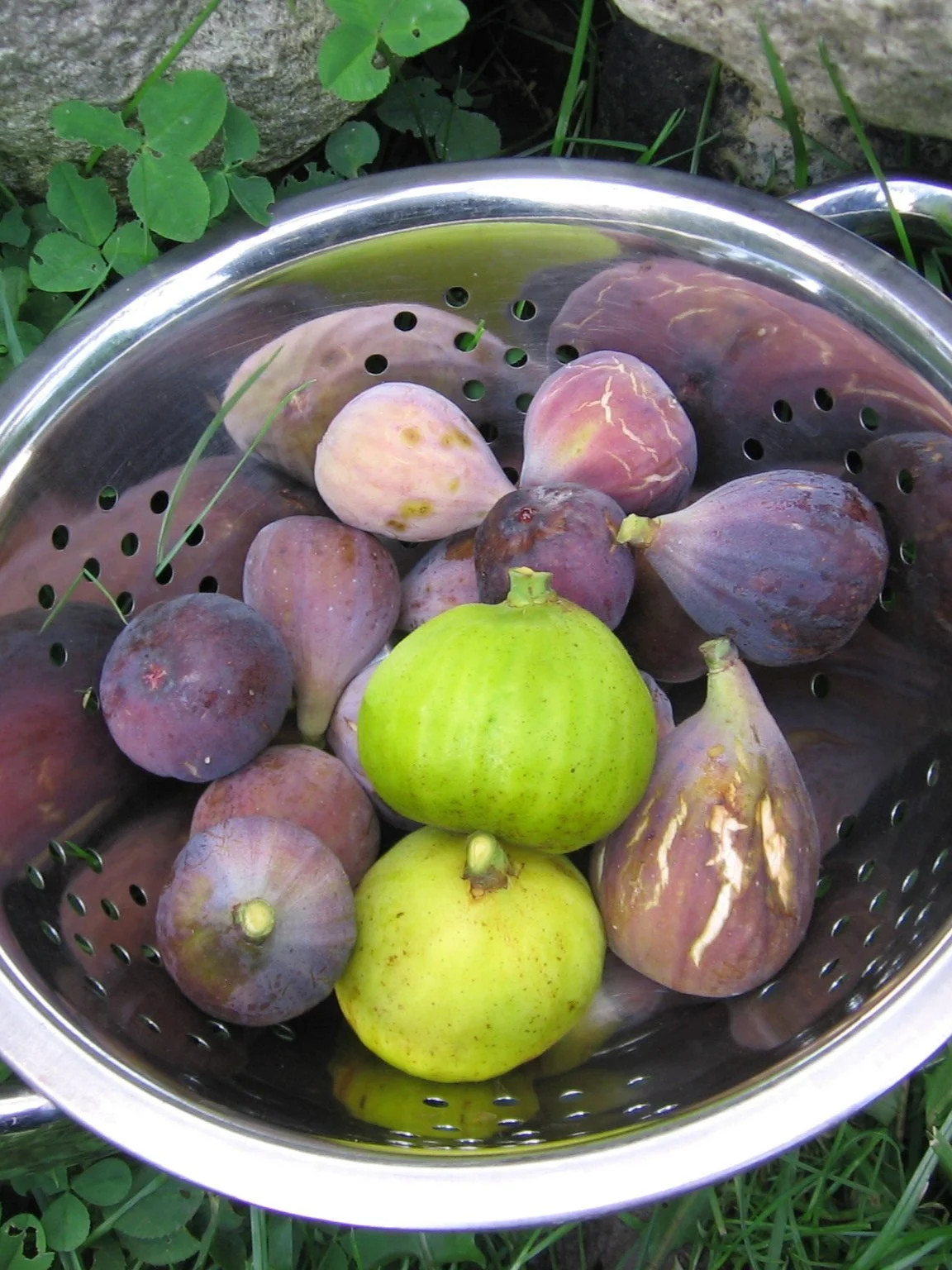
Wake Up! Caring for Fig Trees in Spring
How to care for potted fig trees in the spring, as they come out of dormancy.
By Steven Biggs
How to Care for Potted Fig Trees in Spring

Care for a fig tree in spring. Waking up and caring for potted fig trees in the spring.
It happens every spring: The weather is warm so I move my potted fig plants out of the garage and onto my driveway. It’s time to wake up!
Then…we get a frost warning or cold winds. So I haul my fig plants back into the garage.
I call it the springtime fig shuffle. Some people call it the dance of the figs.
Whatever you call it, it’s heavy work.
But there’s a good reason for the shuffle: Even though dormant fig trees withstand frost, fig trees that are waking up are damaged by frost.
If you’re wondering what to do with your potted fig trees in the spring, when to uncover fig trees, and when fig trees come out of dormancy, keep reading for tips and ideas.
Why Wake up Fig Trees if There’s Still a Risk of Frost?
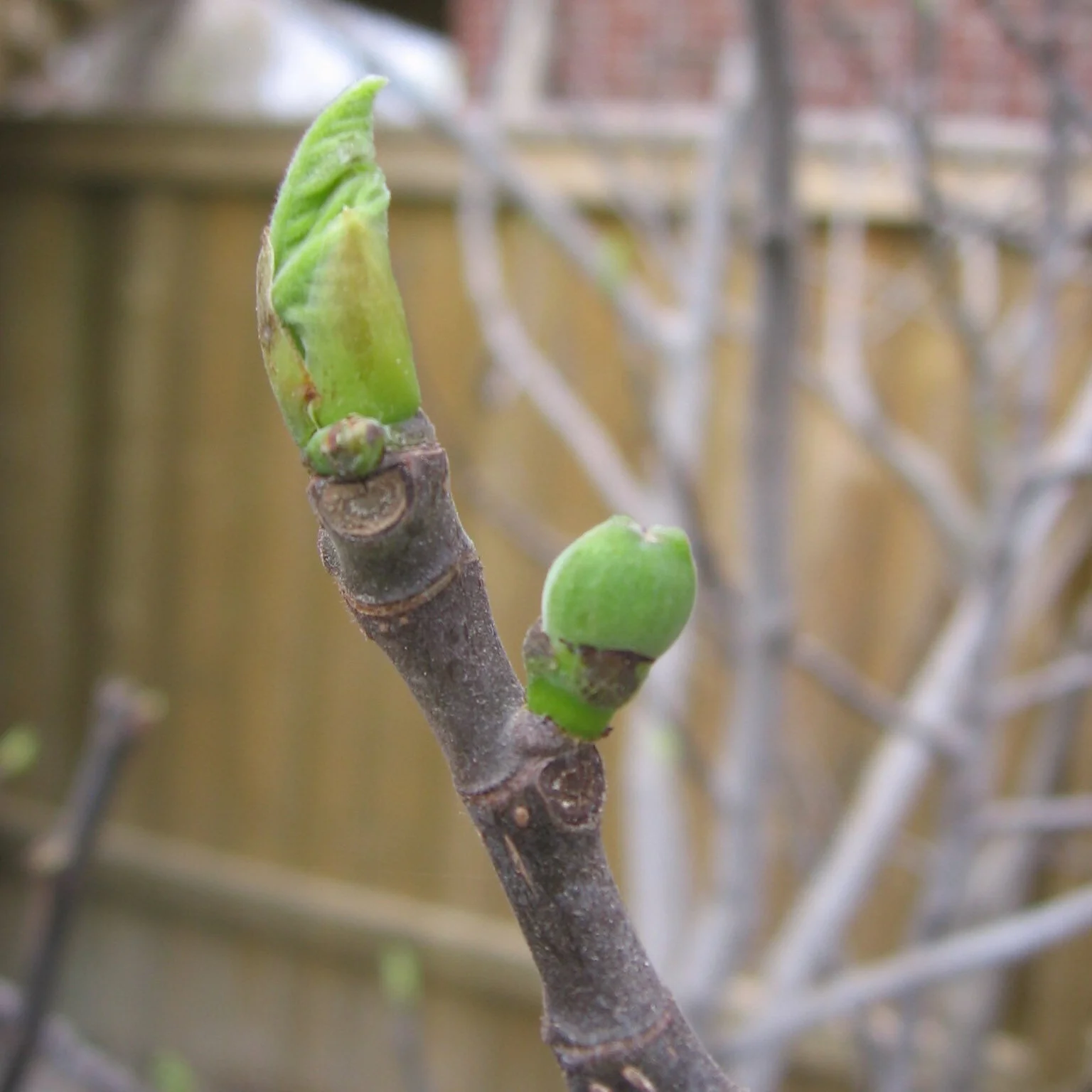
The weather is warm so I move my potted fig plants out of the garage and onto my driveway. It’s time to wake up!
It would be easier to wait for frost-free weather before moving potted fig plants outdoors. Here’s why not to wait:
Earlier Harvest. Season length limits fig harvests in cold climates. An early start gives more time for figs to ripen before the season is over.
Good Growth. Sometimes fig plants wake up early and start to grow indoors, in dim light. That gives lanky growth. But the bright light outdoors gives compact growth.
Did your fig tree wake up too early and you’re wondering what to do now? Here are tips for caring for fig trees that wake up early.
Top Tip: Spring Fig Care
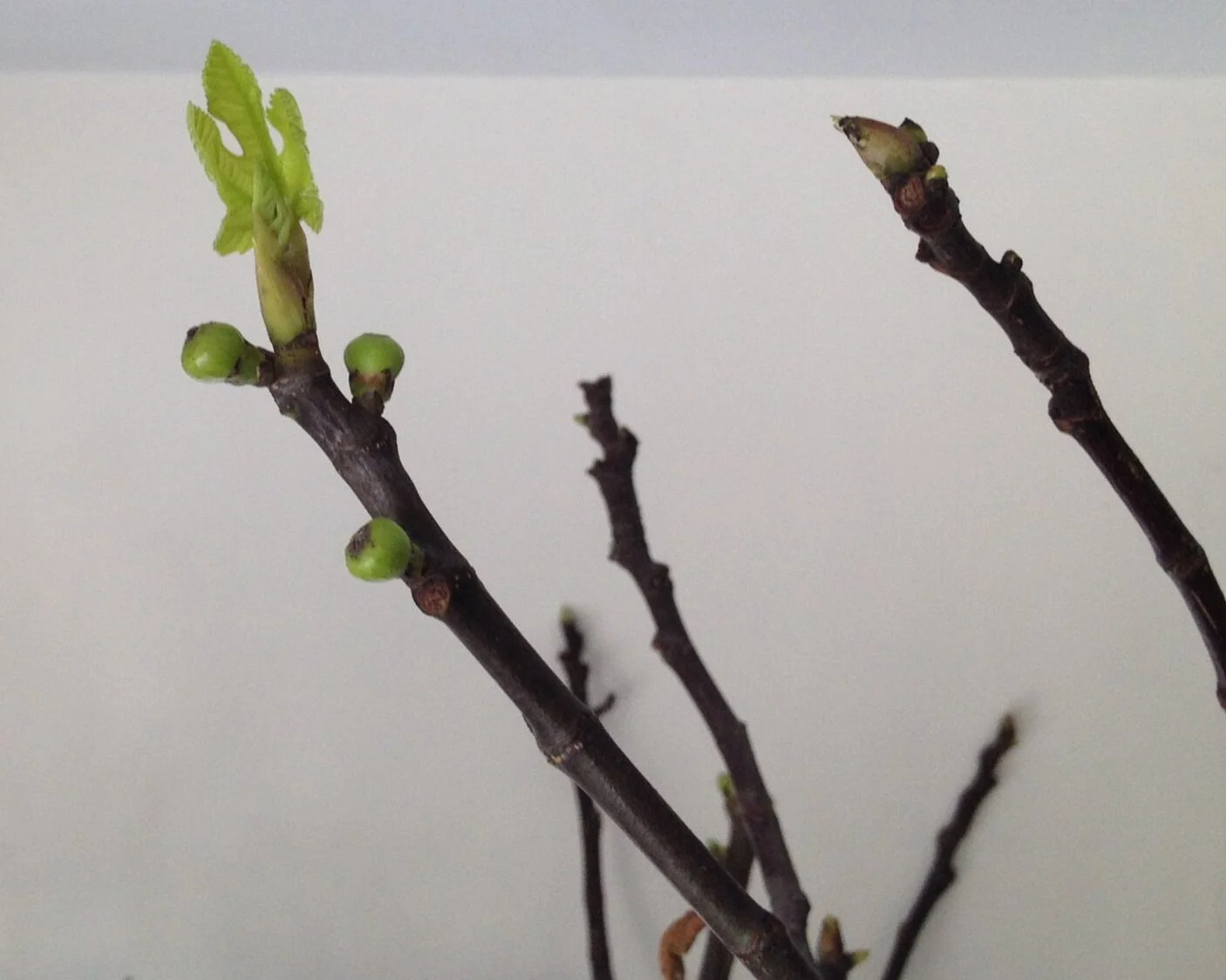
Sometimes fig plants wake up early and start to grow indoors, in dim light. That gives lanky growth. But the bright light outdoors gives compact growth.
Treat your fig plants like tender annuals once they begin to come out of dormancy and buds start to swell. Protect them from frost and cold wind.
That’s because their cold tolerance decreases as they wake up.
How Early to Wake Up Figs?
An early start is always good – as long as it suits you, and your style of gardening.
Do what works in your situation. If you’ll be away in the spring and can’t do the dance of the figs when there’s a frost warning, it might be better to wait.
Waking up Your Figs
When your dormant fig trees get warmth and light, they start to wake up and grow.
To start waking up my figs while they’re still in the garage, I raise the temperature. Then, as buds start to swell, and as we get warm, bright days, I take them out of the garage and onto my driveway.
I wake up my potted fig trees about a month before our frost-free weather arrives. Some cold-climate fig growers do it earlier (some even set up artificial lighting to give their figs trees a very early start).
An early wake-up is especially useful when growing varieties that ripen late in the season.
A Protected Space Helps
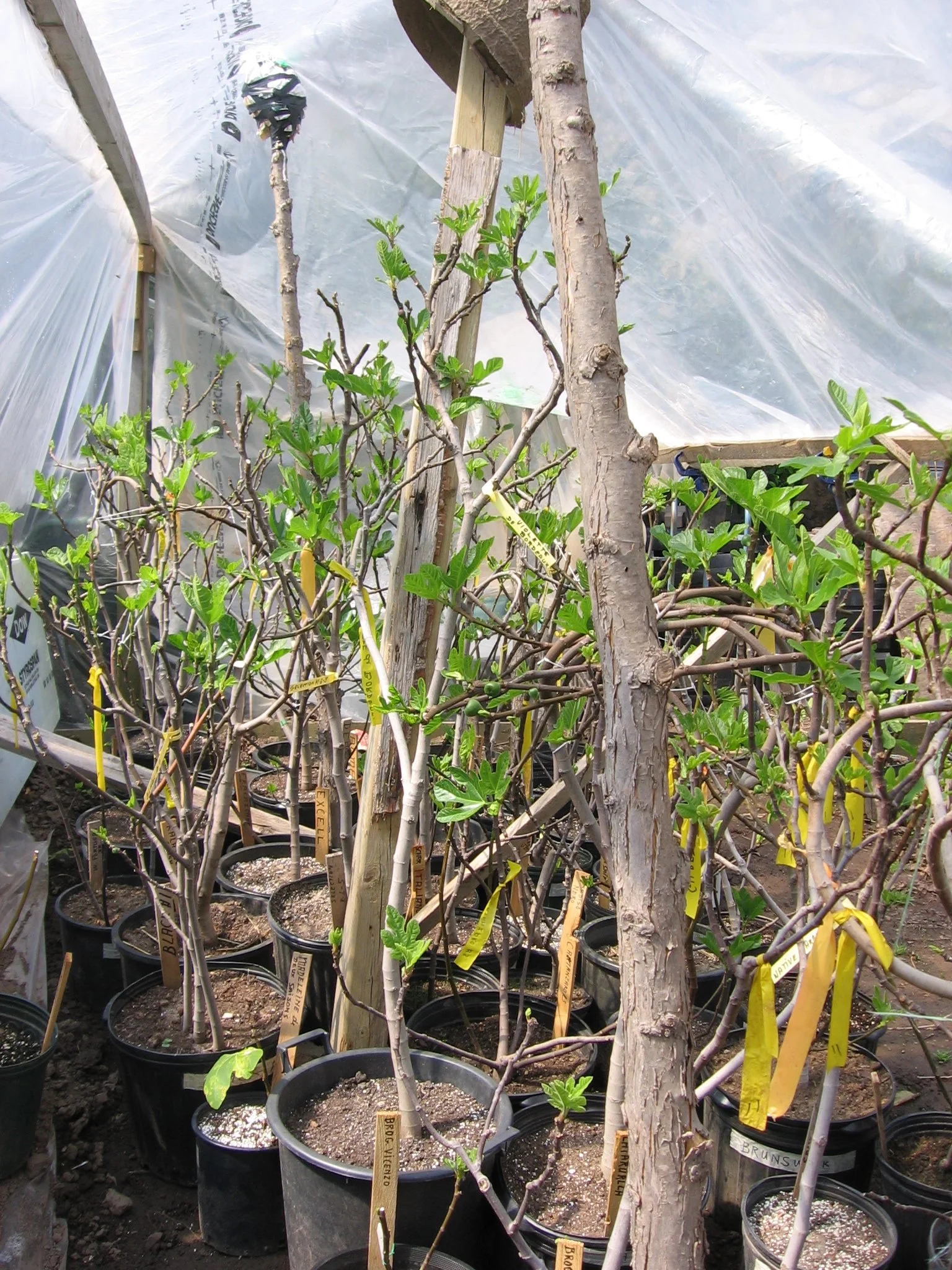
A bright, protected space like this temporary greenhouse can save you shuffling around potted fig plants on cold nights.
If you want to wake up your fig plants early but want less work, a bright, protected space can save you shuffling around potted fig plants on cold nights.
That bright, protected space could be a three-season sun porch. Sun porches often freeze over the winter, but in the spring they provide figs bright conditions and usually stay above freezing.
A protected space could also be something temporary, such as a hoop house, lean-to, or temporary greenhouse.
But if you don’t have this sort of protected space, you just do the dance of the figs.
What if there is a Risk of Frost?
When the forecast is for freezing temperatures, I move my potted fig plants back into the protection of the garage.
But what if the forecast is for a temperature that will be a couple of degrees above freezing? In that case I drape a blanket or sheet over my fig plants…just in case the forecast is wrong.
And remember: Some parts of your property might have a “microclimate” and be slightly warmer than others.
Get Your Fig Trees Through Winter—and Harvest Figs
Growing figs where winters are cold takes a bit of creative thinking.
In Fig Camp and the self-paced Fig Masterclass, I explain how to grow figs in pots or in the ground, extend the growing season, ripen more fruit, and protect your trees through winter.
Harden Off Figs that Start Growing Indoors
Even if you supply artificial light to your fig plants indoors, they should be “hardened off” before placing them in full sunlight outdoors.
Hardening off just means gradually getting the plant used to bright sunlight, cooler temperatures, and wind.
If you have a shaded spot, that’s a great place to start hardening off your fig plants. I have an overhang off of my garage, and the area underneath it gets a couple of hours of morning sun. That’s where I harden off any figs that have started to grow indoors. Their tender buds and little leaves won’t get scalded by strong sun or cold wind.
If your fig plants are still dormant when you move them outdoors, they are less fragile than plants with small leaves.
FAQ: Fig Plants in Spring
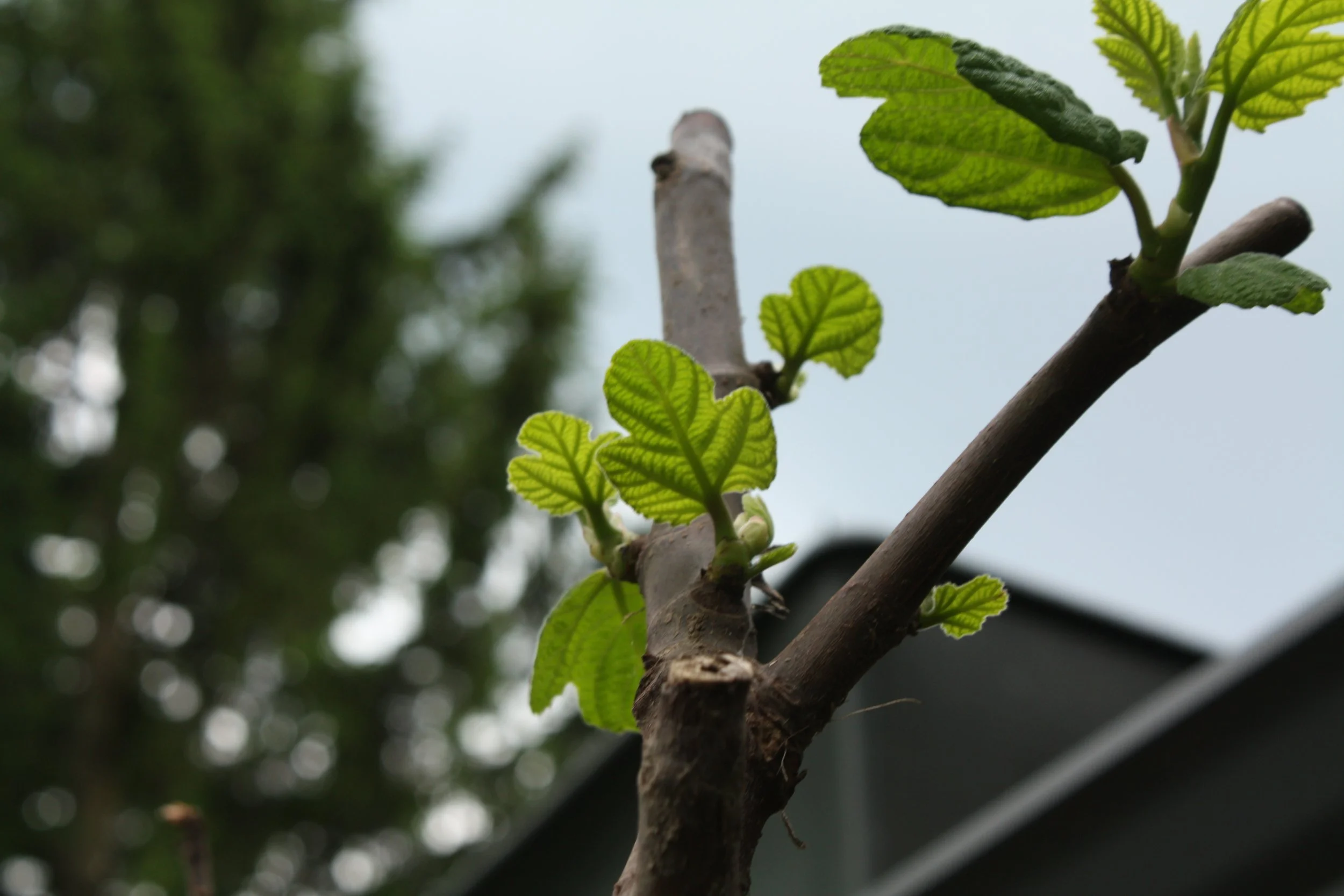
Prevent scalding of new growth on fig plants by hardening off the plants in a shaded, protected protected space.
Is there an easier way to move around potted fig plants?
Put your potted figs on dollies!
Do I need to wake up the fig plants early if it’s just for the breba crop?
Good question. No. If you wake them up later, your breba crop will be a bit later…but still well before fall frosts arrive. So there’s no downside to waking up your breba-producing fig plants later.
But…if you want to get both a breba and a main crop figs from the plants, an early start gives more time for those main-crop figs to ripen at the end of the summer.
Looking for breba fig varieties? Check out the Guide to Cold-Climate Fig Varieties.
What about in-ground figs that are wrapped or buried?
Pin this post!
An early wake-up helps extend the growing season for in-ground figs too. The only thing to remember is that you can’t easily move them inside if there’s a cold spell.
For the fig trees I lay flat and bury, I start to remove the mulch early to allow the soil to warm up – but I don’t stand up the tree early. That way, if I need to protect it, I can throw a bit of mulch back over the top of it.
Should I feed my fig as I’m waking it up?
No, not yet. Feed once it’s actively growing.
How moist should I keep the soil?
While potted fig trees are dormant, keep the soil on the dry side of moist. But as they begin to grow, I give them a bit more water.
The little leaves and figs on my plant fell off. What happened?
Could be cold wind or cold temperatures. To prevent this, harden off your fig plant, starting in a protected space.
What about pruning in spring?
Check out the Cold-Climate Guide to How to Prune a Fig Tree
Summary
In cold climates, it can be useful to wake up some fig trees early because a short growing season limits fig production. An earlier start means a longer growing season.
How early you should wake up your fig trees depends on your setup. Trees waking up early indoors should have good light. Trees waking up early outdoors will probably need protection from cold snaps.
Keep Growing Figs
Looking for more cold-climate fig-growing ideas? Visit the fig home page to browse articles about varieties, pruning, propagation, ripening, winter protection, and more.
Grow Figs Where You Think You Can’t
My revised and expanded fig book is a practical guide to growing figs in pots and cold climates—from choosing varieties and pruning to ripening fruit and conquering winter.
Find This Helpful?
Enjoy not being bombarded by annoying ads? Appreciate the absence of junky affiliate links for products you don’t need?
This site is reader supported. If it has helped you in your food-gardening journey, you can give us a high-five below. Any amount is welcome.
Potted Figs Waking up Early? Here’s Why, and What You Can Do
Your potted figs are leafing out early... When fig trees come out of dormancy early, you need to know what to do next so that you can still harvest figs. Find out what to do—and how to avoid figs waking up early next year.
By Steven Biggs

What to Do When a Dormant Fig Tree Wakes Up Early
“HELP…my fig tree is growing already!”
I often see this sort of email subject line in late winter. If your dormant fig tree is sprouting in storage, you’re not alone.
The usual cause is simple: the storage space is too warm. Once the buds open and tender growth appears, you can’t keep the tree in dark, cool storage conditions.
If it’s still too cold to move the tree outdoors, put it in the brightest, coolest frost-free place you have. Bright light helps produce sturdier growth until outdoor conditions warm up.
In this guide, I’ll explain why potted fig trees wake up early, what to do with them now, and how to keep them dormant longer next winter.
Why Early Growth Is a Problem
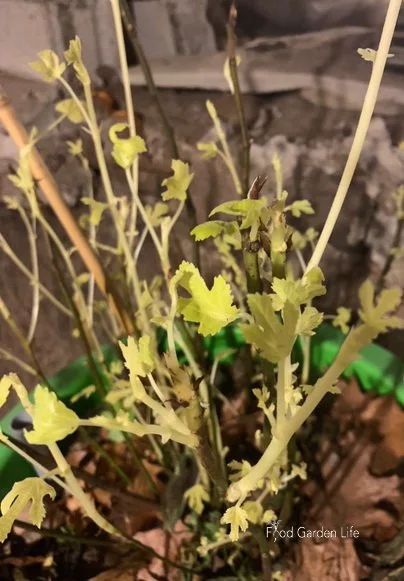
This fig tree woke in a dark crawl space. Without light, the new growth is pale and stretched.
In cold climates, we can overwinter dormant potted fig trees in cool, dark places. Because they have no leaves and aren’t actively growing, they need no light.
Once a tree begins growing, it needs light—but if your tree starts growing in a dim storage space, the light is probably too weak to give sturdy growth.
A fig tree growing in dim light produces:
Pale, stretched shoots
Large, thin leaves
Weak growth that flops over or scorches when moved outdoors
Breba figs that may drop off or fail to ripen
And if you’re thinking of just growing it as a houseplant once it wakes up, that’s not usually ideal. Growing a fig tree indoors as a houseplant can keep it alive, but it rarely produces the compact growth and strong harvest you’re after.
Why Fig Trees Wake up Early
When a dormant potted fig tree wakes early, it’s usually because the storage area is too warm. Warm temperatures trigger growth. That’s why a basement may work early in winter but become a problem later: the tree is ready to grow, and the space is warm enough for it to grow.
Modern, centrally heated basements are often too warm to keep fig trees dormant until spring.
It really depends on your house, though:
A friend had a century-old farmhouse with an uninsulated, unheated, earth-floored basement…fantastic for dormant figs. That’s the kind of space that keeps fig trees dormant.
My garage is minimally heated and is a perfect spot for overwintering dormant figs.
Some modern homes have a good root cellar—and the desirable temperatures for root cellaring also work well for keeping fig trees dormant.
Temperature Is the Main Thing to Watch
Shortening days and falling temperatures help a fig tree enter dormancy in autumn. Once it’s dormant, temperature is the most important factor you can control during winter storage.
Day length still plays a role as winter ends, but temperature usually determines how early your tree wakes up. My garage has windows that let in light, yet the potted figs don’t wake early, because the space stays consistently cool.
What to Do if Fig Trees Start Growing Early
What you do if your fig tree starts to grow early depends on how far the tree has progressed.
If the buds are only swelling: Move the tree to a colder—but protected—storage space. Cooler conditions may slow budbreak. Don’t expose swelling buds to a freeze.
If leaves or shoots have appeared: The tree is actively growing. Move it to the brightest, coolest frost-free place available.
If outdoor days are mild: You can move the tree outside temporarily for stronger light, but start in a sheltered, shaded location and bring it back under protection if there are cold winds or the temperature dips.
While it’s growing indoors: Water when the potting mix begins to dry, but don’t keep it sopping wet. Avoid heavy feeding, which encourages even more weak growth in limited light.
Here in Toronto—USDA Zone 5—it’s usually too cold in mid- to late winter to leave an actively growing fig tree outside. Tender new growth can’t tolerate the cold that a fully dormant tree can.
Once a fig tree has leafed out, don’t try to force it back into dormancy. Keep it growing in the best light you can provide until it’s safe to begin moving it outdoors.
Learn how to move a fig tree outdoors in spring.
These two real-life examples show how the best response depends on the growing space available.
Example 1:Figs Leafing Out Early
Here’s an example of a late-winter note that I received about potted figs sprouting early. Holly wrote:
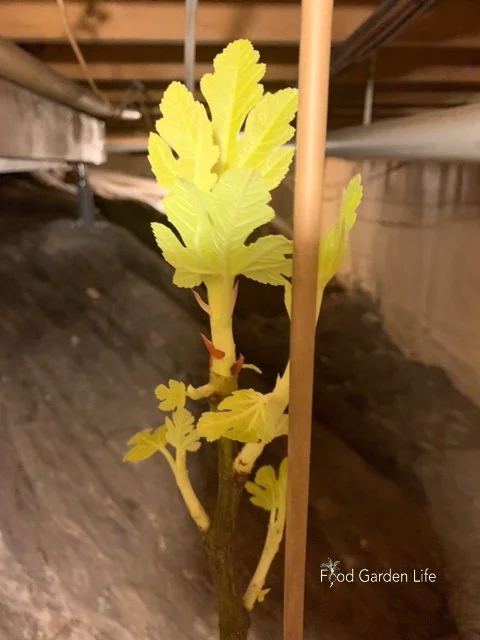
Darkness doesn’t guarantee dormancy. Warm conditions caused these stored fig trees to begin growing.
I brought my six fig trees inside and put them in my crawl space. They are in large containers with reservoirs in the bottom.
Anyway, it is dark but too warm, and they are sprouting small albino-pale leaves.
Now I don’t know what to do? Leave them? Move them to my cooler sunroom with light? Help!!!
Here is my response:
Sorry to hear about your fig dilemma! The crawl space is too warm, so the trees have come out of dormancy early. It’s difficult to return actively growing trees to dormancy. A cool sunroom with bright light is your best option—as long as the trees don’t freeze.
The Challenge
Holly’s crawl space is completely dark—but it’s warm enough to trigger growth. Without light, the emerging shoots are pale and stretched.
What to Do
Move the fig trees to a bright, cool, frost-free growing space. The brighter the light, the more compact the new growth will be.
Holly’s sunroom is the best option in this case because it’s both bright and cool.
Other possibilities include:
A bright, south-facing window
A cool greenhouse or enclosed porch that remains frost-free
Strong grow lights placed close enough to provide useful light
Artificial light isn’t necessarily inferior. A suitable grow-light setup can provide better light than a window during winter.
Avoid Early Sprouting Next Year
Holly is considering an insulated storage compartment inside her garage next winter. This can work well in a garage that occasionally becomes too cold for potted fig roots.
In an attached garage, build the compartment against the wall shared with the house, where temperatures usually fluctuate less than they do near the large garage door. Add a remote thermometer so you can monitor conditions inside.
Insulation slows heat loss but doesn’t create heat. If the garage becomes extremely cold, the compartment may still need a small, thermostatically controlled heat source.
Example 2: A Fig Tree with Breba Figs Wakes Early
Here’s another example of a late-winter enquiry I received about potted figs coming out of dormancy early:
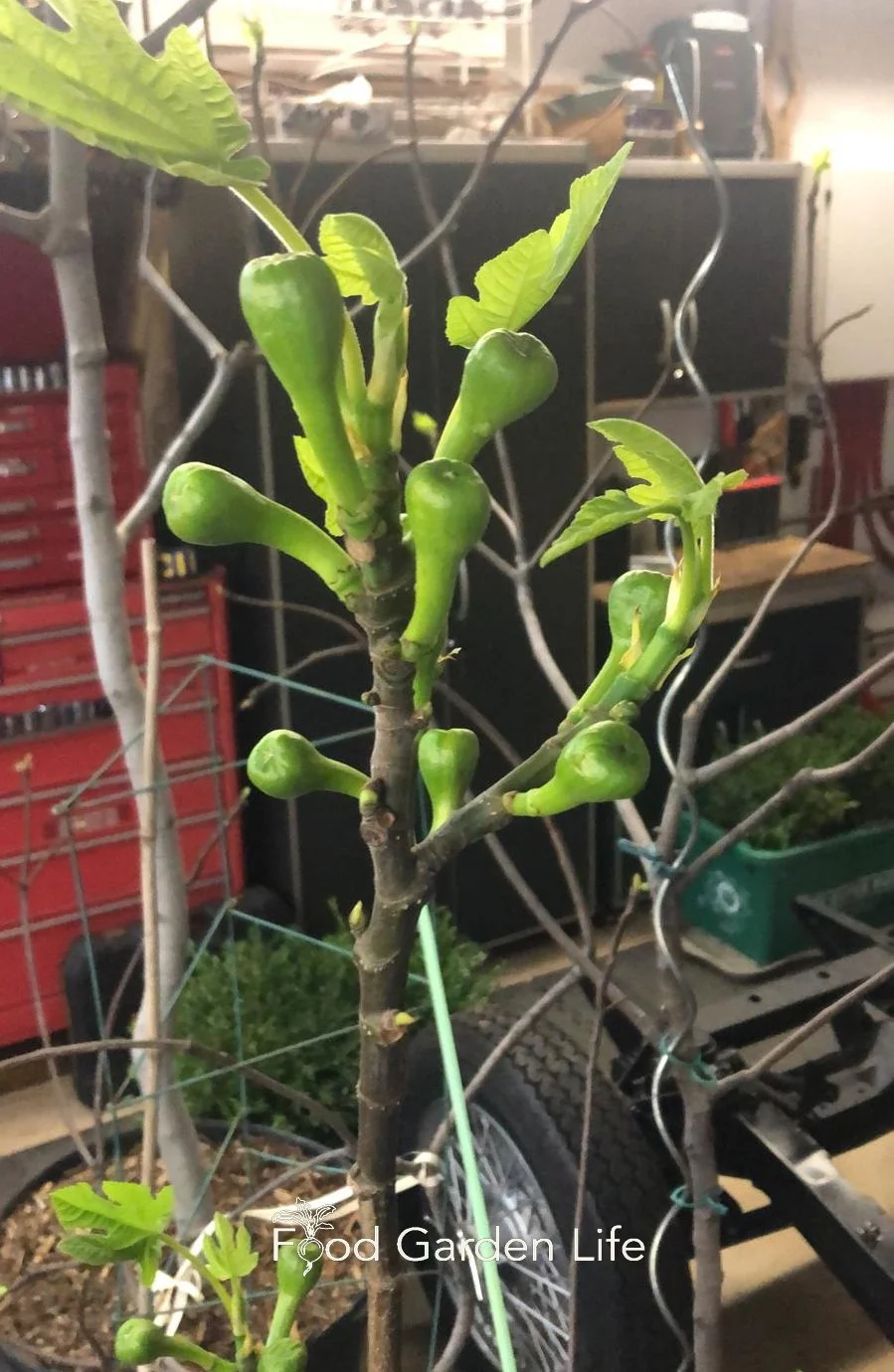
David’s potted fig tree woke early in his heated garage—and its branches were loaded with breba figs.
“My fig trees are growing, what should I do?” That was the question my neighbour David asked during a late-March phone call.
David grows his fig trees in pots on his patio during summer. He leaves them outdoors in autumn until they’re dormant, then stores them in his garage.
The garage is heated because David works on cars there during winter. It also has large windows. The warmth triggered early growth, while the window light wasn’t strong enough to produce compact shoots.
To complicate matters, the branches were carrying oodles of breba figs—a crop that develops on the previous season’s growth.
The Challenge
It was still too cold to move the actively growing trees outdoors. More freezes were likely, and they could damage the tender new growth.
But the light inside the garage wasn’t bright enough for sturdy growth.
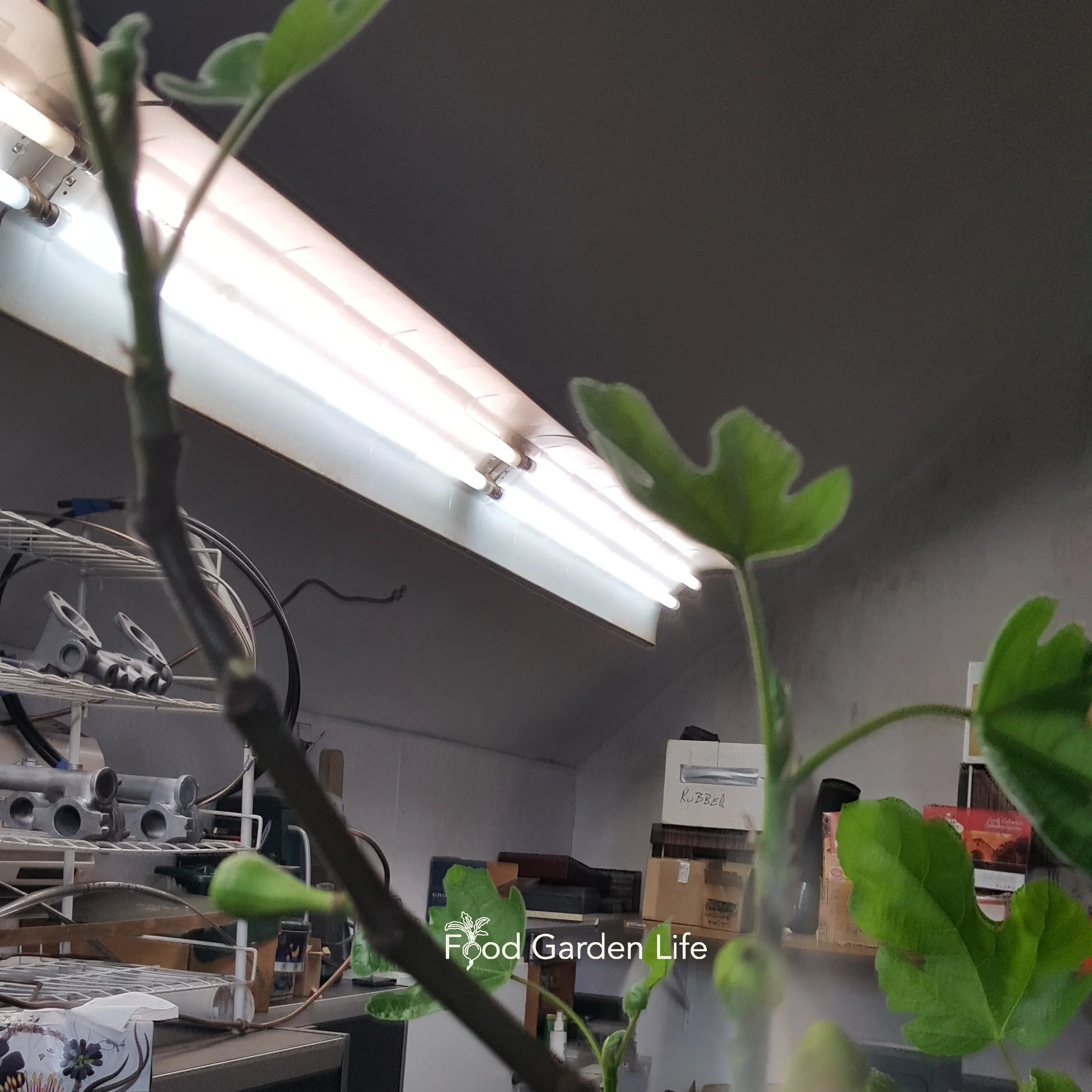
Potted fig tree making lanky growth beneath a shop light in David’s heated garage.
Give the Trees More Light
I suggested moving the trees to the brightest part of the garage until outdoor conditions improved.
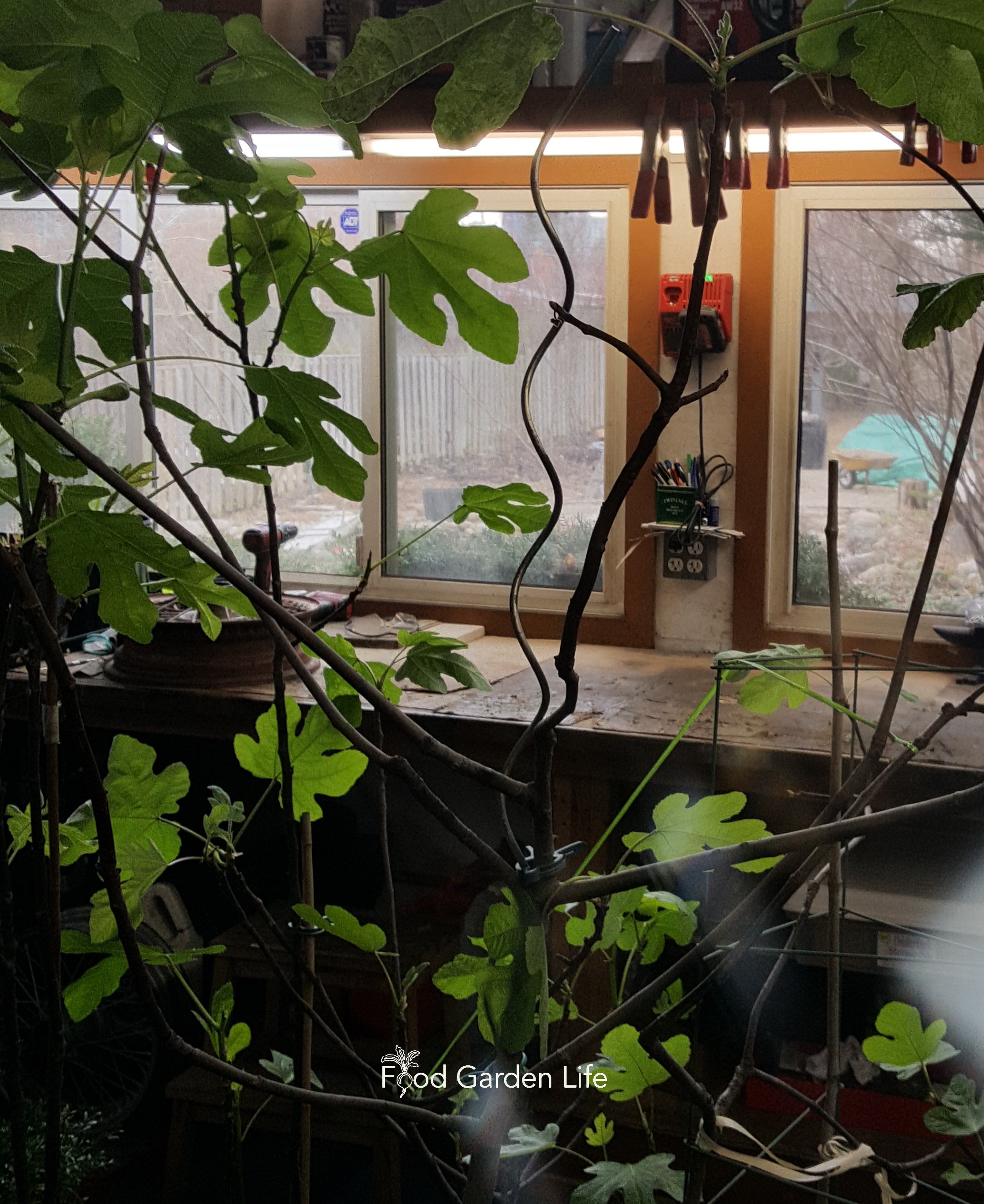
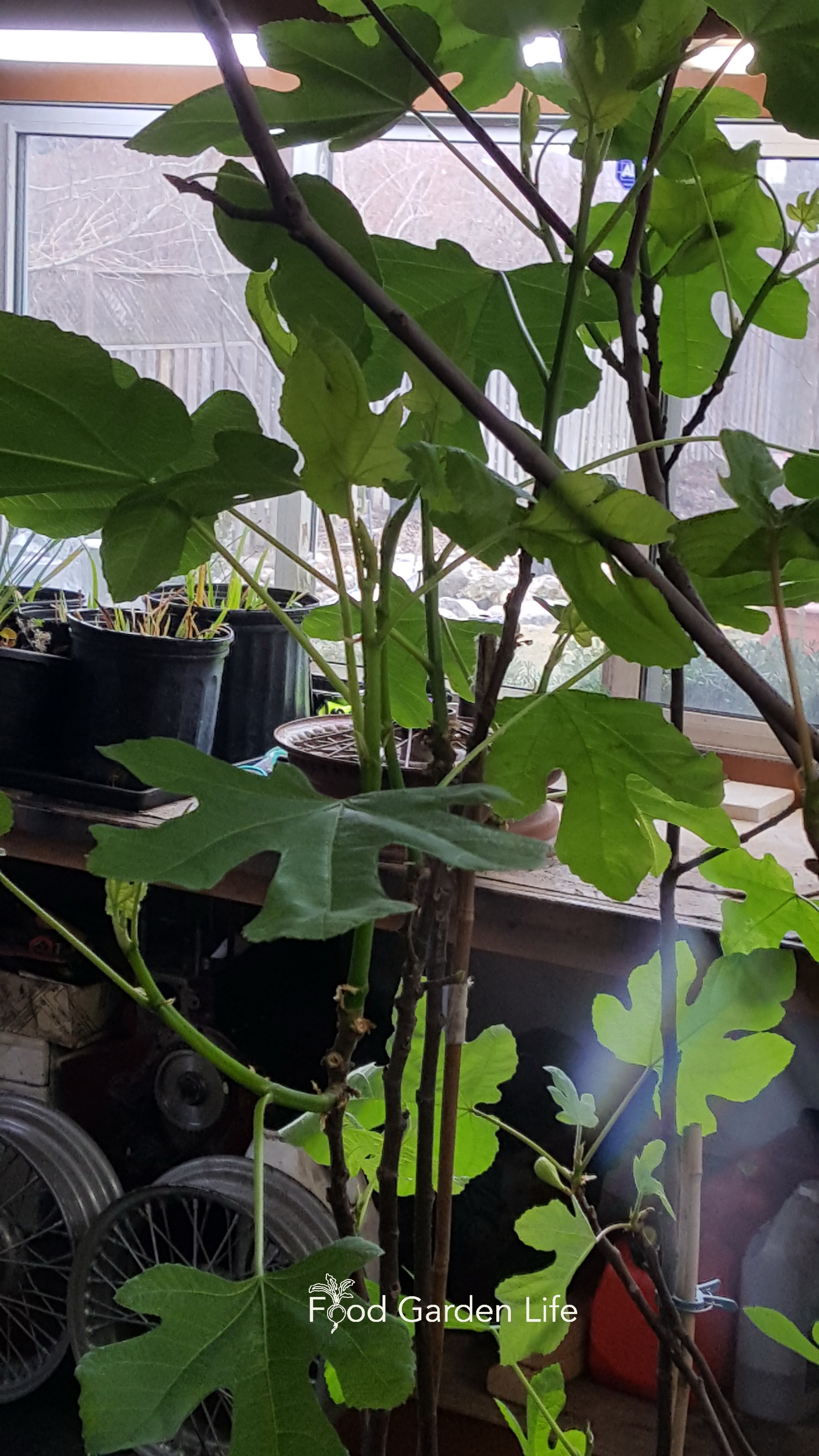
On mild days, David could move them outside for stronger light. He would need to start in a sheltered, shaded location, protect them from strong wind, and return them to the garage whenever frost threatened.
Another possibility was a simple temporary greenhouse against the garage. This could provide brighter light during the shoulder season while protecting the trees from cold nights.
A temporary greenhouse can heat up surprisingly quickly in sunshine, so it needs ventilation and temperature monitoring.
Avoid Figs Waking Up Early Next Year
The following winter, David could:
Keep the garage cooler
Build an insulated storage compartment within the garage
Store the trees in another consistently cold location
Overwinter the figs outdoors using a protected in-ground or trench method
If he walls off a corner of the garage, a remote thermometer will show whether the compartment remains cold enough for dormancy without reaching temperatures that could damage the potted roots.
Another option is to grow the trees in the ground and protect them by tipping and covering them, or to overwinter the pots outdoors in a protected trench.
Here are more ideas for overwintering figs in cold climates.
Important Tip for Fig Trees That Leaf Out Early
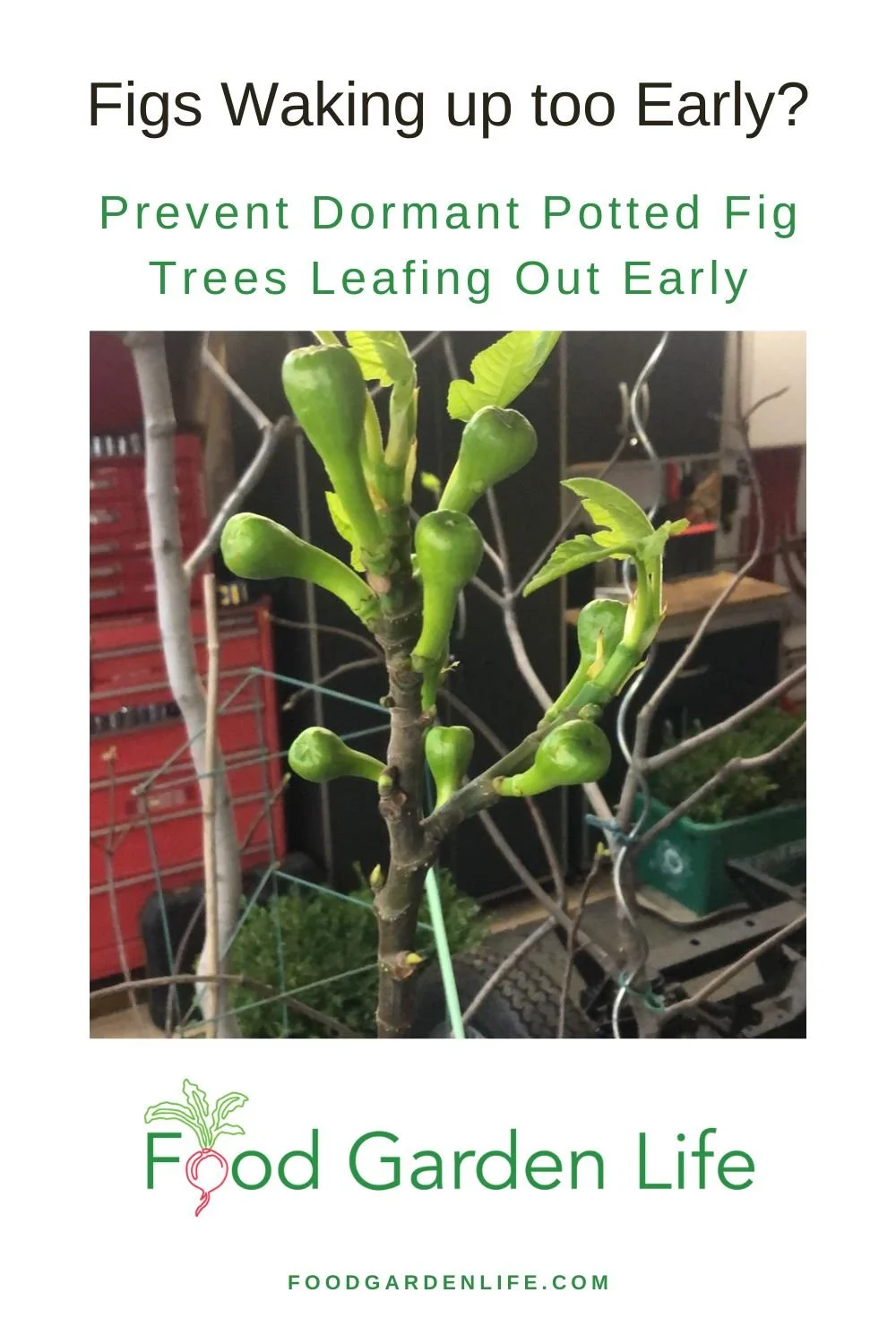
Pin this post!
There’s one more important thing to remember.
New leaves that develop indoors aren’t adapted to full outdoor sunlight or wind. If you move the tree directly from dim indoor conditions into full sun, the leaves can scorch badly.
I’ve fried my fig leaves more than once by moving the trees into full sun too quickly.
Start in a sheltered, shaded outdoor location. After a few days, introduce gentle morning sun, then gradually increase the amount of direct light over a week or two.
Watch the forecast throughout this process. Bring actively growing trees back under protection if freezing temperatures threaten.
Find out what to do with your fig tree in the spring.
FAQ: Fig Trees Waking Up Early
Why did my fig tree wake up early?
Warm storage conditions are the most common cause. Once the tree has been dormant for a while, warm conditions can trigger budbreak—even in complete darkness.
Will waking early kill my fig tree?
Usually not. The challenge is keeping the new growth healthy until outdoor conditions improve. Give the tree bright light, protect it from freezing temperatures, and don’t overwater it.
Can I make it go dormant again?
If the buds are only swelling, moving the tree to a colder protected space may slow them down. Once leaves and shoots have appeared, it’s difficult to return the tree to dormancy without damaging the new growth.
Should I grow it indoors now that it’s awake?
If it’s still too cold outdoors, yes. Put it in the brightest, coolest frost-free location available. Indoor growing isn’t ideal, but it’s safer than exposing tender shoots to freezing temperatures.
Does a dormant fig tree need light?
No. A fully dormant fig tree has no leaves and doesn’t need light. Holly’s trees began growing in complete darkness because the crawl space was warm.
Once growth begins, however, the tree needs bright light.
Can I put an actively growing fig tree outside?
You can put it outside on mild days, but begin in shade and shelter it from wind. Bring it back under protection before temperatures freeze. Gradually get it used to stronger sunlight.
Should I remove pale, lanky shoots?
It’s tempting, but pruning the branches may remove developing breba figs, while removing the new shoots can delay the main crop. Move the tree into brighter light first. Once it’s growing outdoors, you can assess whether weak shoots need pruning. It’s often better to accept less-than-perfect growth for the season, get some figs, and then prune back that lanky growth next year while the tree is dormant.
How can I help my potted fig enter dormancy in autumn?
Leave it outdoors as days shorten and temperatures fall. A few light frosts help encourage leaf drop and dormancy. Don’t move it into warm winter storage too early, but protect the pot from temperatures cold enough to damage the roots.
Get Your Fig Trees Through Winter—and Harvest Figs
Growing figs where winters are cold takes a bit of creative thinking.
In Fig Camp and the self-paced Fig Masterclass, I explain how to grow figs in pots or in the ground, extend the growing season, ripen more fruit, and protect your trees through winter.
Explore Fig Camp and Fig Masterclass
Keep Growing Figs
Looking for more cold-climate fig-growing ideas? Visit the fig home page to browse articles about varieties, pruning, propagation, ripening, winter protection, and more.
Grow Figs Where You Think You Can’t
My revised and expanded fig book is a practical guide to growing figs in pots and cold climates—from choosing varieties and pruning to ripening fruit and conquering winter.
Find This Helpful?
Enjoy not being bombarded by annoying ads? Appreciate the absence of junky affiliate links for products you don’t need?
This site is reader supported. If it has helped you in your food-gardening journey, you can give us a high-five below. Any amount is welcome.

Hi, We’re Steve and Emma!
We help people grow food on balconies, in backyards, and beyond—whether it’s edible landscaping, a vegetable garden, container gardens, or a home orchard.
Fig Masterclass

This self-paced, virtual Fig Masterclass is hosted by Horticulturist and Cold-Climate Fig Expert Steven Biggs.