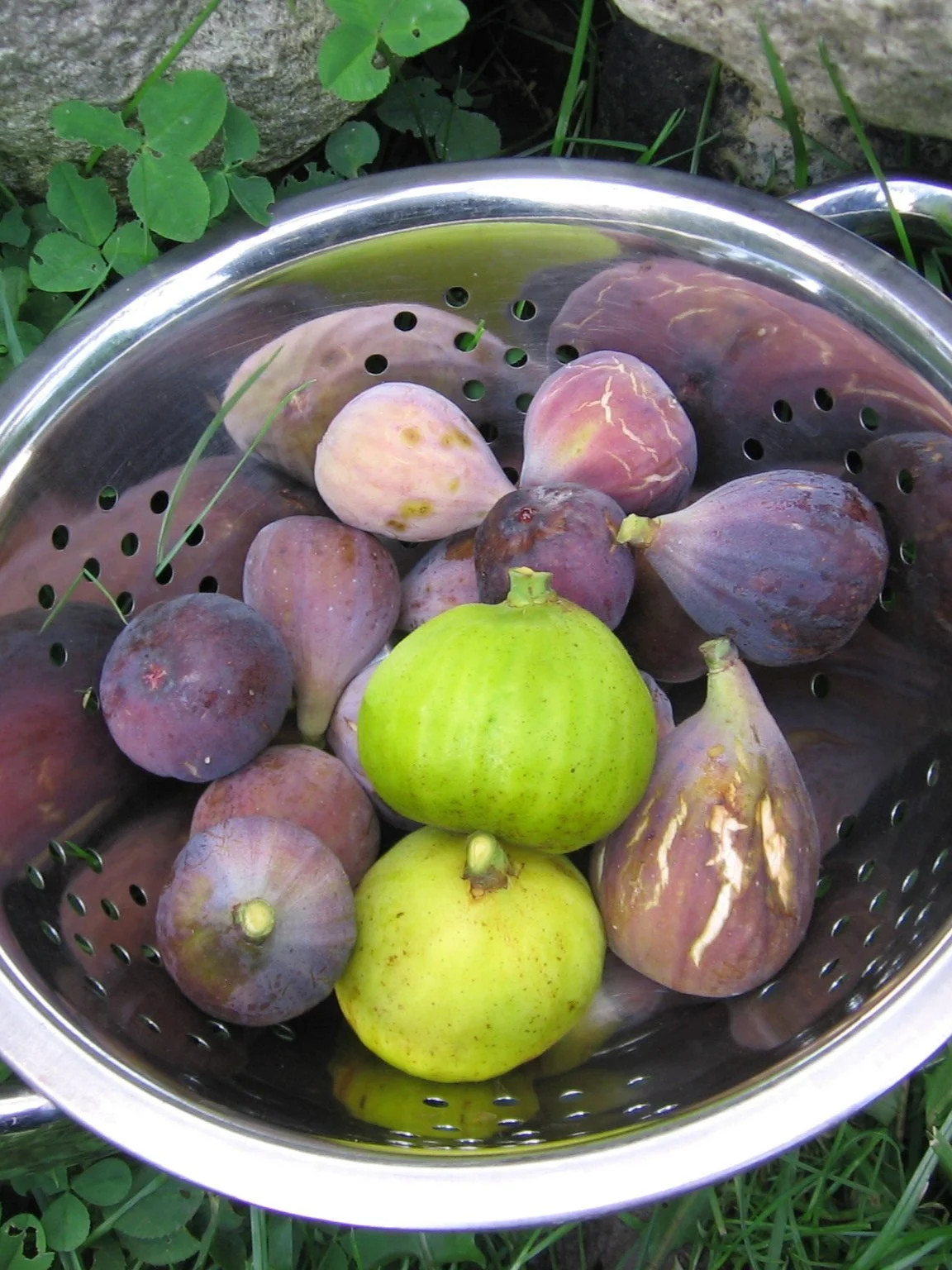
These Espaliered Fig Trees Make Winter Protection Easy
Here's a way to grow figs that makes it easy to protect them for the winter in cold climates.
By Steven Biggs
Diminutive Fig Low Cordons for Easier Overwintering

Fig low-cordon espalier, an easier way to grow an in-ground fig tree in a cold climate.
Francesco had a fig tree in his Toronto yard. And every year, in what became a community event, he and some neighbours wrapped it up in burlap and tarps, then wrestled it down to a horizontal position, into a trough they’d dug for it. Then they covered it up for the winter. Each spring, they’d reverse the process.
When the tree got too tall to be tipped, they built a temporary enclosure around it, and put a space heater inside. It’s a fun story, and you can hear about it here.
It’s also heavy work. (I tip some of my fig trees, but I keep them much smaller than Francesco’s…so I don’t need to invite over the neighbourhood! See how I tip my fig trees.)
If tipping trees isn’t your cup of tea, there’s an easier way to grow an in-ground fig tree in a cold climate.
In this post I’ll tell you about growing a low-to-the-ground fig espalier that’s pruned right back in the fall.
No tipping. No wrapping. No lugging potted figs to a protected spot. Just cover the ground-level stem.
Keep reading and I’ll explain how to make yourself a simple-to-cover fig low-cordon espalier.
What is Espalier?
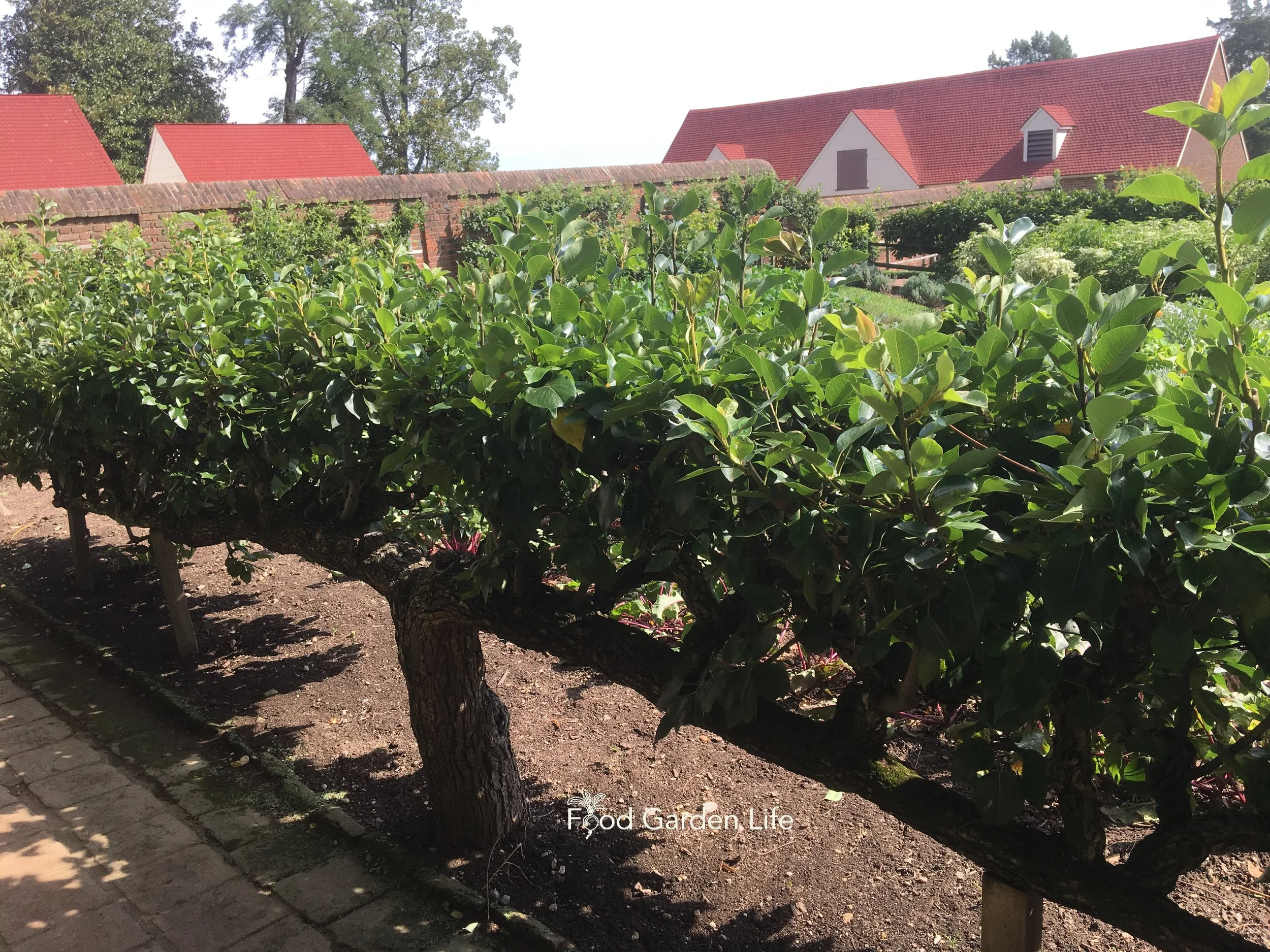
Espaliered pear trees at Mount Vernon.
Espalier is when we prune a tree so that it’s flat: It’s a two-dimensional tree.
In borderline fruit-growing areas such as northern Europe, there’s a long history of growing espaliered fruit trees against stone and brick walls. The walls warm up in the sun, and the flat fruit tree is nestled up against the warmed walls. The extra little bit of heat protects flowers from frost damage and speeds up ripening.
Along with extra heat, espalier is also a great technique to fit fruit trees into small spaces. I grow espaliered apples along a fence where there’s not enough space for a wider tree.
While espalier can be practical, it’s also be an art form. At Mount Vernon, George Washington’s estate (open to the public and well worth a visit) there are espaliered pear trees that frame the plots in the kitchen garden.
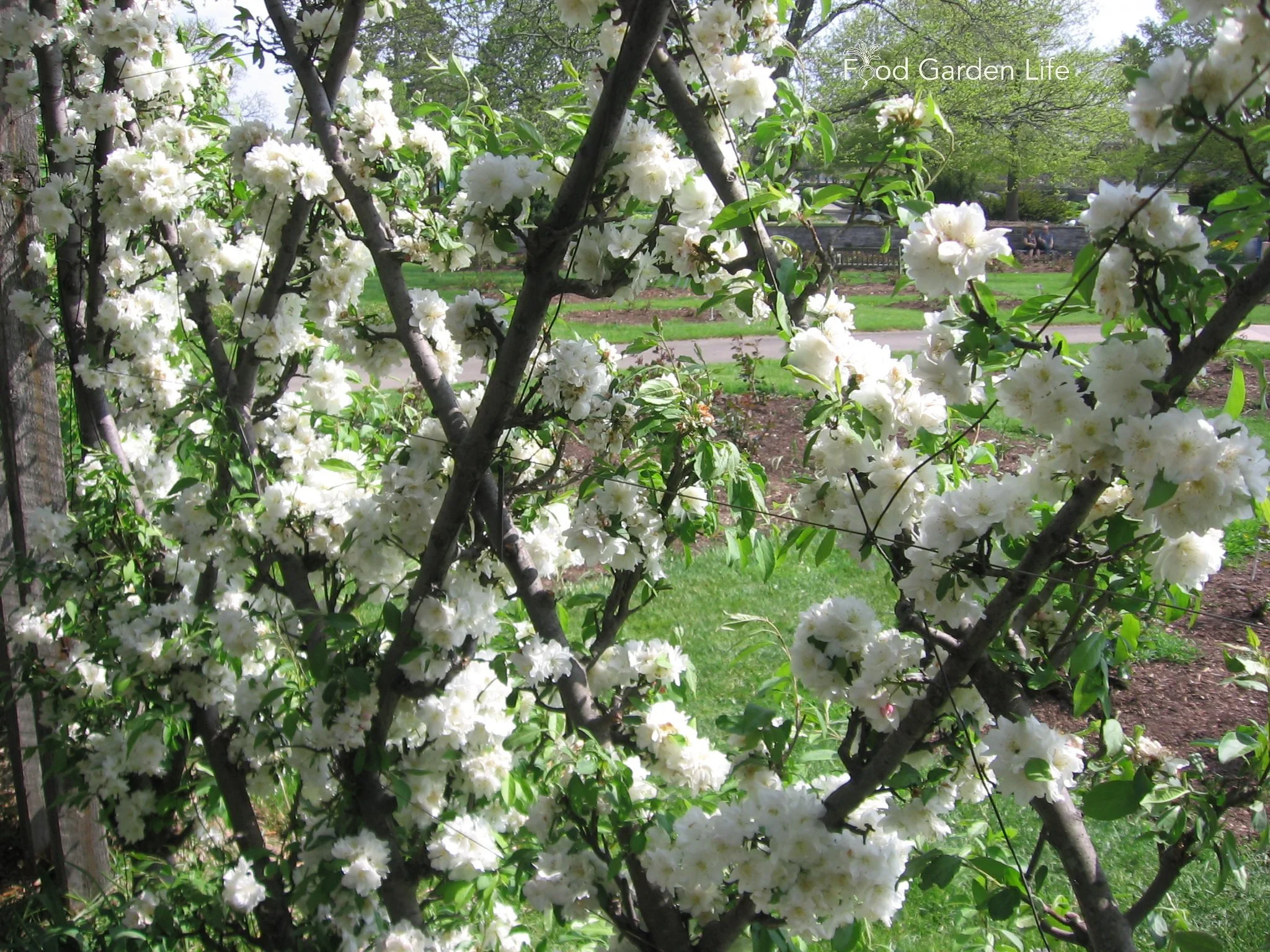
A Belgian fence is like a living wall!
Another beautiful espalier is the Belgian fence. A Belgian fence is like a living wall, with trees pruned to grow in a lattice-like pattern. (There’s are nice examples at Royal Botanical Gardens in Hamilton, Ontario, made from crab apple and serviceberry.)
There are many other espalier forms worth investigating if you like making the garden an artistic creation as well as a food-bearing one. Here are three of them:
Candelabra: U-shaped main stems that reach out horizontally, before bending upwards
Fans: As the name says, fan shaped
Step-over: A very low, horizontal main stem (called a “cordon”) that is close to the ground. (There’s a famed step-over apple tree in Monet’s garden…I’ve never seen it, but have seen pictures of it.)
Today, we’re taking our inspiration from Monet’s step-over apple tree. We’re using the step-over form—low cordons—to make overwintering fig trees in cold climates easier. I wonder what Francesco would think!
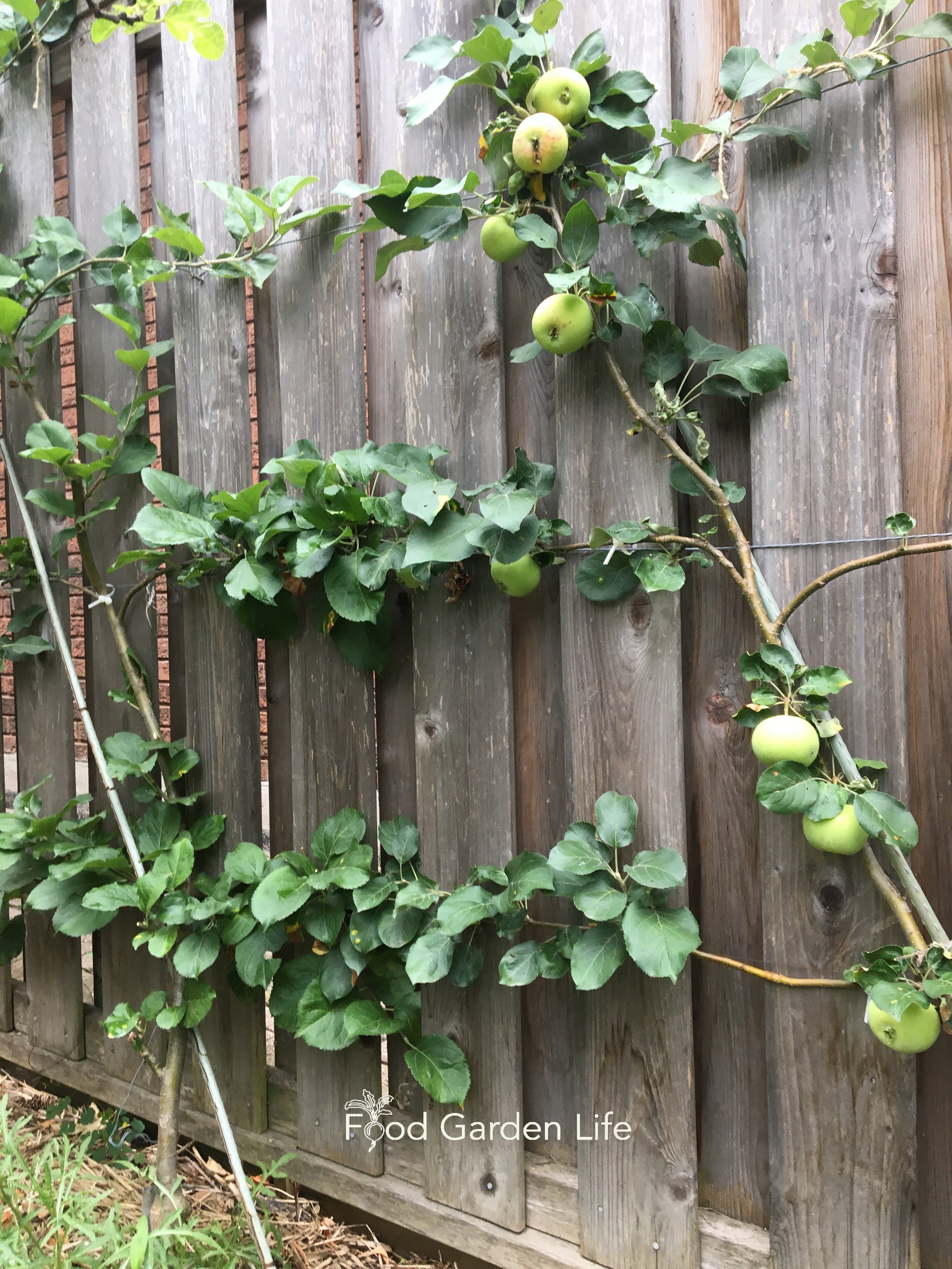

What’s a Fig Tree Espalier?
Before we unpack the idea of the fig low cordon, let’s quickly look at other forms of fig espalier.
It’s rare to find large fig trees for sale here in Toronto. Rarer still are unusual varieties. I never see fig espaliers.
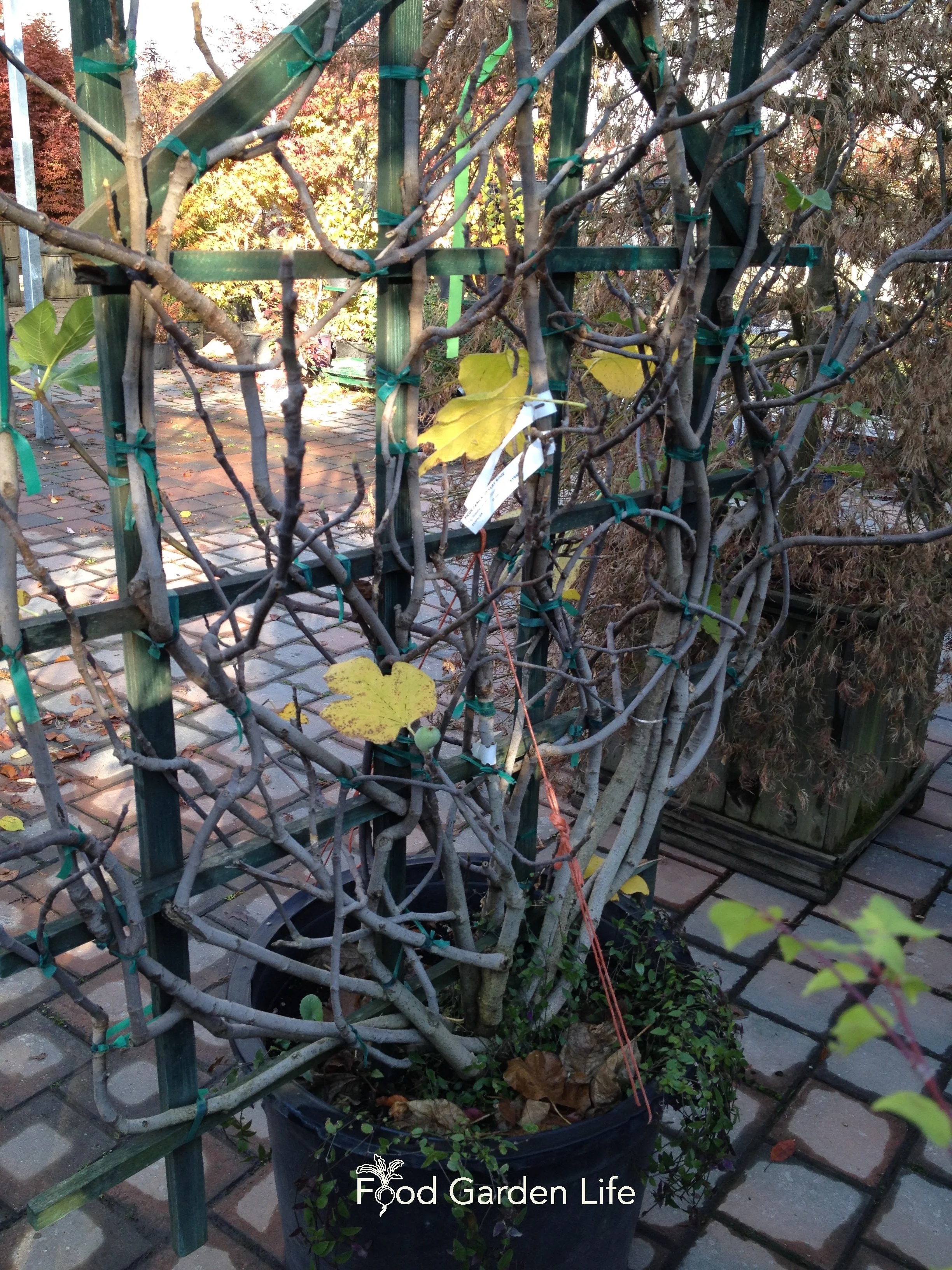
Espaliered fig tree in a pot. This one was rather dear…so I made my own instead!
Except once I did.
One day I came across a fig espalier at a nearby garden centre. As soon as I saw it, I pictured this potted fig espalier on my driveway, flat against my house. It was a bit of a tangled mess—but nothing a good pruning couldn’t fix.
Then I flipped over the tag to see the price. Gulp. $500.
So that fig espalier never made it home to my driveway.
Instead, I went home and looked through my potted figs to see if I had any with branching suited to creating an espalier. I did, and you can see the beginnings of my work in the picture below.
In a climate such as mine in Toronto, potted fig espaliers like this have a couple of benefits:
They look nice (imagine a patio surrounded by a living wall of figs)
Placed against a warm, south-facing wall, there is lots of heat to ripen the figs faster
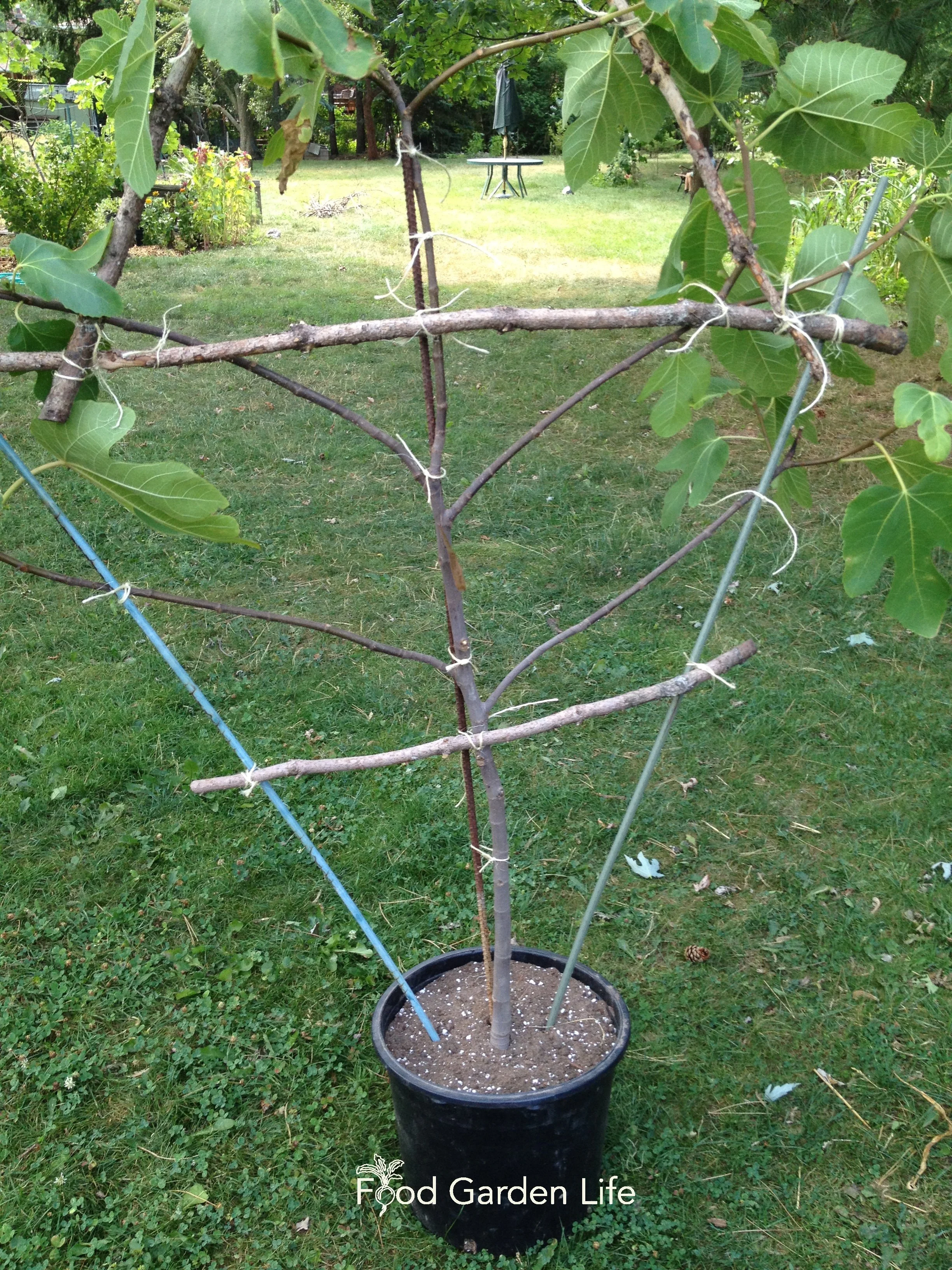
Pruning fig trees to make an espalier is something a home gardener can tackle. Here’s a fig espalier in the making.
But I think the form of espalier that has the most to offer cold-climate growers in areas such as my Canadian Plant Hardiness Zone 6 (USDA Zone 5) garden is the fig low cordon, a.k.a. the step-over fig.
The Fig Low Cordon Espalier
Like the other espalier forms, with a fig cordon we’re making a “flat” tree. But the main stem is horizontal—and it’s just above the ground level.
Think of those pear trees from George Washington’s garden. Now, imagine them hugging ground level.
Benefits of a Low Fig Tree Over Cold Winters
This step-over form makes overwintering of in-ground figs trees very easy. There’s no wrapping. No space heaters. No tipping.
It’s easy to prune. Before winter, all new growth is removed. It’s that straightforward.
That seemingly harsh pruning means that all that has to be protected for the winter is the horizontal cordon—and it’s so close to the ground that it’s a cinch. (We’ll talk about protection below.)
There’s something else we should touch on too: Why this drastic pruning method works with figs. It works because figs can form on new wood. (With many fruit trees, it’s the older wood that bears flowers and fruit.)
Note: this method won’t grow you any breba figs…none! Breba figs form on wood from the previous year—while main-crop figs grow on new wood. With the low-cordon espalier fig, all the fruiting wood each year is new wood, meaning all the figs are main-crop figs.
Where to Grow a Fig Low-Cordon Espalier
Location is very important. The first time I tried fig cordons, I planted them in a low-lying part of my property where the soil was slow to heat up in the spring. The fig trees survived, no problem. But because they were slow to wake up in the cooler location, the season wasn’t long enough for figs to ripen.
Here's what I recommend:
Full sun
South-facing, so the soil heats up
Even better if it’s beside a wall for extra heat capture
How to Make a Low Fig Cordon Espalier
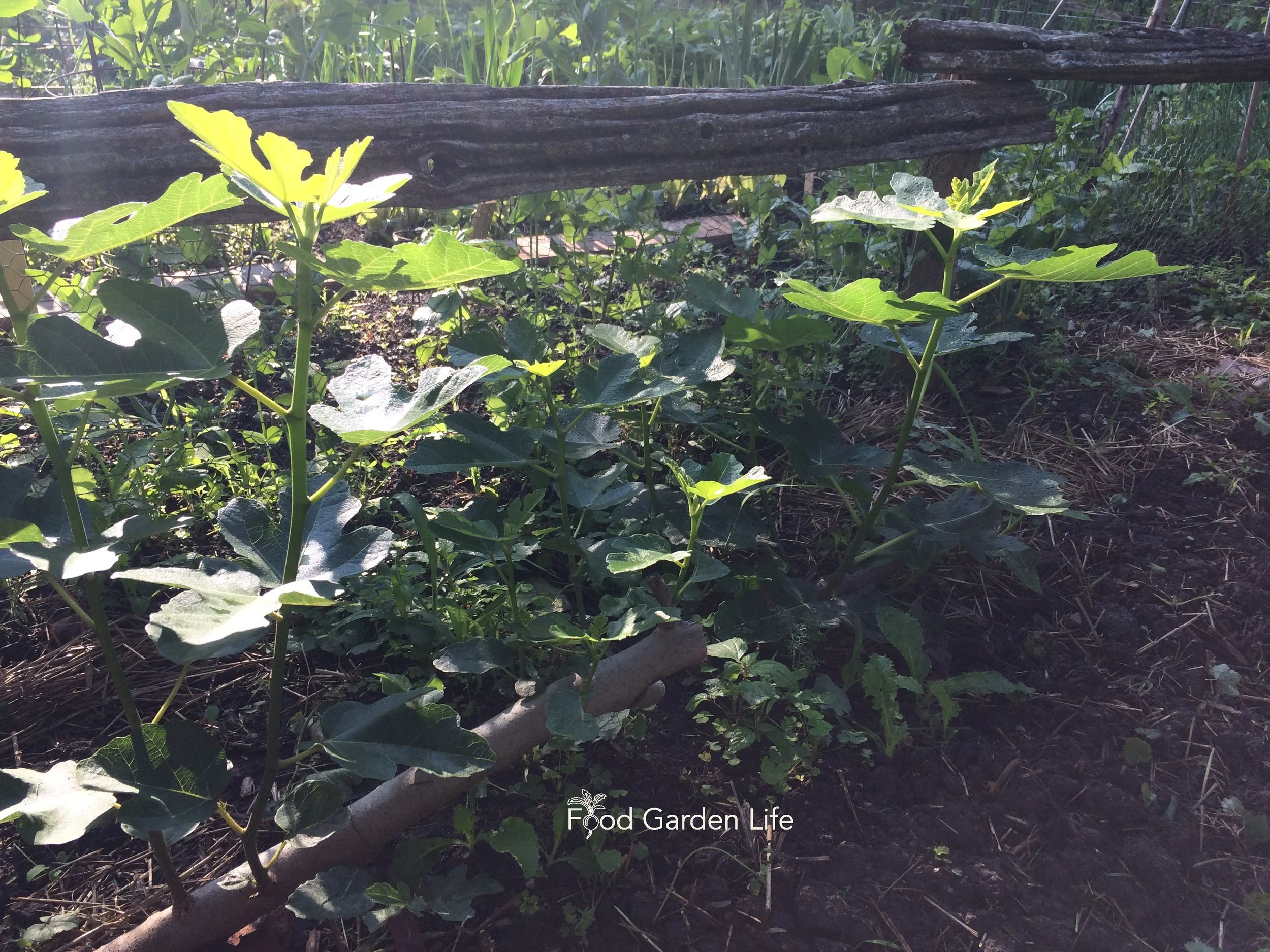
Fig low cordon that I made by lopping the top off of a mature fig trees, and them planting them so the trunk was almost horizontal, right above ground level.
The first time I made fig cordons I cheated. Instead of developing new branches, and training them horizontally, I took fig trees with long, straight trunks and planted them so that the trunks were almost horizontal. So if you want an instant step-over, low-cordon fig, that’s what I did.
But here’s a more traditional approach, starting with a small fig tree.
Year 1: In the first year, you create the cordons
Year 2: Then, the following year, you allow upright growth (and figs!) to form
Year 1, Scenario 1
Fig tree has a few branches coming from the base
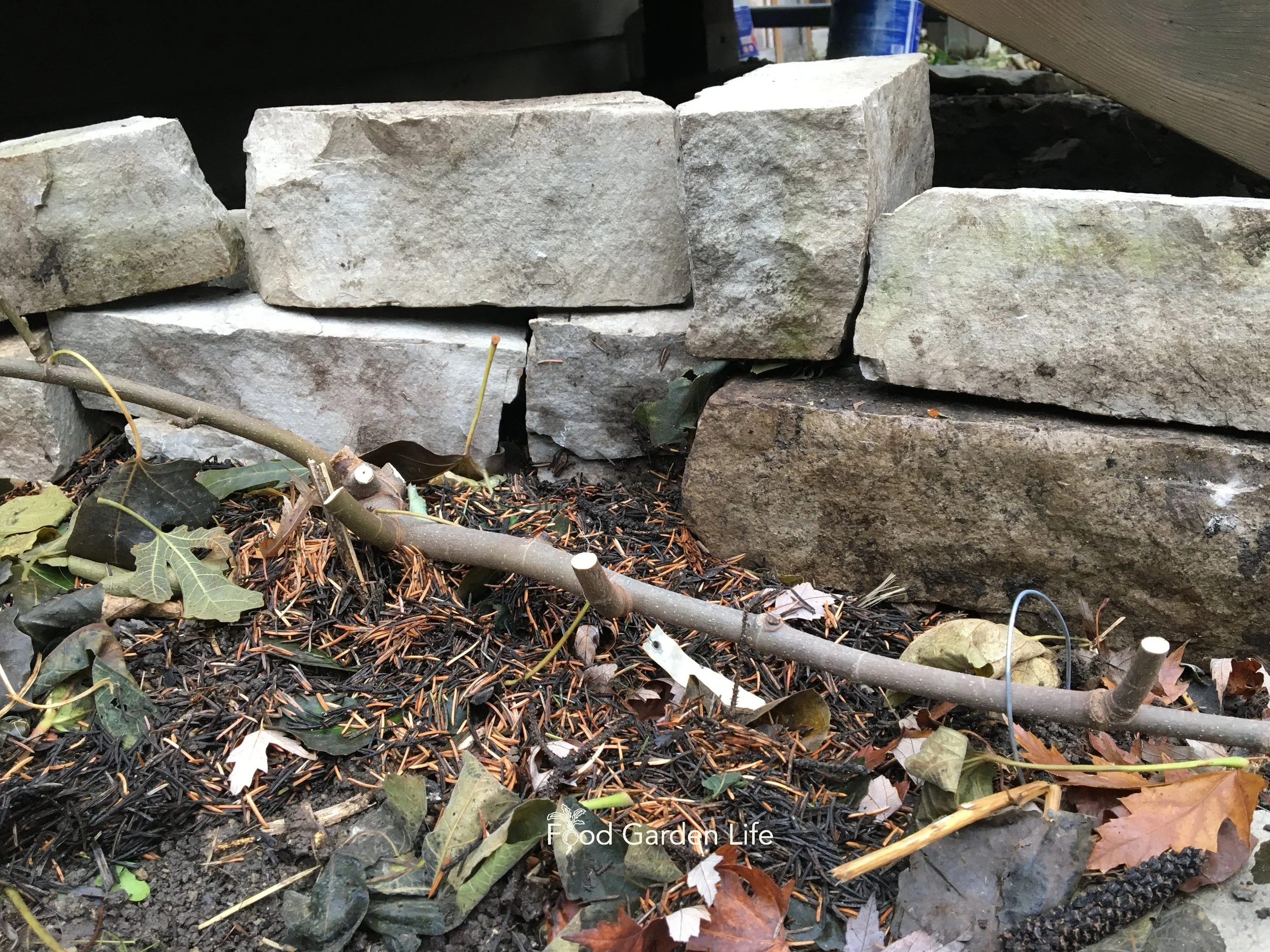
The goal in year 1 is to create the cordon, the low, horizontal branch that’s just above ground level. This is an example of a cordon.
If you have more than one branch, keep the two tallest branches (so you can have cordons going out in both directions from the base)
I grow branches at 45 degrees for the first year because they grow more quickly than if they’re horizontal. Tie them to bamboo stakes that are on 45° angle
At the end of the first year, gently bend over the 2 branches so that they’re horizontal
You will probably need to pin down the “cordon” at first (I use a wire hoop, see Hints and Tips below)
The bamboo on the cordon is temporary, remove it after a year, once the cordon has thickened and stays in place
Year 1, Scenario 2
Fig tree has only one branch
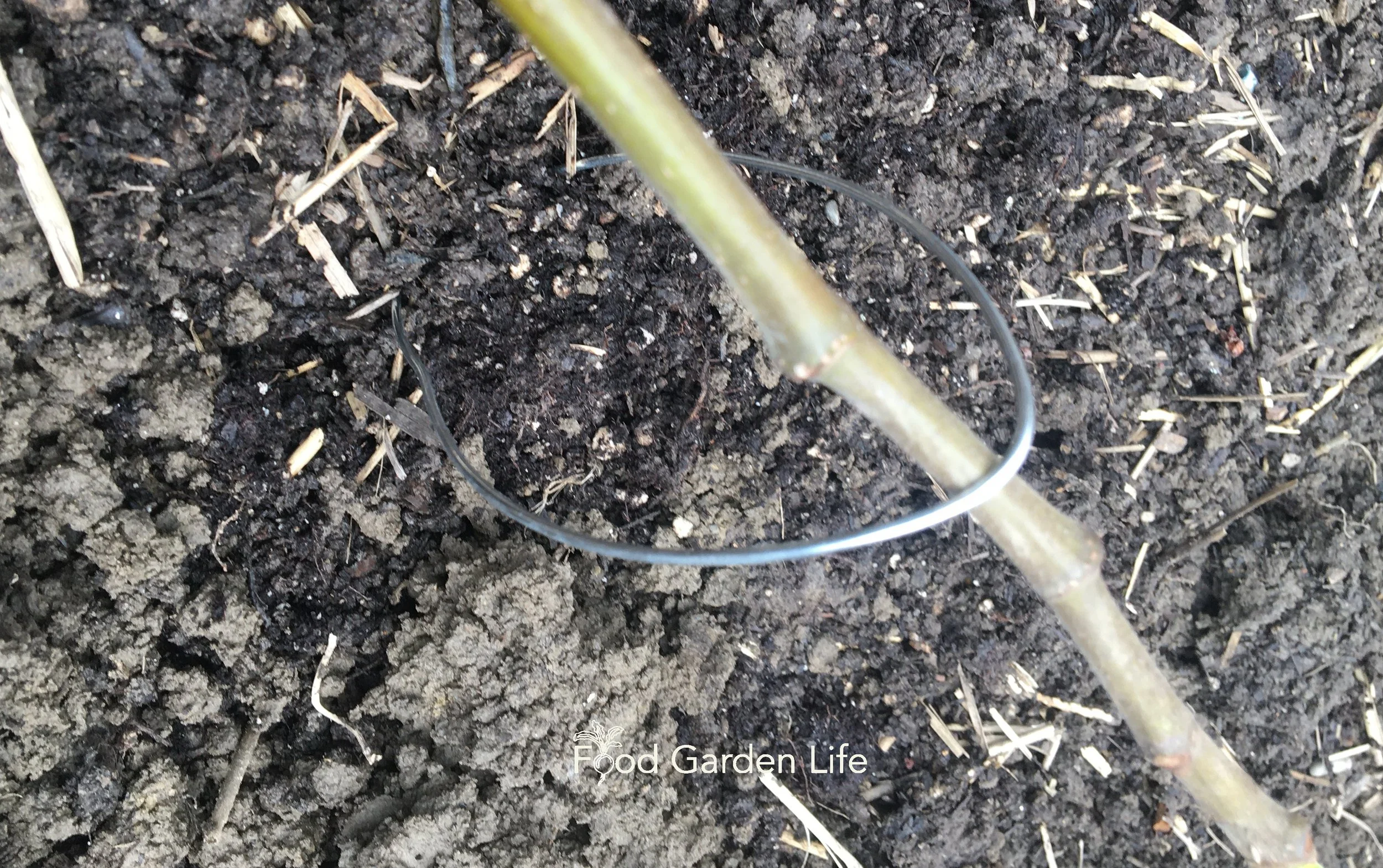
Pinning down the cordon after bending it to a horizontal position, using metal wire hoops.
If your fig tree has only one stem, decide if you want a cordon on just one side—or if you want cordons on each side
If you want a cordon on only one side, train the single stem as above
If you want 2 cordons, nip off the top of the stem at the height where you want cordons (this causes new shoots to grow)
Keep two new shoots for cordons—and treat as above
Year 2
In year two, with the horizontal cordons in place, upright shoots to grow.
Get Your Fig Trees Through Winter—and Harvest Figs
Growing figs where winters are cold takes a bit of creative thinking.
In Fig Camp and the self-paced Fig Masterclass, I explain how to grow figs in pots or in the ground, extend the growing season, ripen more fruit, and protect your trees through winter.
Pruning an Established Low-Cordon Fig Espalier
Spring Pruning
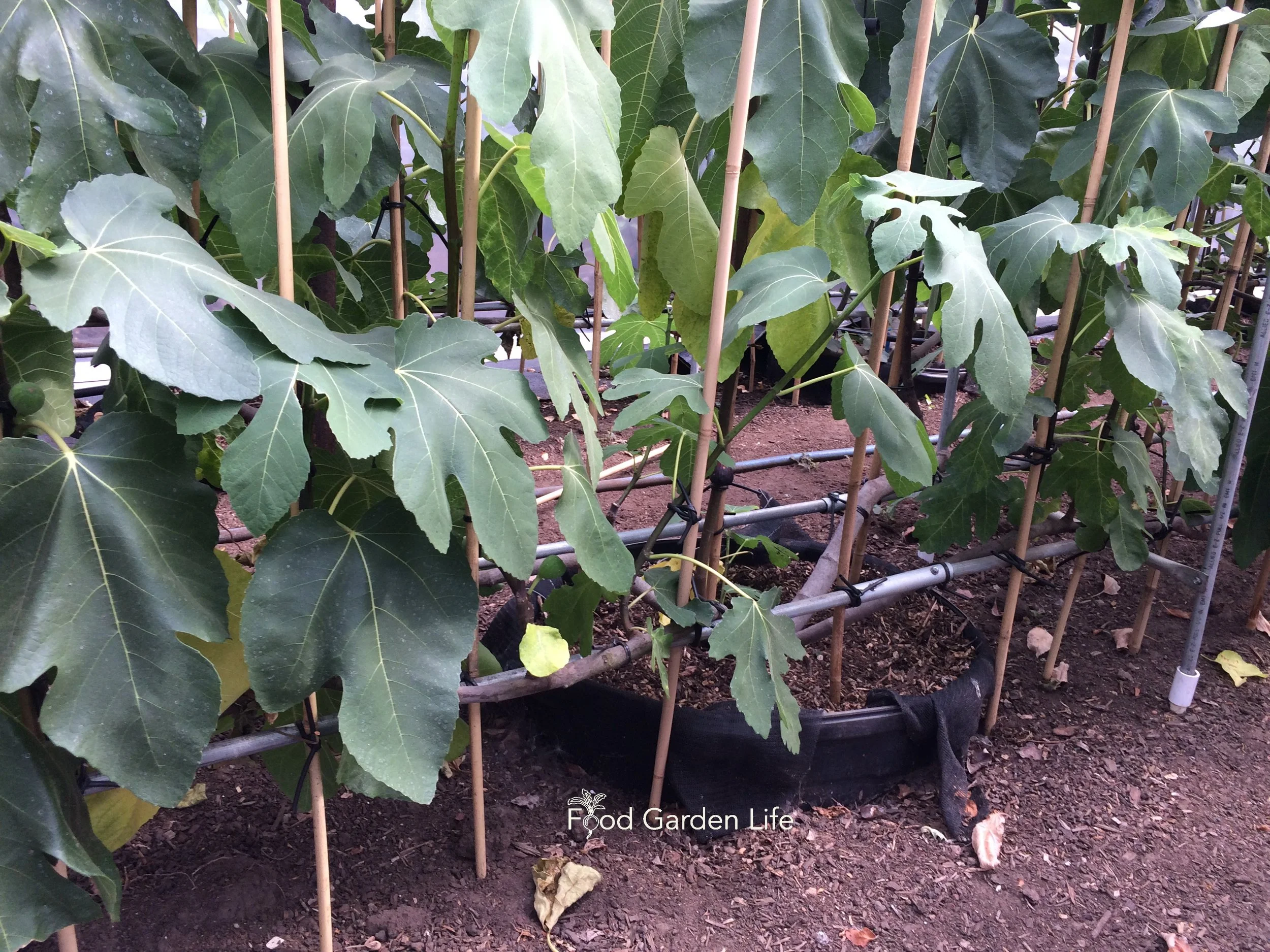
Fig cordons at Fruit Trees and More. Not the spacing and bamboo stakes. (These figs are in a moderate climate where winter protection is not needed—but this is a good method to grow figs in a small space and make them easy to harvest.
The fig tree might try to make more shoots than you need. Prune so they’re spaced 15-20 cm (6-8”) apart.
To grow them straight upwards, tie them to bamboo poles.
Fall Pruning
As the fig trees go dormant in the fall, cut back the vertical branches to within an inch of the cordon.
Leave a nub of branch, about 2 cm (1”). It’s from this that new branches arise in the spring.
If the ends of the cordons grew out over the summer, now is the time to shorten them back to your permanent framework.
Protecting a Fig Low-Cordon Espalier for the Winter
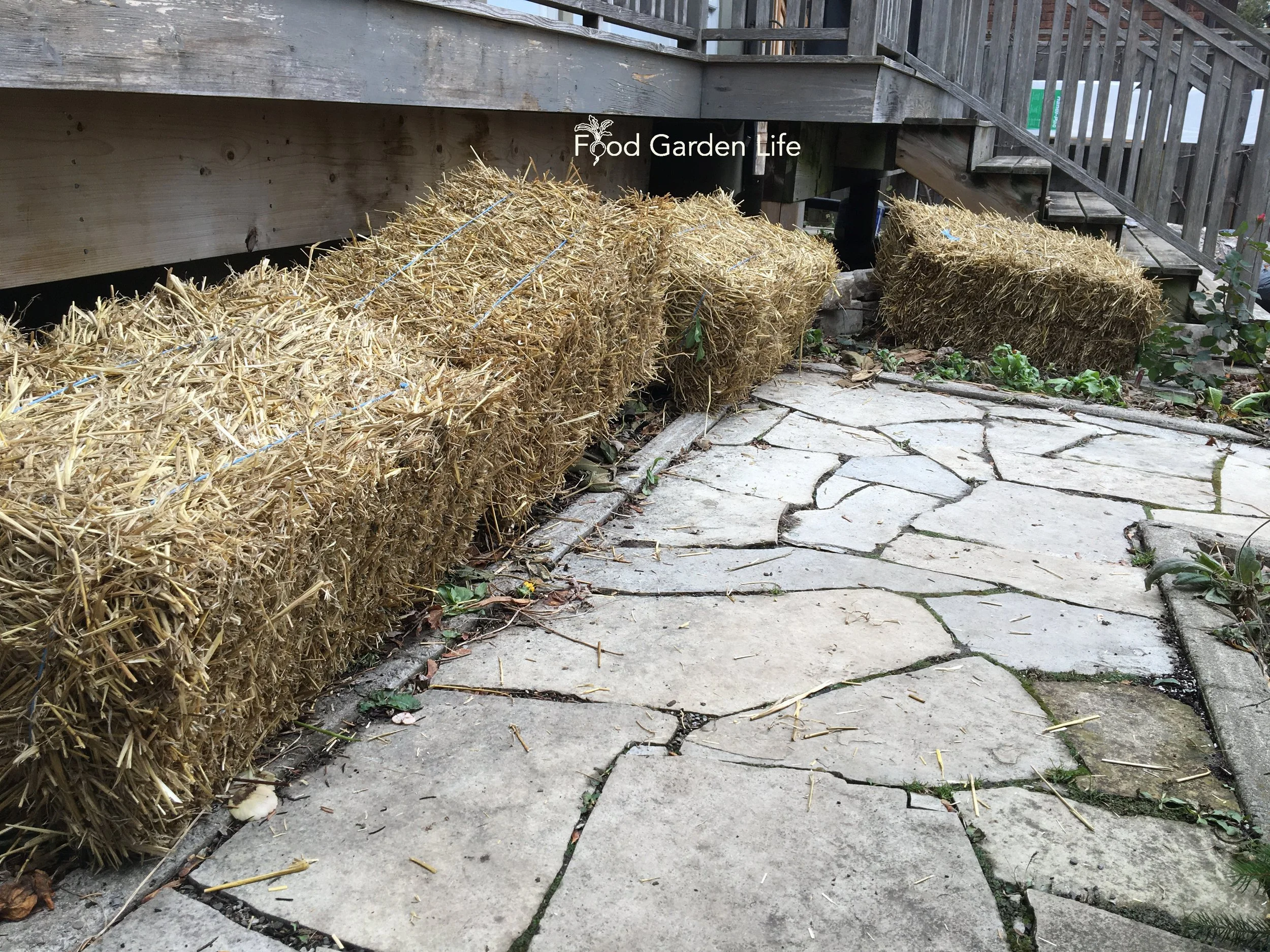
With the vertical branches removed, you’re left with only the cordon. And it’s just above the ground.
All you need to do is insulate it. Because it’s low to the ground and insulated, winter temperatures are moderated and stable.
The colder your winters, the more insulation you’ll need.
Here in Toronto, it’s enough for me to insulate with straw.
(I use straw for straw-bale gardening. Find out how to make a straw-bale garden.) If you don’t have straw, here are other ideas:
Bags of potting soil
Garbage bags filled with leaves (preferable to raking leaves over top because wet, matted leaves don’t insulate as well as dry leaves with air.)
Espalier Fig Spacing
You have a lot of leeway when choosing the spacing for your fig cordons. If you want longer cordons, obviously you’ll need fewer fig trees. If, like me, you have lots of fig varieties to fit into a small garden, you might opt for shorter cordons and more fig trees!
The tip of a cordon can reach it’s neighbour. No need to leave much of a gap in between.
Variations
Fig Trench
I also grow fig cordons in a trench. The idea of a trench is that it stays a bit warmer over the winter. In late fall, I cover the top of the trench with windows and bags of leaves. In spring, once I remove the bags of leaves, sun shines through the windows into the trench to warm things up.
The colder your zone, the more appealing a trench might make.
(There’s a rich history of trench cultivation! Here’s a fun article if you like this idea.)
Fig Trees in an X-Shape
Don’t be constrained by the 2-dimensional nature of espalier. You could make a low-to-the-ground fig growing out in an X pattern.
Early spring start
In cold climates, summer heat and season length are limiting factors to ripening fruit. If fig plants wake up in good time, the season is longer. Then there’s more chance of ripe figs.
Warm soil helps to wake up the fig tree. A south-facing location warms up more quickly than a location with less sun. If the location is next to a wall or something that catches the heat from the sun, the soil warms more quickly.
I have a low stone wall next to my cordon fig trees to capture heat. In the spring, I angle old windows against the wall, making a temporary low-tech mini greenhouse. The windows hold in heat to help the fig trees wake up earlier. They also protect them from late spring frosts.
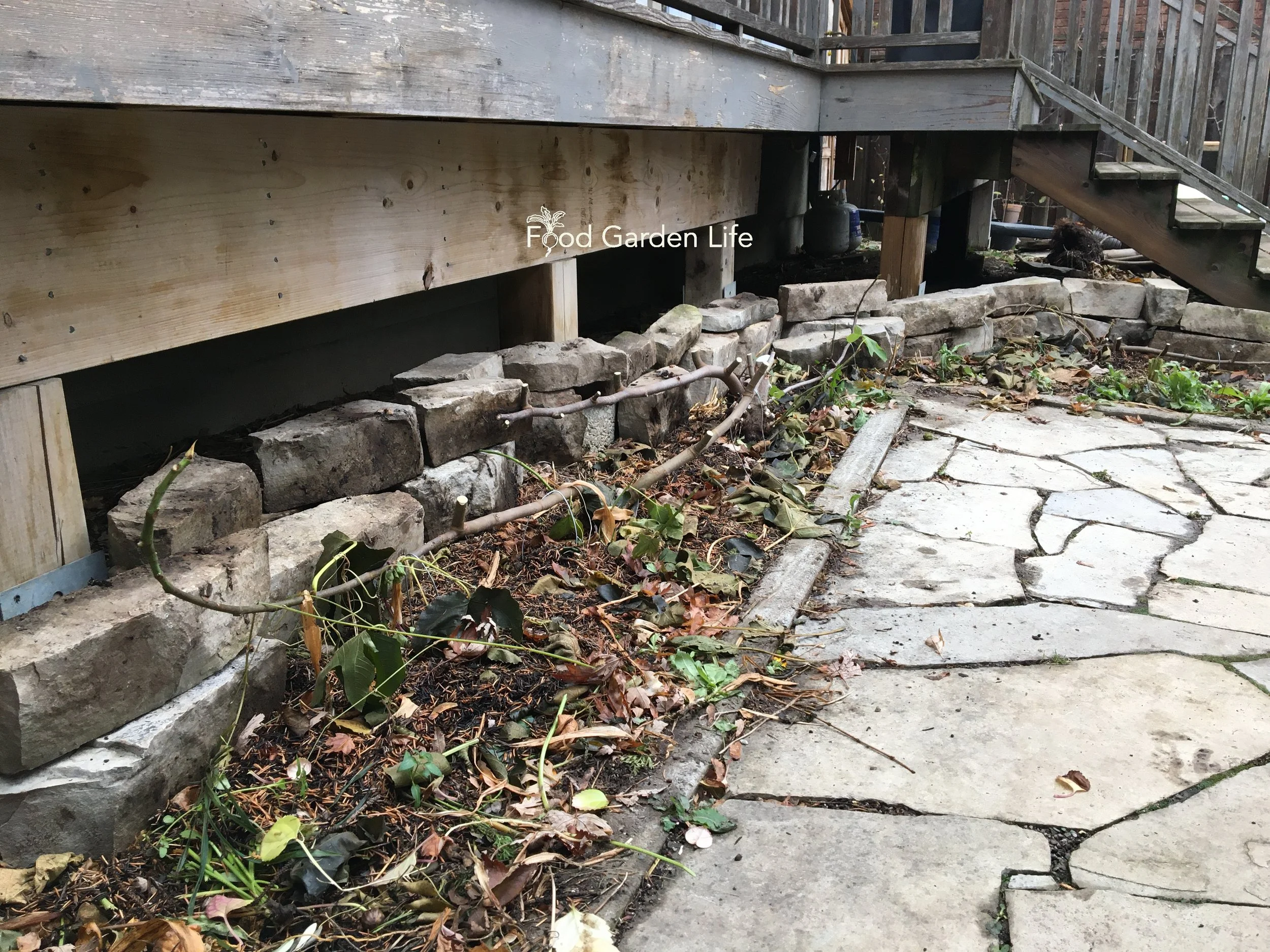
Low stone wall next to cordon fig trees.
Fig Varieties for Fig Espalier
Choosing the right fig variety is important for success with fig cordons in cold climates.
Here’s what we’re looking for a fig variety suited to low-cordon espalier:
A consistently heavy main crop
An early-ripening main crop
Tolerance of harsh pruning (my ‘Ronde de Bordeaux’ was not pleased about it)
I’m still experimenting with this, but my best results have been with the variety Natalina. Tune in to my chat with Jonathan Bates, below, to hear what he does with cordon figs. He has good results with the varieties ‘Florea’ and ‘St. Rita.’
(If you’re using this method and have a variety that does well, e-mail me—I’d love to hear about it.)
Hints and Tips
While you’re first forming the horizontal cordons, tie them to horizontal stakes so that they’re straight. I use bamboo stakes and sisal twine, which decomposes within a year.
If fig trees are growing quickly, the tie might constrict the branch—so check a couple of times over the summer to make sure the branch hasn’t outgrown the tie.
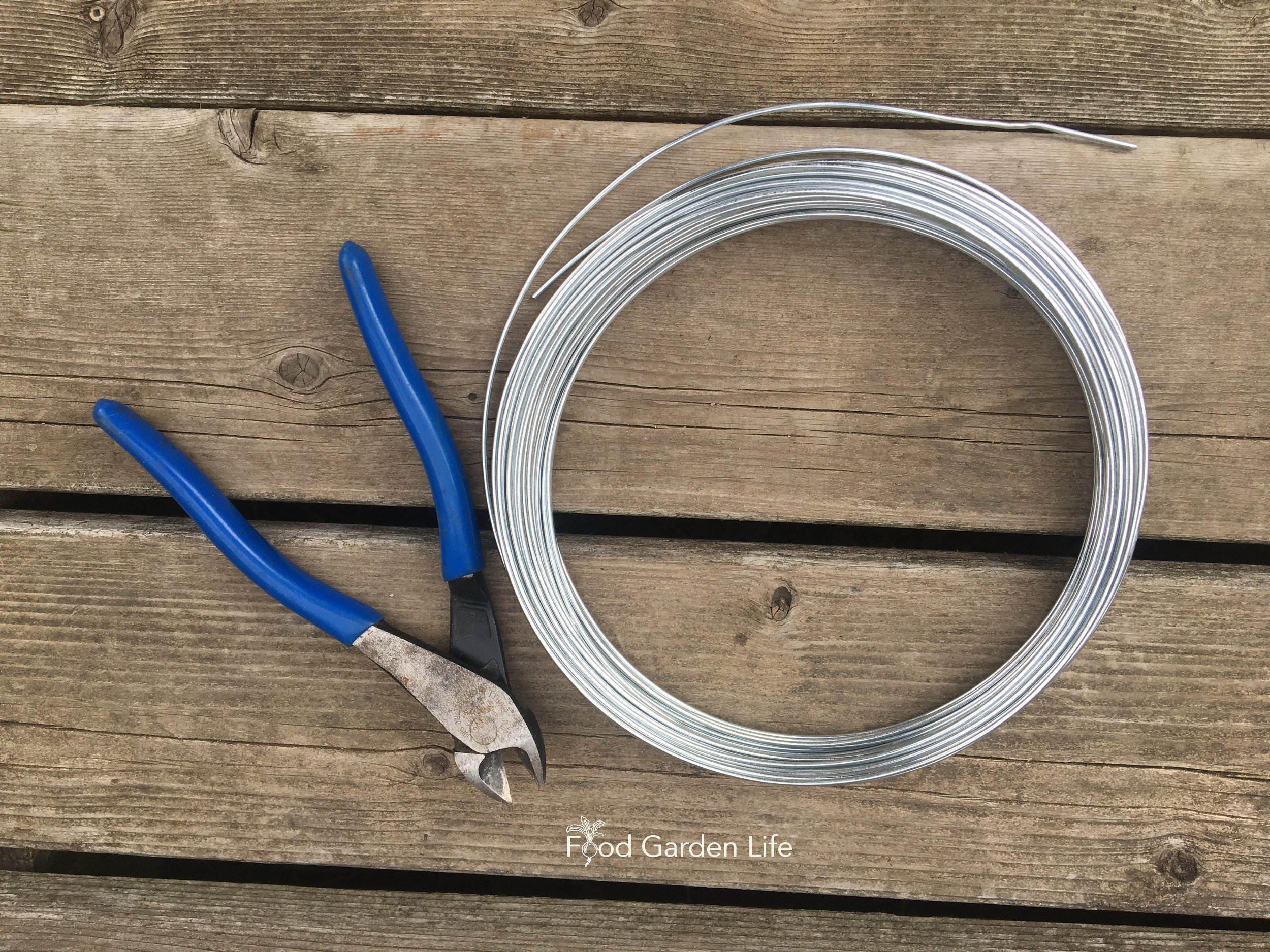
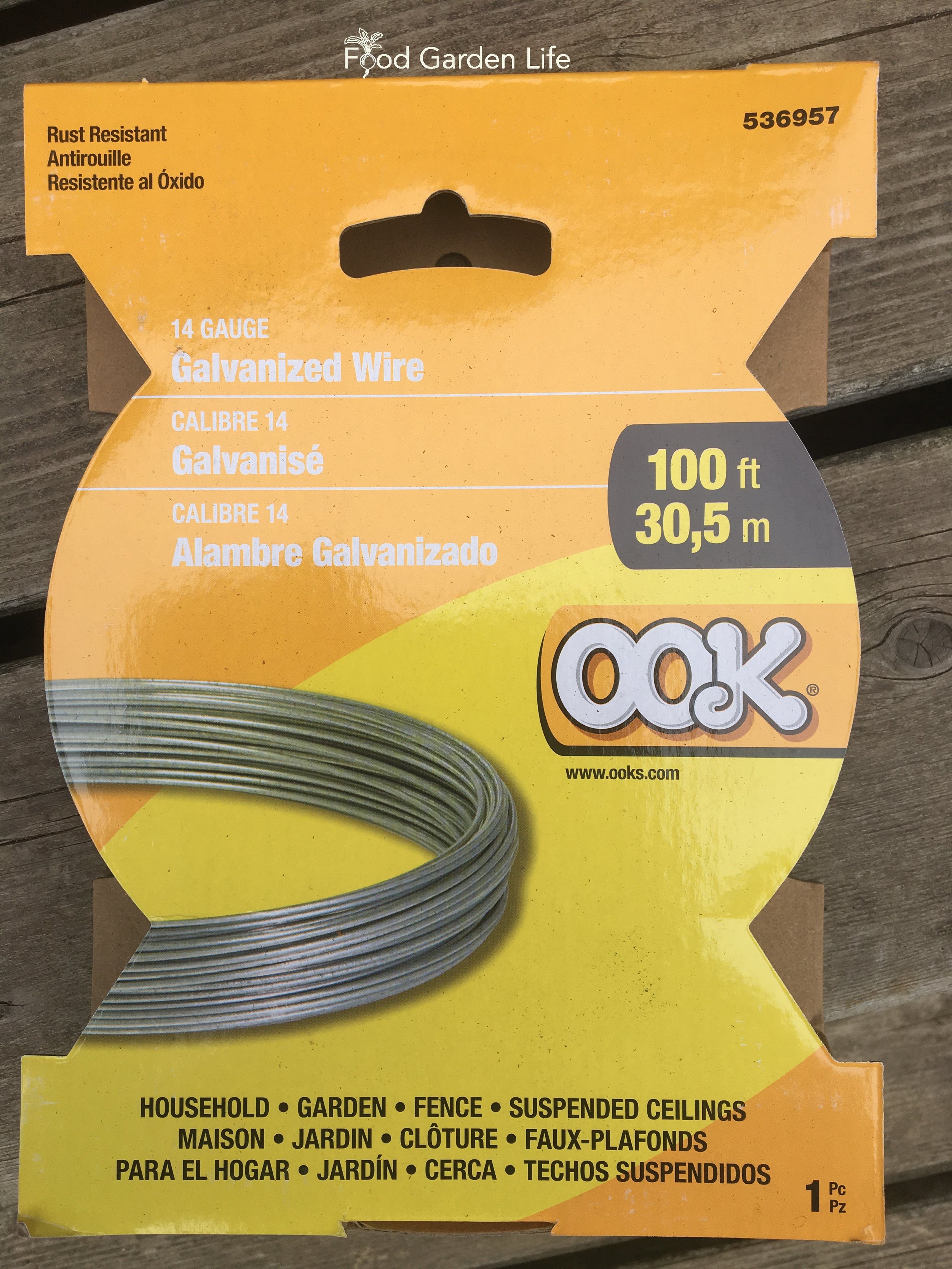
To pin down the cordon until it’s thickened and stays in place, use metal hoops. I make them from 14-gauge galvanized wire, the same wire that I used to create a framework for my espalier apples. Pieces of metal coat hanger work nicely too.
FAQ Fig Tree Espalier
Pin this post!
I accidentally broke a branch I was trying to bend. What should I do?
All art is recovery from the first stroke. And with pruning, we recover by encouraging and training new growth to do what we want. Be patient, and the fig will send out a replacement shoot that you can train to go where you want it to.
(one year the squirrels chewed off ALL the branches on my new apple espalier. I was furious! But the tree sent out new branches, and now you wouldn’t even know!)
Can I prune my fig tree even more, right back to the roots, so it's even more easy to cover for the winter?
That would sure make overwintering easy. That harsh a pruning is too much of a setback for a cold-climate fig tree. There probably won’t be enough time in a short season for new branches to ripen figs. (There will be new growth, and it will have figs…but they probably won’t ripen in a cold climate.) Retaining that horizontal fig cordon through winter means the pruning isn’t so much of a setback—and the new growth it sends out will produce figs that ripen.
Hear a Chat with a Greenhouse Grow who has Fig Cordons
Tune in to this chat with Jonathan Bates at Food Forest Farm in New York State. To grow figs in his cold growing zone, near the finger lakes, Bates grows horizontal cordons low to the ground, within a greenhouse.
Keep Growing Figs
Looking for more cold-climate fig-growing ideas? Visit the fig home page to browse articles about varieties, pruning, propagation, ripening, winter protection, and more.
Grow Figs Where You Think You Can’t
My revised and expanded fig book is a practical guide to growing figs in pots and cold climates—from choosing varieties and pruning to ripening fruit and conquering winter.
Find This Helpful?
Enjoy not being bombarded by annoying ads? Appreciate the absence of junky affiliate links for products you don’t need?
This site is reader supported. If it has helped you in your food-gardening journey, you can give us a high-five below. Any amount is welcome.
Potted Figs Waking up Early? Here’s Why, and What You Can Do
Your potted figs are leafing out early... When fig trees come out of dormancy early, you need to know what to do next so that you can still harvest figs. Find out what to do—and how to avoid figs waking up early next year.
By Steven Biggs

What to Do When a Dormant Fig Tree Wakes Up Early
“HELP…my fig tree is growing already!”
I often see this sort of email subject line in late winter. If your dormant fig tree is sprouting in storage, you’re not alone.
The usual cause is simple: the storage space is too warm. Once the buds open and tender growth appears, you can’t keep the tree in dark, cool storage conditions.
If it’s still too cold to move the tree outdoors, put it in the brightest, coolest frost-free place you have. Bright light helps produce sturdier growth until outdoor conditions warm up.
In this guide, I’ll explain why potted fig trees wake up early, what to do with them now, and how to keep them dormant longer next winter.
Why Early Growth Is a Problem
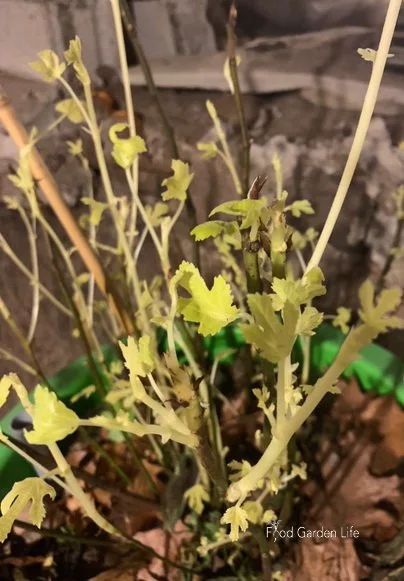
This fig tree woke in a dark crawl space. Without light, the new growth is pale and stretched.
In cold climates, we can overwinter dormant potted fig trees in cool, dark places. Because they have no leaves and aren’t actively growing, they need no light.
Once a tree begins growing, it needs light—but if your tree starts growing in a dim storage space, the light is probably too weak to give sturdy growth.
A fig tree growing in dim light produces:
Pale, stretched shoots
Large, thin leaves
Weak growth that flops over or scorches when moved outdoors
Breba figs that may drop off or fail to ripen
And if you’re thinking of just growing it as a houseplant once it wakes up, that’s not usually ideal. Growing a fig tree indoors as a houseplant can keep it alive, but it rarely produces the compact growth and strong harvest you’re after.
Why Fig Trees Wake up Early
When a dormant potted fig tree wakes early, it’s usually because the storage area is too warm. Warm temperatures trigger growth. That’s why a basement may work early in winter but become a problem later: the tree is ready to grow, and the space is warm enough for it to grow.
Modern, centrally heated basements are often too warm to keep fig trees dormant until spring.
It really depends on your house, though:
A friend had a century-old farmhouse with an uninsulated, unheated, earth-floored basement…fantastic for dormant figs. That’s the kind of space that keeps fig trees dormant.
My garage is minimally heated and is a perfect spot for overwintering dormant figs.
Some modern homes have a good root cellar—and the desirable temperatures for root cellaring also work well for keeping fig trees dormant.
Temperature Is the Main Thing to Watch
Shortening days and falling temperatures help a fig tree enter dormancy in autumn. Once it’s dormant, temperature is the most important factor you can control during winter storage.
Day length still plays a role as winter ends, but temperature usually determines how early your tree wakes up. My garage has windows that let in light, yet the potted figs don’t wake early, because the space stays consistently cool.
What to Do if Fig Trees Start Growing Early
What you do if your fig tree starts to grow early depends on how far the tree has progressed.
If the buds are only swelling: Move the tree to a colder—but protected—storage space. Cooler conditions may slow budbreak. Don’t expose swelling buds to a freeze.
If leaves or shoots have appeared: The tree is actively growing. Move it to the brightest, coolest frost-free place available.
If outdoor days are mild: You can move the tree outside temporarily for stronger light, but start in a sheltered, shaded location and bring it back under protection if there are cold winds or the temperature dips.
While it’s growing indoors: Water when the potting mix begins to dry, but don’t keep it sopping wet. Avoid heavy feeding, which encourages even more weak growth in limited light.
Here in Toronto—USDA Zone 5—it’s usually too cold in mid- to late winter to leave an actively growing fig tree outside. Tender new growth can’t tolerate the cold that a fully dormant tree can.
Once a fig tree has leafed out, don’t try to force it back into dormancy. Keep it growing in the best light you can provide until it’s safe to begin moving it outdoors.
Learn how to move a fig tree outdoors in spring.
These two real-life examples show how the best response depends on the growing space available.
Example 1:Figs Leafing Out Early
Here’s an example of a late-winter note that I received about potted figs sprouting early. Holly wrote:
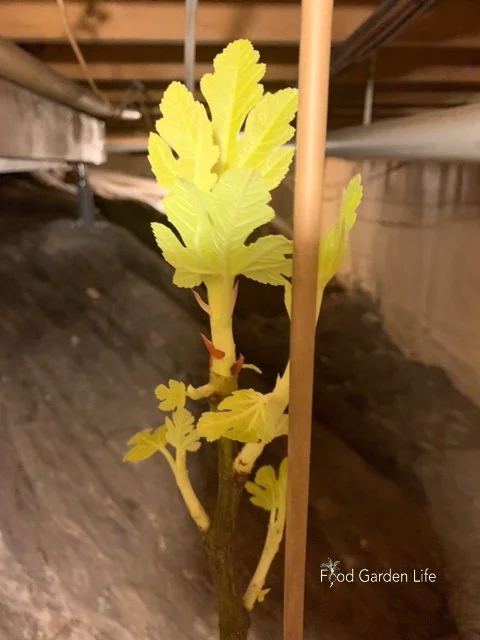
Darkness doesn’t guarantee dormancy. Warm conditions caused these stored fig trees to begin growing.
I brought my six fig trees inside and put them in my crawl space. They are in large containers with reservoirs in the bottom.
Anyway, it is dark but too warm, and they are sprouting small albino-pale leaves.
Now I don’t know what to do? Leave them? Move them to my cooler sunroom with light? Help!!!
Here is my response:
Sorry to hear about your fig dilemma! The crawl space is too warm, so the trees have come out of dormancy early. It’s difficult to return actively growing trees to dormancy. A cool sunroom with bright light is your best option—as long as the trees don’t freeze.
The Challenge
Holly’s crawl space is completely dark—but it’s warm enough to trigger growth. Without light, the emerging shoots are pale and stretched.
What to Do
Move the fig trees to a bright, cool, frost-free growing space. The brighter the light, the more compact the new growth will be.
Holly’s sunroom is the best option in this case because it’s both bright and cool.
Other possibilities include:
A bright, south-facing window
A cool greenhouse or enclosed porch that remains frost-free
Strong grow lights placed close enough to provide useful light
Artificial light isn’t necessarily inferior. A suitable grow-light setup can provide better light than a window during winter.
Avoid Early Sprouting Next Year
Holly is considering an insulated storage compartment inside her garage next winter. This can work well in a garage that occasionally becomes too cold for potted fig roots.
In an attached garage, build the compartment against the wall shared with the house, where temperatures usually fluctuate less than they do near the large garage door. Add a remote thermometer so you can monitor conditions inside.
Insulation slows heat loss but doesn’t create heat. If the garage becomes extremely cold, the compartment may still need a small, thermostatically controlled heat source.
Example 2: A Fig Tree with Breba Figs Wakes Early
Here’s another example of a late-winter enquiry I received about potted figs coming out of dormancy early:
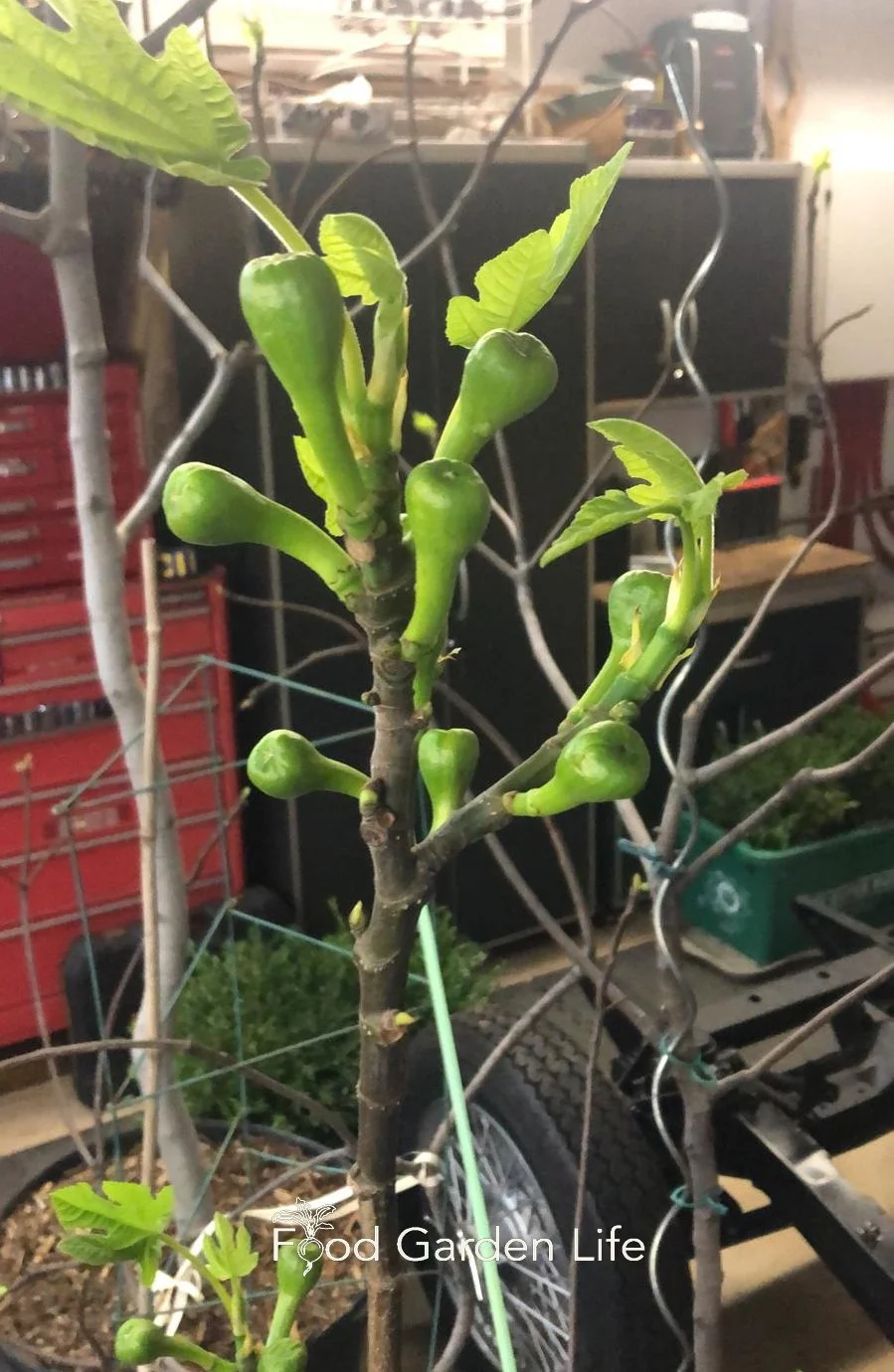
David’s potted fig tree woke early in his heated garage—and its branches were loaded with breba figs.
“My fig trees are growing, what should I do?” That was the question my neighbour David asked during a late-March phone call.
David grows his fig trees in pots on his patio during summer. He leaves them outdoors in autumn until they’re dormant, then stores them in his garage.
The garage is heated because David works on cars there during winter. It also has large windows. The warmth triggered early growth, while the window light wasn’t strong enough to produce compact shoots.
To complicate matters, the branches were carrying oodles of breba figs—a crop that develops on the previous season’s growth.
The Challenge
It was still too cold to move the actively growing trees outdoors. More freezes were likely, and they could damage the tender new growth.
But the light inside the garage wasn’t bright enough for sturdy growth.
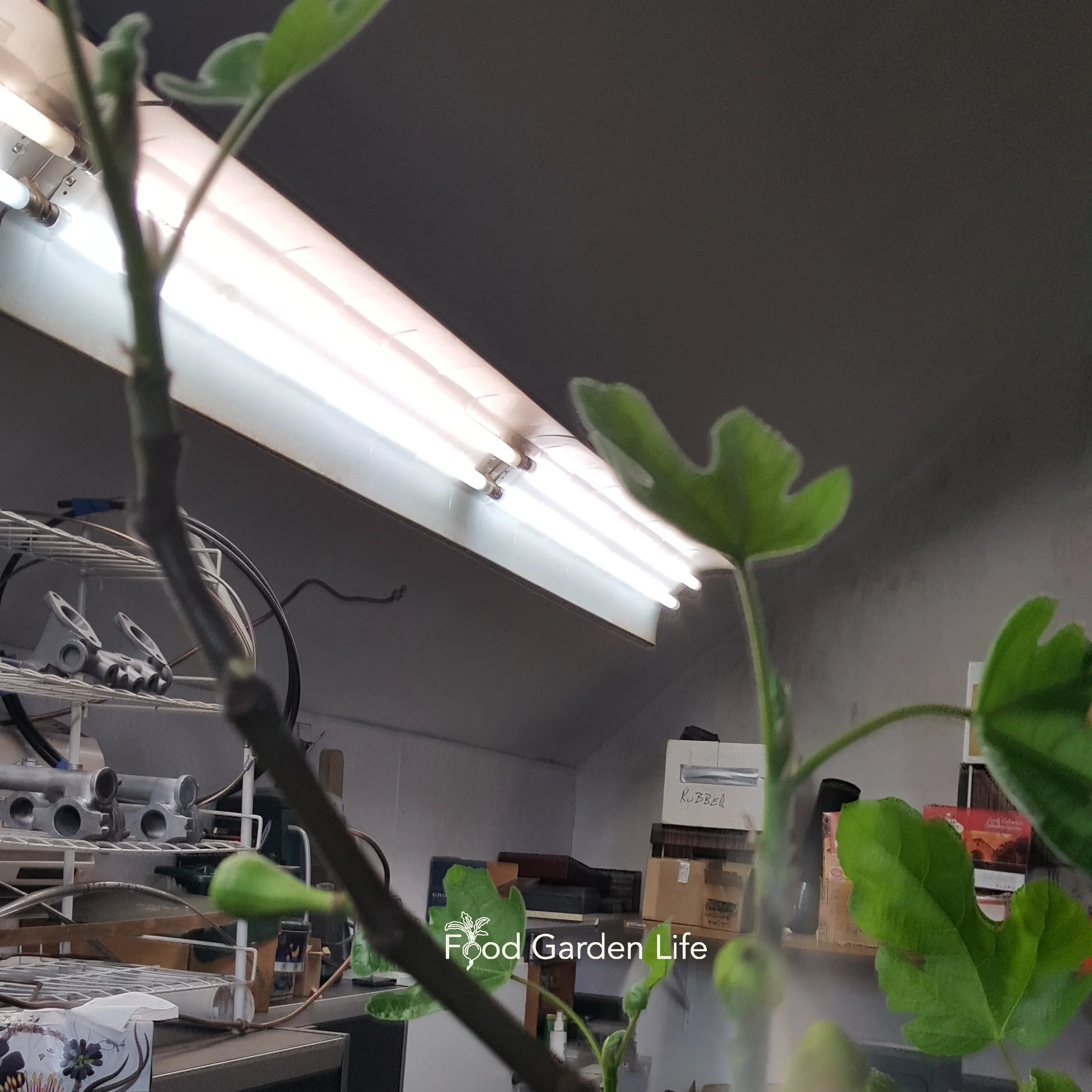
Potted fig tree making lanky growth beneath a shop light in David’s heated garage.
Give the Trees More Light
I suggested moving the trees to the brightest part of the garage until outdoor conditions improved.
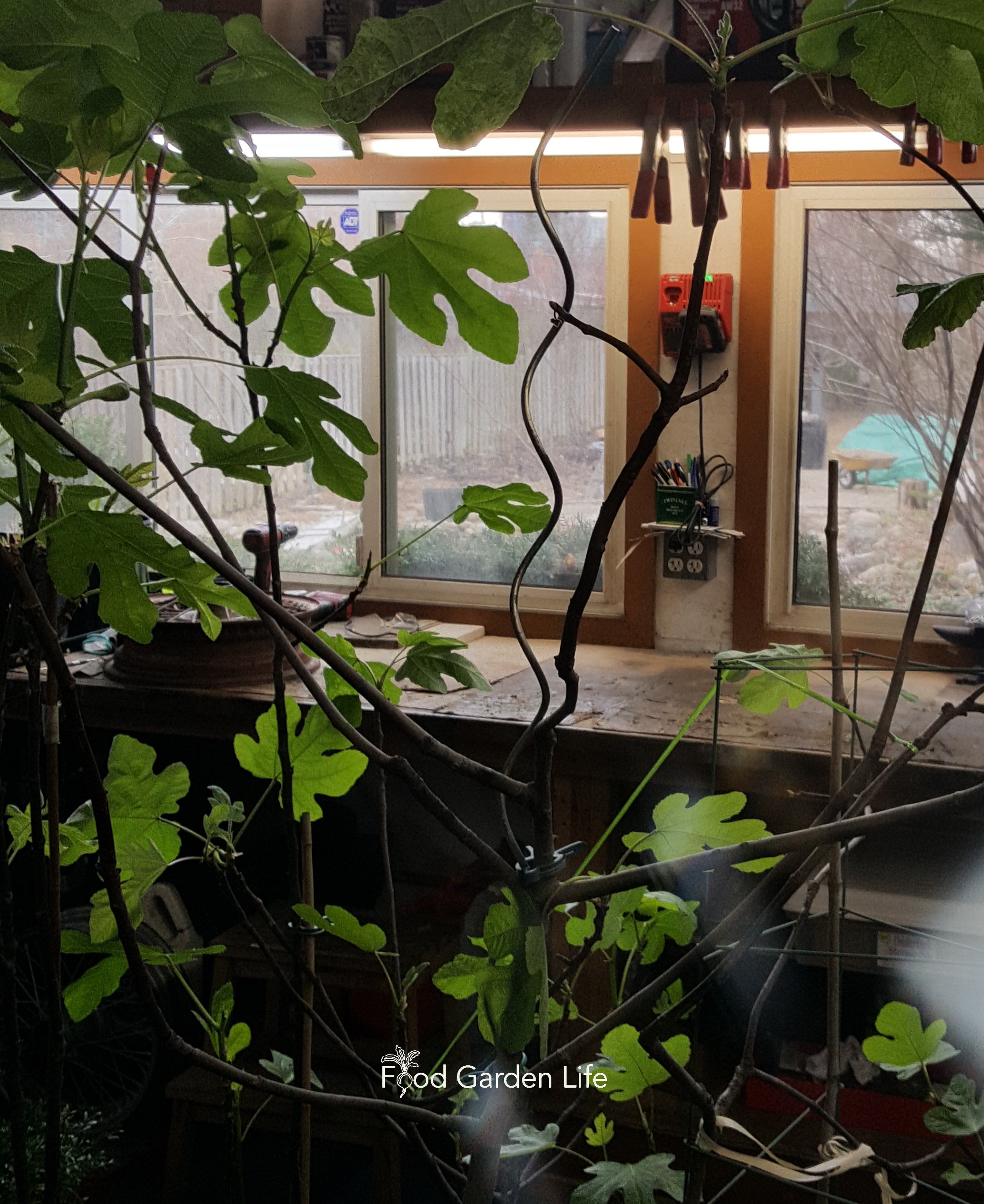
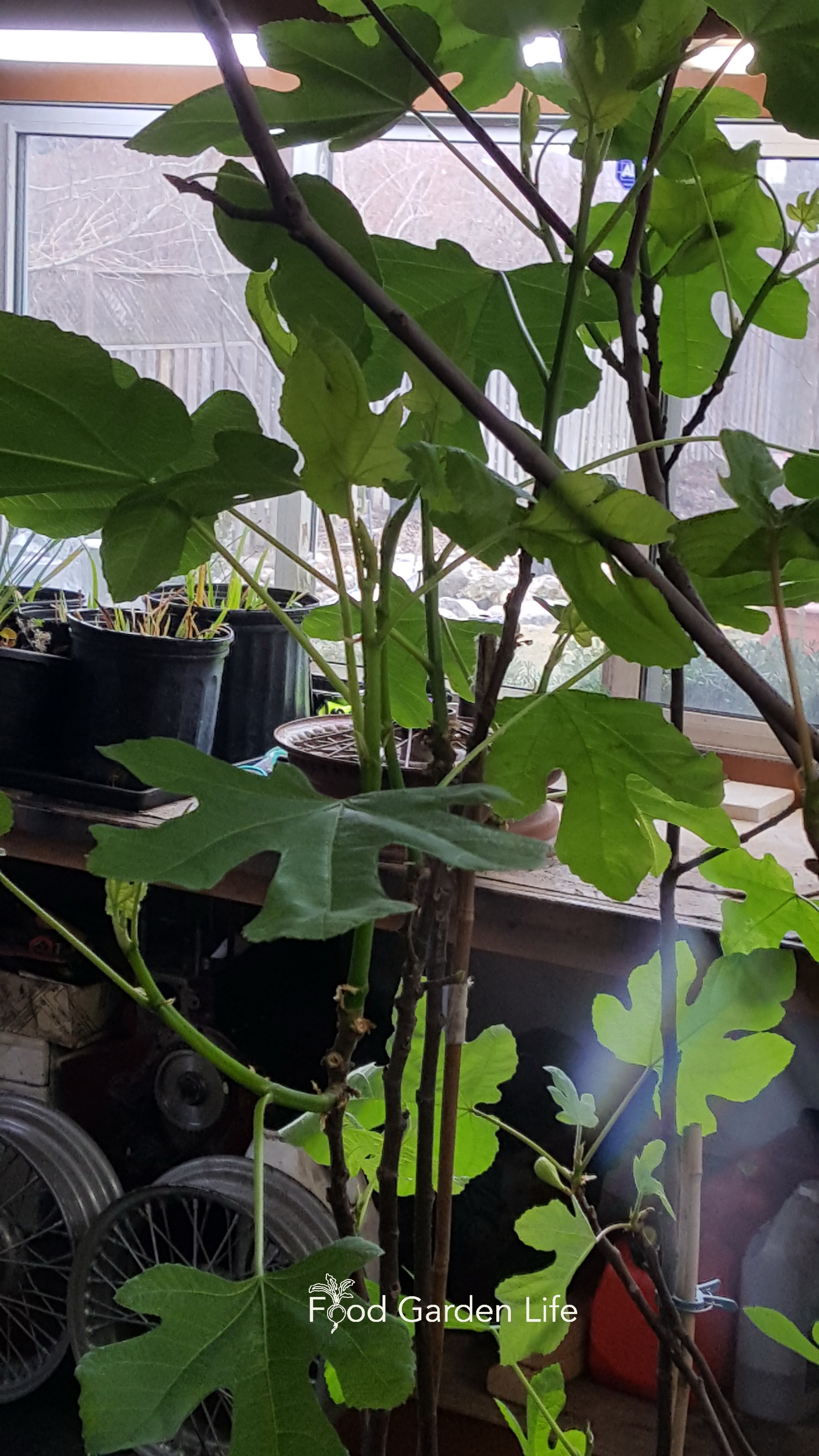
On mild days, David could move them outside for stronger light. He would need to start in a sheltered, shaded location, protect them from strong wind, and return them to the garage whenever frost threatened.
Another possibility was a simple temporary greenhouse against the garage. This could provide brighter light during the shoulder season while protecting the trees from cold nights.
A temporary greenhouse can heat up surprisingly quickly in sunshine, so it needs ventilation and temperature monitoring.
Avoid Figs Waking Up Early Next Year
The following winter, David could:
Keep the garage cooler
Build an insulated storage compartment within the garage
Store the trees in another consistently cold location
Overwinter the figs outdoors using a protected in-ground or trench method
If he walls off a corner of the garage, a remote thermometer will show whether the compartment remains cold enough for dormancy without reaching temperatures that could damage the potted roots.
Another option is to grow the trees in the ground and protect them by tipping and covering them, or to overwinter the pots outdoors in a protected trench.
Here are more ideas for overwintering figs in cold climates.
Important Tip for Fig Trees That Leaf Out Early
Pin this post!
There’s one more important thing to remember.
New leaves that develop indoors aren’t adapted to full outdoor sunlight or wind. If you move the tree directly from dim indoor conditions into full sun, the leaves can scorch badly.
I’ve fried my fig leaves more than once by moving the trees into full sun too quickly.
Start in a sheltered, shaded outdoor location. After a few days, introduce gentle morning sun, then gradually increase the amount of direct light over a week or two.
Watch the forecast throughout this process. Bring actively growing trees back under protection if freezing temperatures threaten.
Find out what to do with your fig tree in the spring.
FAQ: Fig Trees Waking Up Early
Why did my fig tree wake up early?
Warm storage conditions are the most common cause. Once the tree has been dormant for a while, warm conditions can trigger budbreak—even in complete darkness.
Will waking early kill my fig tree?
Usually not. The challenge is keeping the new growth healthy until outdoor conditions improve. Give the tree bright light, protect it from freezing temperatures, and don’t overwater it.
Can I make it go dormant again?
If the buds are only swelling, moving the tree to a colder protected space may slow them down. Once leaves and shoots have appeared, it’s difficult to return the tree to dormancy without damaging the new growth.
Should I grow it indoors now that it’s awake?
If it’s still too cold outdoors, yes. Put it in the brightest, coolest frost-free location available. Indoor growing isn’t ideal, but it’s safer than exposing tender shoots to freezing temperatures.
Does a dormant fig tree need light?
No. A fully dormant fig tree has no leaves and doesn’t need light. Holly’s trees began growing in complete darkness because the crawl space was warm.
Once growth begins, however, the tree needs bright light.
Can I put an actively growing fig tree outside?
You can put it outside on mild days, but begin in shade and shelter it from wind. Bring it back under protection before temperatures freeze. Gradually get it used to stronger sunlight.
Should I remove pale, lanky shoots?
It’s tempting, but pruning the branches may remove developing breba figs, while removing the new shoots can delay the main crop. Move the tree into brighter light first. Once it’s growing outdoors, you can assess whether weak shoots need pruning. It’s often better to accept less-than-perfect growth for the season, get some figs, and then prune back that lanky growth next year while the tree is dormant.
How can I help my potted fig enter dormancy in autumn?
Leave it outdoors as days shorten and temperatures fall. A few light frosts help encourage leaf drop and dormancy. Don’t move it into warm winter storage too early, but protect the pot from temperatures cold enough to damage the roots.
Get Your Fig Trees Through Winter—and Harvest Figs
Growing figs where winters are cold takes a bit of creative thinking.
In Fig Camp and the self-paced Fig Masterclass, I explain how to grow figs in pots or in the ground, extend the growing season, ripen more fruit, and protect your trees through winter.
Explore Fig Camp and Fig Masterclass
Keep Growing Figs
Looking for more cold-climate fig-growing ideas? Visit the fig home page to browse articles about varieties, pruning, propagation, ripening, winter protection, and more.
Grow Figs Where You Think You Can’t
My revised and expanded fig book is a practical guide to growing figs in pots and cold climates—from choosing varieties and pruning to ripening fruit and conquering winter.
Find This Helpful?
Enjoy not being bombarded by annoying ads? Appreciate the absence of junky affiliate links for products you don’t need?
This site is reader supported. If it has helped you in your food-gardening journey, you can give us a high-five below. Any amount is welcome.
Watering Dormant Potted Figs...and Getting it Right so They Survive Winter
Pointers on how often to water potted dormant figs over the winter.
By Steven Biggs

How Often to Water Dormant Figs
Once you protect your dormant, in-ground fig plants for the winter, there’s no need to think about watering them over the winter.
In the same way that you don’t need to water dormant landscape shrubs over the winter, you don’t need to water your dormant, in-ground fig trees.
But your potted fig plants might need water.
Or they might not.
It depends on the conditions where you’re storing them.
This post will help you figure out how often to water a dormant fig plant.
Don't Overwater…
When a dormant fig plant gets too much water, the roots might rot.
Knowing when —and whether — to water can be difficult to gauge for new growers.
Here’s how I judge: I stick my finger right into the soil—and if I feel moisture, I don’t water.
Explained another way: Keep the soil on the dry side of moist.
Not Too Dry Either…
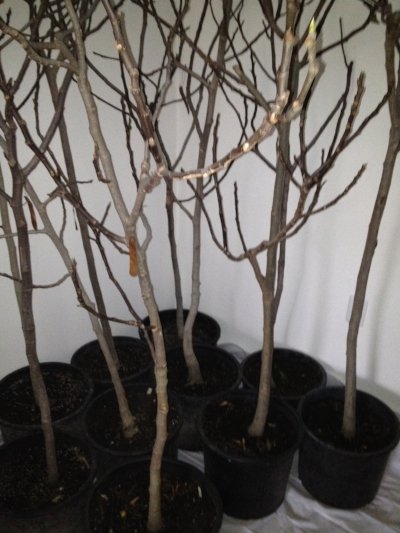
Not sure how often to water dormant fig trees? Keep them on the dry side of moist.
But if the soil becomes too dry while the fig plant is dormant, the plant can die.
If the soil feels extremely dry, it’s probably time to water.
Remember: Keep it on the dry side of moist—not bone dry.
You will know the soil is quite dry if it shrinks and is no longer in contact with the edge of the pot.
When potting soil shrinks like this, water goes down the side of the pot instead of soaking into the soil. So before watering, use your fingers to spread out the soil so there is no space for the water to go down the side of the pot.
Is There a Rule for How Often to Water?
No.
When dormant figs are stored somewhere with dry air (e.g. in a cold room in house with forced air heating) they might need occasional watering.
But they might not.
The figs in my garage, where the air is humid, often need no water all winter long.
Fig Trees Waking up Early?
Keep Growing Figs
Looking for more cold-climate fig-growing ideas? Visit the fig home page to browse articles about varieties, pruning, propagation, ripening, winter protection, and more.
Grow Figs Where You Think You Can’t
My revised and expanded fig book is a practical guide to growing figs in pots and cold climates—from choosing varieties and pruning to ripening fruit and conquering winter.
Find This Helpful?
Enjoy not being bombarded by annoying ads? Appreciate the absence of junky affiliate links for products you don’t need?
This site is reader supported. If it has helped you in your food-gardening journey, you can give us a high-five below. Any amount is welcome.
Figs and Winter Temperatures
Find out what you need to know about fig hardiness and winter temperatures so you can figure out what sort of winter protection (if any) your fig trees need.
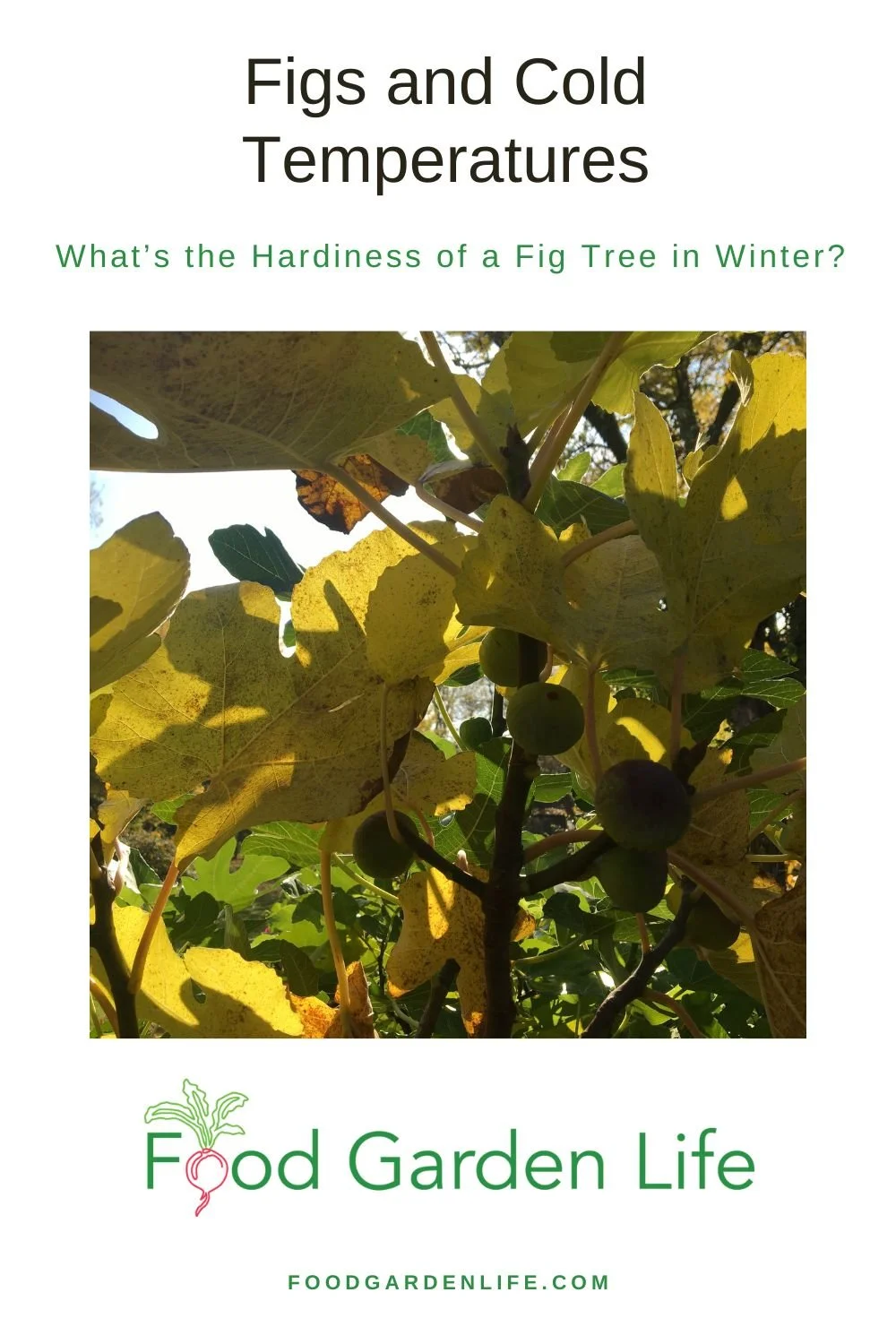
What’s the Hardiness of a Fig Tree in Winter?
Fig plants tolerate more cold than many people realize.
But just how cold can they get without damage?
It depends on a few different things.
This article tells you what you need to know about fig hardiness and winter temperatures so you can figure out what sort of winter protection (if any) your fig trees need.
(If you already have an idea of how hardy fig trees are in your area and just want ideas to get them through the winter, find out more here.)
Hardiness Isn’t Exact
Hardiness is never an exact thing.
That's because fig tree hardiness is affected by what's going on with the tree—and it's also affected by the conditions around the fig tree.
The cold hardiness of fig trees is affected by what's going on with the tree:
Young trees are more tender than mature trees
Fruit and new growth are affected by cold before older, woodier stems
If the fig tree is dormant, it can better withstand cold
Some fig varieties are more cold-tolerant than others
The conditions the fig tree is exposed to also affect cold hardiness:
The duration of cold temperatures
How sheltered or exposed the fig tree is
How many degrees the temperature drops
The timing of extreme cold (e.g., at the end of the night the plant might be soon warmed by sun)
So How Much Cold Can Fig Trees Take?
There is no magical number. Some fig plants can take temperatures as cold as -7 to -9°C (15-20°F).
Some colder.
Some not so cold…
If you want to think in terms of zones, you’ll often see the recommendation that figs are hardy into USDA Zone 8. But you can push the growing zone recommendations if you figure out a way to moderate temperature extremes around your fig plant over the winter.
Even if a cold winter causes the top of a fig tree to die back, the roots usually survive and send up new shoots.
Potted Figs: Remember the Root Ball
If you're growing fig trees in containers, it's good to remember that a potted fig tree can't tolerate as much cold as an in-ground fig tree.
That's because the root ball will freeze and thaw more often and more quickly than the soil in the ground.
The main trunk and branches probably have the same cold tolerance.
Things to Think About as you Plan Fig Tree Winter Protection
Here are things to think about as you consider what to do with your fig tree for the winter.
Your Zone: How much protection your fig tree needs over winter is affected by your plant hardiness zone.
Microclimate: Most gardens have some sort of protected area (called a “microclimate.”)
Your Storage Options: Each house and yard is different. I met a Toronto gardener with what he called a “fig cave”. This cave—and underground stairwell between his garage and his house—was a sheltered space he used to store dormant potted fig trees. In some areas, you might not need to store potted figs—and might only need to wrap in-ground fig trees during winter months.
Your Budget: There are lots of gadgets… I’ve met gardeners with thermostatically controlled space heaters. Other gardeners keep things simple, using insulating materials.
You: The way that you decide to protect your fig over the winter will depend on how much lifting and hauling you want to deal with.
Get Your Fig Trees Through Winter—and Harvest Figs
Growing figs where winters are cold takes a bit of creative thinking.
In Fig Camp and the self-paced Fig Masterclass, I explain how to grow figs in pots or in the ground, extend the growing season, ripen more fruit, and protect your trees through winter.
FAQ: Winter Fig Tree Hardiness
Do figs lose their leaves in winter?
Yes.
How do you take care of a fig tree indoors in the winter?
In a cold climate, it's easiest to let a potted fig tree go dormant, and then store it somewhere cool and dark for the winter. Find out more ways to overwinter figs in cold climates.
Do figs do well in pots?
The do very well in pots. Here's an article that gives more information about how fig trees grow.
Where is the best place to keep a fig tree in the winter?
There is no best place. It depends on how cold your zone is and what sort of spaces you have for winter protection.
Should I prune my fig before I store it for the winter?
It depends on a few things. Find out more in this Cold-Climate Guide to How to Prune a Fig Tree.
Video: Figs Waking Up Early
Keep Growing Figs
Looking for more cold-climate fig-growing ideas? Visit the fig home page to browse articles about varieties, pruning, propagation, ripening, winter protection, and more.
Grow Figs Where You Think You Can’t
My revised and expanded fig book is a practical guide to growing figs in pots and cold climates—from choosing varieties and pruning to ripening fruit and conquering winter.
Find This Helpful?
Enjoy not being bombarded by annoying ads? Appreciate the absence of junky affiliate links for products you don’t need?
This site is reader supported. If it has helped you in your food-gardening journey, you can give us a high-five below. Any amount is welcome.
What to do with a Fig Tree in Winter
Find out what you can do to protect a fig tree in winter. There are lots of ways to do it, and the right choice will depend on your situation.
Fig Tree Winter Protection
In places where the seasons change, figs drop their leaves and go dormant over the winter.
In some places, you don’t need to do anything for fig trees to survive the winter.
But as you move into colder zones, you’ll need to protect a fig tree in winter.
Protecting a fig tree in winter is fairly easy because the tree is dormant. There are no leaves, and you don’t have to fuss over it.
A dormant fig tree is easier to take care of than a houseplant!
This guide to how to protect a fig tree in winter has lots of ideas for ways to protect your fig plants.
You Don’t Need a Greenhouse for Fig Tree Winter Protection
I break fig tree winter protection into two broad tactics:
Indoors
Outdoors
Remember, they go dormant. If they haven’t already shed their leaves by the first fall frost, they will drop them soon afterwards.
Having no leaves means you don’t need bright conditions for them. They don’t need warmth either.
Fig Tree Winter Temperatures
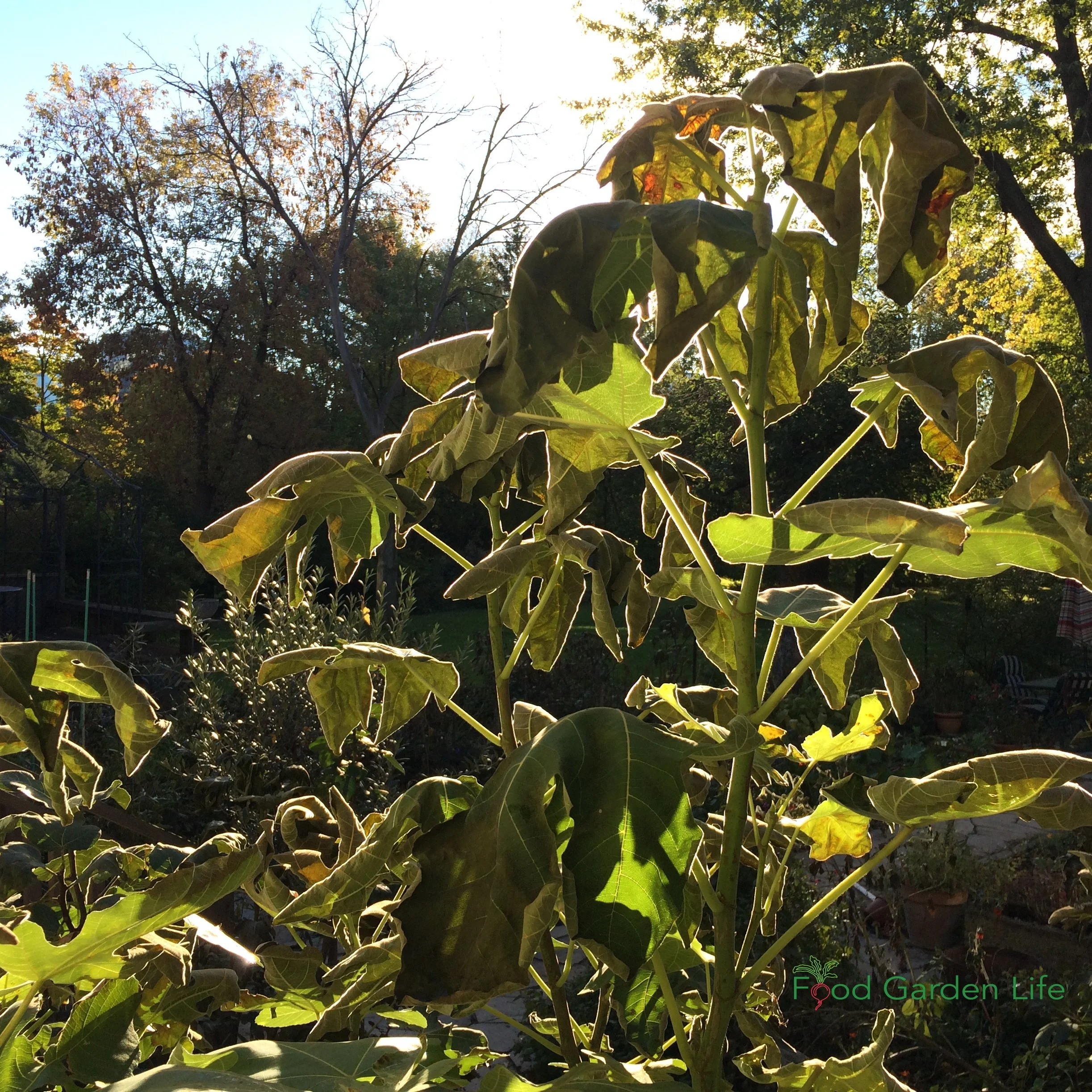
Fig leaves wilting after frost. As the fig tree goes dormant, you have many options for protecting it over the winter.
Fig trees can take colder temperatures than many people realize. Mature trees survive temperatures down to approximately -7 to -9°C (15-20°F). (Often more…but hardiness is not an exact science.)
Figs are hardy into USDA Zone 8. And beyond that with suitable varieties and the right location.
Here’s your challenge: Figure out a way to moderate temperature extremes around your fig plant over the winter.
If you’re new to figs, read this introduction to figs.
Whichever way you protect your fig tree for the winter, you’ll want to keep the plant dormant until you’re ready for it to grow in the spring. So ideally, you want somewhere cool and dark.
If it grows indoors, in low-light conditions, you end up with weak, lanky growth. Here’s what you’d end up with.
Fig Tree Winter Protection – Winter Outdoors
Outdoors – Tipped Over
A common overwintering technique in cold climates is to lay over the fig plant so that it’s at ground level. This is because soil temperature fluctuates more slowly than air temperature – and the soil temperature usually doesn’t get as cold as air temperature.
In very cold areas, fig growers will lay over a fig tree and bury it below the ground level. Being below ground level and covered with soil greatly moderates temperature changes.
In areas where winter temperatures are not as cold, it might be sufficient simply to lay a fig plant flat to the ground and then mulch it.
In either case, it is helpful to prune the plant first, and then tie the branches together before laying it flat. It makes it easier to cover.
One final consideration: Mulches that are dry have better insulating properties.
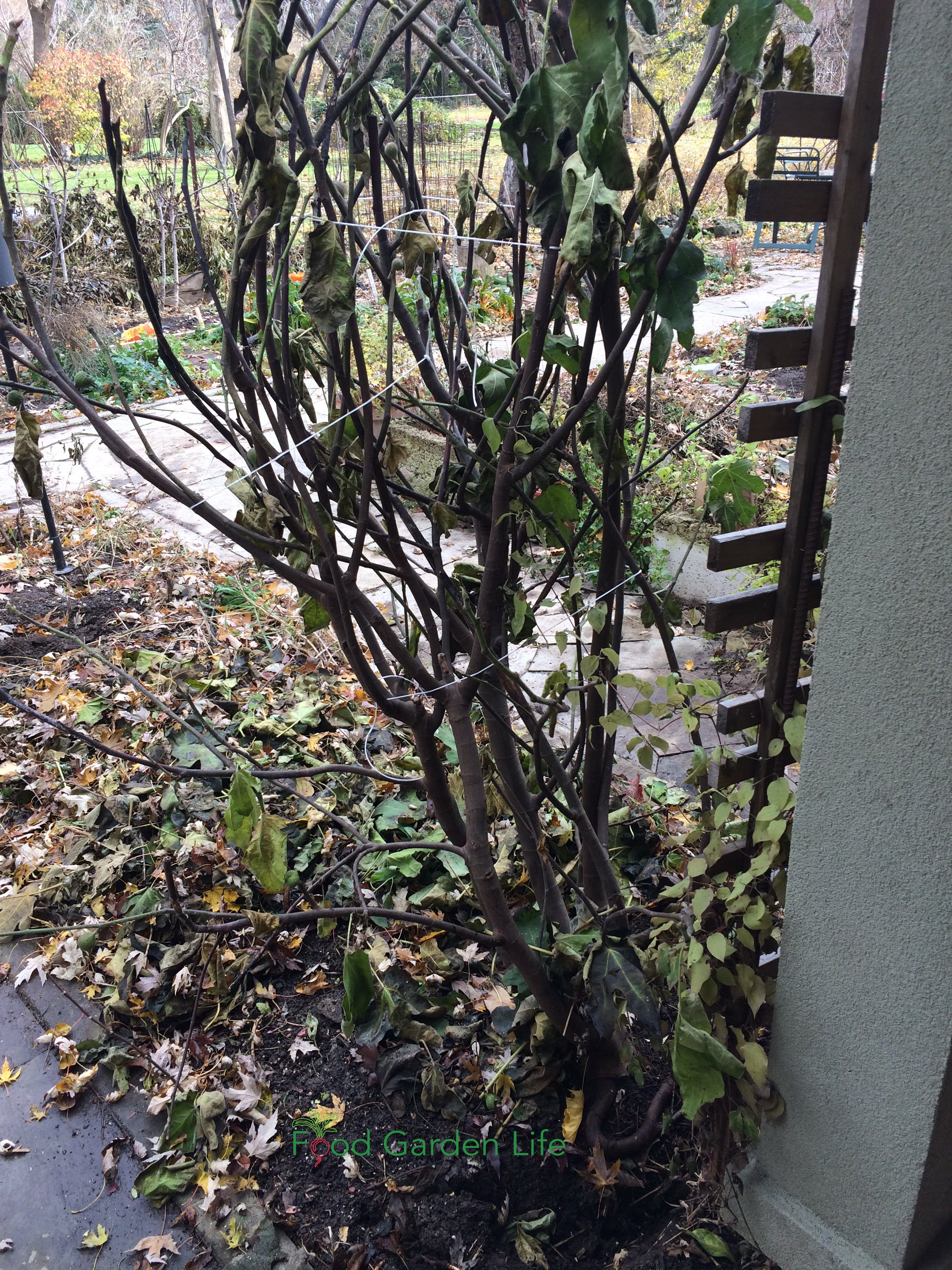
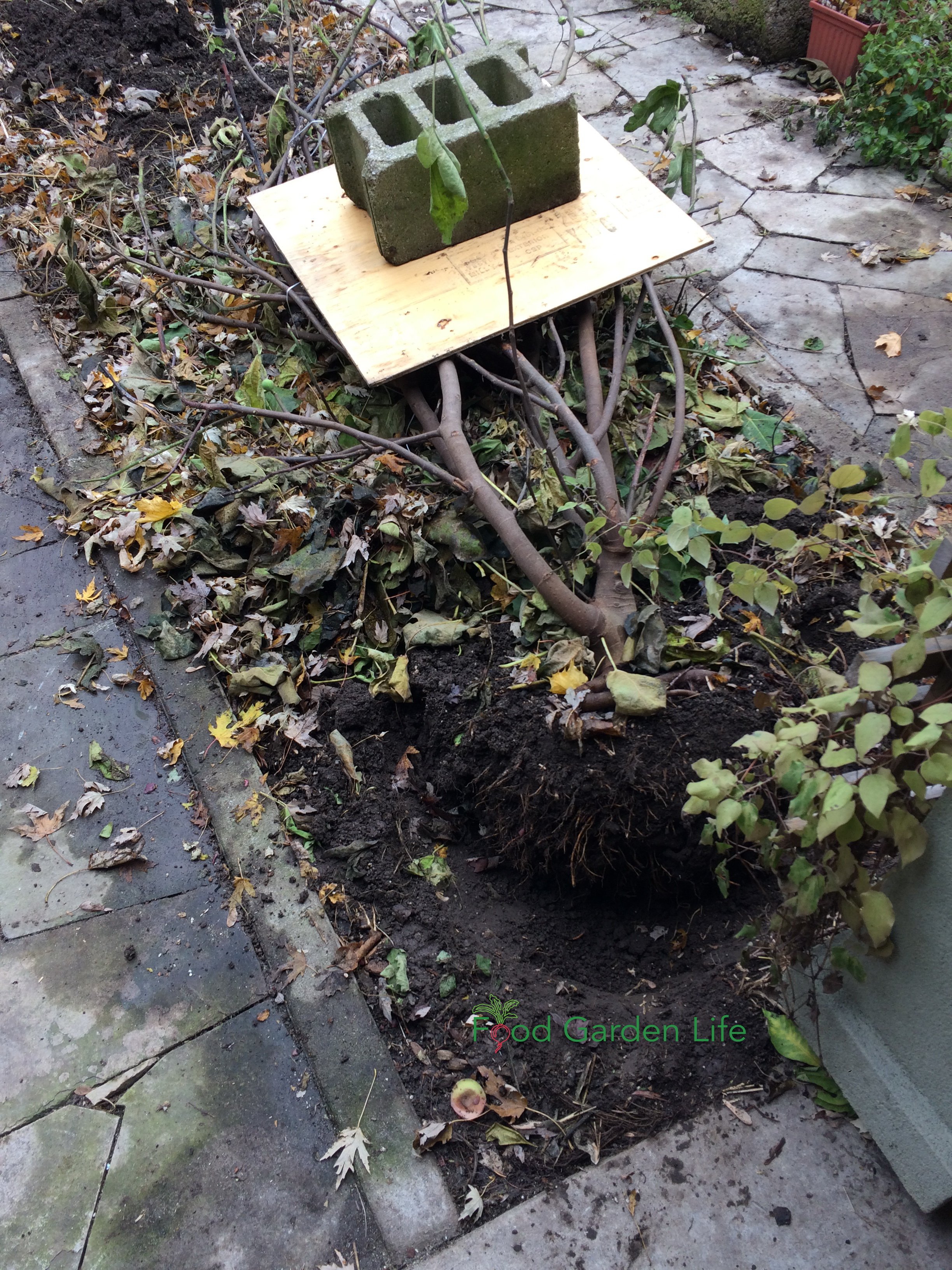
Steps to Tipping Over Fig Trees for Winter
Prune your dormant fig tree.
Bunch up the branches with twine…it might look like a rocket ship!
Excavate around the tree (leaving just a little “hinge” of roots on the side towards which it will be tipped).
Bend, and see if it moves. If not, dig more. Don’t force so hard that you break the trunk…I know from experience that this can happen.
When you’ve finished digging, there will be far fewer roots…and that’s OK.
Tip over the plant so that it’s flat to the ground.
You might find it necessary to pin down the plant (I use concrete blocks over a piece of plywood).
Cover with mulch or soil (if using soil, you can put down a plywood covering first, which makes it easier to unbury the plant in the spring).
Here’s a bit more about tipping over a fig tree.
Materials for Insulating Fig Trees for Winter
There are lots of materials that can be used to insulate figs. I use straw bales (which I use for my straw-bale gardens afterwards.)
Here are some more ideas:
Bags of potting soil
Leaves in garbage bags
Wood chips
Wood with foam sheeting attached
Some gardeners also use a tarp or sheeting so mulch doesn’t get wet and lose insulating properties…just be aware that tarps can hold in moisture, and a wet tarp touching shoots can cause rot
Outdoors – Wrapping a Fig Tree for Winter
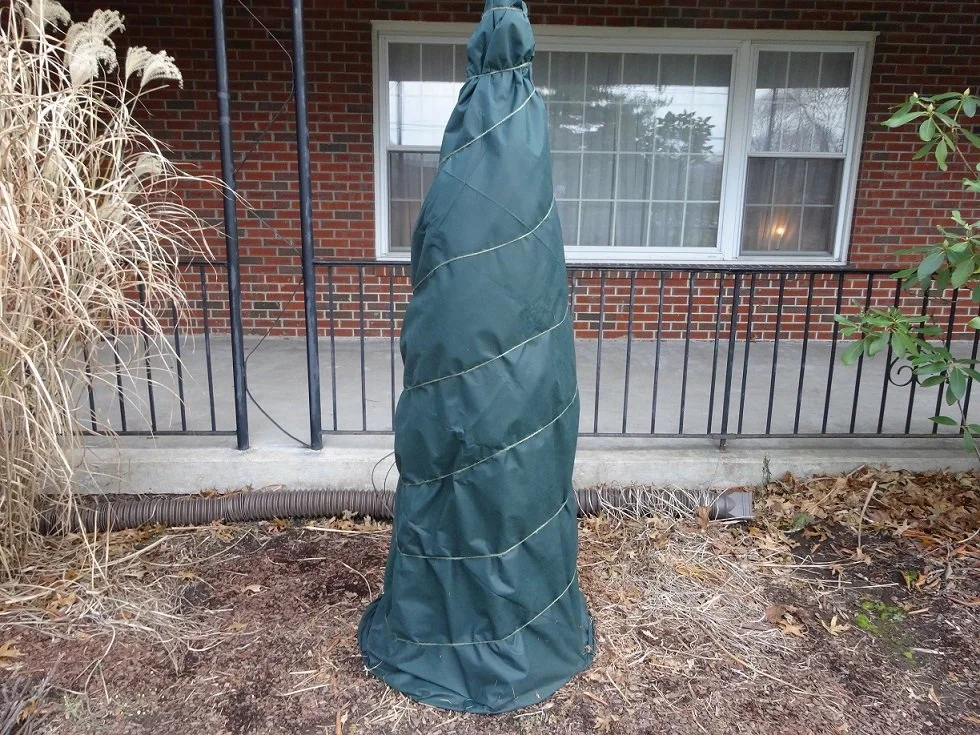
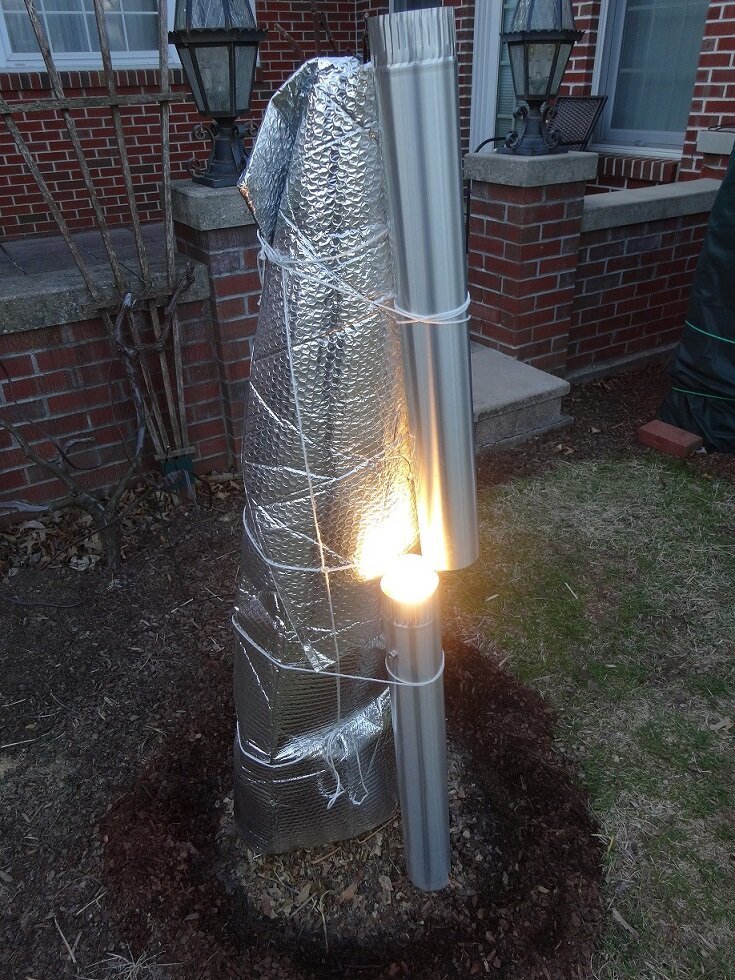
Fig tree wrapped for winter. (Spoiler alert, there is a heat tube hidden in there, here’s how it’s done.)
In some areas, it’s possible to leave in-ground fig plants in the same spot year-round, without chopping away at the roots and tipping them flat to the ground.
In such borderline hardiness areas, gardeners can simply wrap fig trees to protect them.
Wrapping materials can include:
Burlap (topped with tar paper so water does not seep in)
Old carpet
Snow fencing and filled with dry leaves
Where wrapping is not quite enough, a temporary structure can provide sufficient protection.
Temporary structure ideas:
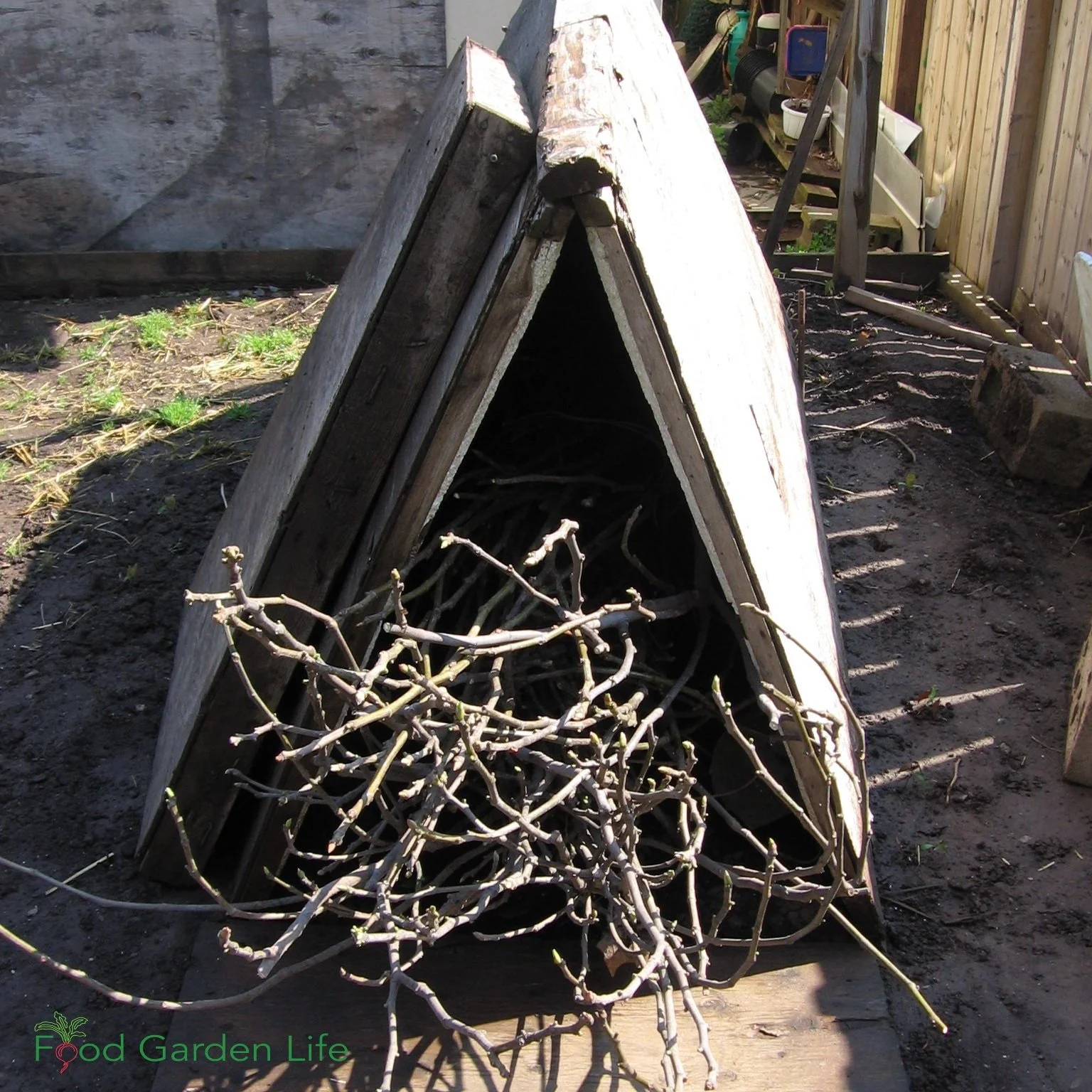
A fig bush bent over for winter, and covered with an insulated a-frame.
Building a box-like structure against the wall of a building to shelter figs growing against the wall
A “fig house” made by cladding plywood to posts
An insulated a-frame structure built over bent-over fig plants
In any of these temporary structures, a drum full of water can be used to capture and slowly release heat.
Here’s a super-creative temporary structure, heat tubes!
Fig Tree Winter Protection – Winter Indoors
Indoors – In a Bright Space
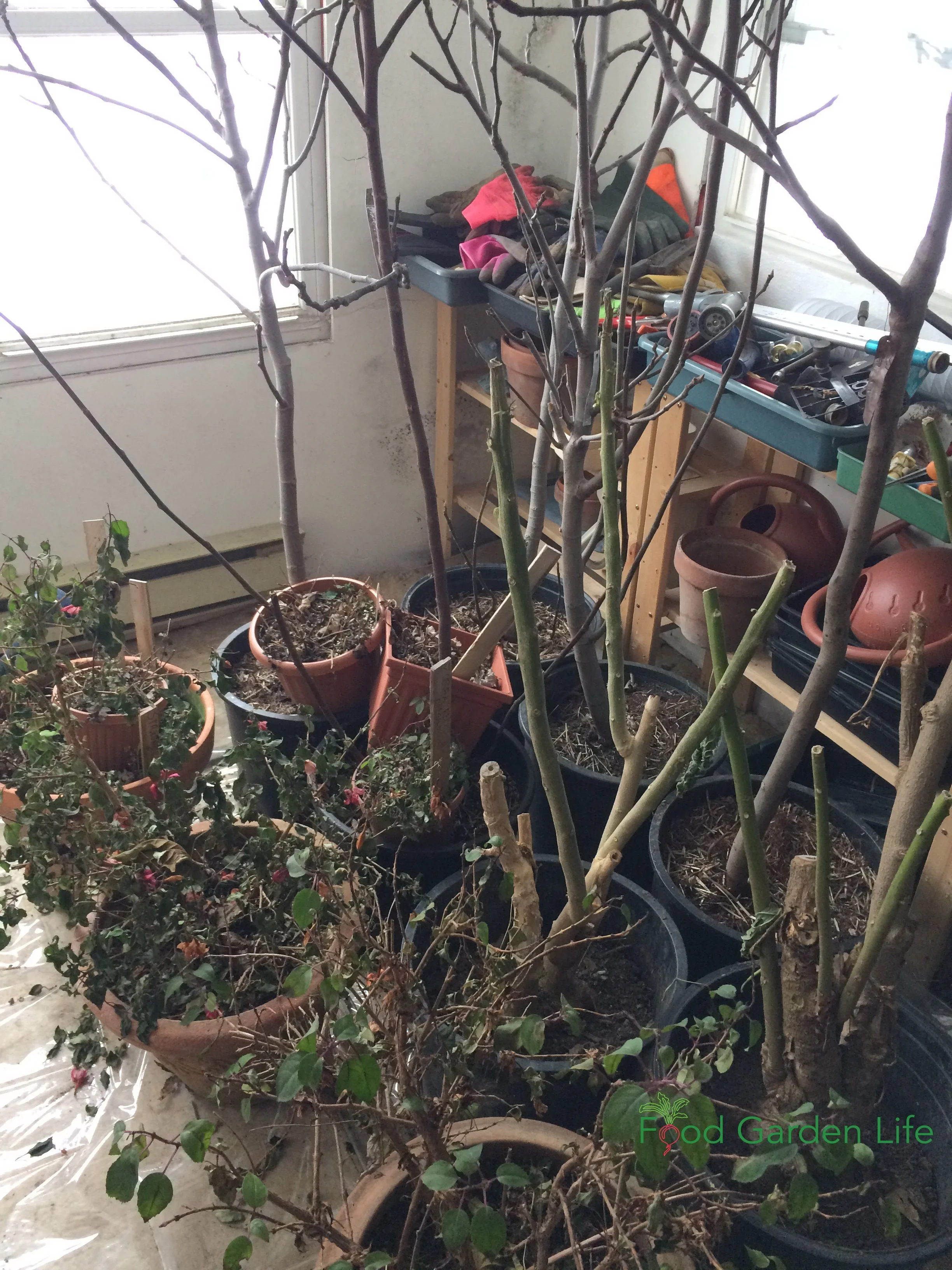
Dormant fig trees spending the winter in my cold, bright potting shed.
If you have a greenhouse, you can keep your fig there. Let your potted fig become dormant, and then store it in the greenhouse. The temperature can be cool in the greenhouse – you don’t need to keep the fig plant actively growing.
Some gardeners have a small greenhouse that is only heated in time to grow seeds for spring garden transplants. This sort of setup can work well, waking up your fig early so that it has an early start. The key thing to watch is the minimum temperature in the early winter, when the greenhouse is unheated.
If you’re considering planting a fig in the ground in a greenhouse, know that they grow a lot. It’s common practice to line the bottom and sides of the planting hole with stones or brick to restrict root growth.
One final thought on figs in greenhouses: A greenhouse that has permanent sides and a removable top. I saw this setup once, something that the owner, Peter, called his “figatorium.” Same idea as a sports stadium with a retractable roof!
The advantage to this sort of arrangement is that the plants benefit from more warmth in the shoulder seasons of spring and fall, allowing an earlier start and additional ripening time in the fall. In areas with sufficient summer heat for ripening main crop figs, the removable roof is helpful because it prevents the temperature from becoming excessively hot.
Get Your Fig Trees Through Winter—and Harvest Figs
Growing figs where winters are cold takes a bit of creative thinking.
In Fig Camp and the self-paced Fig Masterclass, I explain how to grow figs in pots or in the ground, extend the growing season, ripen more fruit, and protect your trees through winter.
Indoors – In a Dark Space
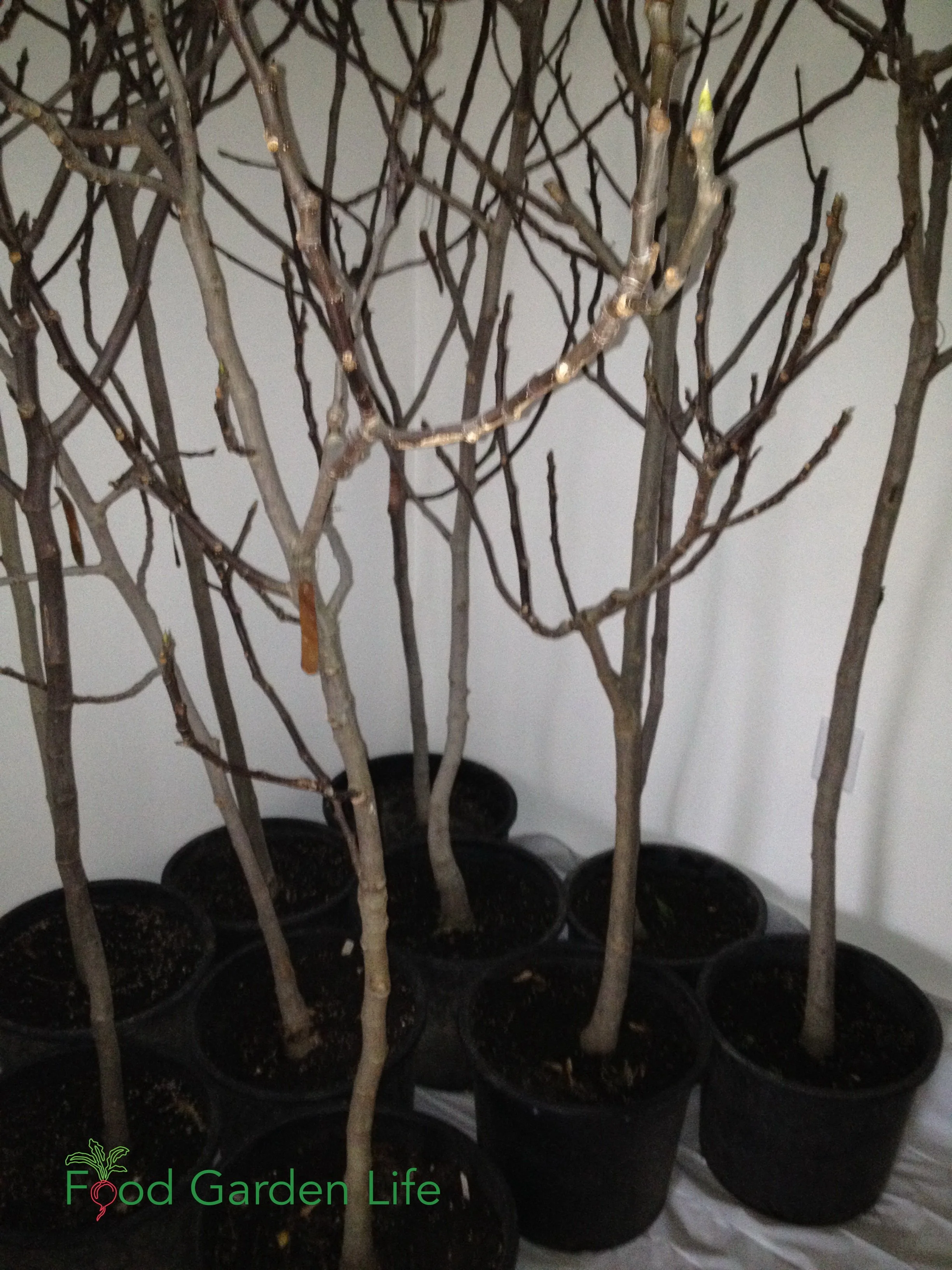
Dormant fig trees spending the winter in my cold, dark garage.
While many gardeners aspire to a greenhouse, a far more common approach to overwintering dormant fig plants is somewhere cool and dark.
I’m talking about somewhere like a cold cellar, a shed, a garage, or an attic.
Ideally, this space will have a maximum temperature of 4-7°C (40-45°F). If it’s warmer than this, fig plants often come out of dormancy earlier than you want.
If you have an indoor space but it gets too cold, consider an insulated space within it and heat only that space, and only as needed.
For example, build an insulated lean-to within a garage, or wrap plants with insulation.
A note on garages: Attached garages tend to be warmer than stand-alone garages, because they benefit from heat escape from the house. Structures on concrete pads tend to stay warmer too. I have a stand-alone garage, so I insulated it and installed a small electric baseboard heater. Here in the Toronto area, there’s no need for me to turn on the heater for most of the winter, and I only turn it on low for a few of the coldest days in January and February.
Indoors – Care over Winter
Check the soil moisture of dormant potted fig trees that are stored indoors over the winter. It should be on the dry side of moist.
How often you need to water (if at all) depends on the humidity of the air where you’re storing it.
If the soil is too moist, the roots might rot.
If the soil is too dry, the plant can die.
When you’re in doubt about when to water, stick your finger into the soil. If it feels damp, wait a bit longer.
Here’s more about how often to water a potted fig tree over the winter.
Top Tip: Fig Tree Winter Protection
Be creative and overwinter your figs in a way that suits you and your yard. Because fig trees go dormant, there are lots of different ways we can get them through the winter.
There is no need for a greenhouse or bright window to keep figs in cold climates!
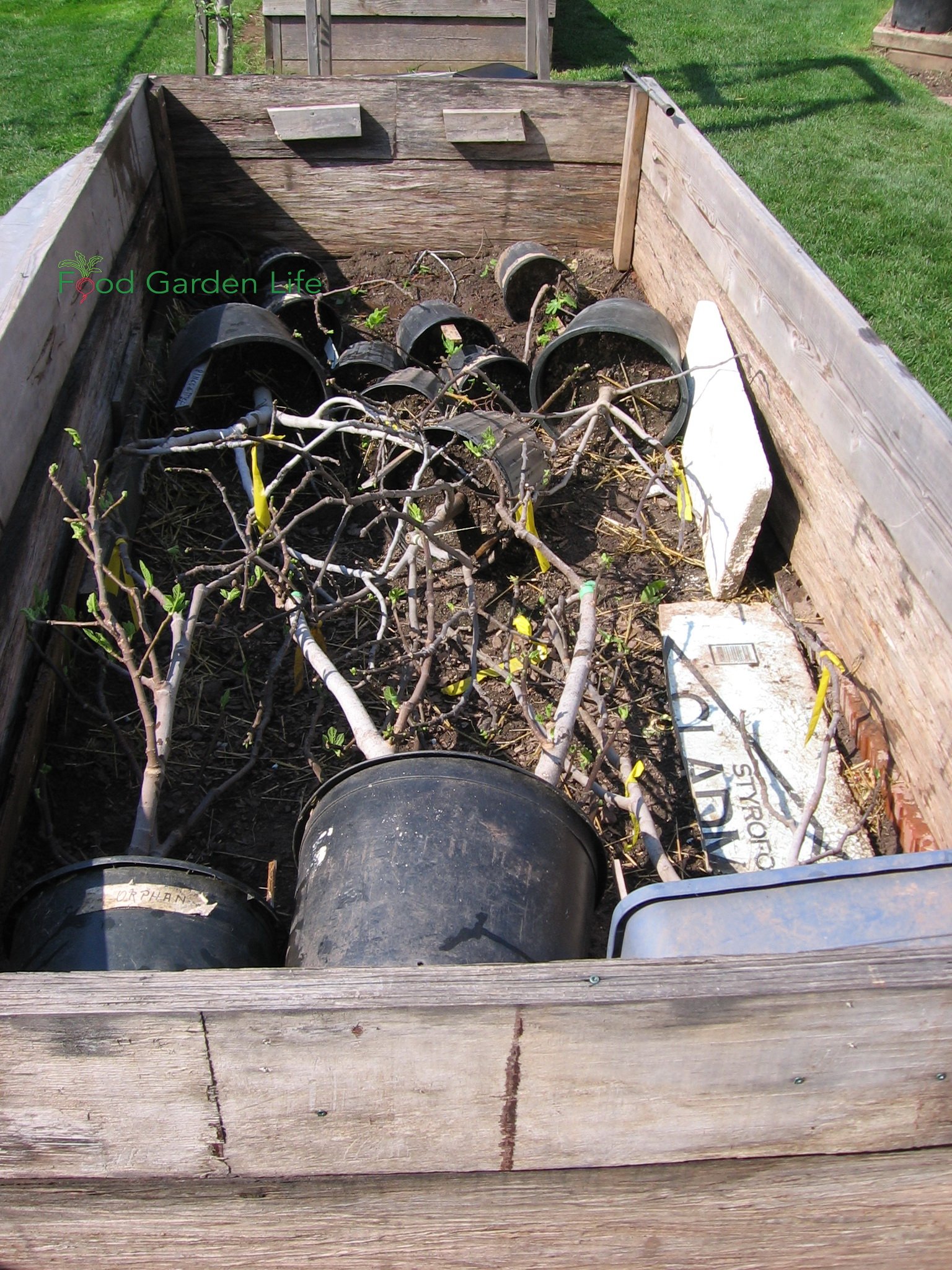
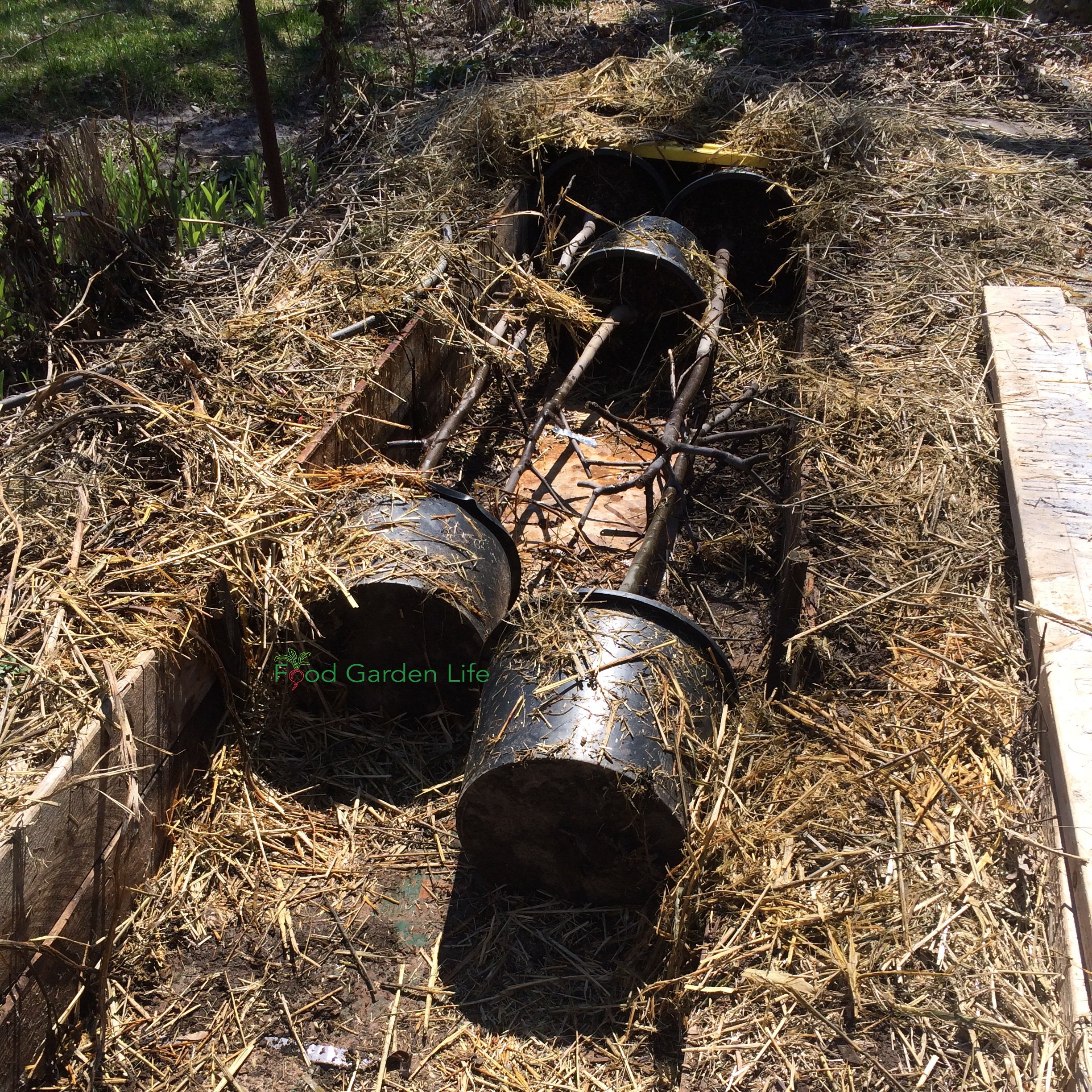
Fig Tree Winter Hardiness
Many things affect fig tree cold hardiness:
Young fig trees are more tender than mature ones
Fruit and young shoots are affected by cold before older, woodier stems
If the fig tree is already dormant, it can take more cold
Some fig varieties are more cold-tolerant than others (see this article for good cold-adapted varieties)
And then there’s the elements:
The amount of wind the fig tree is exposed to
The duration of cold temperatures
How sheltered or exposed the fig is
How many degrees the temperature drops
The timing of the cold temperature (e.g., at the end of the night the plant might be soon warmed by sun)
Planning What to do with you Fig Tree in Winter
So now you have more ideas about fig tree winter protection, you can think about your own situation.
Here are things to think about as you plan what to do with your fig tree:
Your zone: How much protection your fig tree needs over winter depends on your plant hardiness zone and on whether you have protected areas within your yard (called “microclimates.”)
You: The way that you decide to protect your fig over the winter will depend on how much lifting and schlepping you can deal with.
Your Property: Each house and yard is different. I once met a Toronto gardener with what he called a “fig cave,” a stairwell between his garage and his house, which was on a hill. Think about what options you have for overwintering figs around your property.
Your Budget: There are unusual gadgets for people who want to innovate when overwintering figs. (For example, I know a gardener with a thermostatically controlled outlet that runs the heating cable around his fig.) Other gardeners innovate using commonly available supplies.
Pin this post!
Keep Growing Figs
Looking for more cold-climate fig-growing ideas? Visit the fig home page to browse articles about varieties, pruning, propagation, ripening, winter protection, and more.
Grow Figs Where You Think You Can’t
My revised and expanded fig book is a practical guide to growing figs in pots and cold climates—from choosing varieties and pruning to ripening fruit and conquering winter.
Find This Helpful?
Enjoy not being bombarded by annoying ads? Appreciate the absence of junky affiliate links for products you don’t need?
This site is reader supported. If it has helped you in your food-gardening journey, you can give us a high-five below. Any amount is welcome.
Bury Fig Trees for Winter in Cold Climates
A common way to protect in-ground fig trees over the winter is to lay them flat to the ground, and then insulate them with mulch or soil.
By Steven Biggs
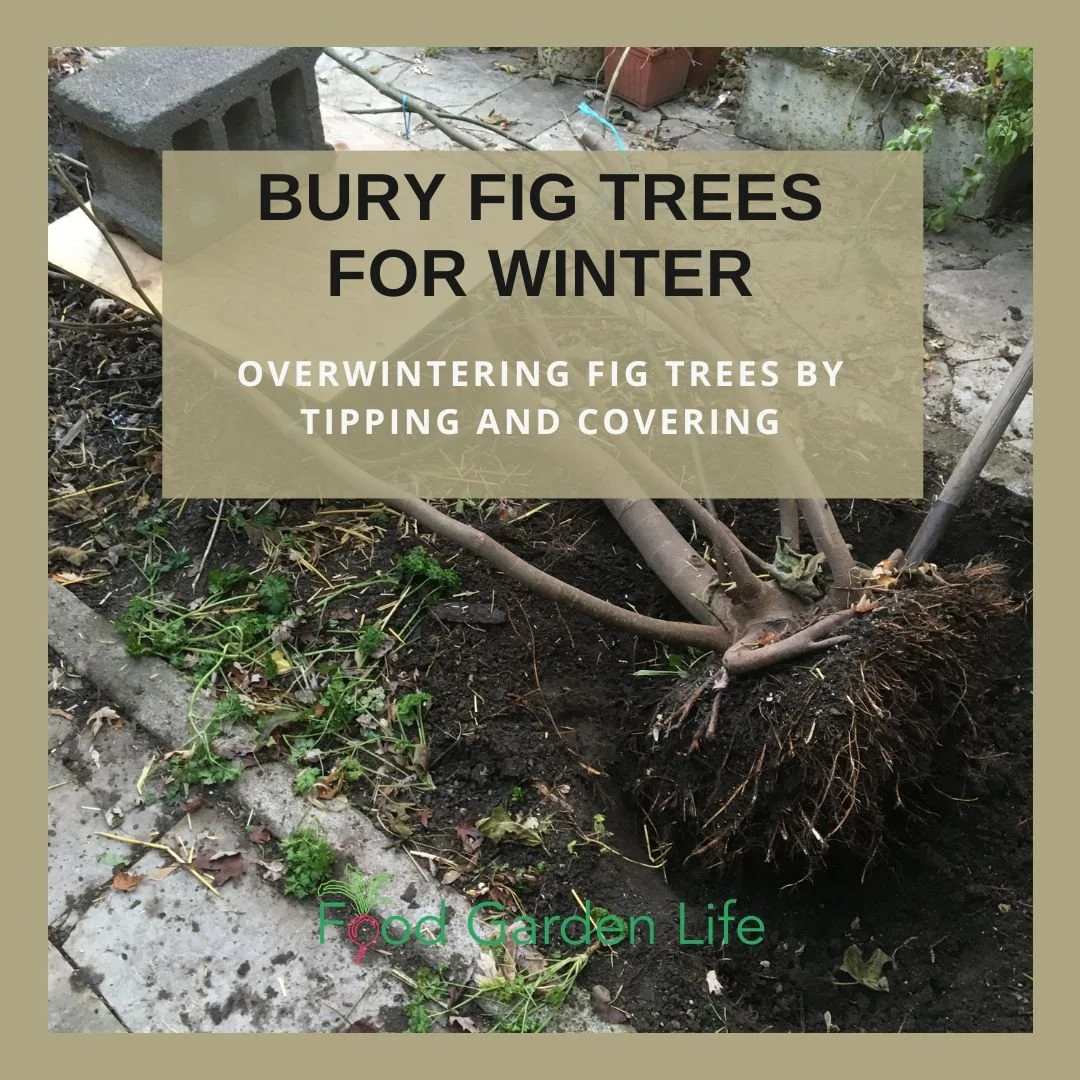
IT’S MID NOVEMBER and my fig trees here in Toronto have dropped their leaves and gone dormant. I moved my potted fig fig trees into my garage (I keep the temperature in the garage near freezing over the winter.)
But like many fig growers in areas with cold winters, I still grow figs in the ground and give them extra winter protection.
A common way to give that protection is to insulate the tree by burying it.
Chop Roots on One Side
At this time of year, I use a spade to chop away the roots on one side of the fig plant—and then lay it flat against the ground.
How Deep?
Some people avoid the burying method of overwintering figs, worried about the work of digging.
Once, after I gave a talk about figs, an audience member came up to me to confide that he had tried burying his fig tree, but it was too much work to dig down six feet!
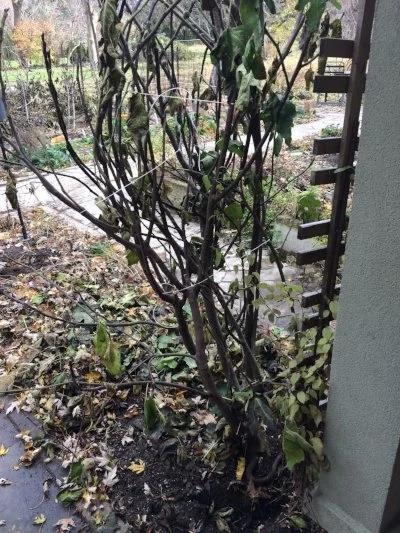
Fig tree ready to protect for the winter. I use twine to pull in tie the branches together before laying the plant against the soil.
I reassured him that it’s not necessary to dig his fig plant a grave—that at the most he needed a shallow trench. Then I explained that around here, the fig plants are usually fine if you lay them flat against the surface of the soil and put a thick mulch on top. You don’t even need to dig a trench!
Next, the Covering
You will see in the above photos one of my fig trees before and after. Once the roots on one side are loosened and I’ve tipped over the plant, I put a board and concrete block over the top to hold it in place. Soon, I’ll put a thick layer of straw or leaves over the top to insulate it. And when it snows, I’ll heap on some snow too.
Remember the Rodents
But I don’t rush the mulching…mice love to eat fig bark, and I want them to find a home elsewhere before I mulch my figs.
Keep Growing Figs
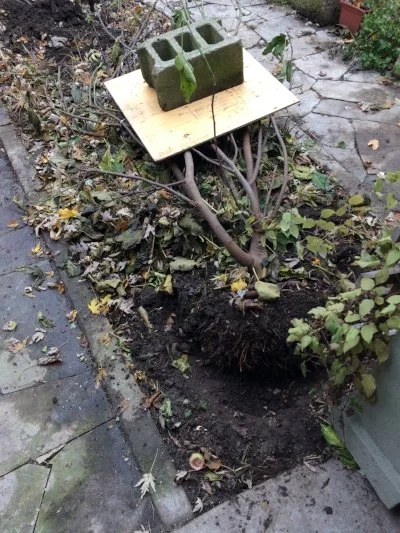
Fig tree with roots loosened on one side, tipped over to lie on the ground. The board and concrete block weigh it down. Next step is to add leaves or straw over top to insulate it.
Looking for more cold-climate fig-growing ideas? Visit the fig home page to browse articles about varieties, pruning, propagation, ripening, winter protection, and more.
Grow Figs Where You Think You Can’t
My revised and expanded fig book is a practical guide to growing figs in pots and cold climates—from choosing varieties and pruning to ripening fruit and conquering winter.
Find This Helpful?
Enjoy not being bombarded by annoying ads? Appreciate the absence of junky affiliate links for products you don’t need?
This site is reader supported. If it has helped you in your food-gardening journey, you can give us a high-five below. Any amount is welcome.
Figs on the Prairies
Getting creative when overwintering fig trees on the prairies, in Edmonton Alberta.
By Steven Biggs
Overwintering Figs in Edmonton
Over the past few years I’ve been in touch with Bernie, a fruit grower in Edmonton, Alberta, Canada. Bernie’s minimum winter temperature can dip to -40°C (-40°F)…so his figs need a bit of help making it through the winter.
Laying the plants flat to the ground and mulching, as I do here in Toronto, isn’t enough protection for his figs from winter temperatures.
Buried Fig Tree
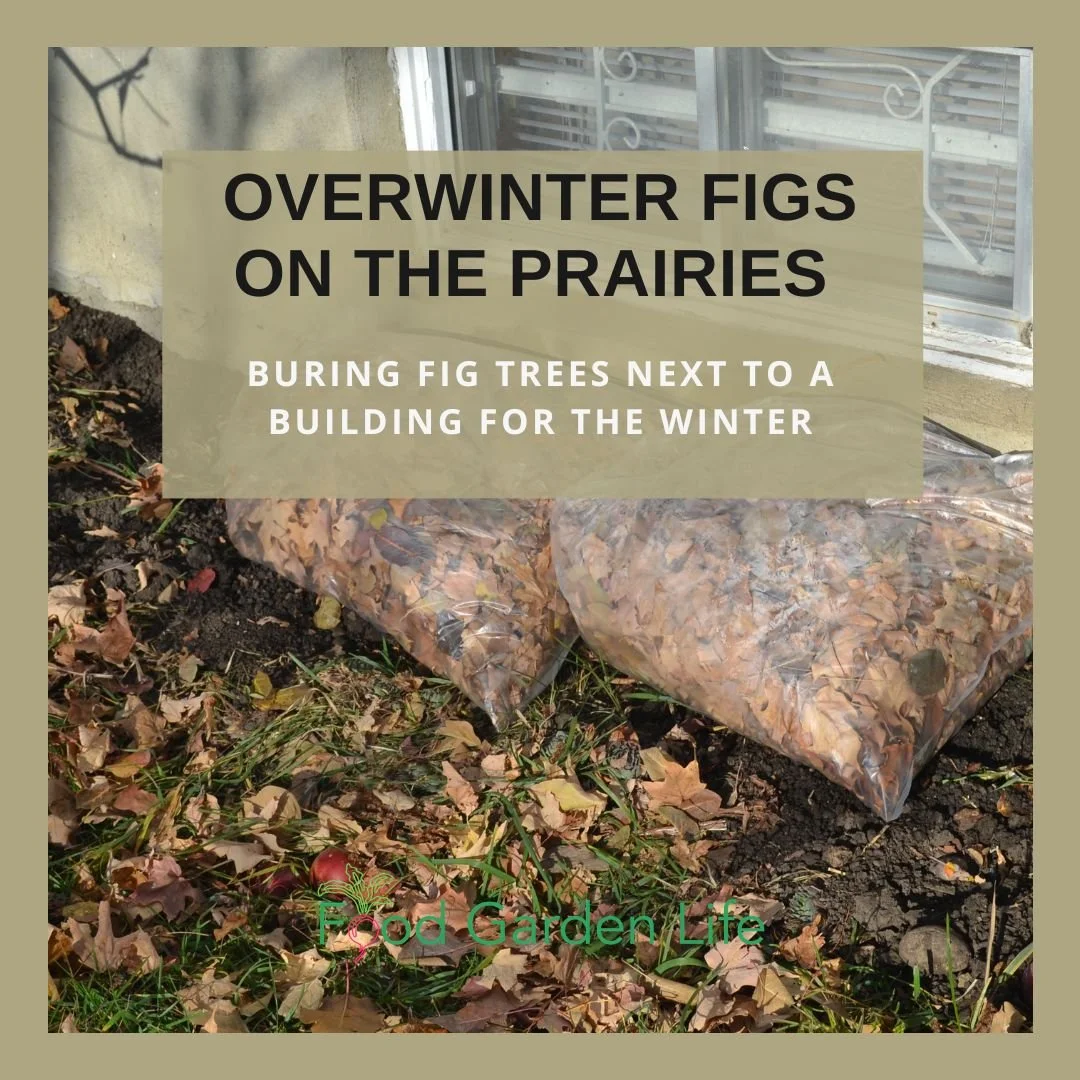
Bernie sent me this photo. There’s a fig tree in there, even though you can’t see it!
The fig tree is buried in a trench alongside the foundation of his house. He covers the buried fig tree with a few bags of leaves—like a blanket to keep it even warmer. Once snow arrives, he covers it with snow for added insulation.

Overwintering figs in Edmonton
Why bury the fig tree beside the foundation of the house? The soil close to the foundation stays a bit warmer.
Bernie uses a max-min thermometer to track temperatures. Last winter, the soil temperature around his buried fig tree dropped to 2°C (36°F), while outside, the air temperature outside dropped as low as -36°C (-33°F).
Some Figs in the Garage Too
Bernie also has potted fig trees that he stores in the safety of his garage for the winter—a more common fig overwintering technique in his garden zone.
Video
Check out Bernie’s video below.
Keep Growing Figs
Looking for more cold-climate fig-growing ideas? Visit the fig home page to browse articles about varieties, pruning, propagation, ripening, winter protection, and more.
Grow Figs Where You Think You Can’t
My revised and expanded fig book is a practical guide to growing figs in pots and cold climates—from choosing varieties and pruning to ripening fruit and conquering winter.
Find This Helpful?
Enjoy not being bombarded by annoying ads? Appreciate the absence of junky affiliate links for products you don’t need?
This site is reader supported. If it has helped you in your food-gardening journey, you can give us a high-five below. Any amount is welcome.
PA Fig Grower Uses Heat Tubes to Overwinter Figs
PA fig grower uses creative heat-tube technique to protect his fig trees over the winter.
By Steven Biggs
Banner Fig Harvest
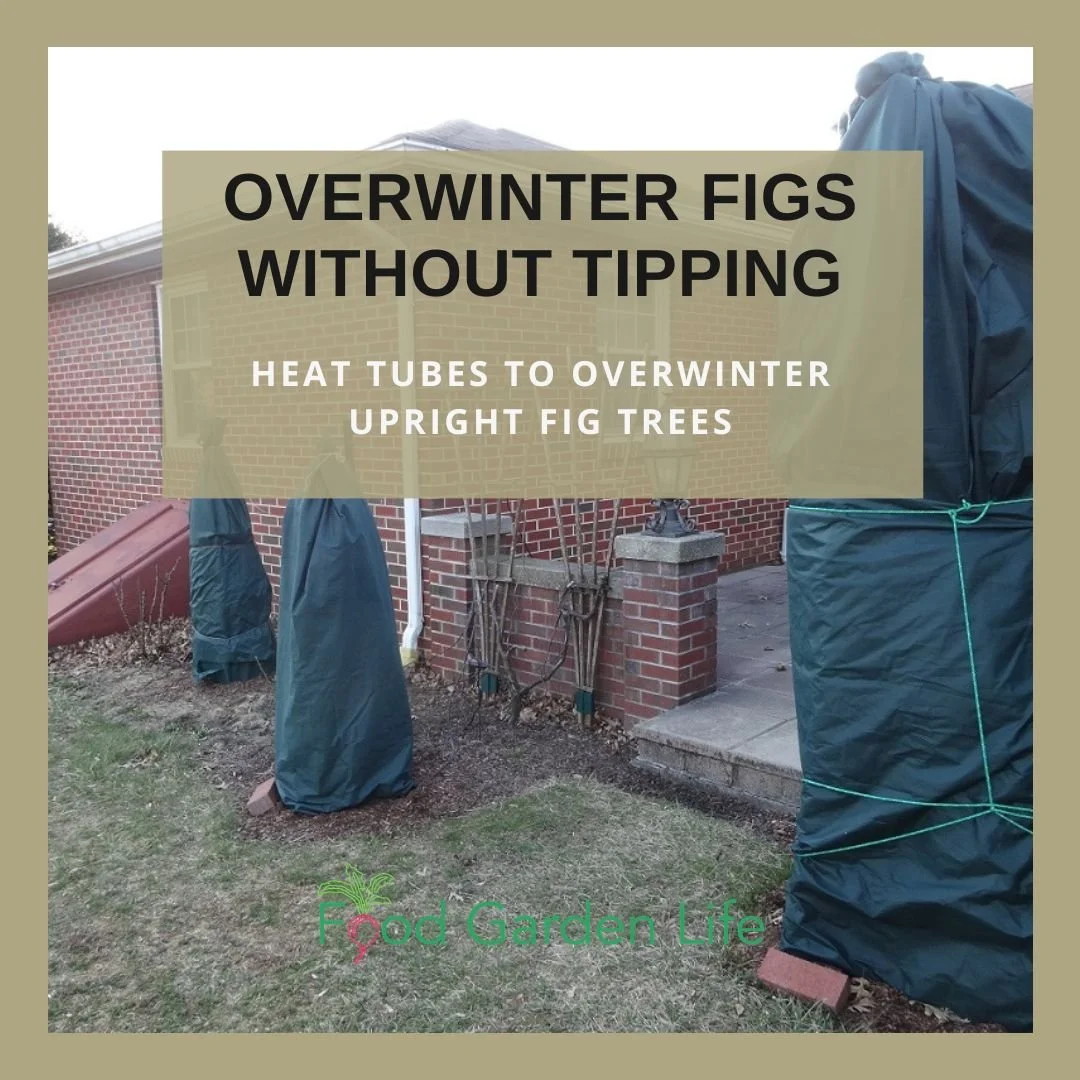
“This year appears to be a banner year, nearly 1,000 figs,” Pananes says as we chat about his creative fig-overwintering technique.
1,000 figs: Not bad for a backyard fig harvest in a zone where figs don’t normally survive the winter. “My growing zone is Pennsylvania 6B,” Pananes notes. (USDA zone 6)
Pananes’ creative heat-tube fig-overwintering method means he has attractive fig trees planted in the landscape around his home—yet he doesn’t need to schlep around potted figs every spring and fall. “I have been using this process successfully for 40 years to ensure my in-ground fig trees don't freeze to the ground, resulting in too short a growing season to ripen figs,” he tells me.
Why Protect an In-Ground Fig Tree?
Will Pananes with a 12-foot-high fig tree in his Pennsylvania garden.
A fig tree can survive a cold winter even if the top dies back. The roots often survive and send up new shoots in spring.
But survival and getting a good fig harvest are two different things.
If an in-ground fig dies back to the ground every winter, it has to spend part of the next growing season replacing that lost growth. In a climate with a short growing season, that can leave too little time for figs to form and ripen.
By protecting the branches from winter cold, Pananes starts each spring with a mature framework instead of a plant starting again from ground level. That gives his trees more time to grow and ripen figs.
Fig Heat-Tube Method Explained

Pananes has in-ground fig trees incorporated in his landscape.
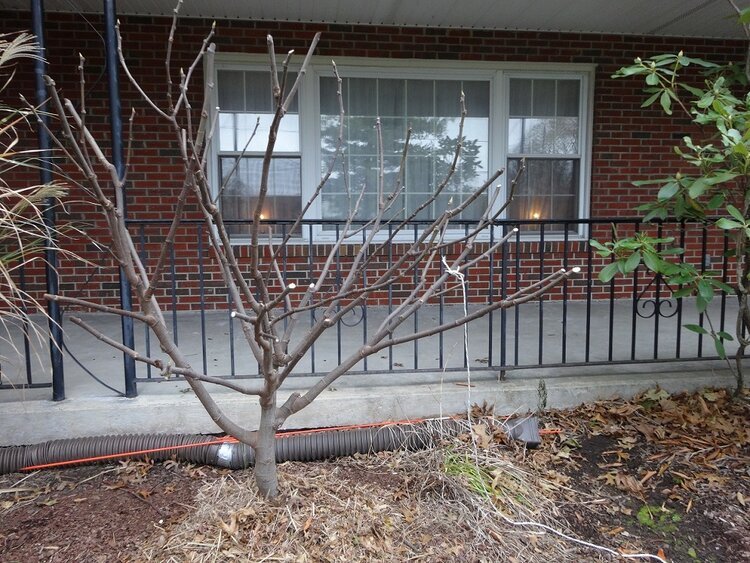
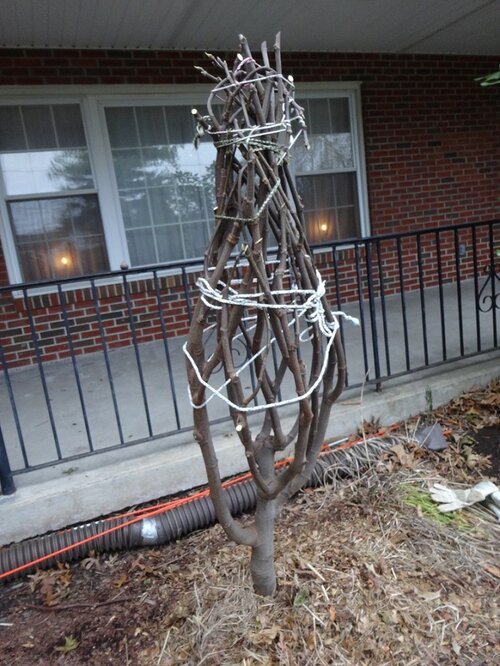
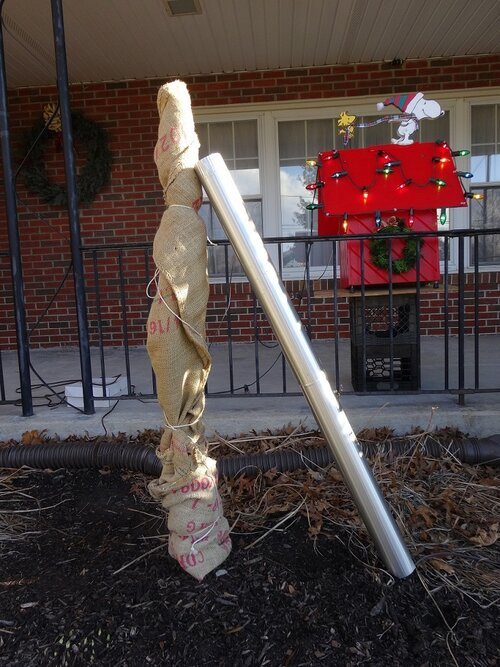
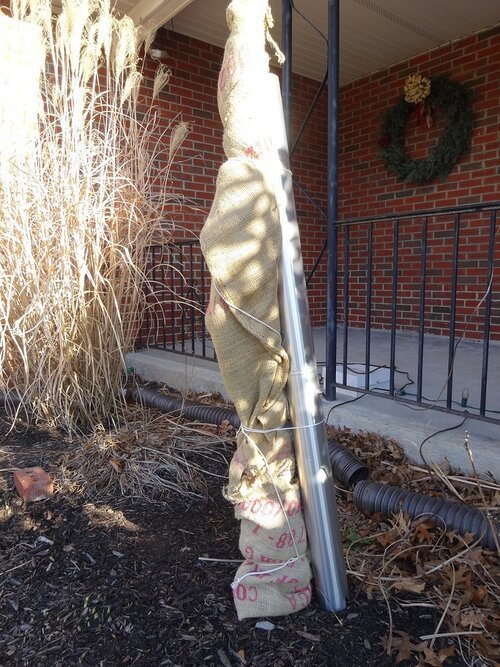
At the heart of Pananes’ fig-overwintering method is using an incandescent light bulb, which emits heat. When I was first in touch with him a few years back, he told me that the first time he used a light bulb, it burnt a hole in the burlap protection around his fig tree.
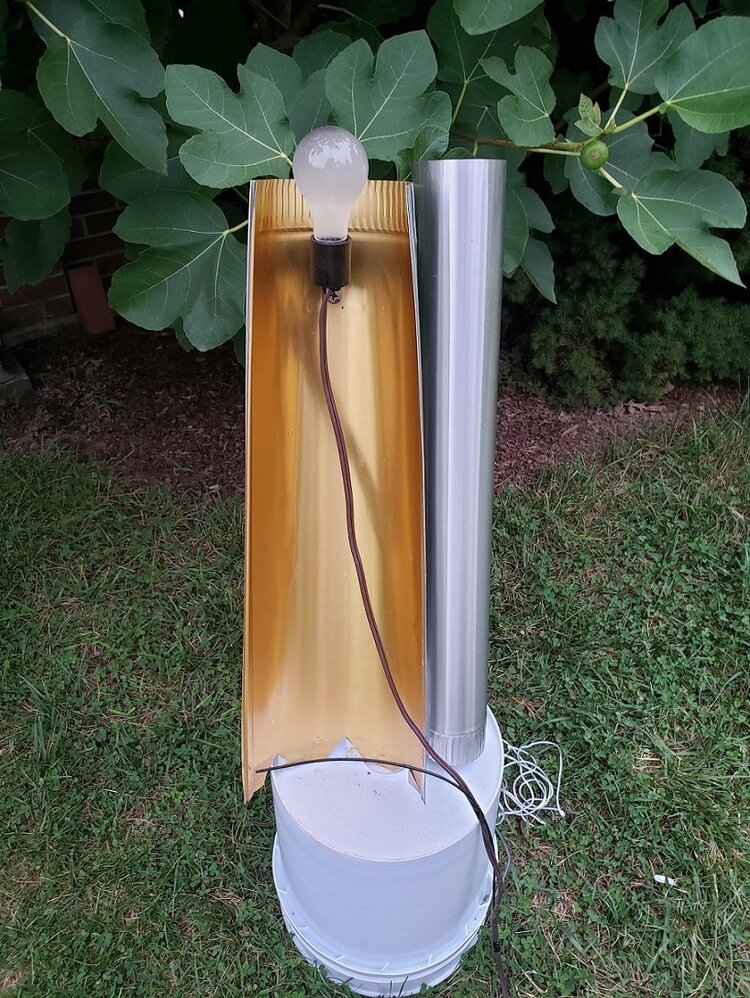
To prevent burning, he started to enclose the light bulb in a metal tube. (See photos below.)
Here is the process, explained in Pananes’ words:
The most important component of my winterizing fig tree process is the heat tube.
I started out with a single exposed light bulb. But when I discovered a burnt hole in the burlap-wrapped tree, I decided that the light bulb needed encased in a metal tube.
This metal tube is two three-inch hot water exhaust pipes, each 24-inches long with a 60-watt incandescent rough-service bulb mounted in the centre for easy access. This makes a four-foot heat tube, which will suffice for most trees.
I plug the heat in when temperatures get down to 15°F (-9°C) and turn off when temps exceed 15°F (-9°C).
A light socket with a metal mounting is attached to the exhaust pipe.
Near the bottom of the tube is a fibre optic cable, which extends outside the tree wrap, and confirms that your light bulb is producing heat.
Another test to ensure your bulb is operating is to do a continuity test across the prongs of the electric plug. An "open" indicates a bad bulb. You don't want to go to all this trouble only to freeze your tree because of no heat.
How Much Cold Can an In-Ground Fig Tree Take?
There isn't one exact temperature at which a fig tree suffers winter damage.
For many established, dormant in-ground fig trees, about -10°C (14°F) is a useful ballpark. But sometimes they tolerate colder temperatures, and sometimes damage occurs when it's warmer.
Variety, the age of the tree, how fully dormant it is, wind exposure, and the duration of the cold all make a difference. A brief dip in temperature is different from deep cold that lasts for hours. A sudden temperature drop can also cause more damage than gradual cooling.
That's why I don't recommend fixating on a single hardiness number. Instead, think about the tree, your site, and the winter conditions.
The Fig-Overwintering Heat Tube
Get Your Fig Trees Through Winter—and Harvest Figs
Growing figs where winters are cold takes a bit of creative thinking.
In Fig Camp and the self-paced Fig Masterclass, I explain how to grow figs in pots or in the ground, extend the growing season, ripen more fruit, and protect your trees through winter.
Overwintering Smaller Fig Trees
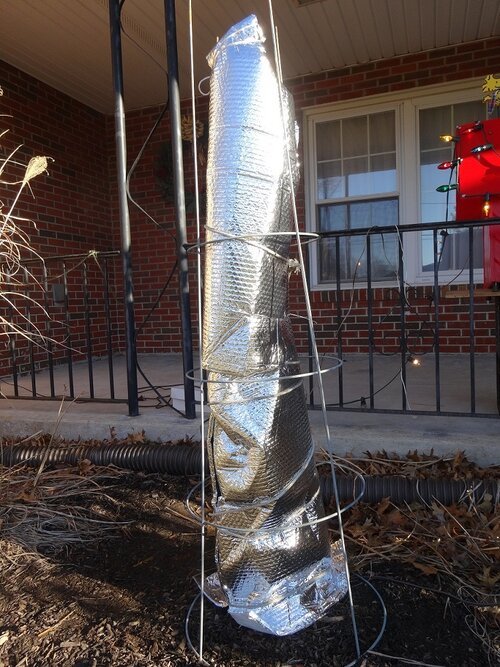
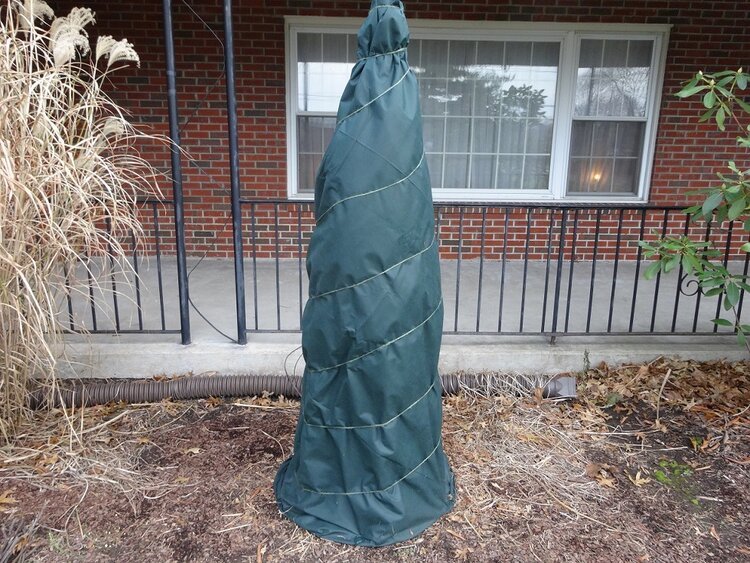
Overwintering Larger Fig Trees
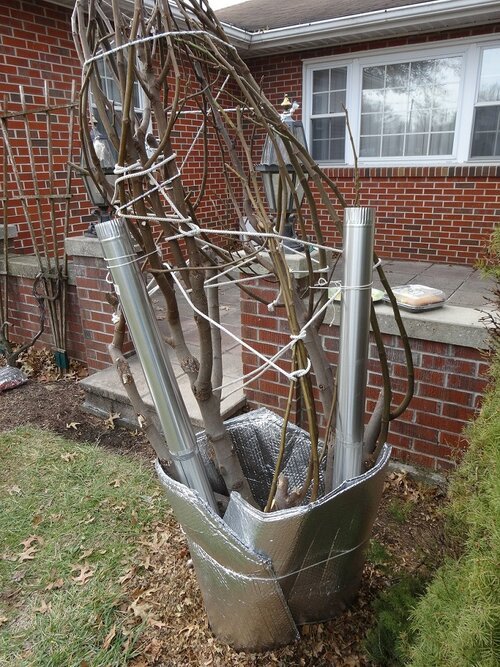
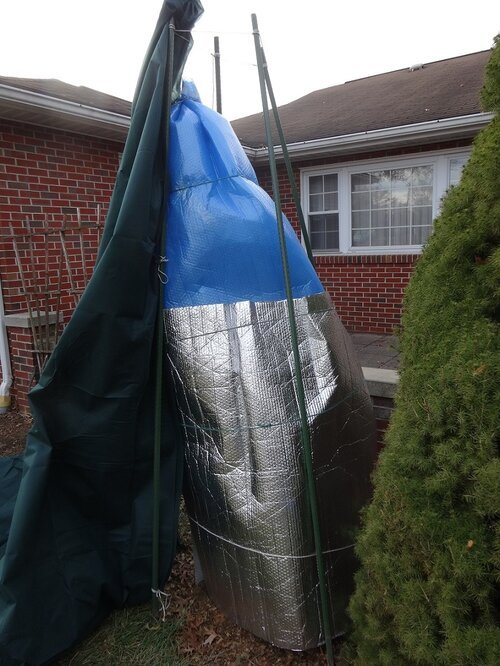
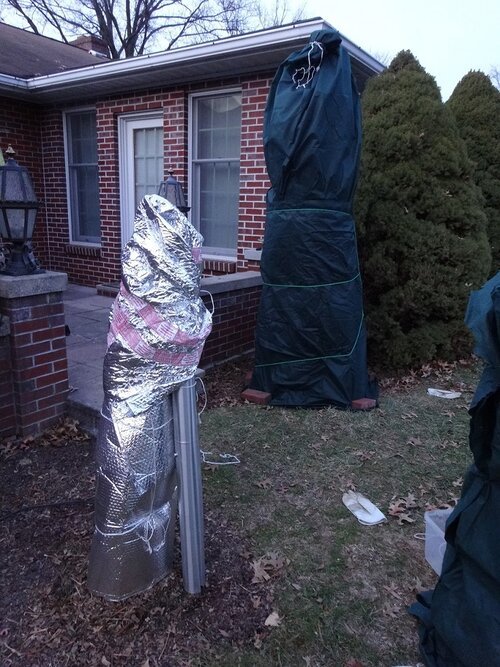
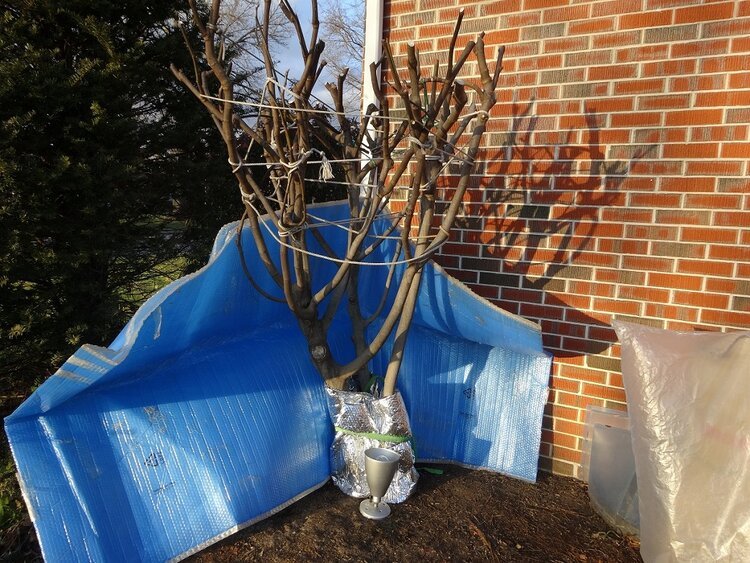
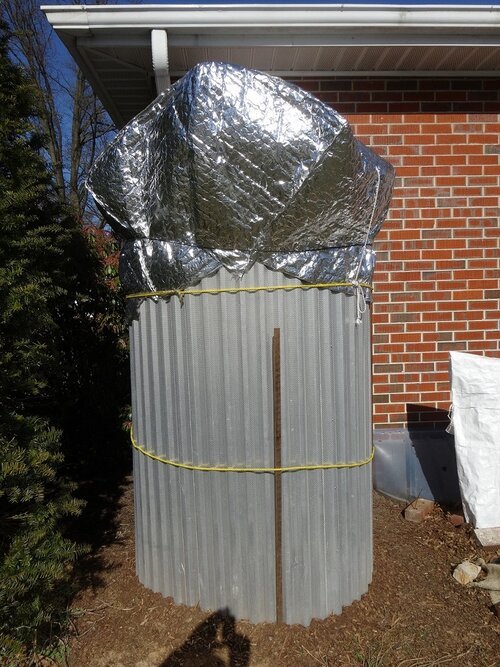
Is the Heat-Tube Method Right for Your Fig Tree?
There's no single best way to overwinter a fig tree. The method that makes sense depends on your winter, your property, and how you want to grow your tree.
Pananes' method is especially interesting for a gardener who wants a permanent, in-ground fig tree but lives where winter cold can kill the branches. His trees are planted near his house, where he has access to electricity and the brick walls help capture and radiate heat.
In another garden, wrapping alone might provide enough protection. In a colder location, bending a tree towards the ground, burying it, or using an insulated structure might make more sense.
Understand what your fig needs, look at what your property provides, and choose a winter-protection method that bridges the gap.
Keep Growing Figs
Looking for more cold-climate fig-growing ideas? Visit the fig home page to browse articles about varieties, pruning, propagation, ripening, winter protection, and more.
Grow Figs Where You Think You Can’t
My revised and expanded fig book is a practical guide to growing figs in pots and cold climates—from choosing varieties and pruning to ripening fruit and conquering winter.
Find This Helpful?
Enjoy not being bombarded by annoying ads? Appreciate the absence of junky affiliate links for products you don’t need?
This site is reader supported. If it has helped you in your food-gardening journey, you can give us a high-five below. Any amount is welcome.
Overwinter Figs on Balconies in Cold Climates
Ideas about how to overwinter dormant figs trees on balconies.
By Steven Biggs
How One Toronto Grower Overwinters Figs on a Balcony
Can you overwinter a potted fig tree on a condo balcony in Toronto?
One local fig grower does exactly that. He has no garden where he can bury the tree, no garage, and no cold room. Instead, he created an insulated outdoor storage box with a small, thermostatically controlled source of heat.
I was impressed by his creative approach and asked if I could share it. Below, he explains the system in his own words.
My thanks to this inventive fig pig, who prefers to remain unnamed.
Below is his email, lightly edited for clarity:
Re: Overwinter Figs Where You Think You Can’t: Fig Overwintering for Condos and Apartments
Hi Steve,
I read the excerpt from your book Grow Figs Where You Think You Can't about overwintering figs, and I applied the basic principles for a condo/apartment situation. I grow figs on my condo balcony in Toronto but have no yard (so no ability to earth-insulate), and no unheated garage or cold, dark room either.
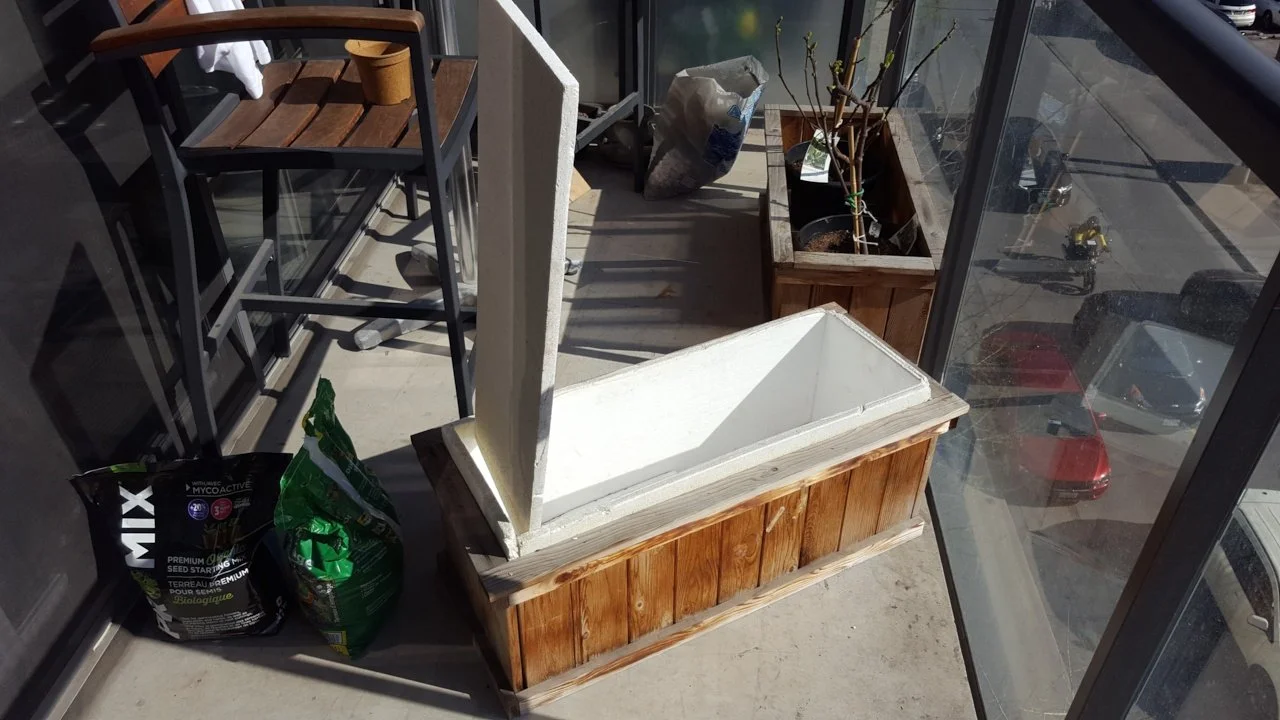
A wooden planter lined with rigid foam insulation became the first winter-storage box.
In my first year, I had only one fig tree, about 60 cm (2 feet) tall. I took a rectangular wooden planter box, approximately 90 × 30 cm (3 × 1 feet) inside, and lined it with Styrofoam. I also cut out a Styrofoam lid. This served as an insulated container for my dormant fig. I placed my dormant fig inside.
Since I planned to store it outside on my balcony over winter, I considered various heat-source options, including a seedling heat mat, light bulb, and coffee warmer. I ended up buying a small, flat, oval 7.5-watt fish-bowl heater designed to go under aquarium gravel. I submerged it in a Mason jar filled with water and placed the jar inside the insulated wooden planter.
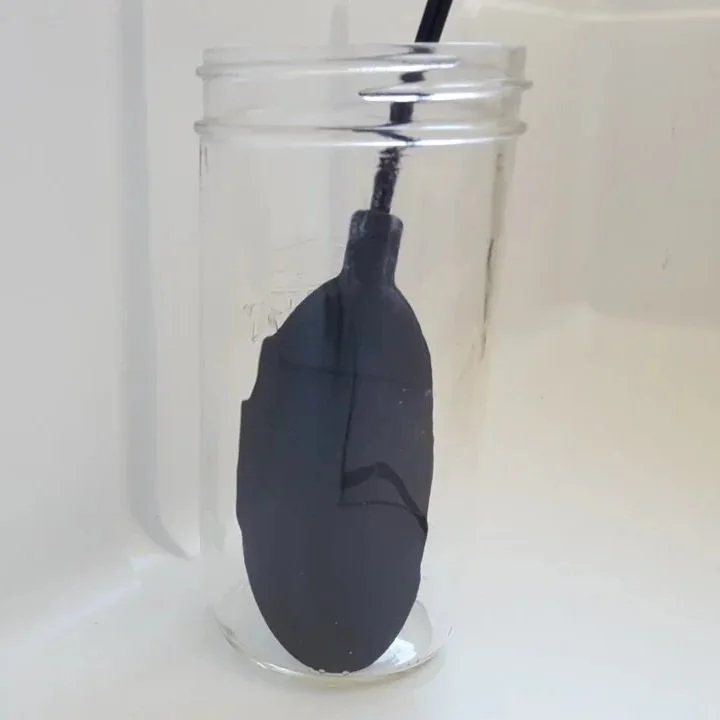
A small aquarium heater submerged in a jar of water provided gentle heat inside the insulated box.
The aquarium heater was my version of a DIY water radiator. The jar of water also acted as thermal mass: the water warmed and cooled slowly, moderating temperature changes inside the box. The heater was designed to remain submerged, and it was inexpensive. A seedling mat was my initial choice, but it cost considerably more and lacked the thermal mass provided by the water.
The flat, plasticized fish-bowl heater I used during the first year provided continuous heat (no thermostat) and it basically kept the water above freezing and about 5-10°C above the ambient air temperature. Only on the coldest of Toronto nights approaching -20°C did it get a bit too cold, and I needed to wrap the whole container in extra blankets to add insulation.
Scaling Up to Four Fig Trees
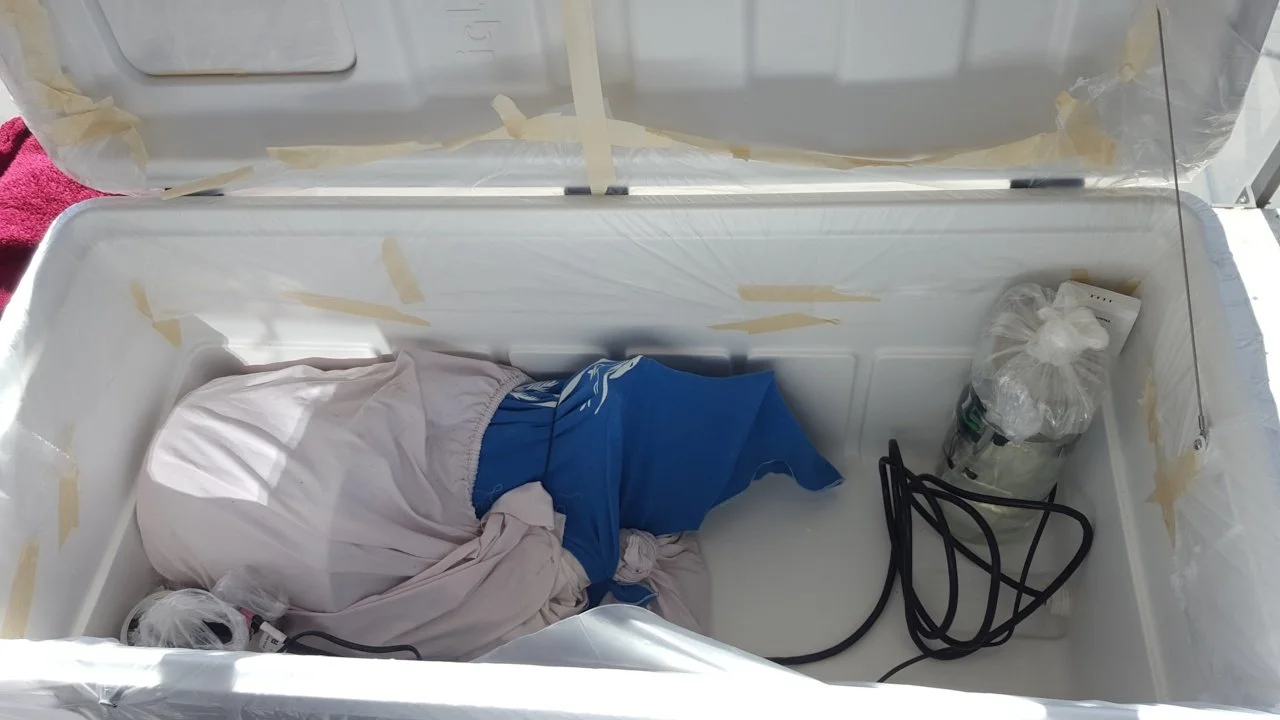
A large insulated cooler provided enough room to overwinter four dormant potted fig trees.
The next year I bought three more fig trees and needed a larger container. I bought the largest picnic cooler I could find—a marine cooler intended for boaters.
I also upgraded to a higher-wattage glass aquarium heater with a built-in thermostat. I paired it with a thermostatically controlled outlet, a ThermoCube TC-3, which turns on the power at about 2°C and turns it off at about 7°C.
I managed to fit all four figs in the cooler. I submerged the aquarium heater in a large glass jar filled with water and ran the power cord out through the top. I covered the jar opening to reduce splashing if it was jostled.
Because I had to lay the trees on their sides, I wrapped the figs in scraps of old cotton sheets to keep the potting mix in place. I initially tried plastic, but it restricted airflow and trapped too much moisture.
For peace of mind, I added a wireless thermometer and hygrometer. I placed the sensor inside the cooler and kept the display indoors, where I could monitor temperature and humidity without repeatedly opening the lid.
The heater in my first setup used 7.5 W and was slightly undersized for the wooden box. The heater in the larger cooler used 200 W—far more than the well-insulated space needed.
The amount of heat required depends on the size of the enclosure, the quality of the insulation, and the lowest outdoor temperature. More wattage isn’t necessarily better: the important part is controlling the heat so that the trees remain cold and dormant without freezing.
Controlling Temperature and Moisture
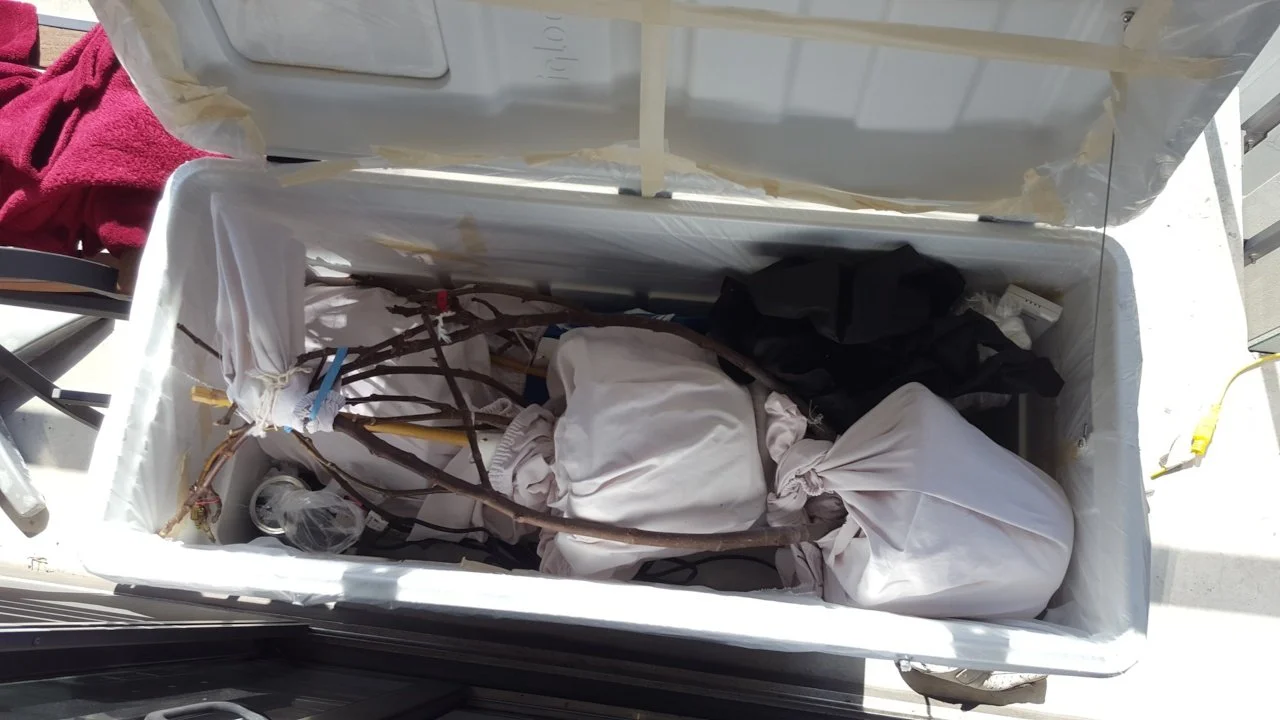
Four dormant potted fig trees packed into the insulated cooler for winter.
A higher-wattage heater can warm the water more quickly, so some form of temperature control is important. Most aquarium heaters are intended to keep water much warmer than a dormant fig tree requires. The minimum setting on my 200 W heater was 16°C.
The ThermoCube prevented the heater from running in milder weather. It turned the power on when the temperature around the plug fell to about 2°C and turned it off when it rose to about 7°C. I used the wireless thermometer to monitor the actual temperature inside the cooler.
Without the ThermoCube, I found myself manually unplugging the smaller heater whenever the outdoor temperature rose above freezing. By early spring, it remained unplugged most of the time.
The cooler also retained a great deal of moisture. I left the lid slightly ajar to improve airflow and reduce humidity. Because the heater was submerged in water, I covered the water container to limit evaporation.
Water dormant figs very lightly before putting them into an enclosed storage system. I watered my four trees thoroughly before storage, and the potting mix was still moist when I removed them months later.
Anyway, that's my fig overwintering technique for condo living. I hope this helps others in similar circumstances. It's very satisfying to be able to grow (and overwinter) figs where I thought I couldn't, on a balcony in an urban northern climate. Thanks for the inspiration!
What This Grower Used
An insulated container large enough to hold the dormant potted trees
An aquarium heater submerged in a water-filled container
A thermostatically controlled outlet
A wireless thermometer and hygrometer for monitoring conditions
Cotton fabric to hold potting mix in place when pots lie on their sides
Why This Balcony Fig System Works
The goal isn’t to keep the fig trees warm. It’s to keep them dormant while preventing damaging cold.
This setup combines four useful principles:
Insulation slows temperature changes. The cooler protects the trees from rapid swings and reduces the amount of supplemental heat needed.
A small amount of heat limits extreme cold. The heater doesn’t create spring-like conditions; it raises the temperature enough to reduce the risk of freezing injury.
Monitoring replaces guesswork. A remote sensor shows what’s happening inside the container without repeatedly opening it.
Limited watering and some airflow reduce excess moisture. Dormant fig trees use very little water, while an enclosed box can remain damp for months.
Every balcony is different. Height, wind exposure, winter sun, the shelter provided by the building, container size, and local minimum temperatures all affect how well a system like this performs. Test and monitor your setup rather than assuming that one combination of insulation and heat will work everywhere.
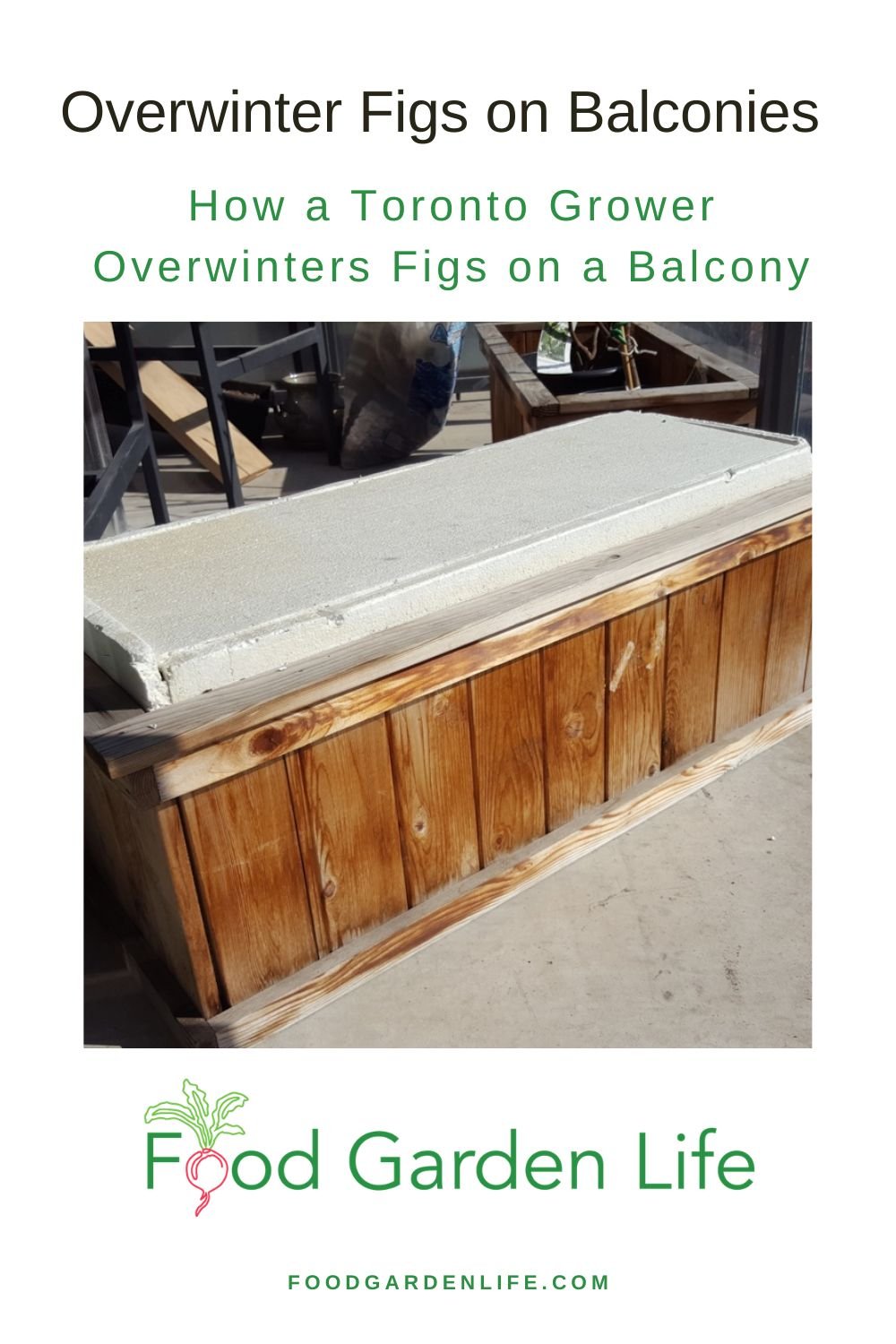
Pin this post!
Get Your Fig Trees Through Winter—and Harvest Figs
Growing figs where winters are cold takes a bit of creative thinking.
In Fig Camp and the self-paced Fig Masterclass, I explain how to grow figs in pots or in the ground, extend the growing season, ripen more fruit, and protect your trees through winter.
Explore Fig Camp and Fig Masterclass
Keep Growing Figs
Looking for more cold-climate fig-growing ideas? Visit the fig home page to browse articles about varieties, pruning, propagation, ripening, winter protection, and more.
Grow Figs Where You Think You Can’t
My revised and expanded fig book is a practical guide to growing figs in pots and cold climates—from choosing varieties and pruning to ripening fruit and conquering winter.
Find This Helpful?
Enjoy not being bombarded by annoying ads? Appreciate the absence of junky affiliate links for products you don’t need?
This site is reader supported. If it has helped you in your food-gardening journey, you can give us a high-five below. Any amount is welcome.

Hi, We’re Steve and Emma!
We help people grow food on balconies, in backyards, and beyond—whether it’s edible landscaping, a vegetable garden, container gardens, or a home orchard.
Fig Masterclass

This self-paced, virtual Fig Masterclass is hosted by Horticulturist and Cold-Climate Fig Expert Steven Biggs.