
Not Enough Garden Space? Try These Small Veg Garden Ideas
By Steven Biggs
Fit More Vegetable Plants in the Same Small Space
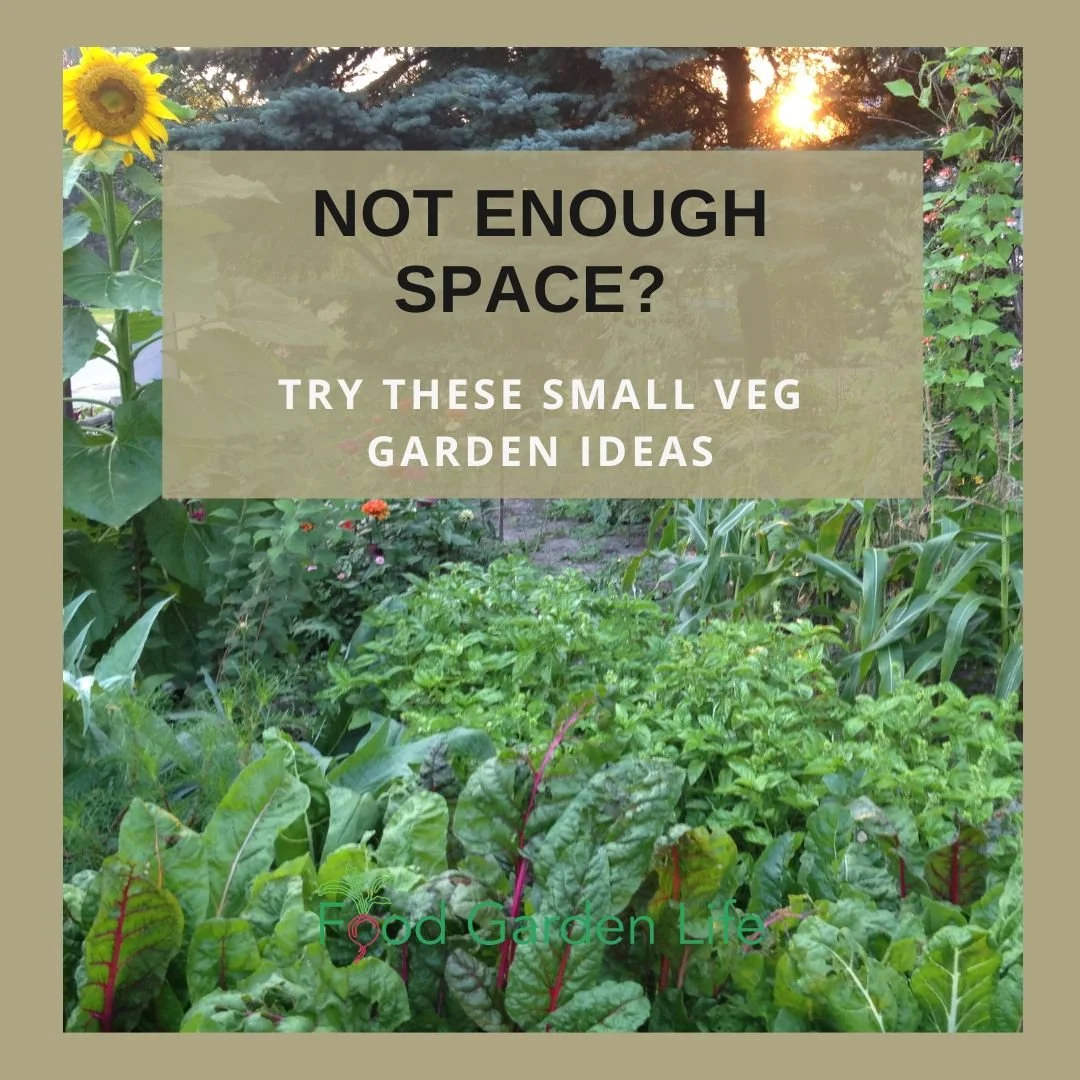
Ideas to help you harvest more from the same small space.
Want to harvest more fresh vegetables from your small-space garden? Sometimes it helps to forget what you’ve seen. And do things differently from what's done in a big garden or commercial farm.
Commercial growers often focus on uniformity, and on perfect, unblemished produce. They also need space for equipment or employees to work around the plants.
But in a small home edible garden, where there’s not a lot of growing space—and where we’re just growing our own food—our needs are different. We want a variety of crops. We want an ongoing harvest. And we want it to be simple enough to fit into our everyday routine.
If you're struggling to fit everything you want to grow in your vegetable garden, keep reading for ideas to make the most of your growing space.
Key Takeaways: Make the Most of a Small Vegetable Garden
Recommended plant or seed spacing sometimes uses more space than required in a small vegetable garden.
Vertical gardening helps to fit more plants in a small garden bed.
Companion planting is a simple way to boost the output of a small vegetable garden.
Farmers sometimes leave fields fallow, but there's no need for this in a home vegetable garden.
Many crops have more than one edible part, making crop choice a simple way to grow more of your own food in a small space.
Reconsider Plant Spacing in a Small Vegetable Garden
Do you grow vegetables with the spacing suggested on seed packets or plant labels?
I don't. I always sow carrots, lettuce, and beet seeds more densely than recommended. Then I thin them out as the plants start to grow.
And the thinning is not a waste. Because I eat the small plants that I've thinned out. Baby carrots, lettuce, and beets are a treat.
Recommended plant spacing usually gives plants a suitable amount a space to develop to their final size. But there's no reason you can't use some of the space to grow baby plants while the crop is small.
There are lots of other ways to save on spacing. I often plant a few onion sets on the sloped edges of my raised soil beds. They might not get quite the amount of space recommended...but I'm using space that might otherwise not be used.
My daughter is an avid tomato grower. Some years she's trying to fit 100 varieties into our yard. She does that by planting them close together, and then growing them up twine (see Vertical Gardening, below.)
Take Up a Smaller Footprint with Vertical Gardening
Use Vertical Space in Your Vegetable Garden
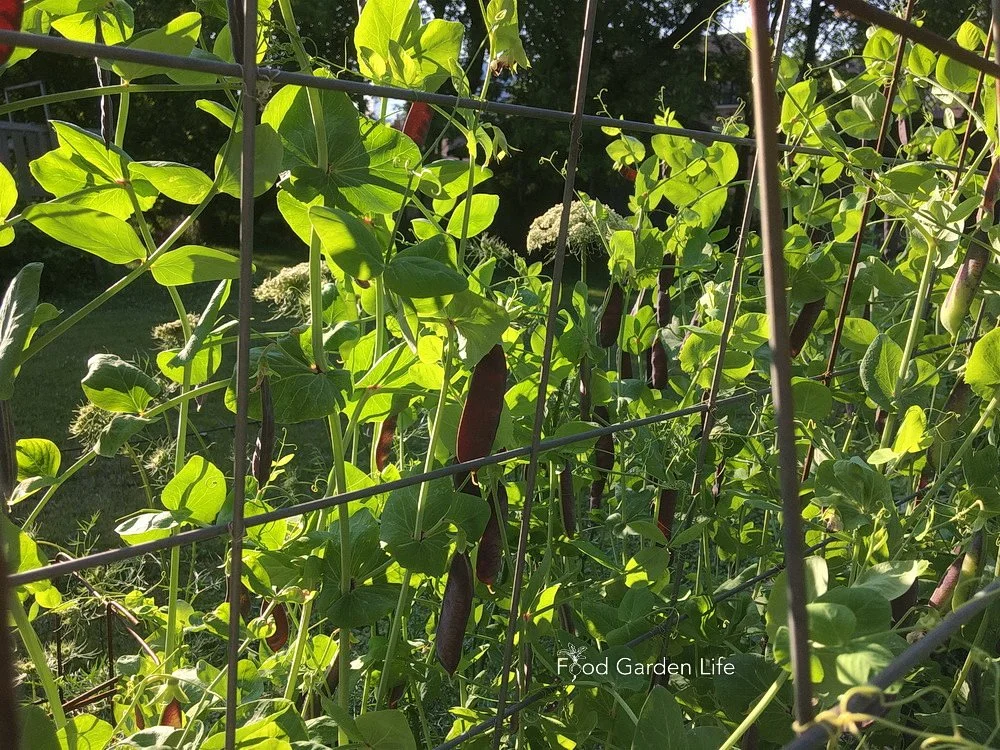
Growing vining peas up a trellis in a small garden.
When space is at a premium, don't let vining plants sprawl all over the garden bed. Grow them upwards, instead.
I’ve seen watermelons growing on A-frames, each melon supported by a sling! And there are other vining plants such as cantaloupe, indeterminate tomatoes, and cucumbers that you can grow vertically to maximize yield in a small space.
With the vining plants growing up your A-frame, you can now grow shade-tolerant vegetables such as leafy greens under the A-frame.
Here's another idea: My neighbour Joe has a 10-foot-high wall of pole beans around his vegetable garden…an edible wall! Bush beans are great, but if your growing space is at a premium, pole beans take up less of a footprint.
Choose Varieties Suited to a Small Space
Pin this post!
When planning your vegetable garden, variety choice can help you grow vertically to maximize your available space.
Some plants, such as peas, beans, tomatoes, and squash, are available in both vining and bush forms. Fit more into a small space by choosing the vining varieties that you can grow vertically.
Bush beans are a great choice if you want a larger harvest all at once for a big feed or preserving...but the trade-off is that they use more space.
Small Space? Grow Vegetables on Fences and Walls
Make the most of your outdoor space by growing on walls. All you need is a trellis or twine.
An empty fence is a wasted opportunity. My neighbour and I share the squash that I grow along our fence. Great way to hide a chain-link fence!
(And don’t forget that the top of a fence can be dressed up with a window box. A fence-top container garden!)
Try Companion Planting
Companion planting just means growing different plants together for some sort of benefit.
Companion plants might attract pollinators, lure away pests, deter pests, or attract beneficial insects. Those beneficial insects can help with pollination, or they might parasitize or eat insect pests. There are lots of opportunities for companion planting in a vegetable garden.
Below are a couple of ways to use companions to fit more vegetables into your small garden.
Plant 2 Different Crops in the Same Spot—at the Same Time
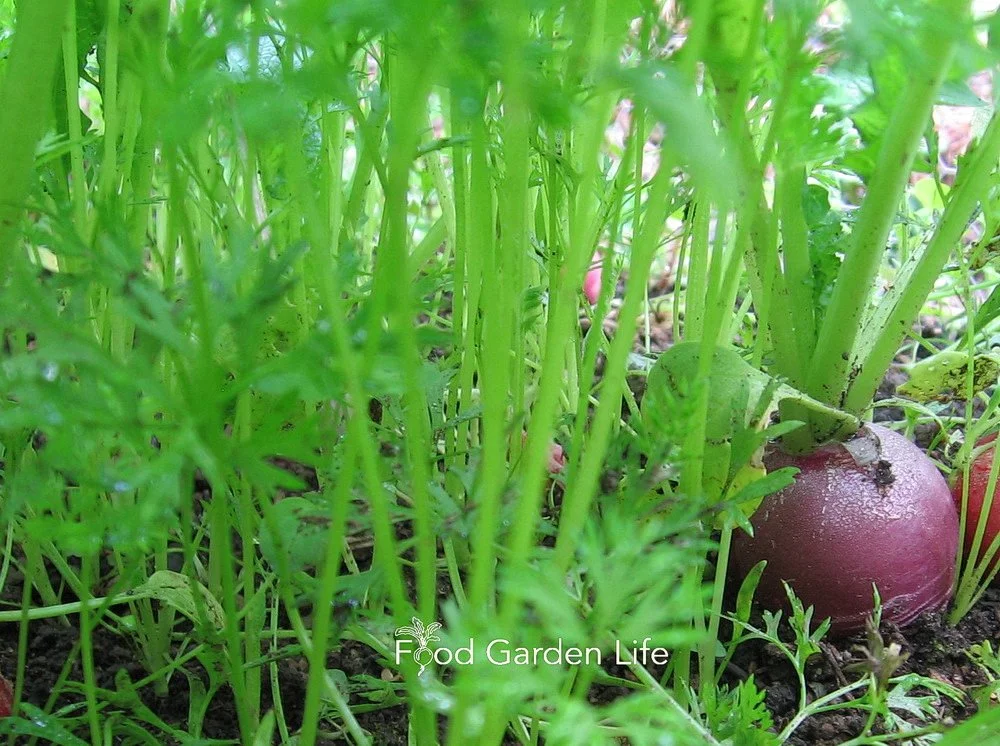
Growing radish and carrots together. The radishes are ready to harvest while the carrots are still quite small.
Waste less space by planting both fast- and slow-germinating seeds in the same space, at the same time.
My favourite example of this combination is pairing carrots and radishes. They are both root vegetables. And they are well-suited to being grown together in the same space because one grows quite quickly, one slowly.
Carrot seed is slow to germinate; radish seed is fast. And radish roots are ready to pluck from your garden way before your carrot roots are even getting chubby. That means you’ll be harvesting full-grown radishes just as your carrot seedlings need more space. As you pull out the radishes, you give the carrots more space to grow.
Wondering how one plant benefits the other in this scenario? Pulling out the radishes, which have taproots, also loosens the soil for your carrot seedlings!
Pair up Sun-Lovers and Shade-Lovers
When deciding which crops to plant together, think about sunlight.
If you have staked tomato plants, there can be a lot of unused, shady ground around them. (If it’s not yet shady, it will be, once the tomato plants get bigger.) Sprinkle seed for leafy vegetables at the base of your tomato plants. Lettuce lasts much longer when growing in some shade in the heat of summer.
Or, make an a-frame for growing climbing plants, and plant leafy greens in the shade below.
Use Your Garden Space as Long as Possible
Start as early as possible in the spring with cold-hardy crops. If your garden includes containers and raised bed, remember that the soil in containers and raised beds heats up more quickly than the ground, and that heat can speed along early spring sowings.
As your crops mature, plant new crops in the same space. Farms sometimes have “fallow” fields, unplanted fields, to control weeds or to conserve moisture. That’s fine for farms—but not for a small vegetable garden. Use your space continuously. You just need to recharge your soil nutrients, and you can do that by amending your garden soil with compost.
Don’t forget to grow cold-hardy crops in the fall to overwinter in cold frames and harvest all winter long. You can also plant cool-season crops in late summer and fall to harvest in early winter and further extend your harvest window.
Grow Vegetables That Produce a Lot in a Small Space
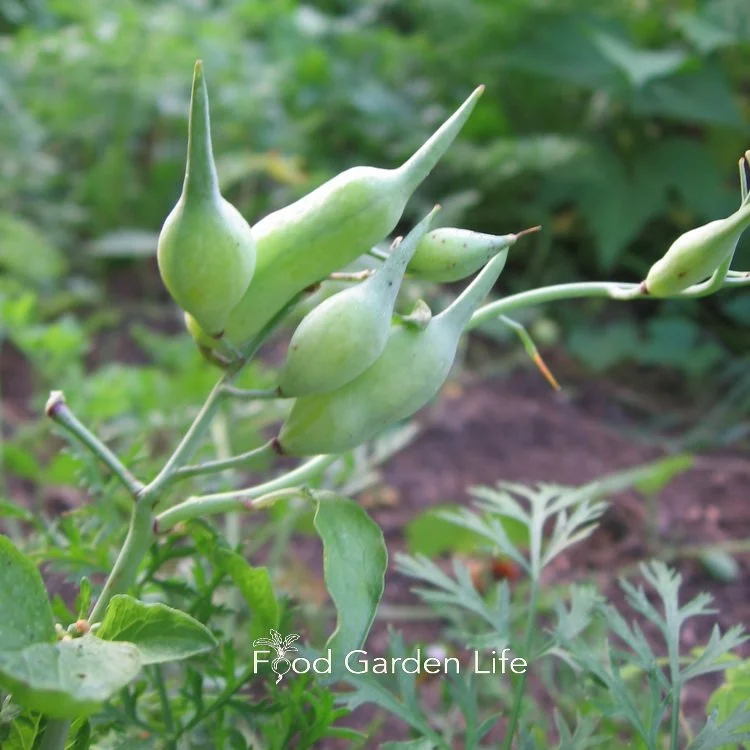
Radish seed pods are edible! A crunchy, peppery garnish.
Grow Plants with Multiple Edible Parts in a Small Garden
Growing plants with more than one edible part is a great way to get more from your growing space. Many plants have more than one edible part.
Growing beets? Eat the leaves, too, which are like chard. Garlic makes “scapes” that are edible and sought after by gourmet chefs! Radishes? Try the crunchy, peppery seed pods. One year, my daughter made pesto from young radish leaves…who knew?
In a Small Space, Plant Vegetables That Mature Quickly
Brussels sprouts? Leave them for farmers because they take up growing space ALL season and then you only harvest them once there's a fall frost.
As you think about vegetables to grow, consider kale, which you can be harvesting spring through fall, and even into the winter. Or cauliflower, which, after you harvest it, you can follow with another crop of something else.
Extend a Small Garden with Containers
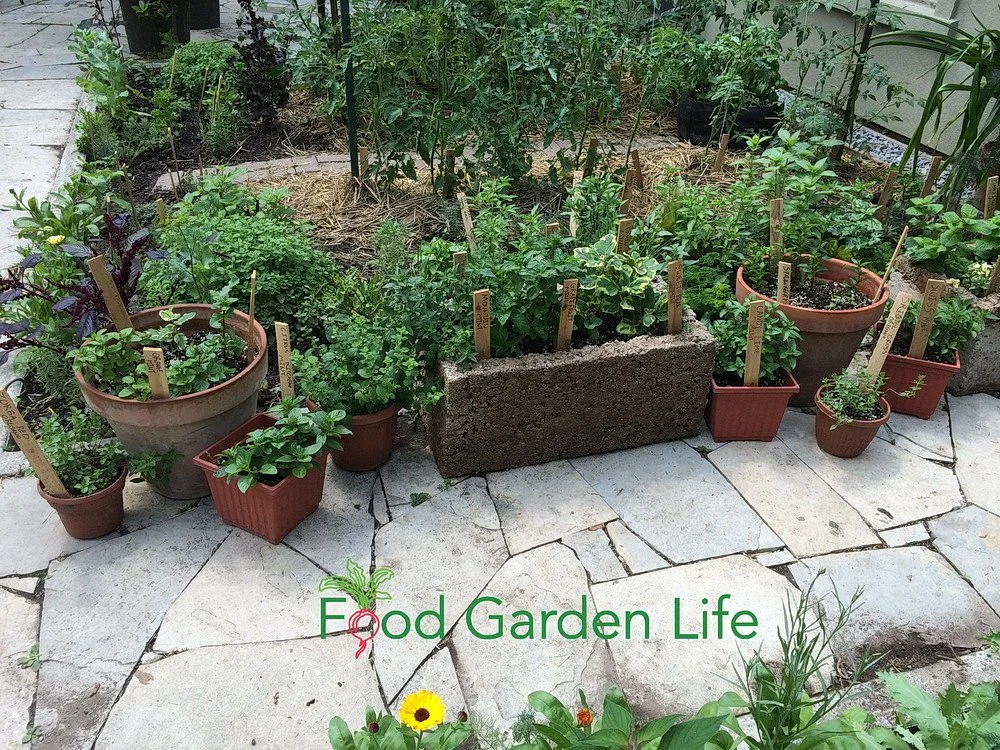
Using containers to make additional growing space beside this small garden.
Add Containers to Small-Space Gardens
Container gardening is a great way to extend a small vegetable garden, even if you don't have more in-ground growing-space.
Extend your small garden onto a patio, a deck, driveway or rooftop. Or even add window boxes.
For best results growing in containers, use a good potting mix. Here's more on potting soil.
And Finally...Forget Perfection in Your Small Garden
You probably don’t have the ideal conditions for some crops. Maybe your garden soil isn’t quite what you want…maybe you don’t have enough sun.
If you were a commercial market gardener, this could be a big deal.
But if you’re a home gardener, figure out how to make the best of what you have. For example, I grow tomatoes in a container garden on my driveway—in less than 6 hours of sunlight. I get A LOT of tomatoes from space that would otherwise go unused. Sure, it’s fewer tomatoes than if I had full sun on my driveway. But it’s more than I’d get if I didn’t grow there.
Making the best of the space and conditions you have is a big part of my approach to home food gardening.
Gardening is a great cure for perfectionism. There’s real satisfaction in harvesting fresh produce from your own garden.
More on Vegetable Garden Planning
Find This Helpful?
Enjoy not being bombarded by annoying ads?
Appreciate the absence of junky affiliate links for products you don’t need?
It’s because we’re reader supported.
If we’ve helped in your food-gardening journey, we’re glad of support. You can high-five us below. Any amount welcome!
Course: Edible Garden Makeover
Want to make an edible garden you love to be in?
If you've been thinking about growing more of your own food, but are holding back because you have information overload...
Or if you just don't know where to start.
Edible Garden Makeover gives you the ideas, knowledge, and confidence to make a unique edible landscape for your yard and your needs.
Move Over Bedding Plants...and Try These Edible Garden Plants Instead
Replace some of your bedding plants with edible plants! Find out how to choose suitable crops to use as bedding plants.
by Steven Biggs
A Few Plants for Edible Landscaping
Attractive? Check.
Low maintenance? Check.
Edible? Check.
The peppers were the finishing touch in my front-yard edible landscape. Right by the sidewalk. A nice pop of colour.
What had been my front lawn three months before was an edible front yard—edible plants including salad greens, herbs, vegetables, fruit bushes, and edible flowers.
I was enjoying the mix of colour, height, and texture as I popped one of those peppers into my mouth.
Sound the fire alarm. My face lit up scarlet. I grabbed a basket and, between hiccups, plucked all those hot peppers…worried about hot-pepper misadventures with the school kids that go by twice a day.
So the hot peppers were not a home run.
But with those little scorchers harvested, I left the pepper plants. They had dark green leaves and compact form. Nice bedding plants nonetheless. Just not next to the sidewalk.
I don't see food-growing and ornamental spaces as separate things. A home food garden can be productive, beautiful, and part of the landscape you already have. That's one of the ideas behind my approach to home food gardening.
If you’re interested in edible plants for edible landscaping, keep reading. This post gives you design ideas and top crops for using as edible bedding plants.
What’s a Bedding Plant?
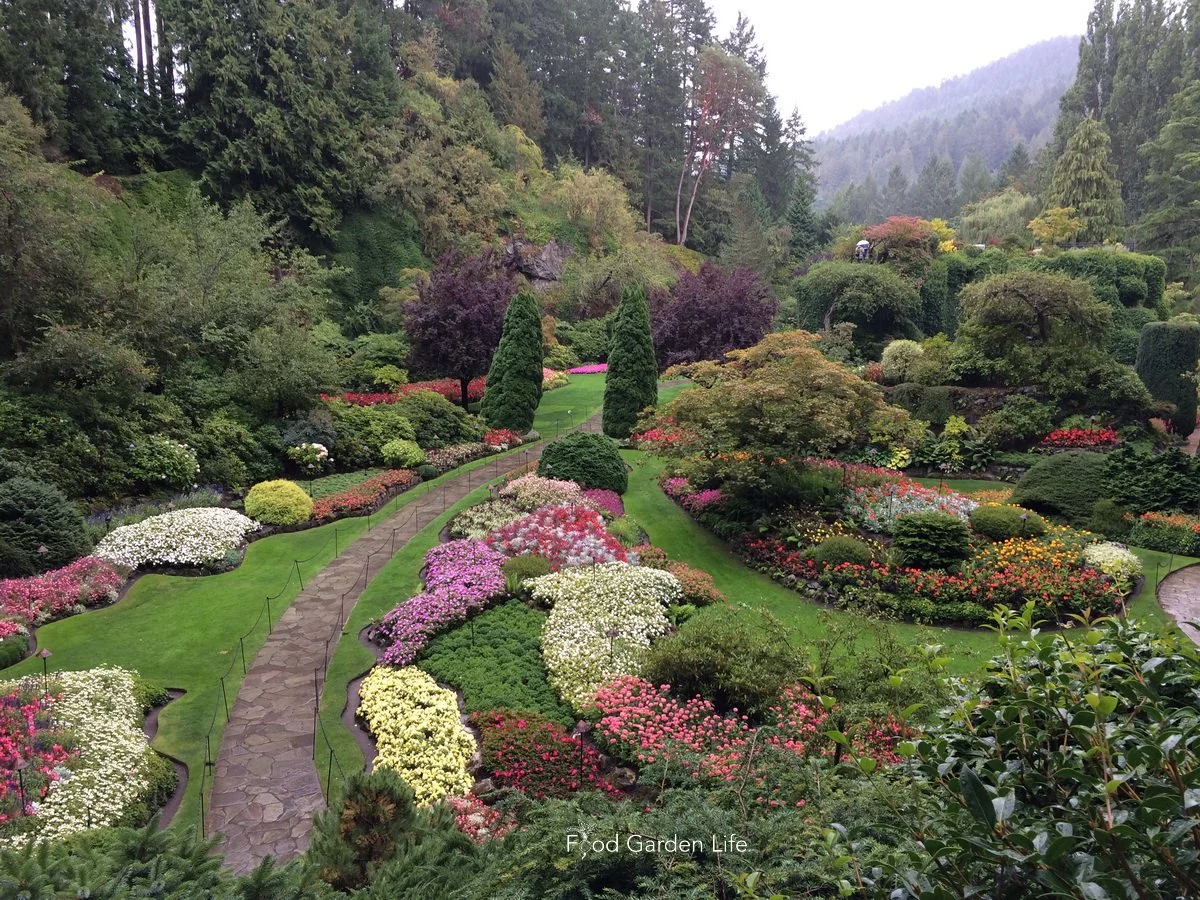
Bedding plants are display plants for seasonal plantings. Here’s a good example, at Butchart Gardens in BC.
Bedding plants are display plants for seasonal plantings. Garden bling. So choices usually combine fast-growing, colour, and resilience.
Some, like coleus, have fabulous foliage. Many have showy flowers. Commonly they’re flowering annuals—though not always. Others, like fuchsia, are tender perennials.
But what they have in common is that they’re typically transplanted into a garden to give an immediate show. Then they’re yanked out at the end of the season.
Lots of common vegetable-garden and herb-garden plants can fit the bill as bedding plants in an edible landscape.
What Makes a Good Bedding Plant?
A good bedding plant is low maintenance. It doesn’t need pruning or staking. You don’t need to hold its hand.
For summertime plantings, a good bedding plant also performs well through the heat of the summer.
Why Use Edible Plants as Bedding Plants?
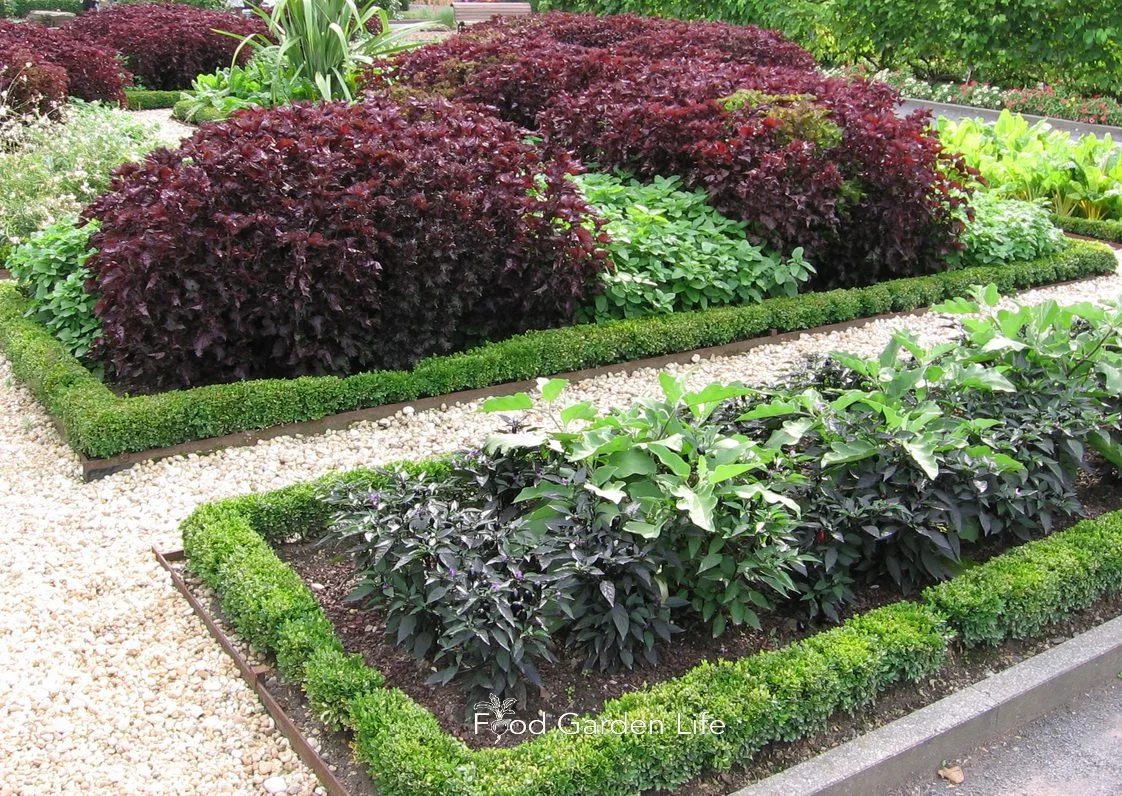
Using edible plants to make ornamental plantings—instead of traditional bedding plants.
I have nothing against flowers. I go overboard planting flowers every year.
But like many home gardeners, I never have enough space to grow all of the plants I want to grow.
So if I can kill two birds with one stone—edibles for both eating and appearance—count me in. Give me space in the flower garden for some veggies…I'll make it into an edible landscape.
Bedding Plants Through the Seasons
Pin this post!
Most ornamental bedding plants are planted after the last spring frost, but there are exceptions. The most common is pansies—which shine on despite a frost.
(If you didn’t know, pansy flowers are edible!)
You might see plantings of ornamental kale and cabbage in the fall. They soldier on through fall frosts while most bedding plant snivel.
(You can eat ornamental cabbage and kale—though they’re bred for looks, not as gustatory delight.)
Just as plant choice can keep the curtains open longer for a flower garden, choosing the right edible bedding plants keeps an edible landscape looking tip-top into the fall.
Designing Edible Landscapes with Edible Bedding Plants
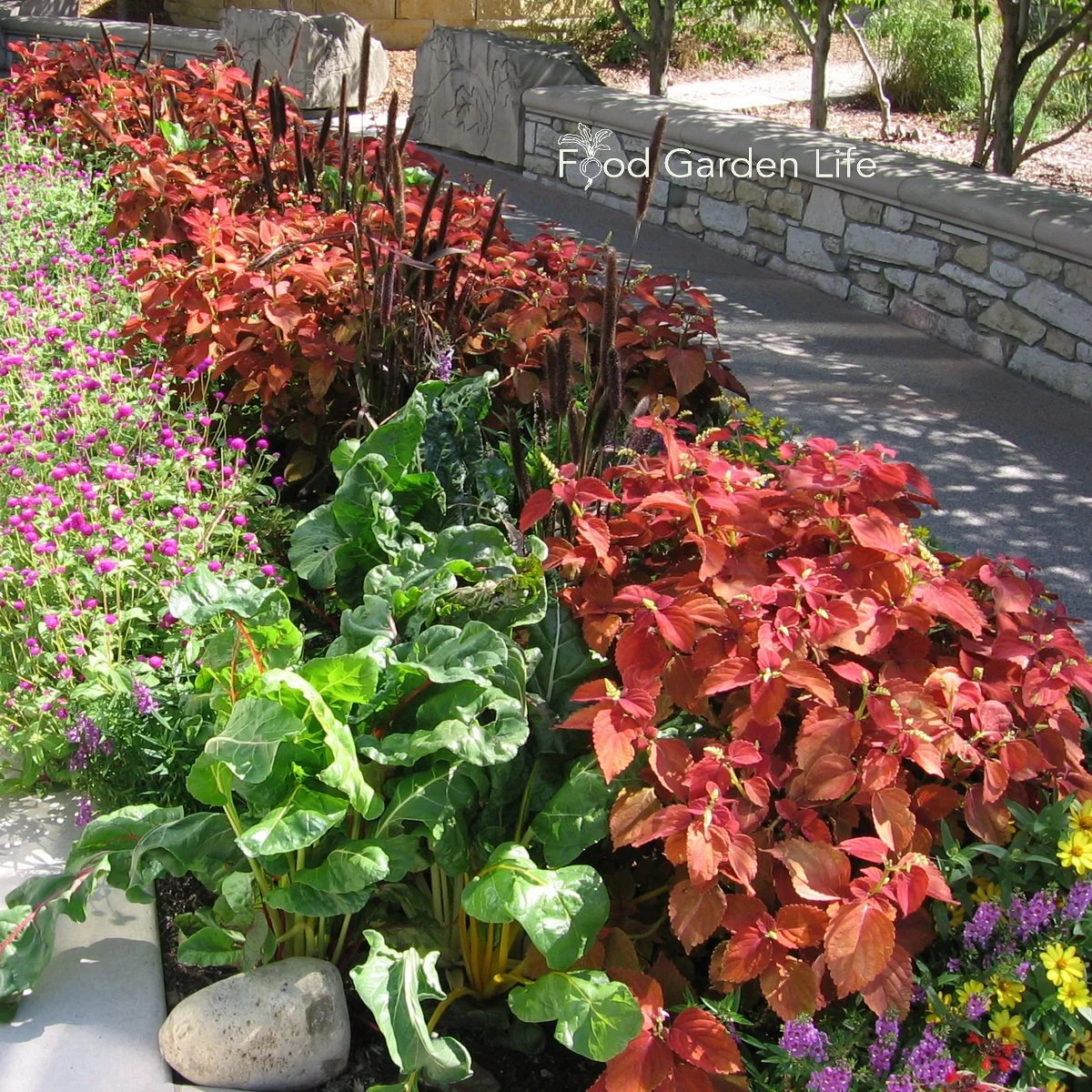
Swiss chard hanging out with some ornamental bedding plants.
The way you use bedding plants depends on the situation and your taste (sorry about the pun.)
My advice? Be wildly creative and do something that your neighbours aren’t doing. Gardening can be more than practical; it can be creative, too.
(It should be creative, that’s the fun part!)
To get your creative juices going, here are three broad ways of using bedding plants in your edible landscape:
Formal. Think of public display gardens with formal flower beds and symmetrical patterns. (If you’re a detail person, this might be up your alley.)
Informal. This is where you’re getting playful with colour and texture and not constrained by having one big formal flower bed. Like icing on a cake, you “ice” the garden bed…a smear of bedding plants here and there.
Carpet. I once worked at a company where we made the company logo from bedding plants. That’s carpet bedding. We’re talking about a tightly planted, intricate pattern. Like painting with plants.
5 Edible Bedding Plants to Start With
Here are five edible bedding plants you can start with. There are lots more (including the pansies and kale I mentioned above.) But these five edible plants are all work horses, easy to find, and give a good mix of colour and texture.
Swiss Chard. Such an underrated plant. While so many of its leafy-green brethren make haste to flower and die, Swiss chard just grows leaves all summer. And along with green varieties, there are red, orange, yellow—even striped red-and-white varieties. Find out why Swiss chard is also a great choice in the fall garden.
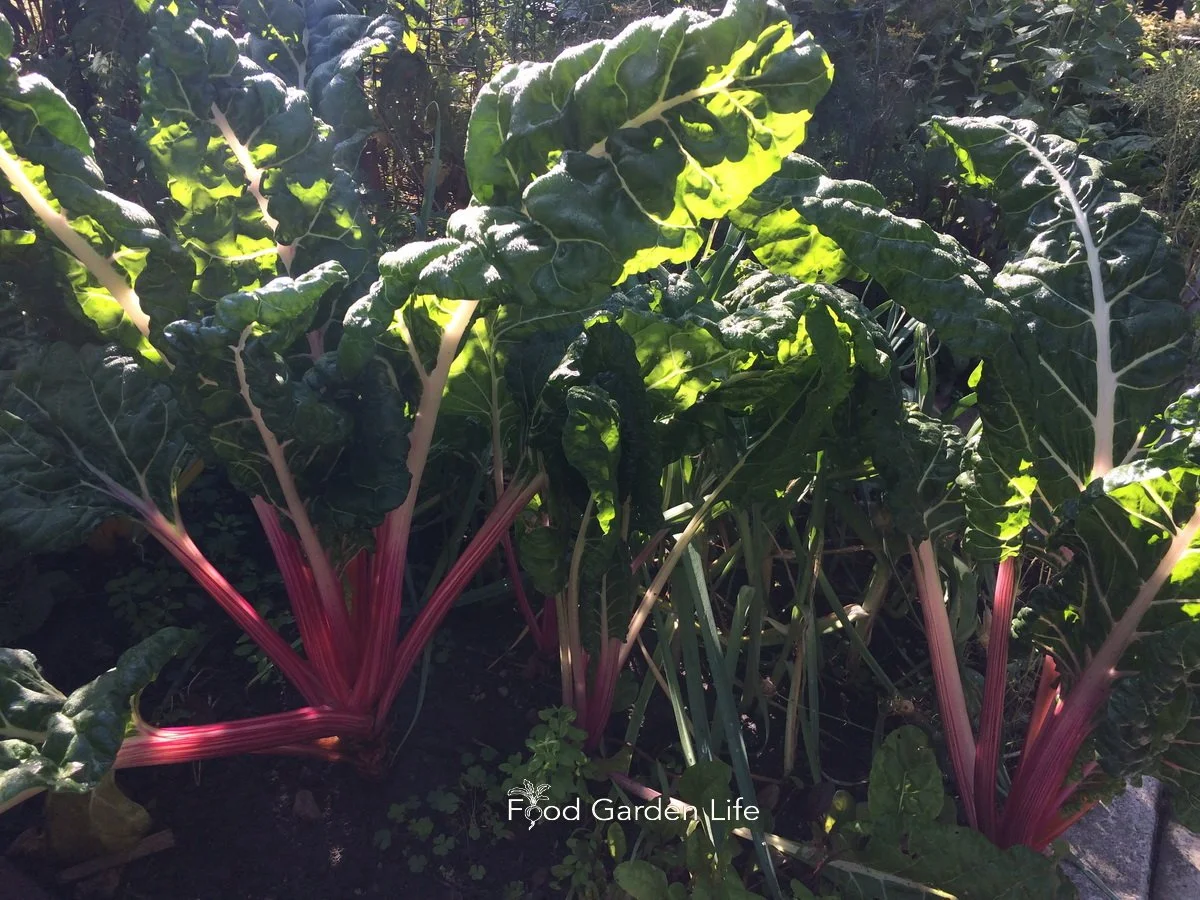
Swiss chard. This underused leafy green makes an excellent bedding plant.
Parsley. The world needs more parsley. Seriously. Beyond garnishing a cheese tray or bulking out your bruschetta mix, parsley is a performer in the edible landscape. Great for edging borders. Planted in larger blocks, curly-leaf parsley is a brush-stroke of texture. And it lasts nicely even as fall frosts fell heat-loving crops.
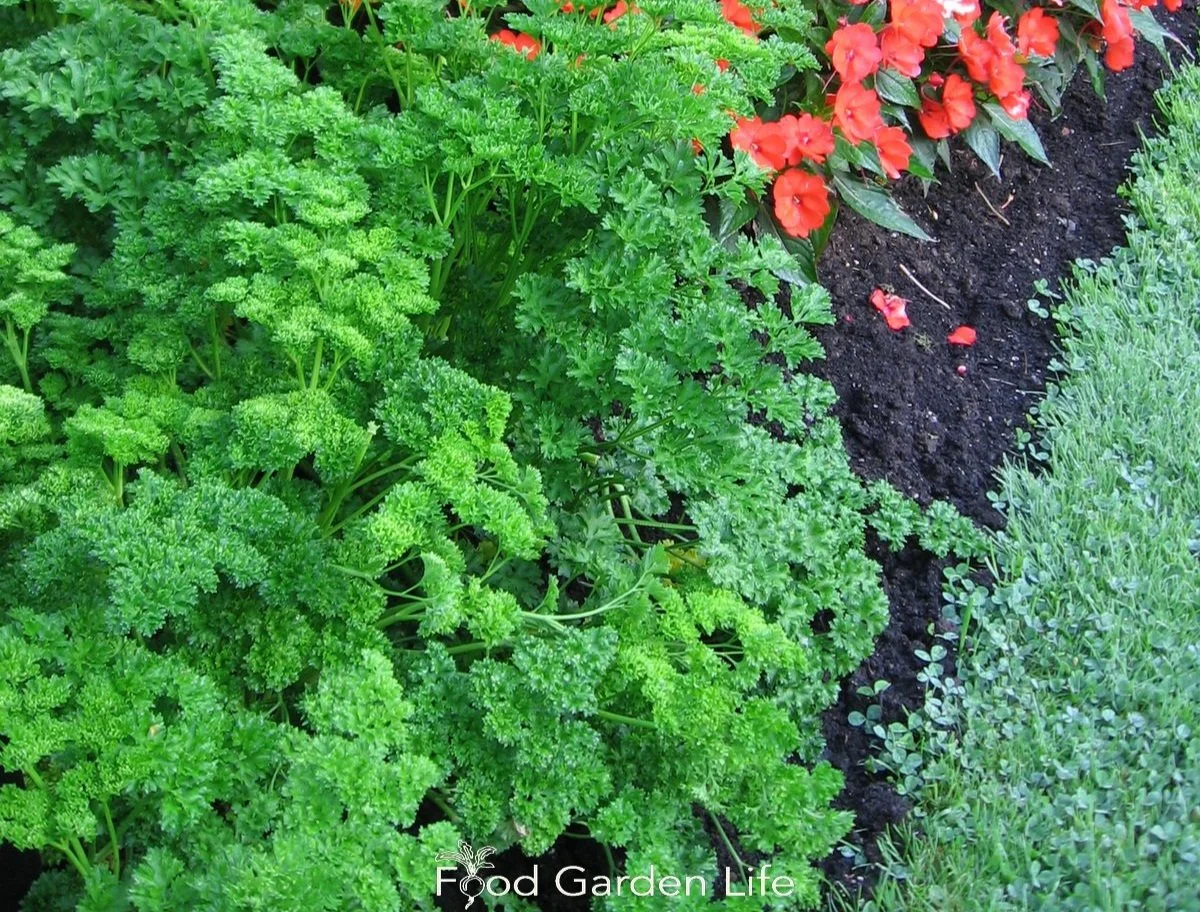
Parsley. A top-notch bedding plant.
Cardoon. How many edible plants can you describe as elegant? This one has a touch of class. I was riveted when I saw cardoon punctuating the landscape of the historic Spadina House mansion in Toronto. What a bold beauty this plant it! Find out more about cardoon.
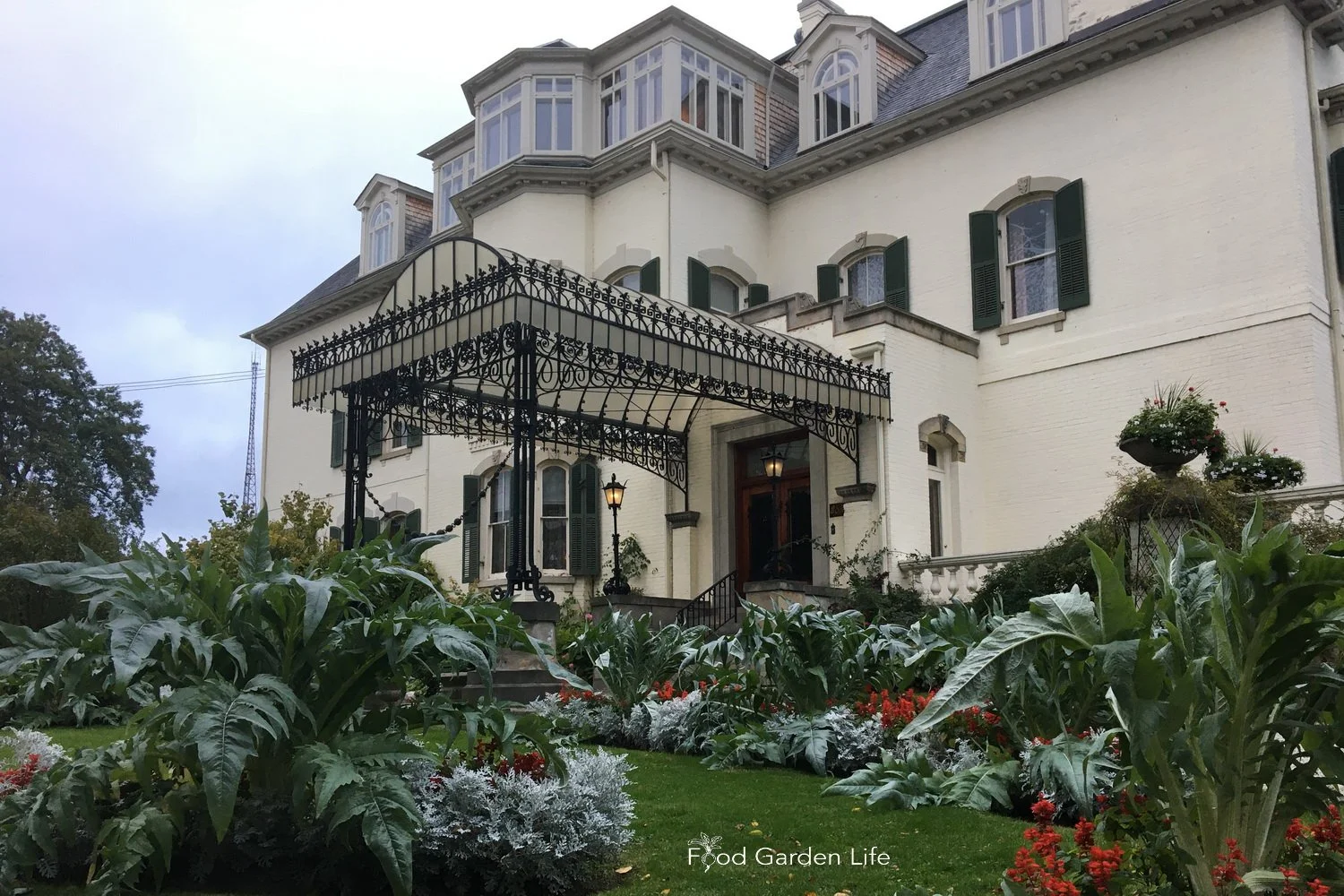
Cardoon. An elegant bedding plant!
Basil. From compact, little-leaf varieties to more gangly family members, you can choose from quite a range of plant and leaf sizes. And for leaf colour, remember there’s red and purple, as well as green. The compact basils are great for carpet-style designs. Keep in mind that basil, after a spell of cold fall weather, will quickly pack it in for winter.
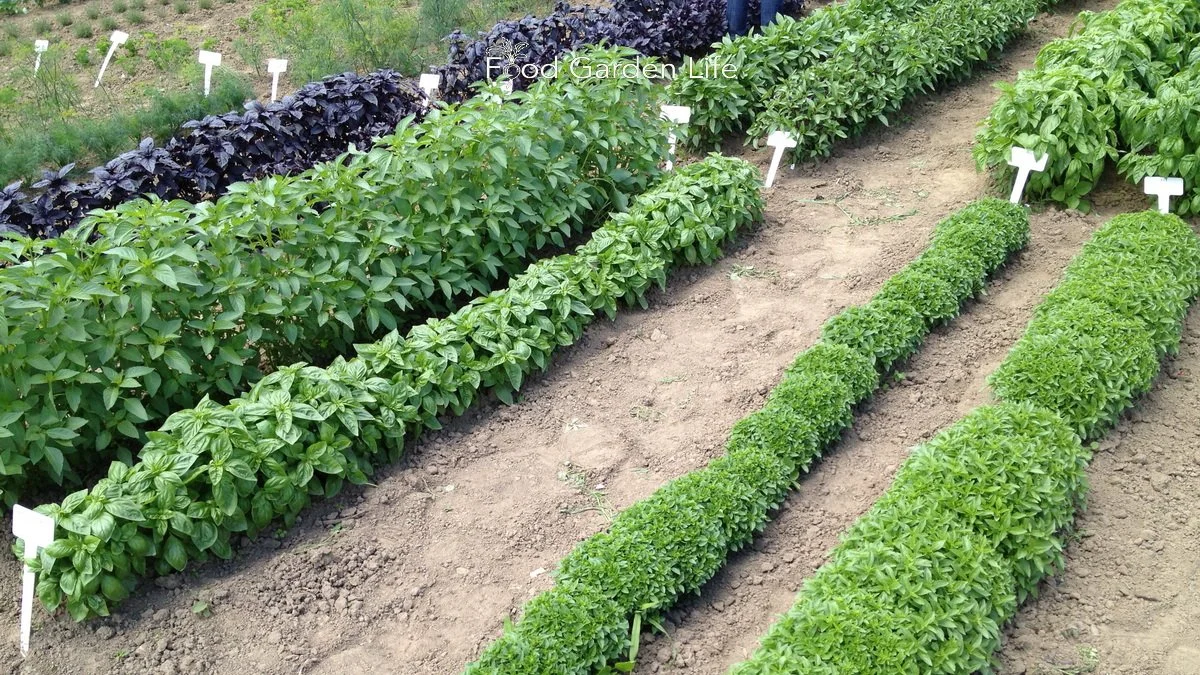
Basil. So many choices…here’s a shot from a trial garden.
Eggplant. Compact plant. Attractive flowers. Beautiful fruit. Eggplant can be front and centre in an edible landscape. I love the small-fruited varieties with interesting colours, such as red-fruited eggplant or the skinny striped ones. Eggplant as a bedding plant? I bet your neighbours aren’t doing this!
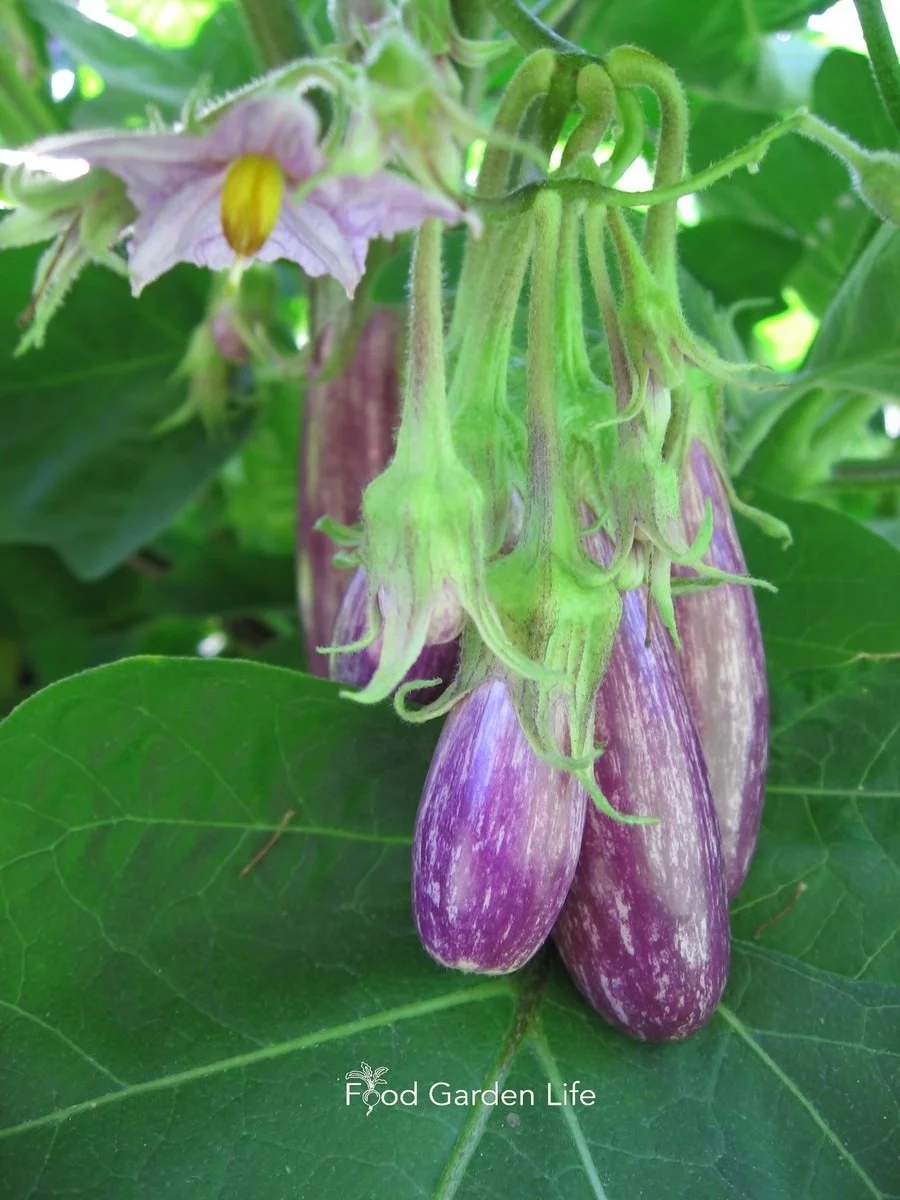
Eggplant. Even if you don’t love eggplant, you have to admit it’s beautiful!
Find This Helpful?
Enjoy not being bombarded by annoying ads?
Appreciate the absence of junky affiliate links for products you don’t need?
It’s because we’re reader supported.
If we’ve helped in your food-gardening journey, we’re glad of support. You can high-five us below. Any amount welcome!
Courses
Here’s a course that guides you through creating an edible garden you love. It’s my ode to edible gardening. You’ll find out how to think outside the box and create a special space. Get the information you need about a wide range of edible plants.
Seed Shopping Smarts: Know The Lingo So You Can Get The Best Seeds
What’s your seed-shopping vocabulary like? Brush up on your seed lingo in this glossary of seed terminology so you can choose the best seeds for your needs.
By Steven Biggs
Best Seeds for Your Needs When You Know The Lingo
Get the best seeds for you needs when you know seed terminology.
When I worked at a marketing and communications company, there was a linguistic divide in our office.
The in-house application developers had a vocabulary that was incomprehensible to those of us working the phones.
As an outsider who wasn’t too tech savvy, it took me a while to absorb the new vocabulary.
Specialized Seed Vocabulary
It’s easy to feel like an outsider when you encounter specialized lingo. And it’s not just in the tech sector. (My father-in-law doesn’t realize I miss most of what he’s telling me when he shows me under the hood of his car…and now I have a son who has a whole vocabulary around mountain biking!)
Gardening has specialized vocabulary too. And I’ll be glad if you find this this glossary of seed terminology helpful in choosing the best seeds for your garden.
Glossary of Seed Terminology
Here are common terms that you’ll find when you seed shop. Knowing what they mean will help you get the best seeds for your situation.
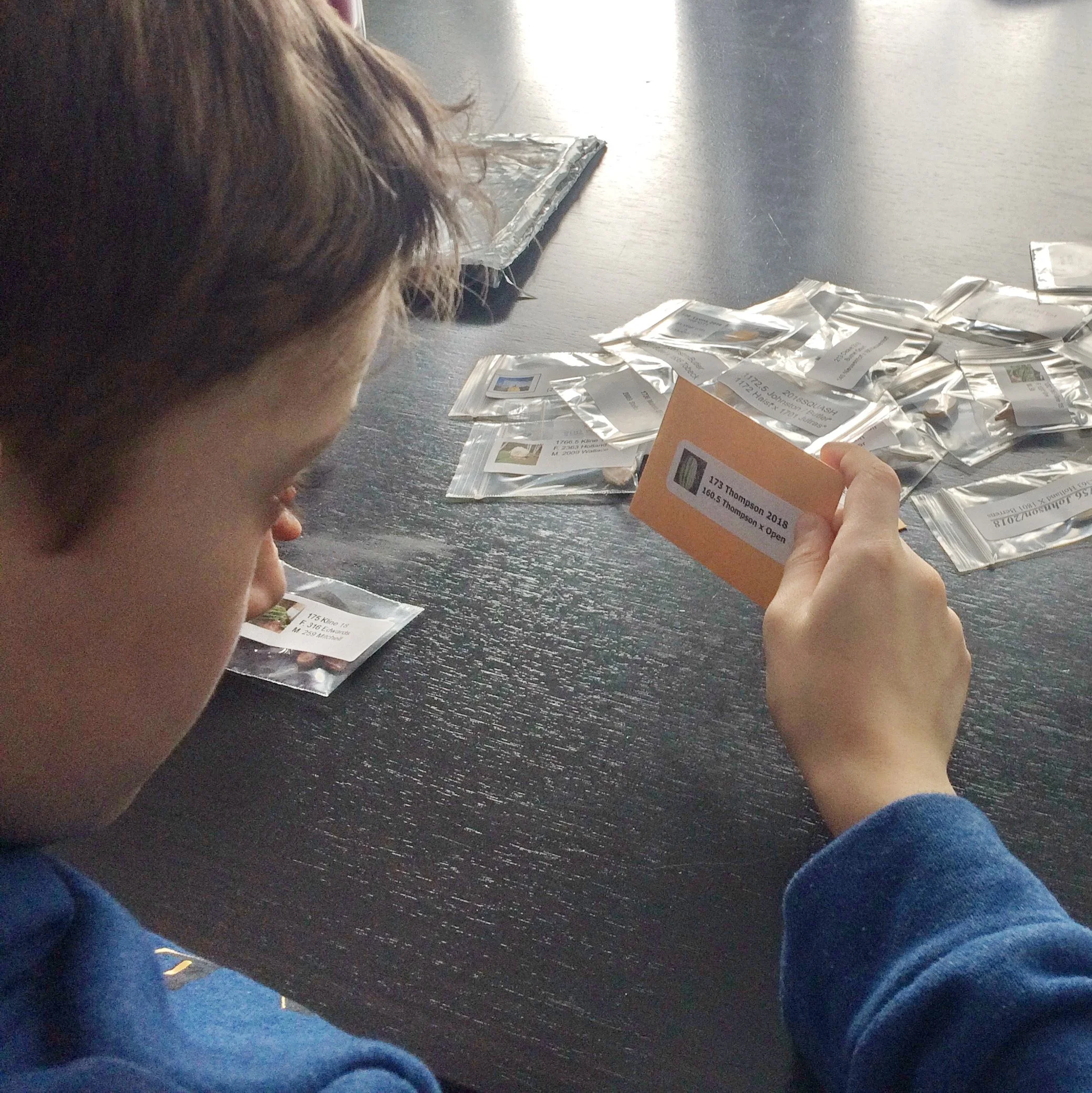
This glossary of seed terminology will explain important seed vocabulary.
Annual
An annual plant has a one-year life cycle. It flowers, makes seed, and dies in one year. Common annuals include veggies such as beans, lettuce, and spinach.
(To confuse things, some of the so-called annuals that we grow in northern gardens live more than one year in warmer climates—but die in our cold winters, so we treat them as annuals. But actually, they’re not. A good example is fuchsia.)
Biennial
A biennial has a two-year life cycle. The first year, it makes leaves; and in the second year, flowers and forms seeds. In the veggie garden, a number of common crops are biennials, but we usually harvest from them during the first year and then remove them. Unless we’re saving seeds. Parsley, Swiss chard, and carrots are biennials.
Botanical Name (Scientific Name, Latin Name)
This is the official two-part name, often italicized. Useful when we want to make sure there’s no confusion around what plant we’re dealing with.
Common Name
This is the everyday, plain English name. The only problem is that sometimes the same name gets used on more than one plant. Bluebell is a good example. That’s why, when in doubt, you can check the Botanical Name to make sure you’re ordering what you want.
Cotyledon
This is the name of the first leaves that emerge when a seed germinates. You might see this word when seed shopping because transplanting guides often talk about “seed leaves” or “cotyledon leaves” when explaining when to transplant your seedlings. They look different from the “true” leaves that come afterwards.
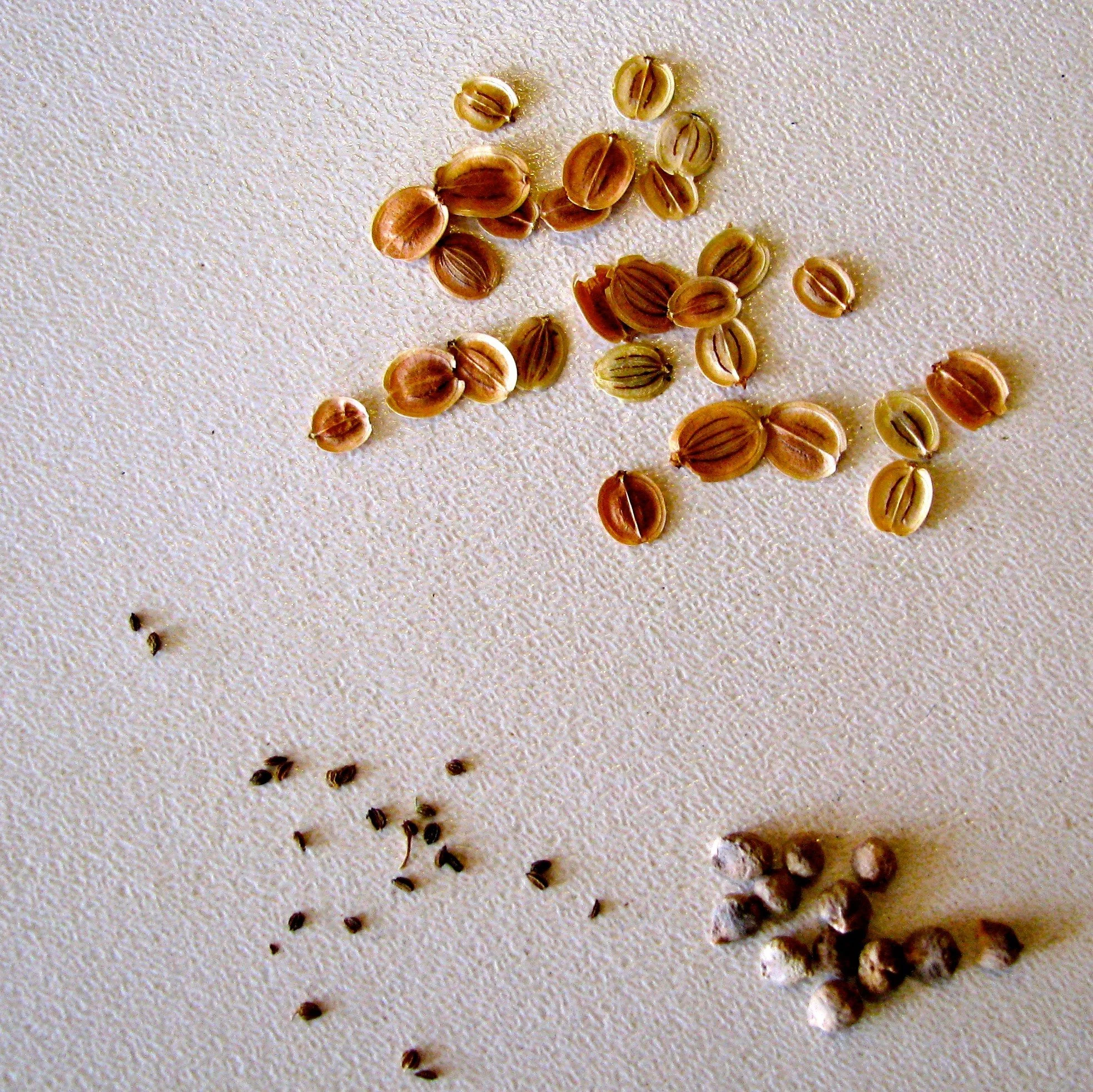
Many common garden crops are biennials. Parsnip (seeds at the top) is a good example of a biennial in the vegetable garden.
Cultivar
This word comes from “cultivated variety.” It just means a variety intentionally grown by humans. People often use this term interchangeably with “variety” although there are also naturally occurring plant varieties—which is why the distinction. If you see a name between single quotes (‘ ‘) it’s likely a cultivar name. A cultivar can be an open-pollinated or a hybrid (see below).
Days to Maturity (Days to Harvest)
An approximate number of days until harvest. This number is always approximate because many things (weather, growing conditions, the stage of harvest) have an effect on it.
For crops we plant directly in the garden, it’s the number of days from seeding until harvest; while for crops we start indoors as transplants (e.g. tomatoes) it the number of days from transplanting in the garden until harvest.
Dioecious
Dioecious plants have male and female flowers on separate plants. In the veggie garden, asparagus is an example of a dioecious plant.
Direct Sow (Direct Seed)
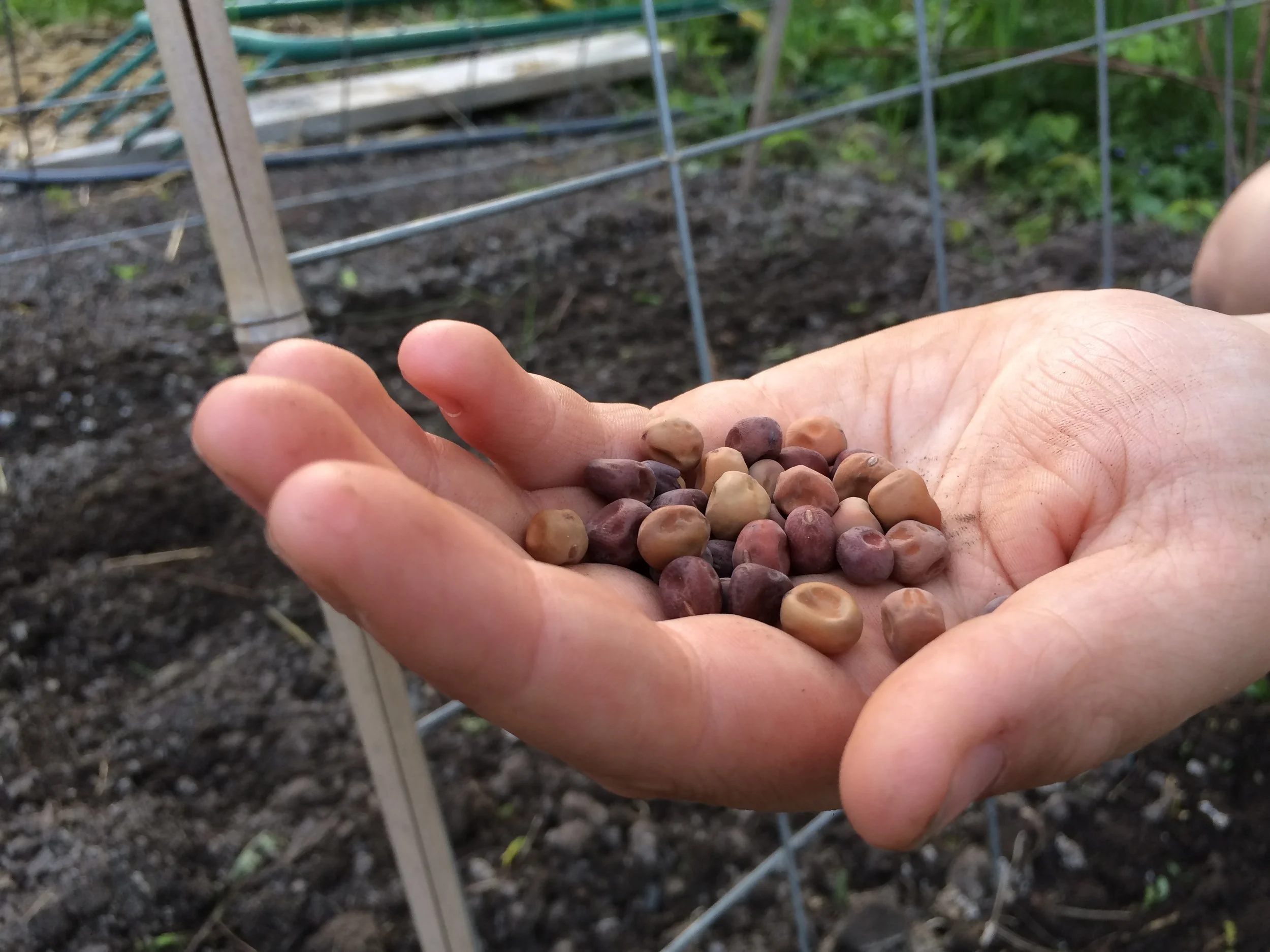
Pea seeds, an example of a crop that we usually direct sow.
This is when we plant seeds in their final, outdoor destination. Crops that are commonly direct seeded include carrots, beets, beans, and peas.
Germination Rate
Seed companies test germination. (At least I hope they do!) If you see a percentage on a seed packet, it indicates the germination rate from a germination test—and this should give you an idea of what sort of germination you can expect at home under good conditions.
GMO (Genetically Modified Organism)
Many people understand this to mean a plant into which genetic material from another plant or life form is inserted. What’s confusing is that the way this term is often understood and the official definitions differ.
The exact definition depends on who you ask and where you are. Here’s the official definition used by the Government of Canada.
“A genetically modified (GM) food is a food that comes from an organism (plant, animal or microorganism) that has had 1 or more of its characteristics changed on purpose. Organisms can be modified by different processes, including: conventional breeding techniques, like cross-breeding or mutagenesis (a change in the genetic make-up of an organism caused by chemicals or radiation); modern biotechnology techniques, such as genetic engineering; gene editing.”
Here’s what can be confusing: The wordy definition above includes traditional breeding…the sort of breeding that might have given us some of our heirloom varieties. What many people want to avoid is “genetically engineered” seeds. Genetically engineered seeds are mostly found in commodity crops (think canola and corn) – and are not sold to home gardeners.
Harden Off
When seedlings are moved from protected conditions such as indoor grow lights or a greenhouse, they are “hardened off,” which means they are gradually acclimated to the brighter light, different temperatures, and wind outdoors.
Hardy Annual
An annual that tolerates some frost and cool conditions. For example, a common hardy annual vegetable is arugula—which, if you let it make seed, you’re likely to find growing up on its own in your garden while there are still cool conditions.
Heirloom
Like the word “natural” in the health food sector, “heirloom” is one of those fuzzy, poorly defined words that marketers adore. There’s no precise meaning. But, in general, it means an older open-pollinated variety.
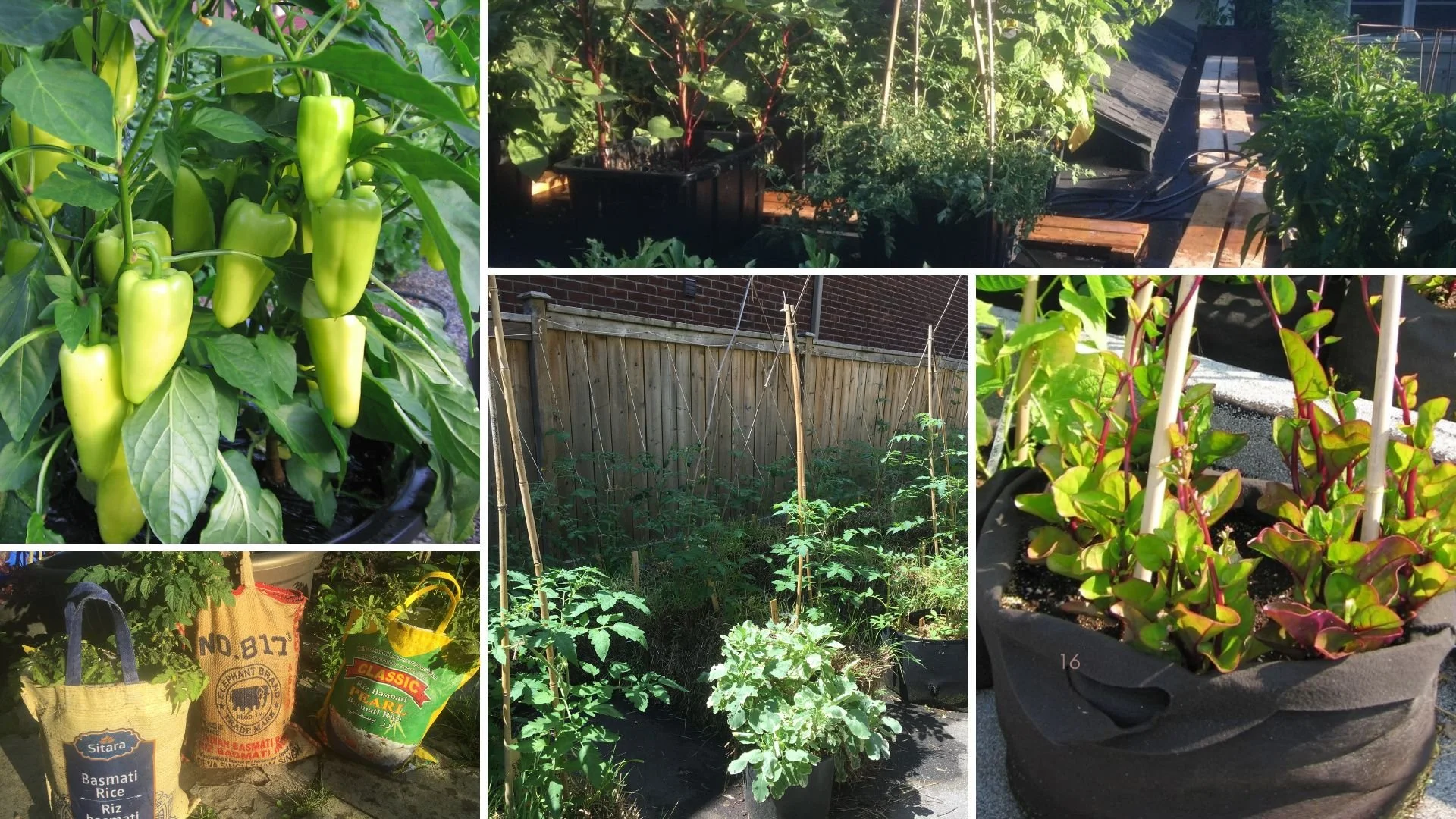
Grow a Container Vegetable Garden
And get an early harvest of crops that usually take too long!
Hybrid Seeds
Hybrid seeds result from cross-pollinating two varieties with desirable traits. In the seed industry, it’s done in controlled conditions, so there’s no chance of an errant pollen grain giving something different.
Hybrid seeds tend to be more expensive because of the labour needed to make the cross. Hybrids are often made to have desirable traits such as disease resistance and vigour…and they’re also made because it’s an industry.
If you see the term “F1,” that refers to the first generation of seed after the cross. That’s usually what’s for sale at seed vendors. When you save seeds from a hybrid plant, it will probably be different from the parent plant.
Hybrids occur in nature too, but the hybrid seeds you find at vendors will have been deliberate. When people are new to seed shopping they sometimes wonder if hybrid has something to do with genetic engineering—and it doesn’t. It’s entirely different.
Last Frost Date (Average Last Frost Date)
The date in the spring when—on average—there isn’t any more frost in your area. It’s figured out using historical weather data.
This date is like a marker post for seed sowing. When a seed catalogue recommends starting tomato seeds 8 weeks before your average last frost date, this is what it’s referring to.
This date is also used when deciding when to move seedlings into the garden. (But remember…an average last frost date means that some years there is frost after that date.)
Monoecious
Monoecious plants have both male and female flowers on the same plant. Melons are monoecious; and if you look closely, you’ll see some of the flowers have little melons-in-waiting next to the female flowers, while the male flowers have none.
Open Pollinated (OP)
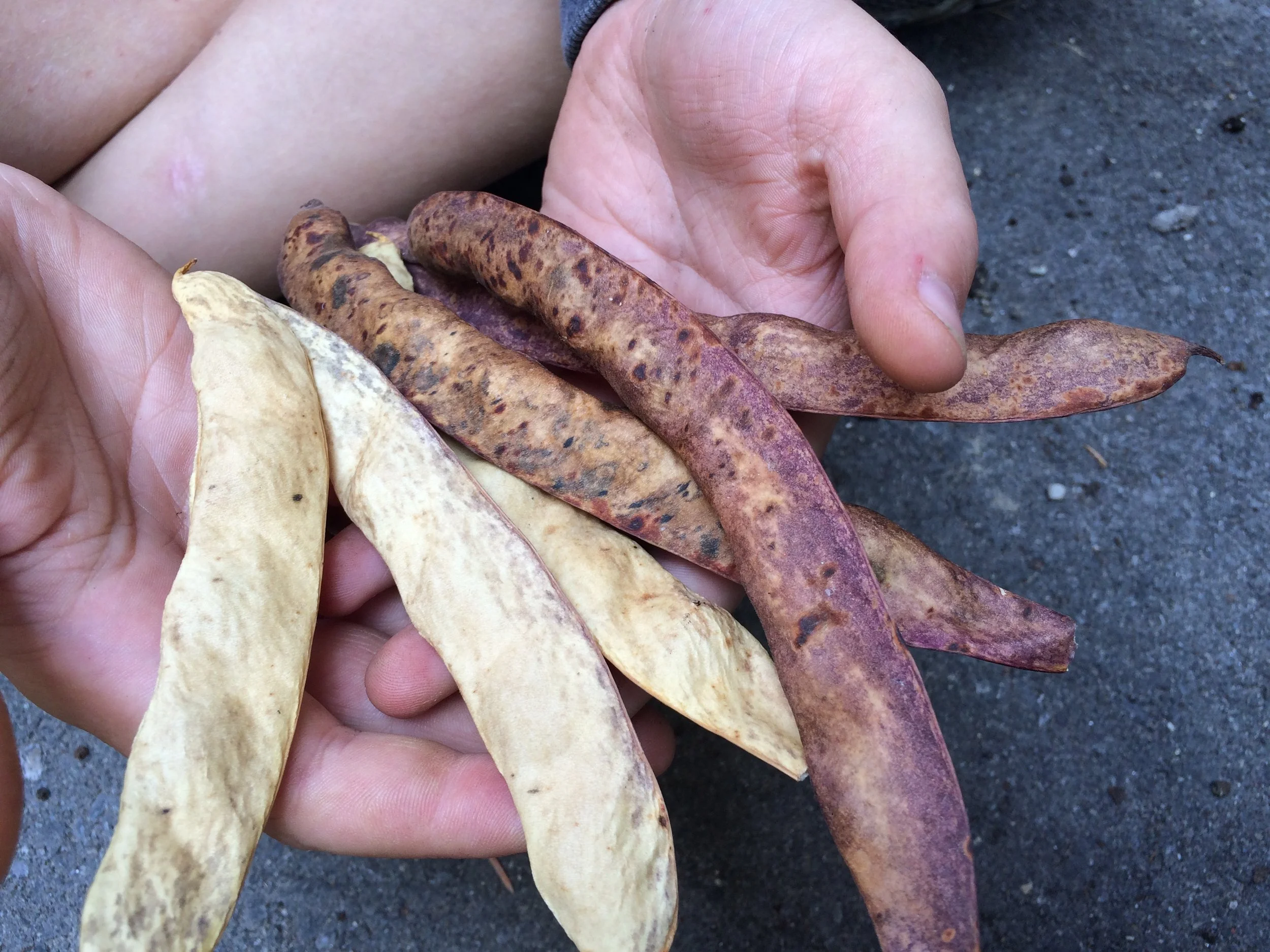
Open-pollinated bean varieties are easy to save seeds from because there is not usually much cross-pollination with other varieties.
Open-pollinated varieties are stable varieties that you can save seed from and get plants that are like the parent plants. Some open-pollinated varieties are heirlooms; some are recent.
Note: To get seeds like the parent plant, there can’t be “cross-pollination” with other varieties. Some types of plants mostly self-pollinate (they have perfect flowers, see below), so you’re likely to get seeds like the parent plant without doing anything special. But some plants have separate male and female flowers—meaning insects might pollinate them with pollen from another variety. Squash is a good example. In that case, open-pollinated varieties are grown in isolation when saving seed.
Organic
Generally understood to mean that the plants the seeds come from are not treated with synthetic fertilizers and pesticides. The thing to keep in mind when seed shopping (food shopping, too, actually) is that there are organic certification bodies—agencies that make sure a producer adheres to a set of standards. So you might come across seed that a seller says is organic—but is not “certified” organic.
Parthenocarpic
This refers to varieties that can make fruit without pollination. The resulting fruit has no seeds. You’re most likely to see this term as you browse cucumber varieties.
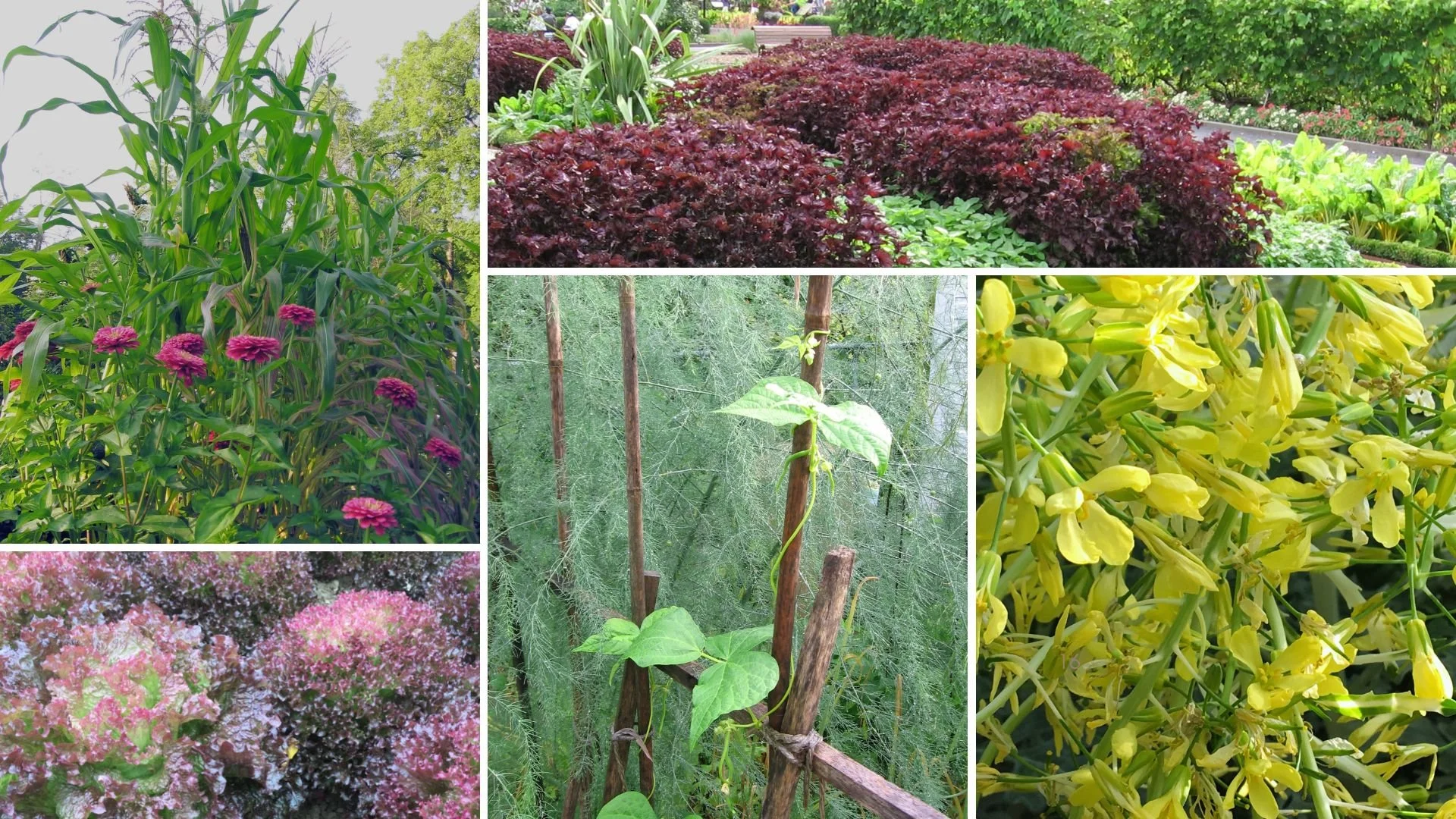
Create Your Own Unique Edible Landscape
That fits for your yard, and your style!
Pelleted
Sometimes small or irregularly shaped seeds are coated with clay to make them easier to handle or dispense with seeding equipment. These “pelleted” seeds are usually more expensive.
Perennial
A plant with a life cycle spanning a number of years.
Perfect Flower
A flower that has both male and female parts.
Set
Onion “sets” are small, pre-grown onion bulbs that you can plant directly in the garden instead of growing onion seedlings. It’s a great option if you don’t have a lot of indoor space for growing onion transplants.
Tender Annual
An annual plant that does not tolerate frost. We usually start tender annuals indoors, in warm conditions, and then transplant them outdoors when there is no further risk of frost. A good example of a tender annual is basil…which quickly wilts in protest in cool weather.
Transplant
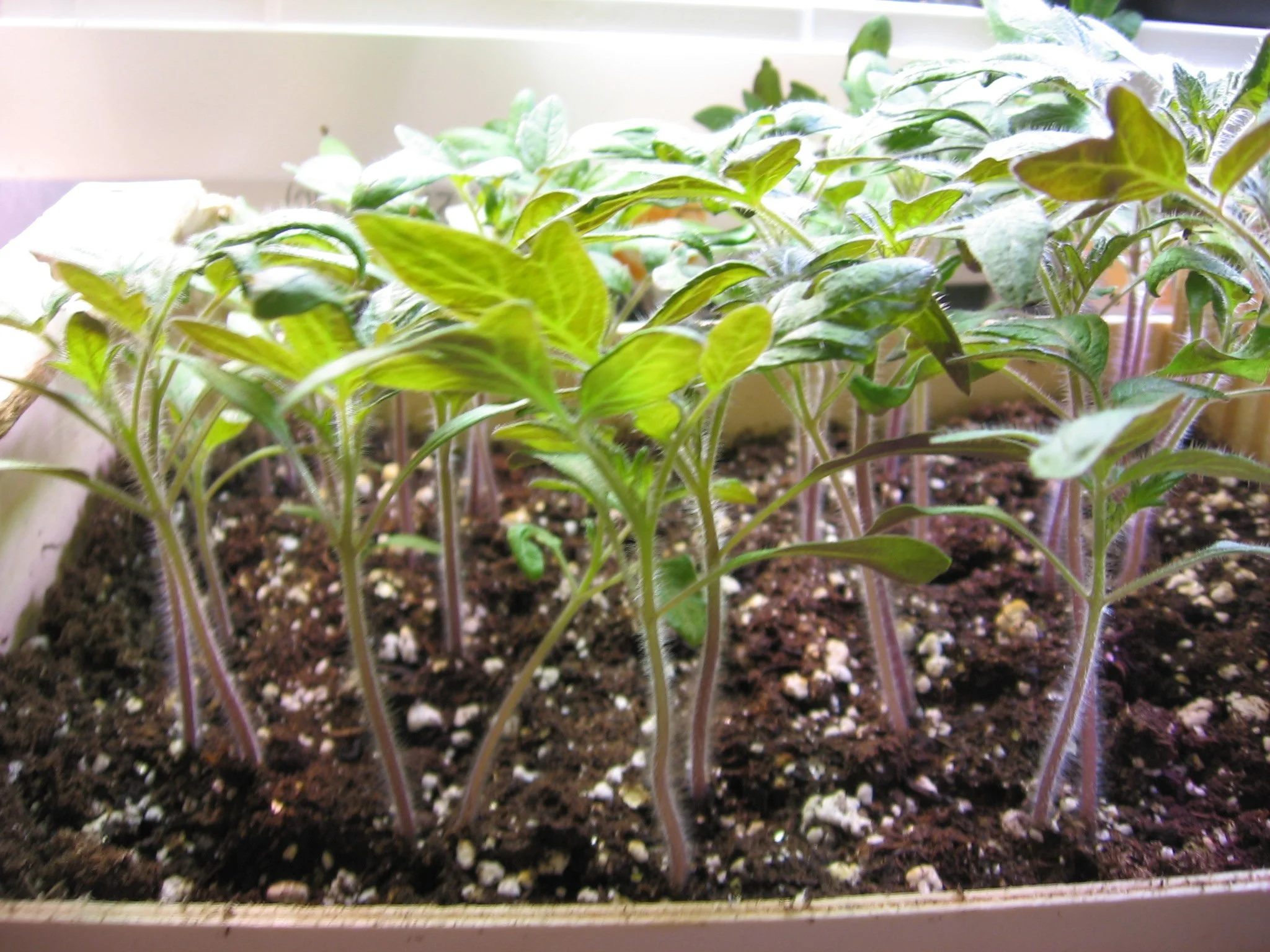
Tomato seedlings, or “transplants.” We use the word transplant as both a noun and a verb.
The word we sometimes use to refer to the little seedlings that we start indoors. Of course, it’s also the act of replanting—transplanting—the little seedings. So both a noun and a verb!
Treated Seed
If you’ve ever seen a pink pea or bean seed, it’s been treated with a fungicide. That treatment is done to prevent rot in cold, wet soil. If you don’t want seed that’s treated, look for “untreated” seed.
Untreated Seed
Seed that has not been treated.
Crop-Specific Lingo
Beans

Pin this post!
Bush bean plants are shorter, and tend to have an earlier and briefer period of harvest. Depending on the variety, they might or might not need support.
Pole and runner beans get quite tall, and will need support. The harvest is later, and the harvest period is longer.
Peas
Vining pea varieties, like runner and pole beans, get quite tall and have a longer harvest window.
Squash
Bush squash are compact (at least for a squash plant!).
Vining (running) squash have long stems that spread far and wide.
Tomato
Determinate (bush, patio) tomato plants get to a certain size and then stop growing. They are relatively compact, and flower and fruit in a shorter time. Even thought they are compact, they are not self supporting—so if you like your tomato plants off the ground, use a stake or a cage.
Indeterminate (vining) tomato plants keep growing and making fruit as long as conditions permit. They get very tall if the growing season permits. (This is the sort of tomato used in greenhouse tomato production here in Ontario: Plants are grown up twine, and as they get taller and taller, the twine is lowered and the base of the stem is coiled on the ground.)
There are also semi-determinate tomato varieties.
Dwarf tomatoes are very compact, making them a good choice for growing in planters. They often grow 60 - 120 cm tall (2-4’)
Micro-dwarf tomato plants are tiny, only 15-30 cm (6-12”) tall. Perfect for a window box. Just adjust your yield expectations accordingly with such a small plant.
Find Out about Seed Shopping in this Podcast
Find This Helpful?
Enjoy not being bombarded by annoying ads?
Appreciate the absence of junky affiliate links for products you don’t need?
It’s because we’re reader supported.
If we’ve helped in your food-gardening journey, we’re glad of support. You can high-five us below. Any amount welcome!
More on Vegetable Seeds
More on Growing Vegetables
Vegetable Gardening Articles
Vegetable Gardening Courses
Vegetable Seed Guide: When to Start Seeds Indoors
Find out when to start vegetable seeds indoors.
By Steven Biggs
When to Plant Vegetables
Not sure when to start planting seeds indoors?
If you time planting well, your seedlings will be big enough to survive transplanting into the garden.
But don’t start seeds indoors too early: Earlier planting and bigger seedlings is not always better.
That’s because a seedling that’s stuck in a pot for too long, waiting to go into the garden, gets stressed. And sometimes stressed transplants don’t bounce back, even once you plant them into the garden.
(Late in the planting season big box stores often have discounted transplants: wilted, root-bound cauliflower, cucumber, and chard that have simply run out of steam…don’t be tempted!)
If you’re wondering when to start seedlings indoors, keep reading. This guide tells you when to sow seeds—and how to know when to sow seeds.
Why Start Seedlings Indoors
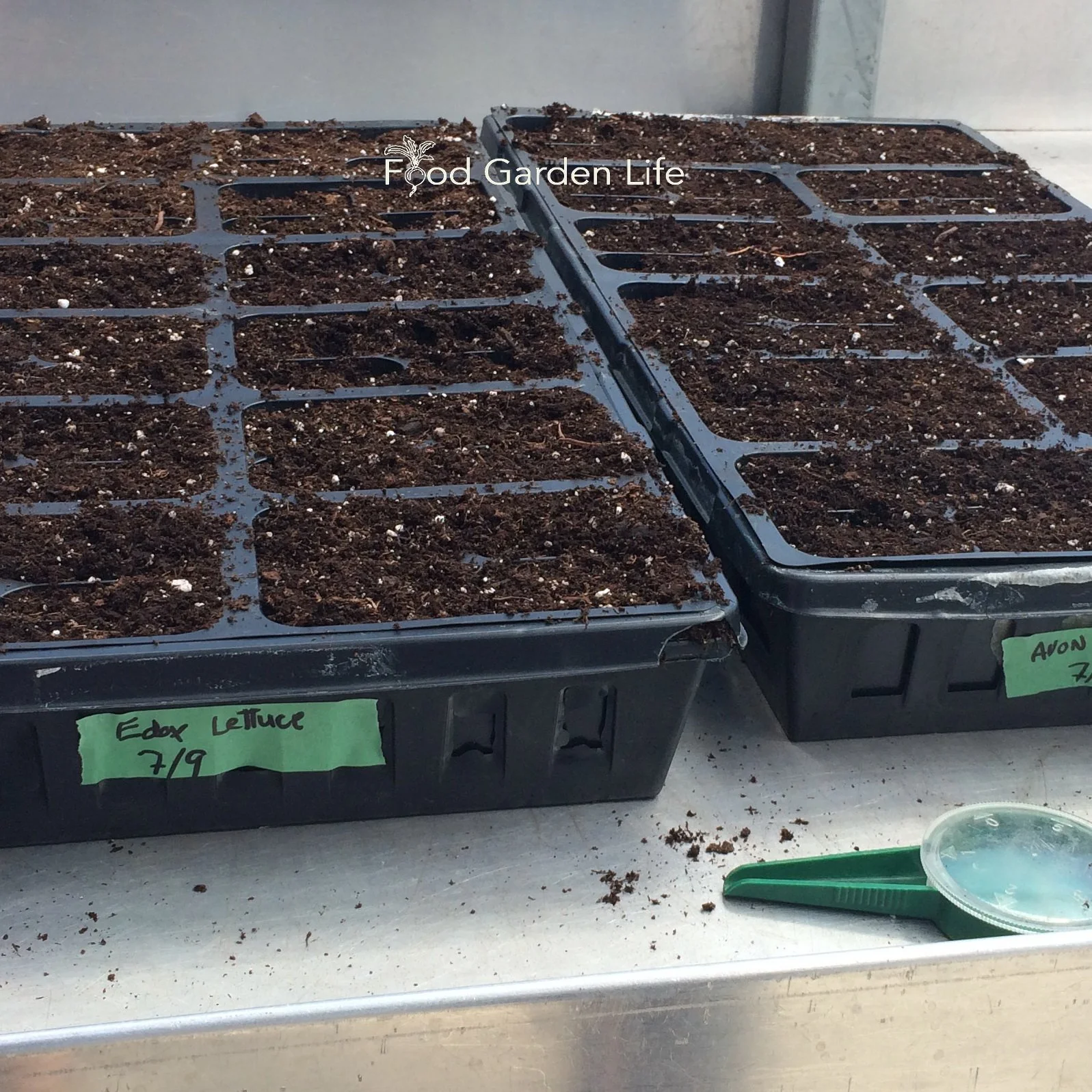
Start seedlings indoors to get a jump start on the season and to protect them from weather and pests.
There are two main reasons to start seeds indoors.
In cold climates, season length limits harvests—and starting seeds indoors give a longer window of growth for the crop.
Indoors, we can control conditions and prevent pest damage, giving small seedlings a chance to get started at a suitable temperature, without getting mown down by bugs.
When to Start Seeds Indoors
Luckily, vegetable seeds don’t all have to be planted at the same time. You can spread out seed sowing from mid winter through spring—when you start sowing some seeds directly in the garden.
The guidepost for choosing when to start planting seeds indoors is something called the average last frost date—or simply “last frost date.” This is the average date of the last spring frost in your area. (It’s an average, so some years there is a frost following this date.)
If you don’t know your average last frost date, a good place to start is by asking local gardeners, or checking with local seed vendors.
Work Backwards from the Average Last Frost Date
Pin this post!
Once you have your last frost date, you just work backwards to get the sowing date for all of your different vegetable seeds.
It’s your guidepost.
Workback: When to Plant Vegetables
Below is how many weeks before the last frost date I sow my vegetable seeds.
Keep in mind that none of this is cast in stone. You have a window of time for seed sowing. It doesn’t have to happen in one specific week.
That means that if you miss the mark with your celery seeds, and forget to sow them at 10 weeks, don’t sweat it. Sow them at 9 weeks, and your celery transplants might just be a bit smaller when you put them into the garden.
This list is a work in progress. If you have a favourite vegetable crop that’s not on here, e-mail me.
10 Weeks Before Last Spring Frost
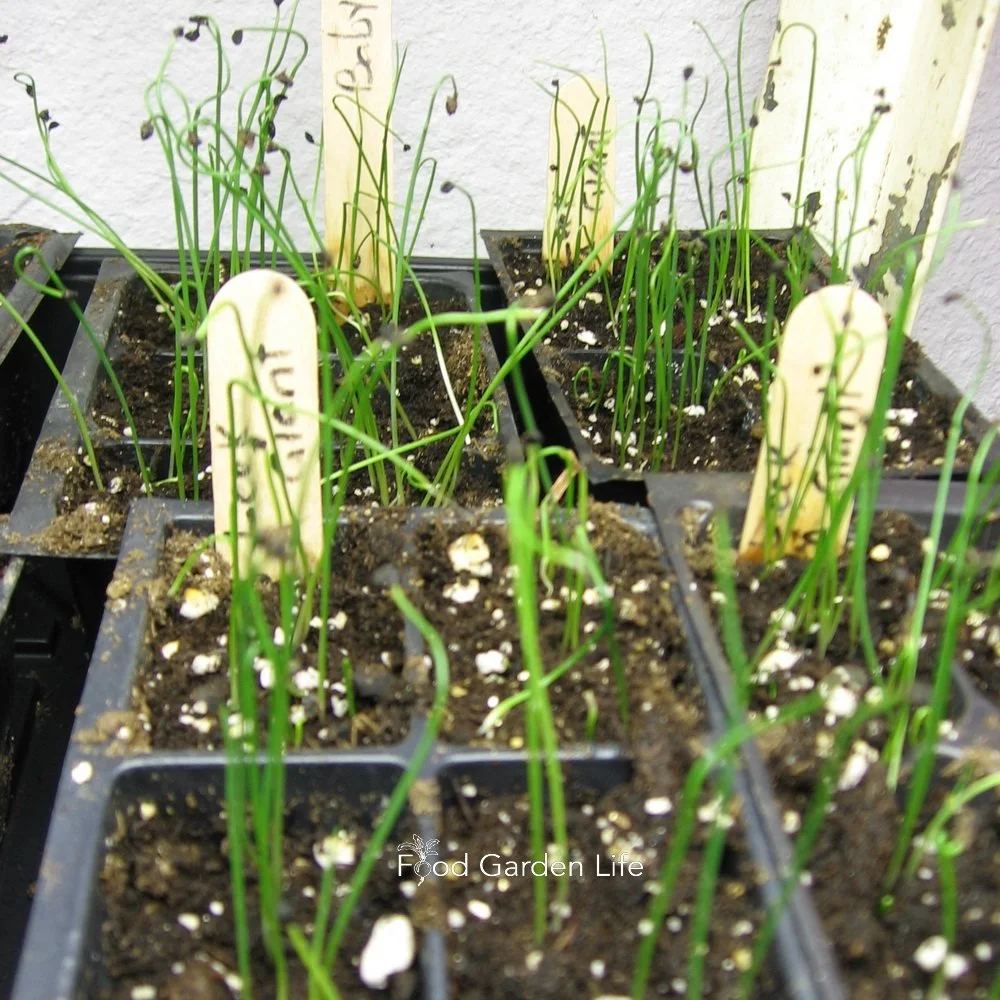
Leek seed are some of the first seeds that I plant indoors, 10 weeks before the last frost date in the spring.
Indoors
These are the first vegetable seeds that I start indoors, under lights.
celery, eggplant, leek, onion, pepper, parsley
8 Weeks Before Last Spring Frost
Indoors
tomato
Find out how to grow tomato plants from seed.
7 Weeks Before Last Spring Frost
Indoors
more tomatoes (we like our tomatoes here in the Biggs household!)
6 Weeks Before Last Spring Frost
Indoors
lettuce, cabbage family (broccoli, cauliflower, Brussels sprouts, kohlrabi, kale)
Direct-Seed in the Garden
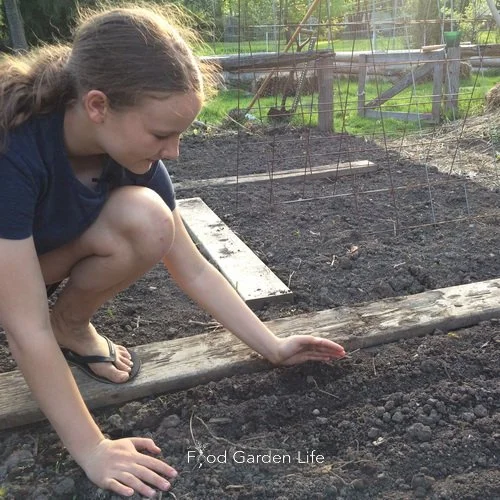
Direct-seeding carrot seeds in the garden 6 weeks before the last frost date.
This is also when I start to direct-seed some cold-tolerant vegetable crops in the garden. These include:
broad bean, carrot, pea, spinach, lettuce, turnip, dill, parsley
Plant or Transplant in the Garden
plant onion sets (small, pre-grown onion bulbs), and transplant onion seedlings
4 Weeks Before Last Spring Frost
Indoors
melon, basil, cucumber, squash, pumpkin
Direct-Seed in the Garden
radish, beet, chard, more lettuce
Plant or Transplant in the Garden
cabbage family seedlings
seed potatoes
2 Weeks Before Last Spring Frost
Direct-Seed in the Garden
corn, cheater beans*
*With beans, we usually wait until the soil is warm and there’s no further risk of frost. That’s because bean seeds can rot in cold, wet soil—and if young bean plants get hit by frost, they’ll die. But some years are warmer than others, and if it seems warm, I like to cheat and get in an early row of “cheater beans.” If they do well, I get beans sooner. (If they get nipped by frost, no big loss; I’ll just replant.)
Plant or Transplant in the Garden
lettuce
gladiolus bulbs (I know…they’re not a veggie, but I like to grow this cut flower in my veggie garden, reminds me of Grandma Q)
The Week of the Last Spring Frost
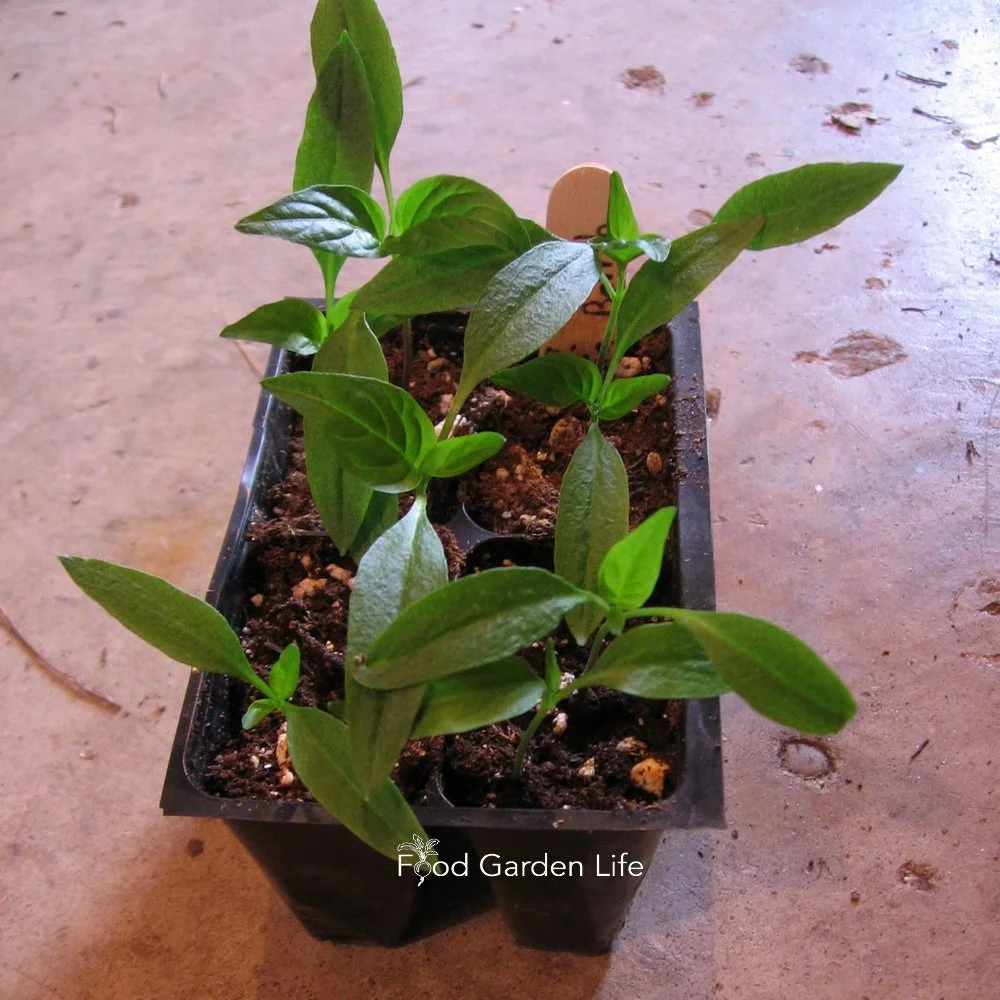
Wait until 1-2 weeks after the last frost date before transplanting pepper seedlings into the garden. They HATE the cold!
Direct-Seed in the Garden
beans, cauliflower, cucumber, squash
Transplant in the Garden
tomato (some people plant tomatoes a week or two after the last frost date…I’m impatient, so I plant them, but protect them as needed)
1-2 Weeks Following the Last Spring Frost
Direct-Seed in the Garden
Now it’s time to direct seed the cold-hating crops!
lima bean, edamame, melon, basil
Plant or Transplant in the Garden
Make sure the temperature will be over 10°C at night
celery, melon, pepper, eggplant
sweet potato slips
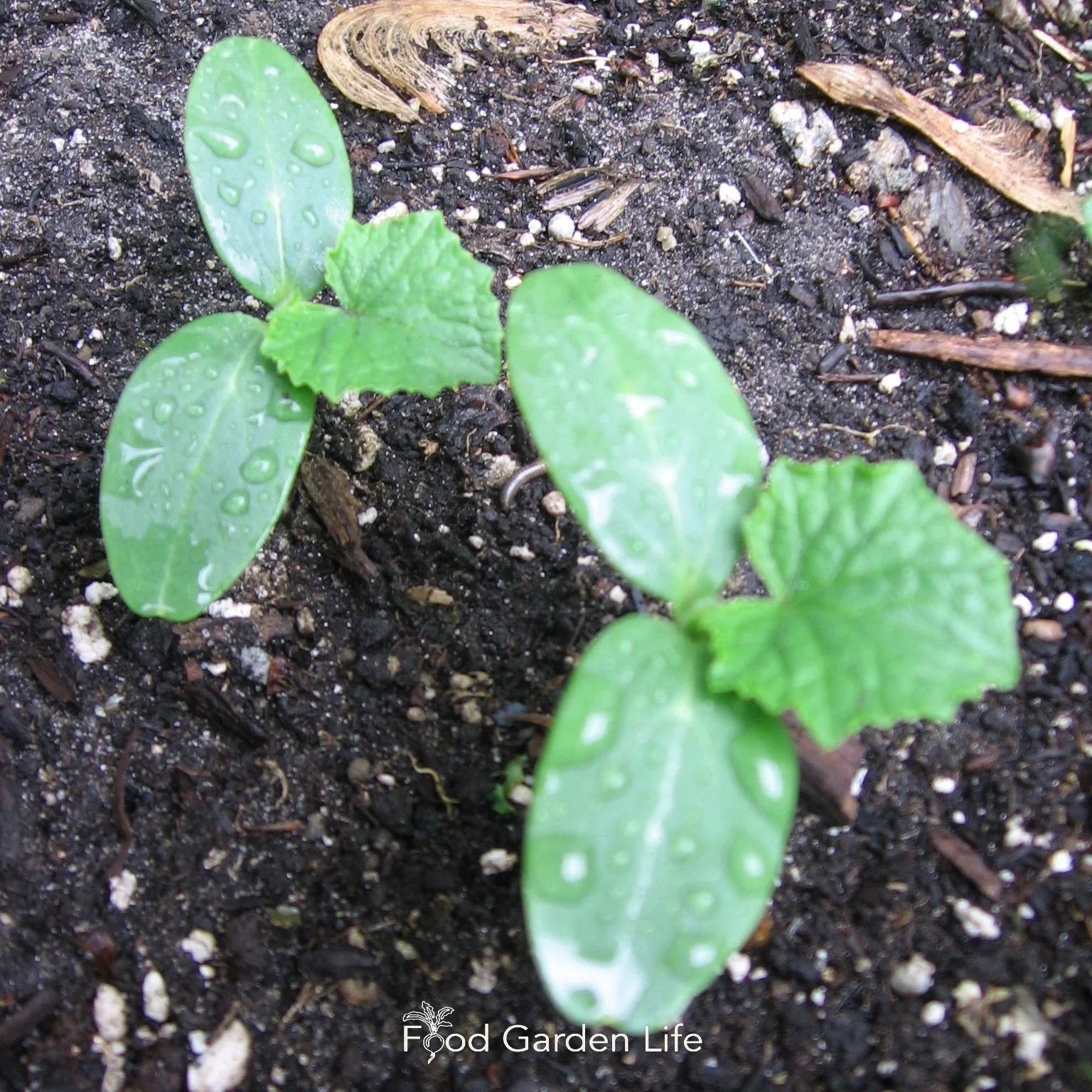
There are some crops that I start indoors, and also sow directly in the garden later. These cucumbers are sown directly in the garden.
You might notice that some crops, such as melon and basil, are in my list above twice: seeded indoors, and then directly sown outdoors. That’s because you can do it both ways, and having the same crop in two stages of development can give you a longer harvest window.
Make Successive Plantings
Don’t forget that after the initial planting of many of these crops, you can make successive plantings so that you have an ongoing harvest. That means after your first sowing of beet seeds, make more, at two-week intervals. Same with carrots, and leafy greens.
How to Stay Organized
If you’ve looked at my planting dates above, you might be wondering if there’s a simple way to stay organized.
There is!
I sort my seed packets by starting date. I’m a visual person—so no spreadsheets for me!
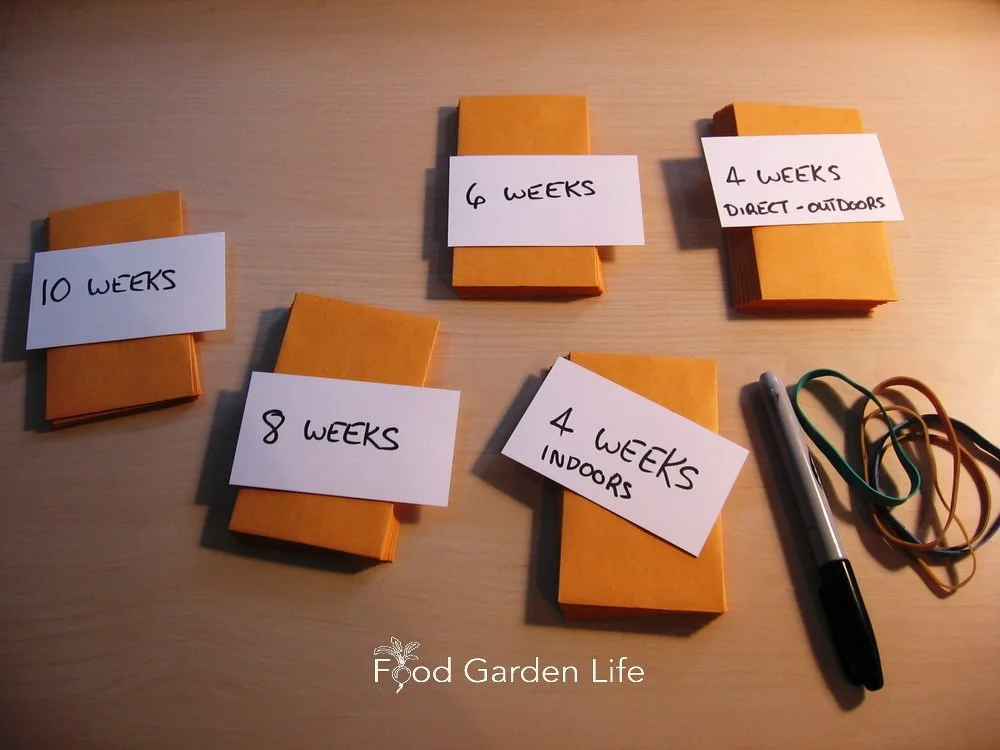
Seed packets organized by planting date, so that I don’t forget to plant anything!
I simply make stacks of seed packets, organized by when they should be planted. Then, I mark my calendar for the various seed-starting dates—flagging 10 weeks, 8 weeks, 6 weeks, etc.
When the given week rolls around, I grab the seed packets for that week.
More on Vegetable Seeds
Find This Helpful?
Enjoy not being bombarded by annoying ads?
Appreciate the absence of junky affiliate links for products you don’t need?
It’s because we’re reader supported.
If we’ve helped in your food-gardening journey, we’re glad of support. You can high-five us below. Any amount welcome!
More on Growing Vegetables
Vegetable Gardening Articles
Vegetable Gardening Courses
Planning a Kitchen Garden that Awes (in Purple!)
Make a kitchen garden with a mix of your favourite crops.
By Steven Biggs
Grazing the Kitchen Garden
How to make a kitchen garden you love.
My family doesn’t think it’s unusual to hear the back door open and close as I cook supper.
They see me come in with a fistful of herbs. Or a colander with vegetables, fresh fruit, and edible flowers.
I think of it as grazing: Picking what’s ready from my kitchen garden: Small portions of a wide variety of ingredients for our meal.
What’s ready in the garden inspires what I make for supper.
Along with a varied, continuous harvest, there’s something else I think about when planning a kitchen garden: Creativity. A great kitchen garden touches the senses. Taste is obvious, smell too. But there’s also touch, sound, and sight.
If you’re looking for great kitchen gardening ideas, keep reading. I have ideas for you about how to make a kitchen garden you love.
Planning a Kitchen Garden – and Having Fun Doing it
The planning stage of gardening can be intimidating. There’s crop spacing, crop timing, succession crops, crop rotation, and more…
So before I throw out ideas for you, here’s my top advice: Have fun. The compost pile takes care of things that don’t go as planned.
Next suggestion: Be playful with style and design because it’s a personal thing. A kitchen garden plan is a personal creation. (And the fun part is that every year you can create something new!)
For me, that's what home food gardening is about: good food, creativity, and a garden that fits naturally into everyday life. Here's the bigger picture of how I approach it.
What is a Kitchen Garden?
How is a kitchen garden different from a vegetable garden? It depends who you ask.
When I think of a kitchen garden I think of a mix of edible plants including herbs, vegetables, fruit, edible flowers, and flowers for cutting. That sets it apart from a traditional vegetable garden geared towards large harvests for canning, freezing, and storing.
Create Your Own Unique Edible Landscape
That fits for your yard, and your style!
Creative Kitchen Gardens
More than a Vegetable Garden
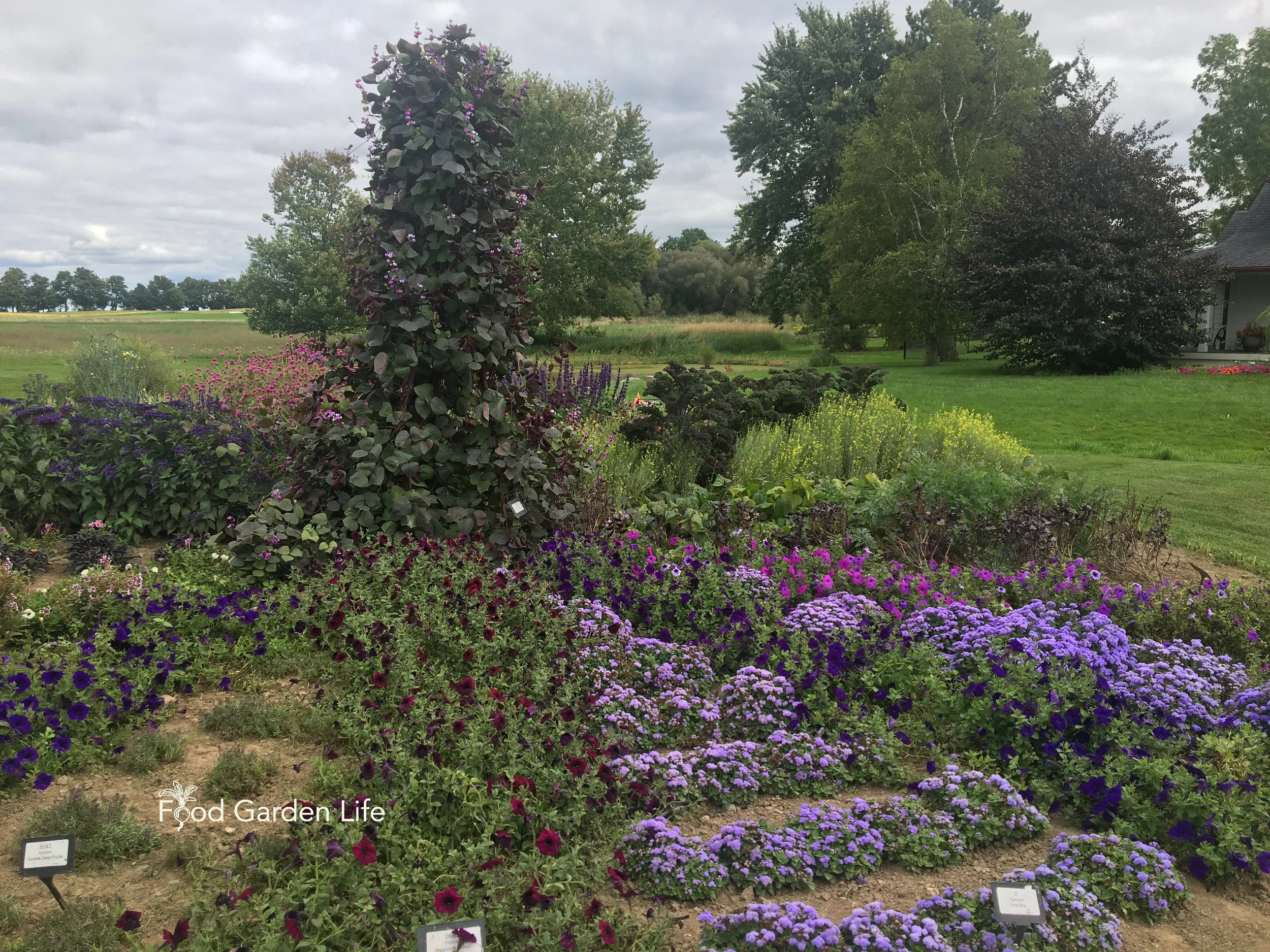
It was late fall and this kitchen garden was getting tired, but the playful design and colour theme still shone through.
However you define a kitchen garden, don’t just make it functional. Make it something that gives you a jolt of delight when you see it.
For example, this fall I took a trip to the William Dam Seeds trial garden. It was late in the season and things were past their prime. But I was still riveted by what remained of their playful purple-themed garden. It was a mix of flowers, veg, and herbs.
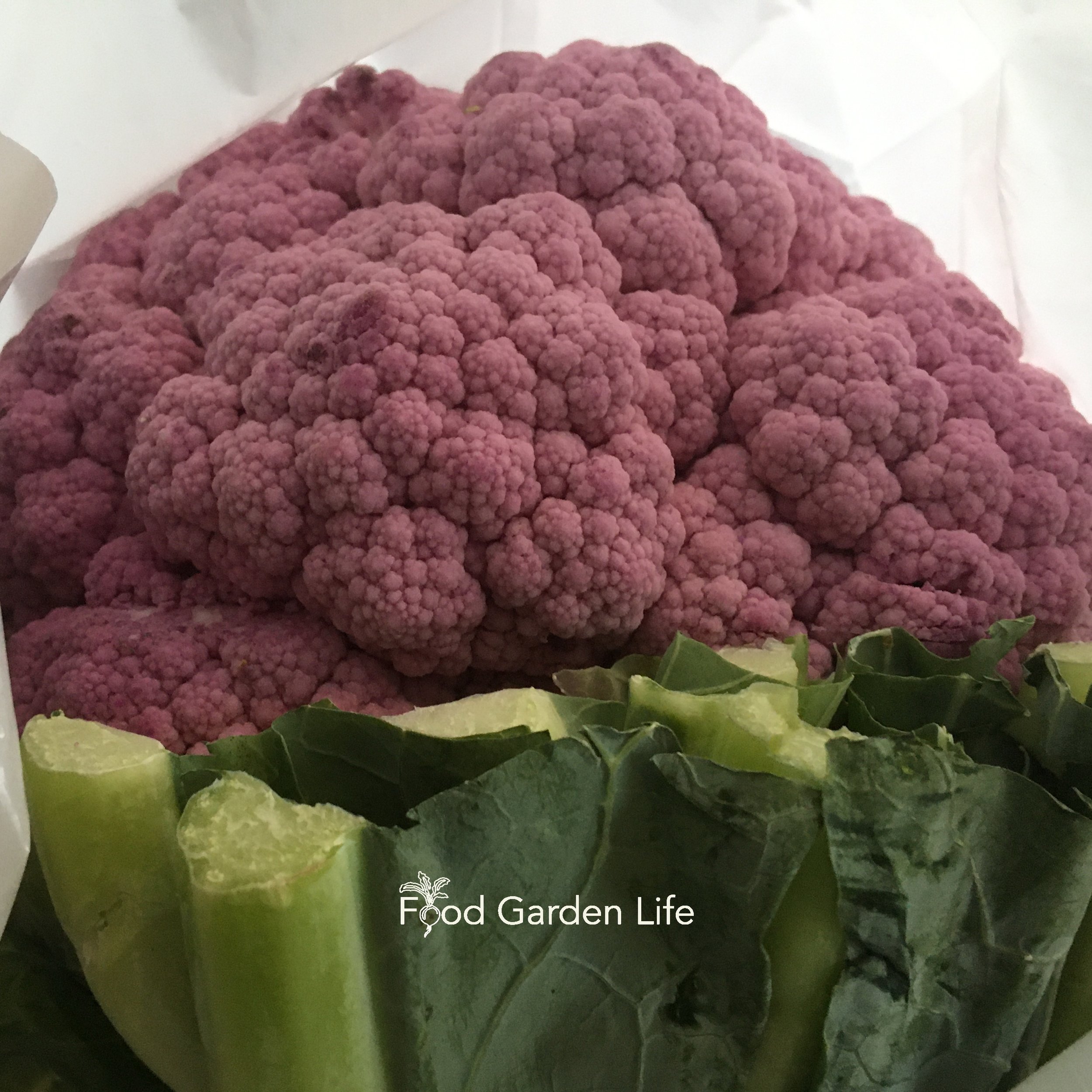
Purple kale, purple basil, purple cauliflower, purple beans…and more.
There were lots of edibles. There was also a hefty dose of flowers. And the garden gave a wallop of colour. It had height. It was fragrant. And it was a playful pinwheel design.
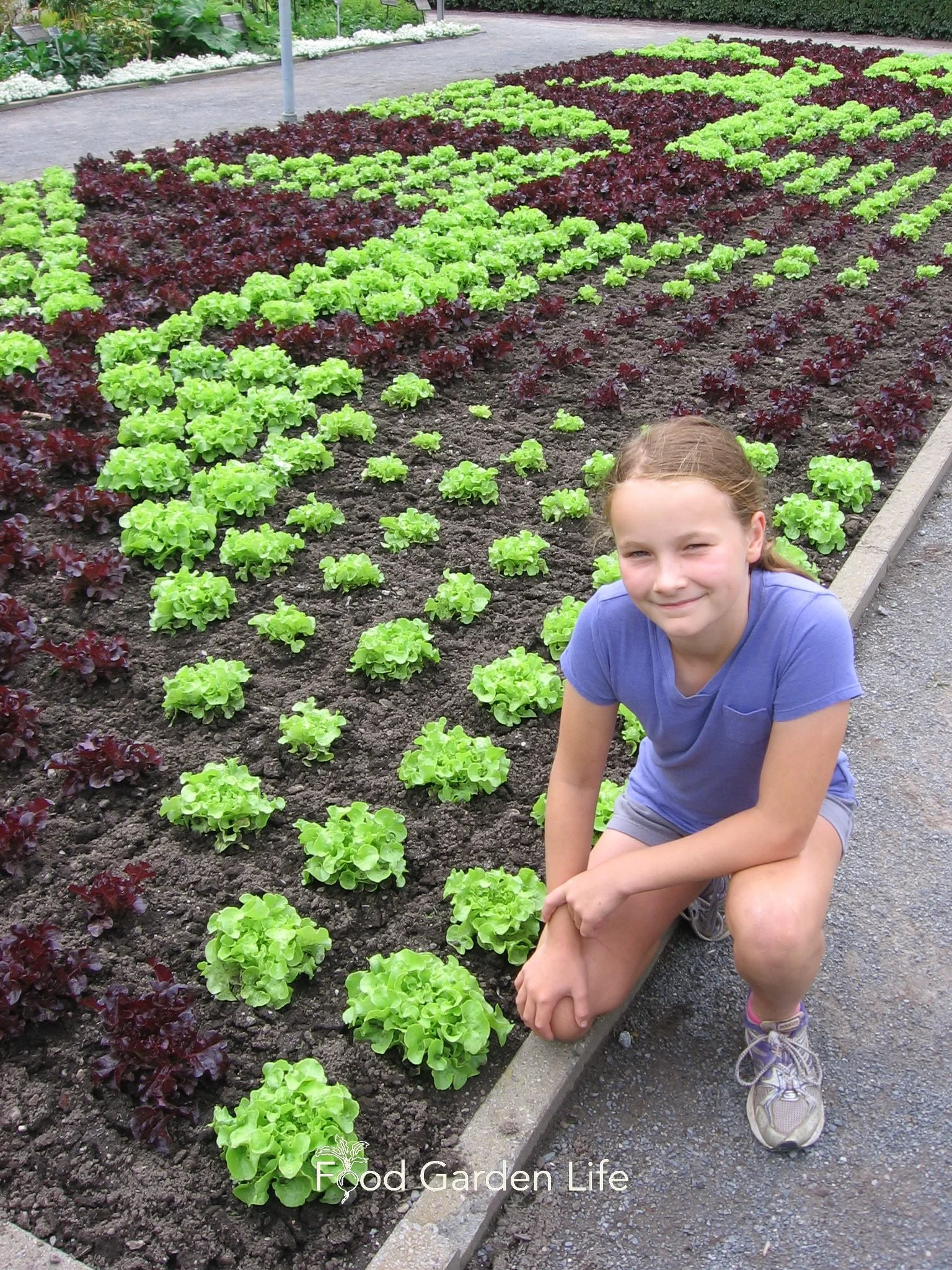
My daughter Emma and I were intrigued by the use of patterns and shapes in the Food Garden at the Montreal Botanical Gardens.
I’m not suggesting a purple-themed garden for everyone. I mention the purple-themed garden to help you think about making your kitchen garden special for you.
So think about:
Colourful crops
Texture
Shapes and patterns
Plant-themes (e.g. lots of lettuces!)
Here’s a fun idea…a dragon-themed garden for kids (seriously! See below.)
Creativity is what makes kitchen gardens shine.
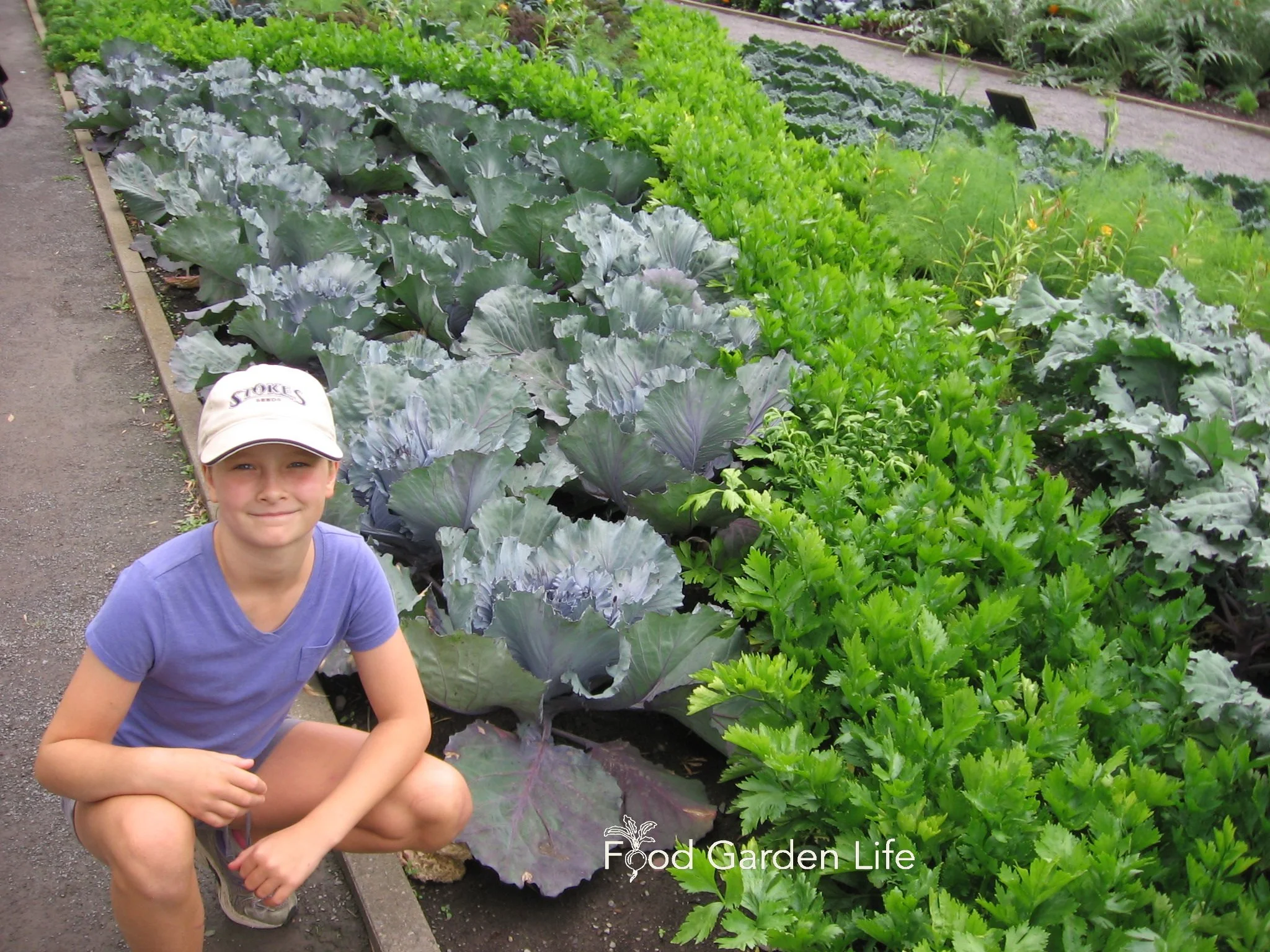
Don’t be afraid to play with texture in the kitchen garden! Here’s an X of celery between cabbage plants at the Food Garden at the Montreal Botanical Gardens.
Purple-Themed Fun
The purple trial garden reminded me of the purple-themed kids garden my daughter Emma included in her book Gardening with Emma.
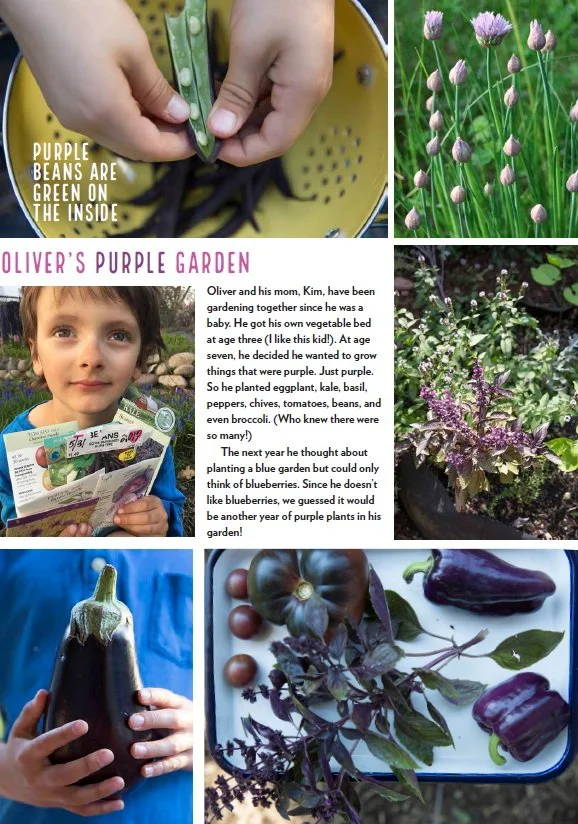
From the book Gardening with Emma.
The gardener, Oliver, was 7 years old. He told his parents he wanted a purple-themed garden.
When Emma got in touch with him for the book, Oliver was growing these purple crops:
Eggplant
Kale
Basil
Broccoli
Peppers
Chives
Tomatoes
Beans
More Colourful Edibles
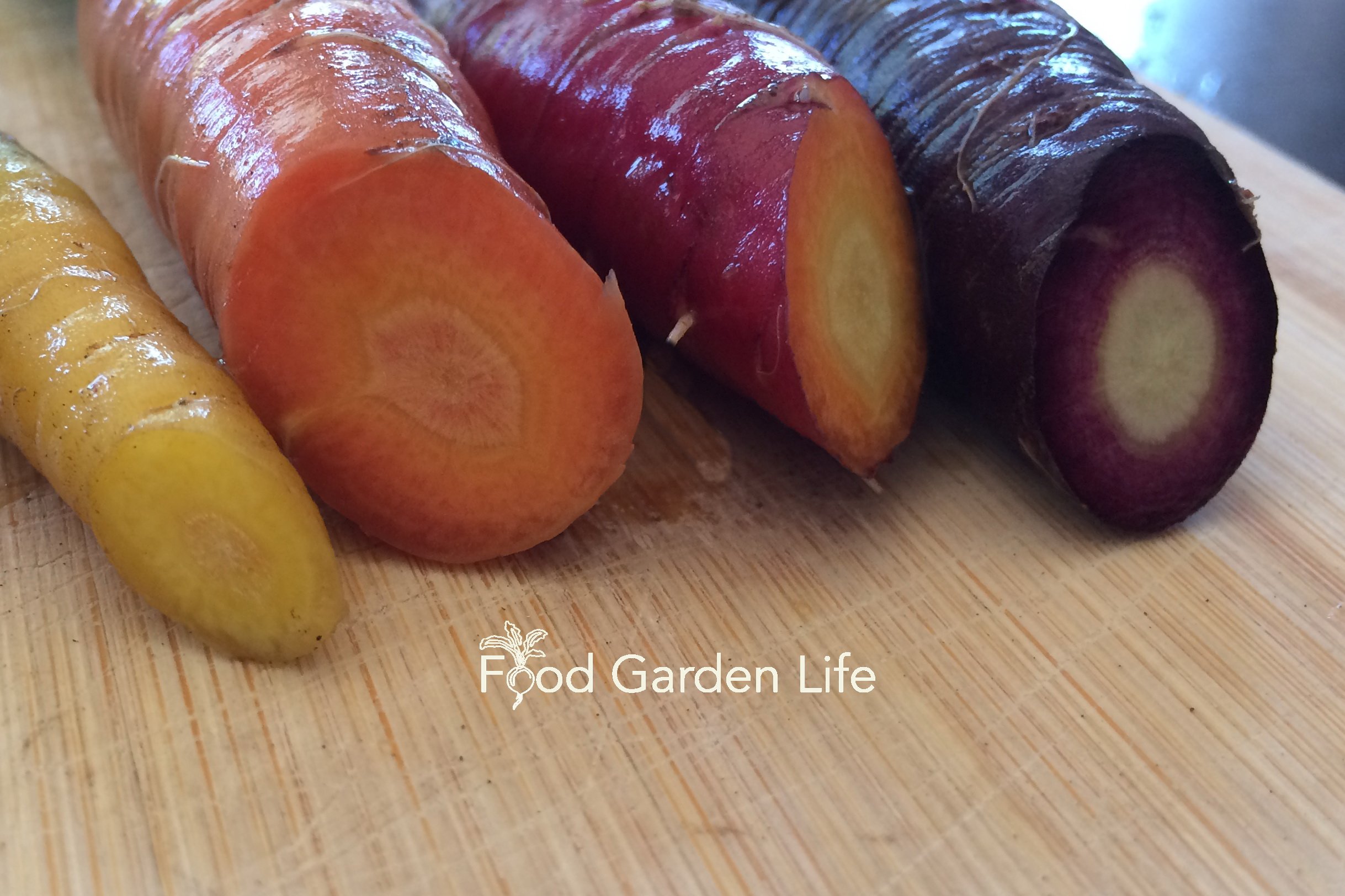
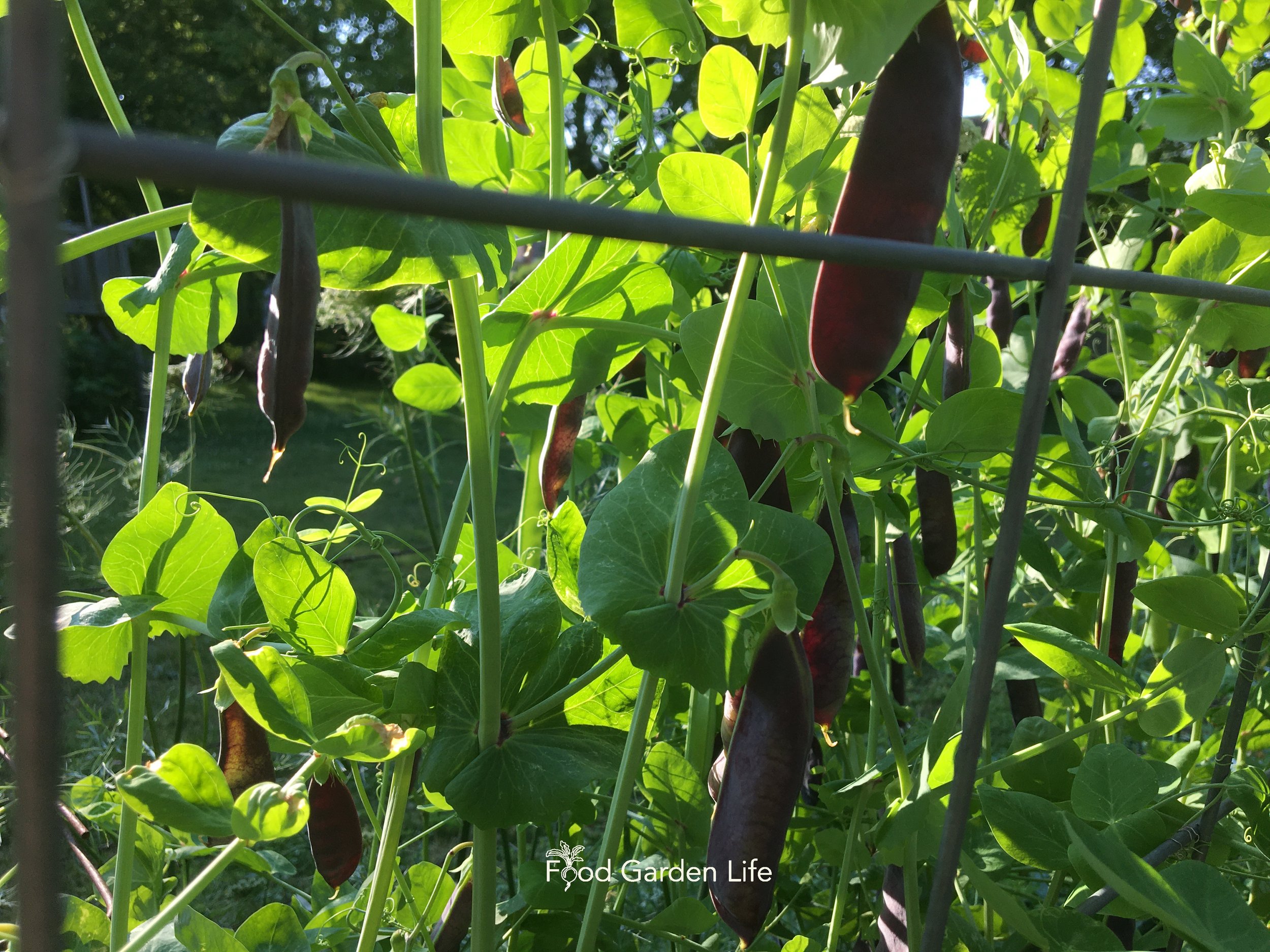
I was thinking about Oliver’s purple kitchen garden, and jotted down purple crops in my garden that we can add to his list of purple crops:
Lavender
Purple peas
Purple mustard
Purple bok choy
Bronze fennel (OK, looks purple to me!)
Purple-leafed elderberry
Purple asparagus
Purple might or might not be your jam. If it’s not, think about what delights you.
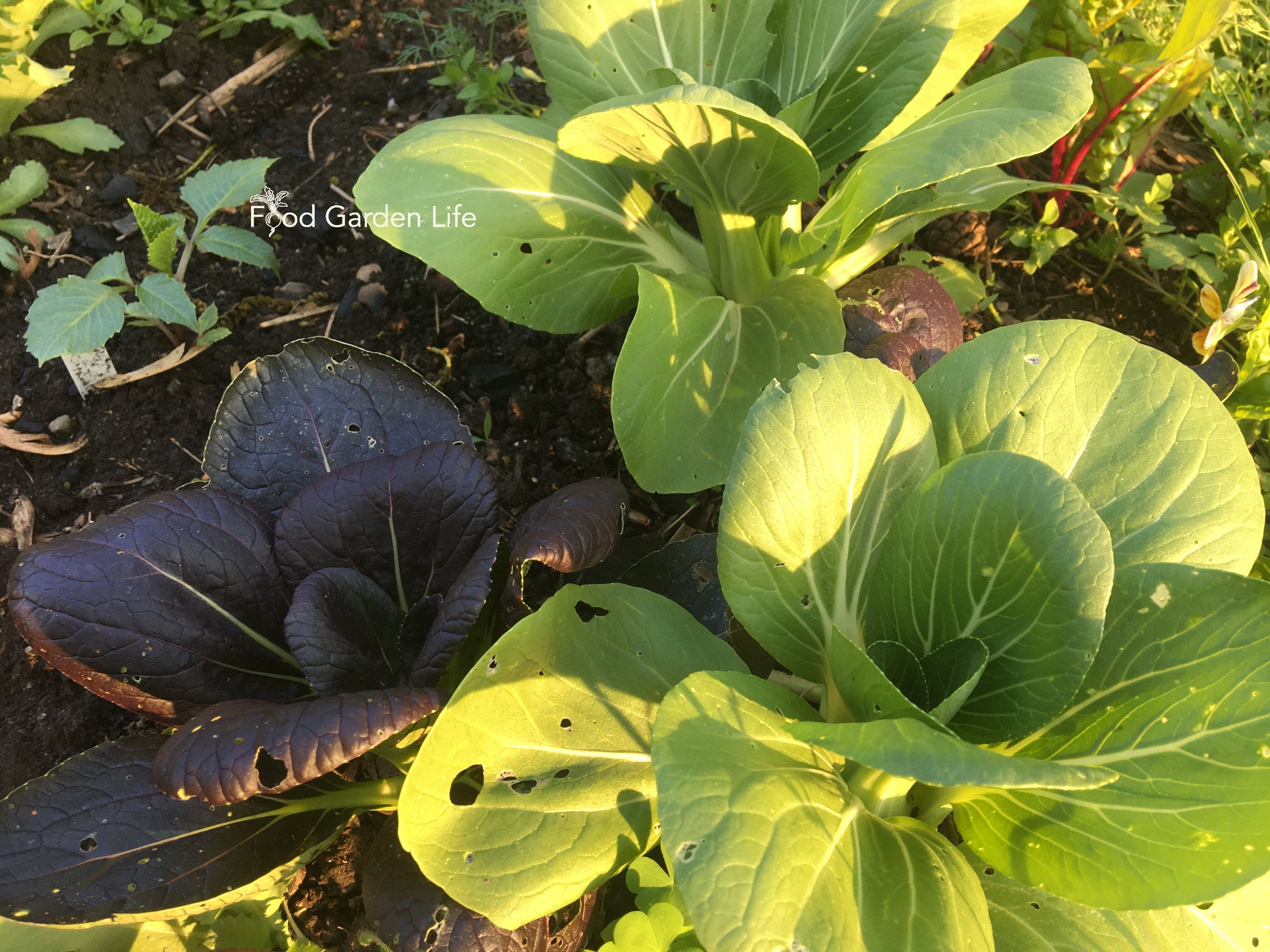
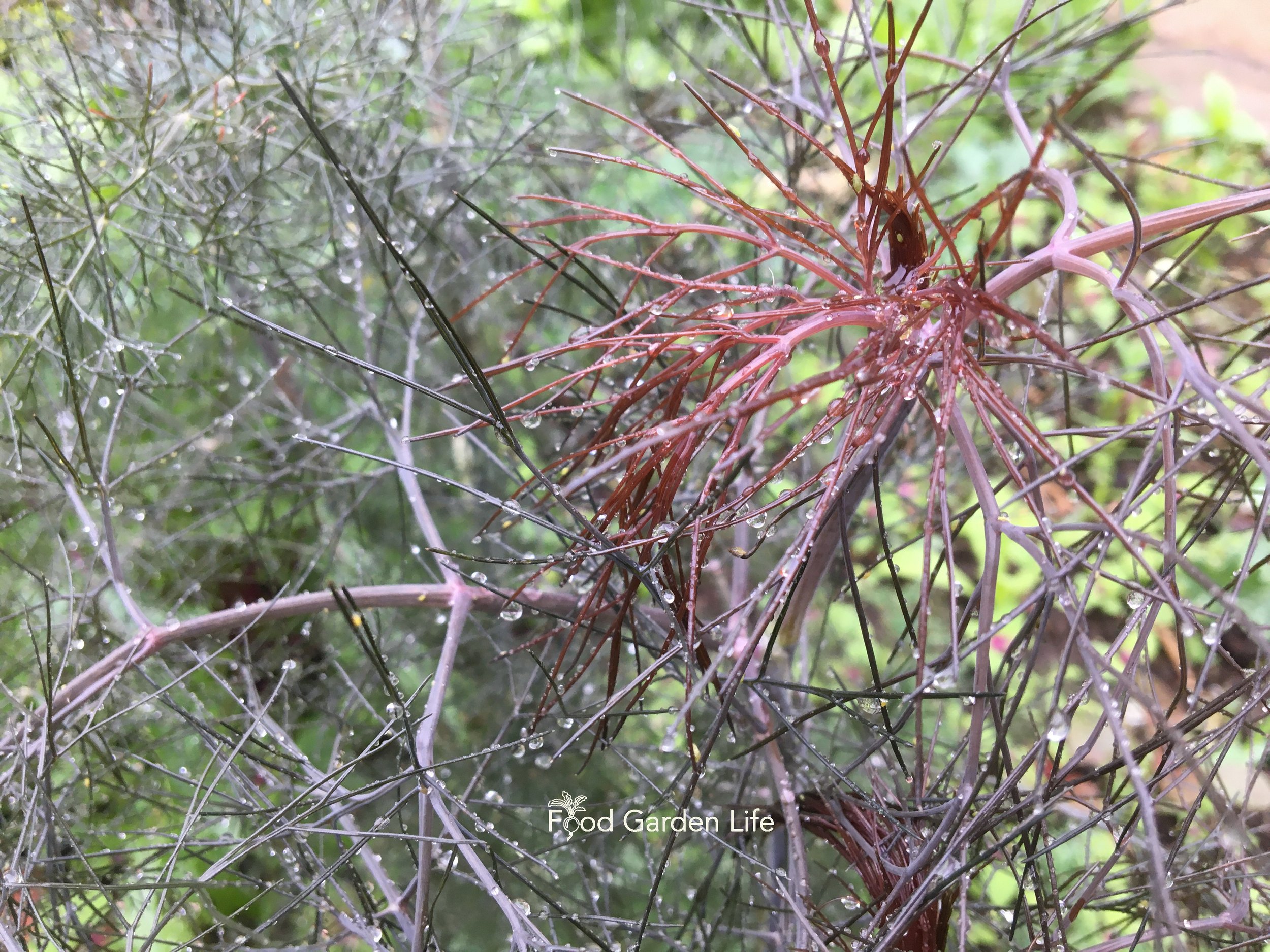
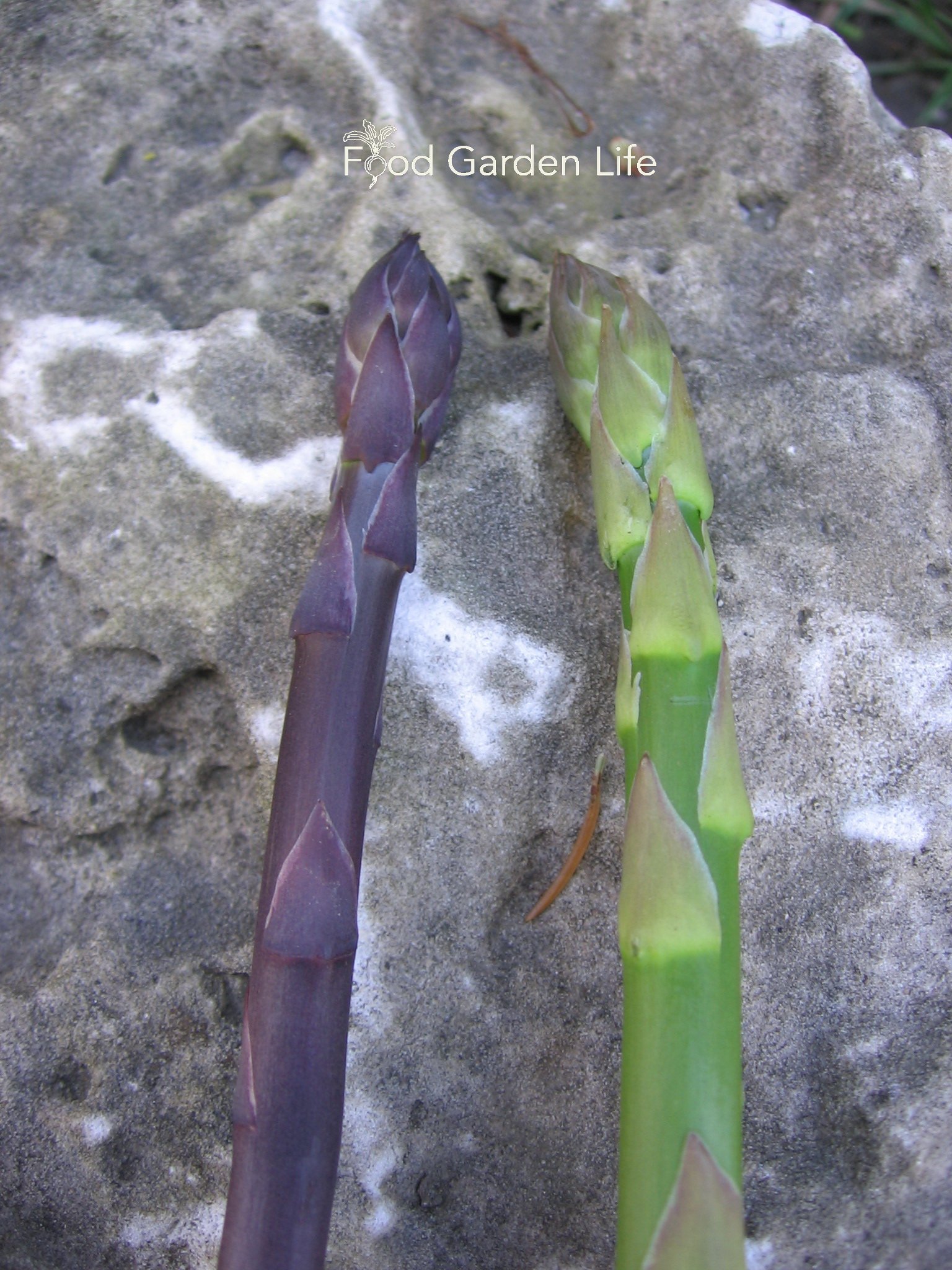
Where to Put a Kitchen Garden
Every yard is different. Every gardener is different. So there’s no one-size-fits-all answer when it comes to the best location for a kitchen garden.
But my top advice is to think about how you use your yard. Here are questions to think about:
Can it be somewhere close to the house if you want to dart outside for ingredients?
Do you want to see the kitchen garden from the house?
Where do you have growing space available?
Where in your yard are the growing conditions suited to a garden?
Kitchen Garden Plants
My own kitchen garden has annual vegetables, perennial vegetables, herbs, edible flowers, cut flowers, and fruit trees.
I’m a big believer in weaving flowers into a garden. They looks nice. They attracts pollinators. And they attract beneficial insects (small parasites and predators that help to keep pest populations in check.)
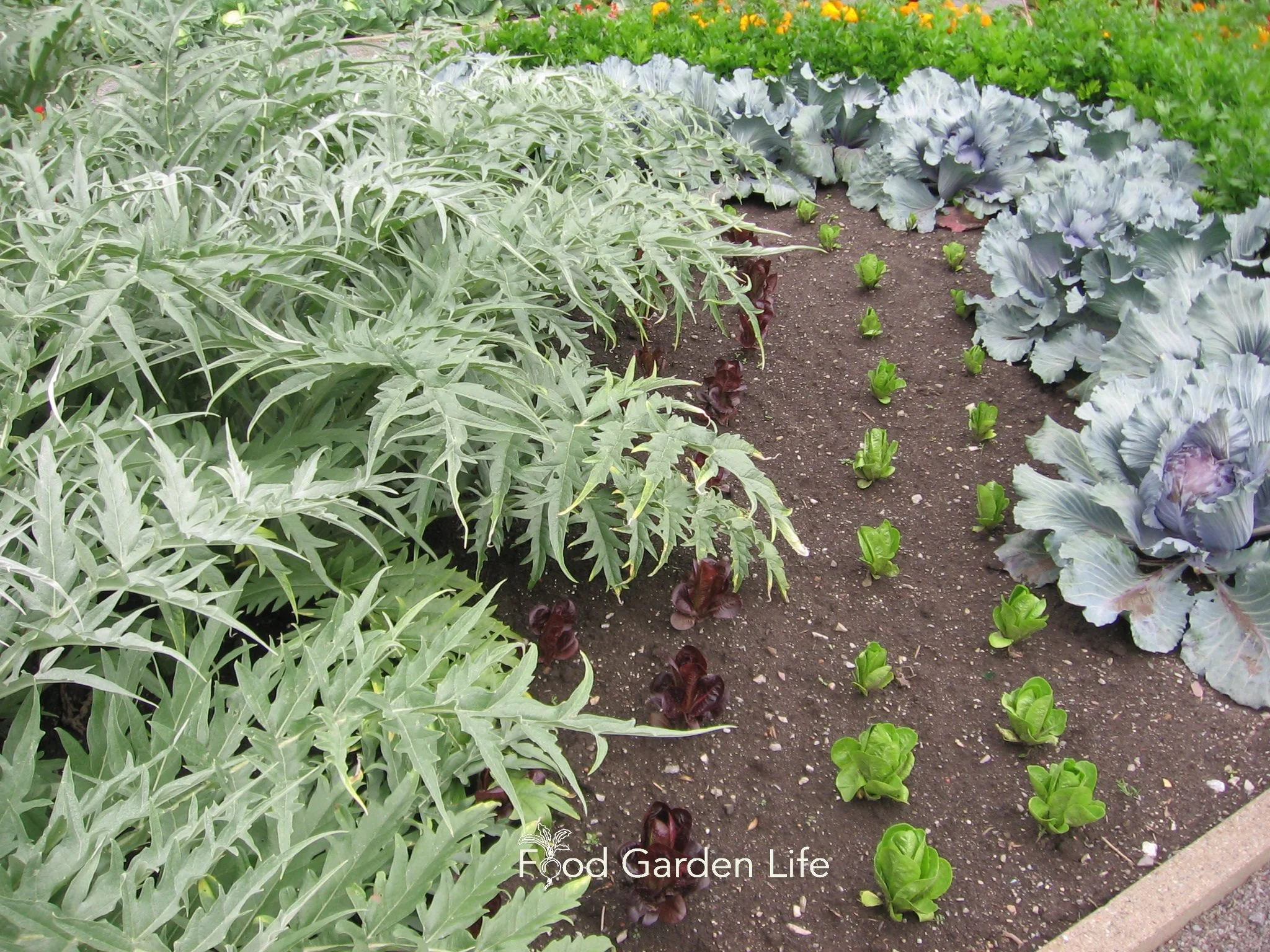
A summer succession crop of lettuce between established cabbage and artichoke crops.
Some crops (e.g. lettuce) don’t last the whole season. As you choose crops, take these short-lived crops into account and plan for succession crops to follow them. (Here’s a guide to succession crops.)
Most importantly, grow things you like to eat. Then add in a few new crops to broaden your palate.
Interested in edible perennials? Check out these edible perennials.
Growing vegetable crops in containers? Here are my favourite container vegetable crops.
Kitchen Garden Layout
How to Start a Kitchen Garden
Layout is a personal thing. I geek out at the mention of traditional French potager gardens.
My kitchen garden doesn’t look quite like a potager—but I took inspiration from that style as I added brick walkways, terracotta pots, and a mix of edibles and flowers for cutting.
Your kitchen garden layout might include raised beds, a cold frame, and large containers. It's up to you.
What is a Potager Garden?
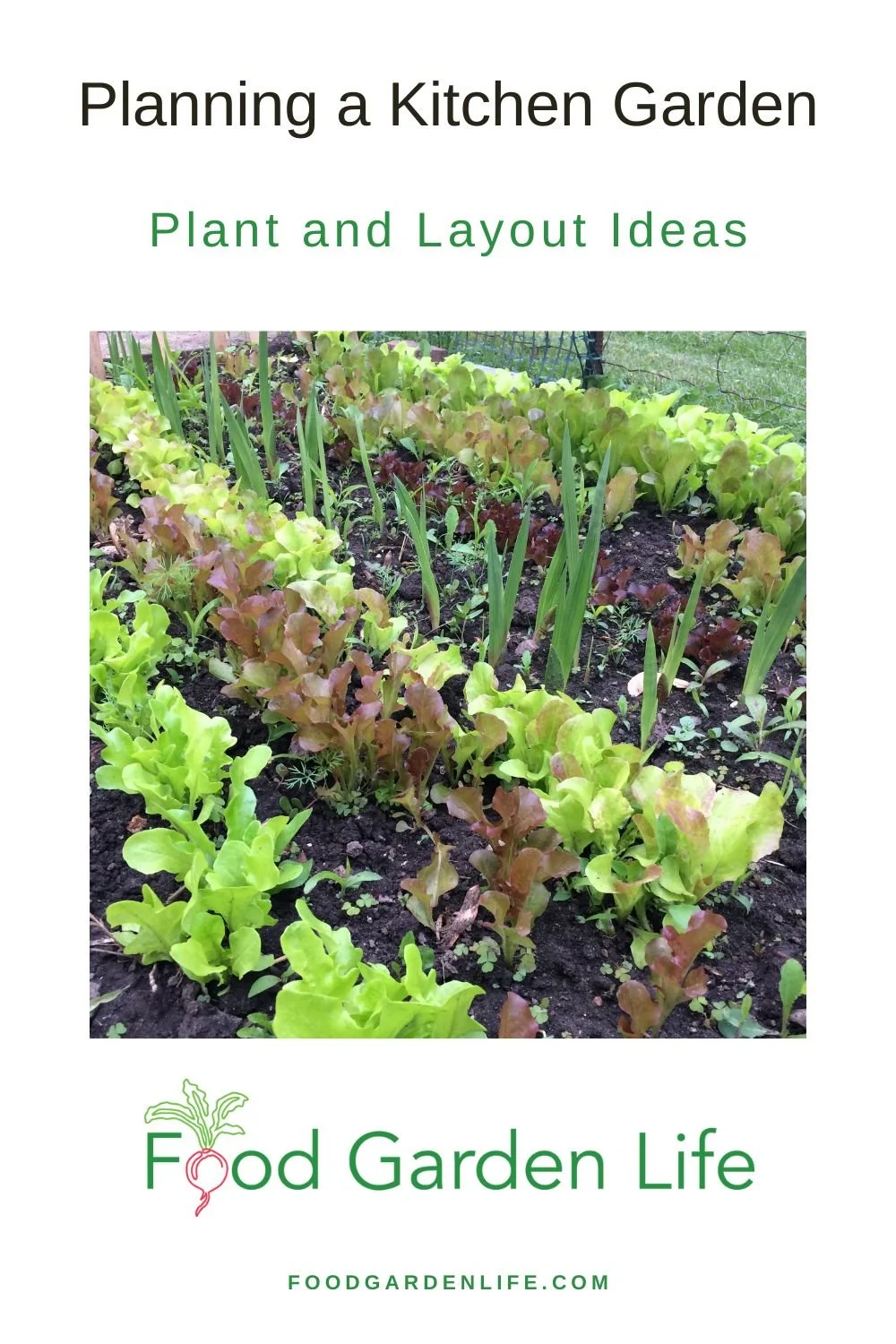
Pin this post!
Think of it as a traditional French kitchen garden. Potager gardens blend colourful flowers, salad greens, fresh fruits, and herbs. There's often symmetry. There's often a focal point.
Oklahoma garden designer Linda Vater loves to create elegant edible gardens. Her work is inspired by the tradition of the potager garden. Get Linda’s tips for making an elegant edible garden.
I love this: Landscape architect Jennifer Bartley says, “The potager is more than a kitchen garden; it is a philosophy of living that is dependent on the seasons and the immediacy of the garden.” Get Jennifer’s tips for designing a kitchen garden.
Spacing in a Kitchen Garden
Experiment with Spacing
Recommendations on seed packets are often geared towards field-scale production, and towards fully mature crops. If you’re planning to harvest baby lettuce, it needs less space than a large, mature head of lettuce.
Another way to look at spacing is through the lens of rows versus blocks. I talk about rows and blocks in this article with 7 garden layout ideas.
Top Kitchen Garden Tip
Be wildly creative.
More Fun Theme Gardens
Fun Kitchen Garden Ideas for Kids (and Adults too!)
In Gardening with Emma, my daughter has a rainbow spread of veggies. Perhaps a rainbow planting in your kitchen garden?
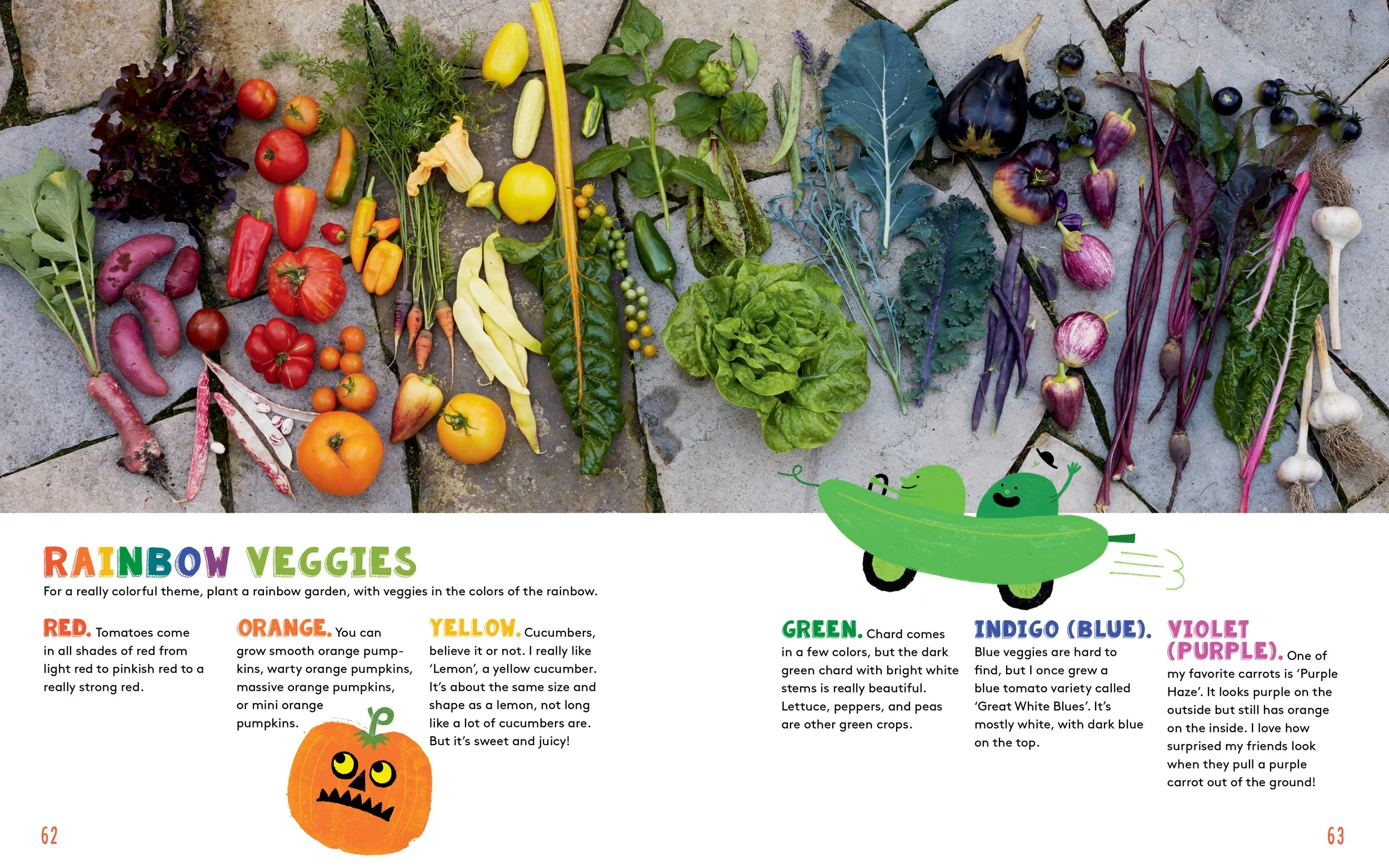
From the book Gardening with Emma.
How About a Dragon-Themed Garden?
Emma and I gave a talk about kids gardening once and the next day a parent emailed to say that her son came home inspired to grow a dragon-themed garden!
Any kids you want to inspire to garden? Get ideas for dragon-themed plants.
Find This Helpful?
Enjoy not being bombarded by annoying ads?
Appreciate the absence of junky affiliate links for products you don’t need?
It’s because we’re reader supported.
If we’ve helped in your food-gardening journey, we’re glad of support. You can high-five us below. Any amount welcome!
More Kitchen Gardening Ideas
Articles and Interviews
For more posts about how to grow vegetables and kitchen garden design, head over to the vegetable gardening home page.
Courses: Edible Gardening
Want more ideas to make a great kitchen garden? We have great online classes that you can work through at your own pace.
Kitchen Garden Consultation
Book a virtual consultation so we can talk about your situation, your challenges, and your opportunities and come up with ideas for your kitchen garden.
We can dig into techniques, suitable plants, and how to pick projects that fit your available time.
Harvest from Your Hedge! Get These Edible Hedge Ideas
By Steven Biggs
Edible Hedge to Food-Forest Hedge
Find out how to grow an edible hedge.
Need more space in your garden? I’m always looking for ways to squeeze more food plants into my edible landscape. My “foodscape.”
I recently dotted my rows of currant and gooseberry bushes with plum trees. At the base of the rows are strawberry plants and mint. My edible hedge of currant and gooseberry bushes is becoming a “food forest hedge.”
The currants tolerate shade—so as the plum trees get bigger and shade them, the two can co-exist. The strawberry plants need some sun, and along the south-facing edge they get it. And the rapacious mint (which I never normally plant in the ground because it’s so aggressive) fills in shadier nooks.
If your challenge is space—if you have a list of fruit trees and bushes you want to grow, but can’t see how they’ll fit into your yard—an edible hedge might be the answer.
Keep reading because this article will give you ideas for creating an edible hedge suited to your space.
My Edible Hedge Inspiration was a Hedgerow
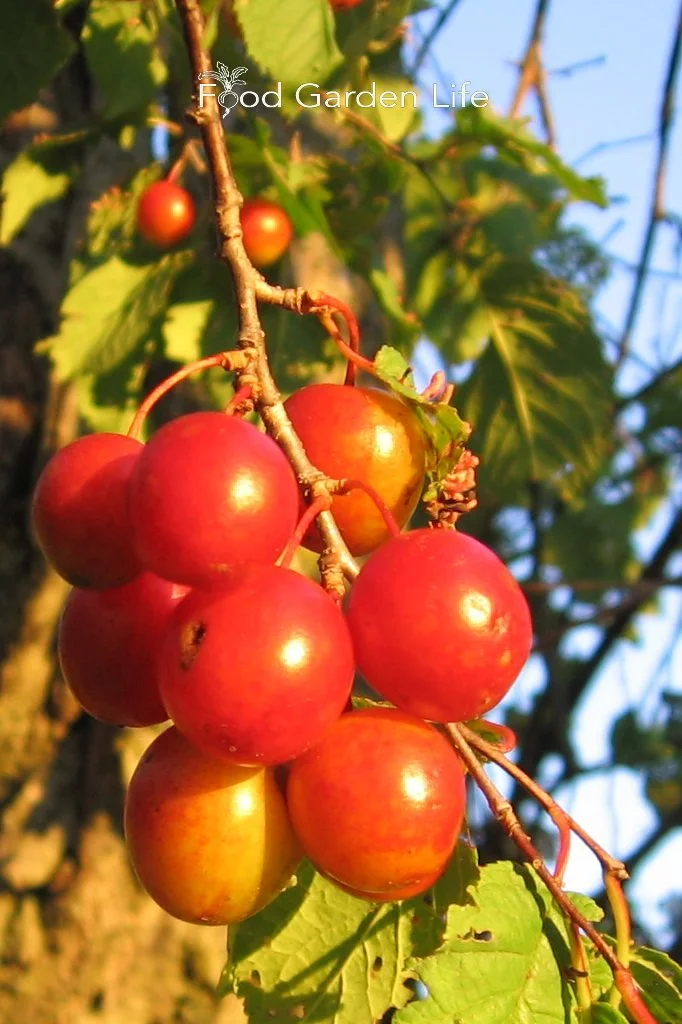
Wild plums growing in a hedgerow at my friend’s farm got me excited about the idea of an edible hedge and food-forest hedges.
When I was walking the edge of a field at my friend Anton’s farm one day, I came to a spot where the hedgerow was painted red by a heavy crop of fruit. Wild plums. I stood there grazing plums—and when I was full I went back to the farmhouse to get Anton.
We picked a bushel of plums and barely scratched the surface. They made excellent plum pie and plum jam.
I remember thinking that if fruit grows so prolifically on its own, the manicured approach of an orchard might not always be the best approach for a busy home gardener.
That experience also made me think of when I lived in the UK, in a rural area where small fields were separated by hedgerows. From those wild hedgerows I picked plums, blackberries, and raspberries.
(And come to think of it, my neighbour gave me a pheasant that he hunted from the hedgerows too! I made roast pheasant with a mulberry-Cointreau sauce.)
What is an Edible Hedge?
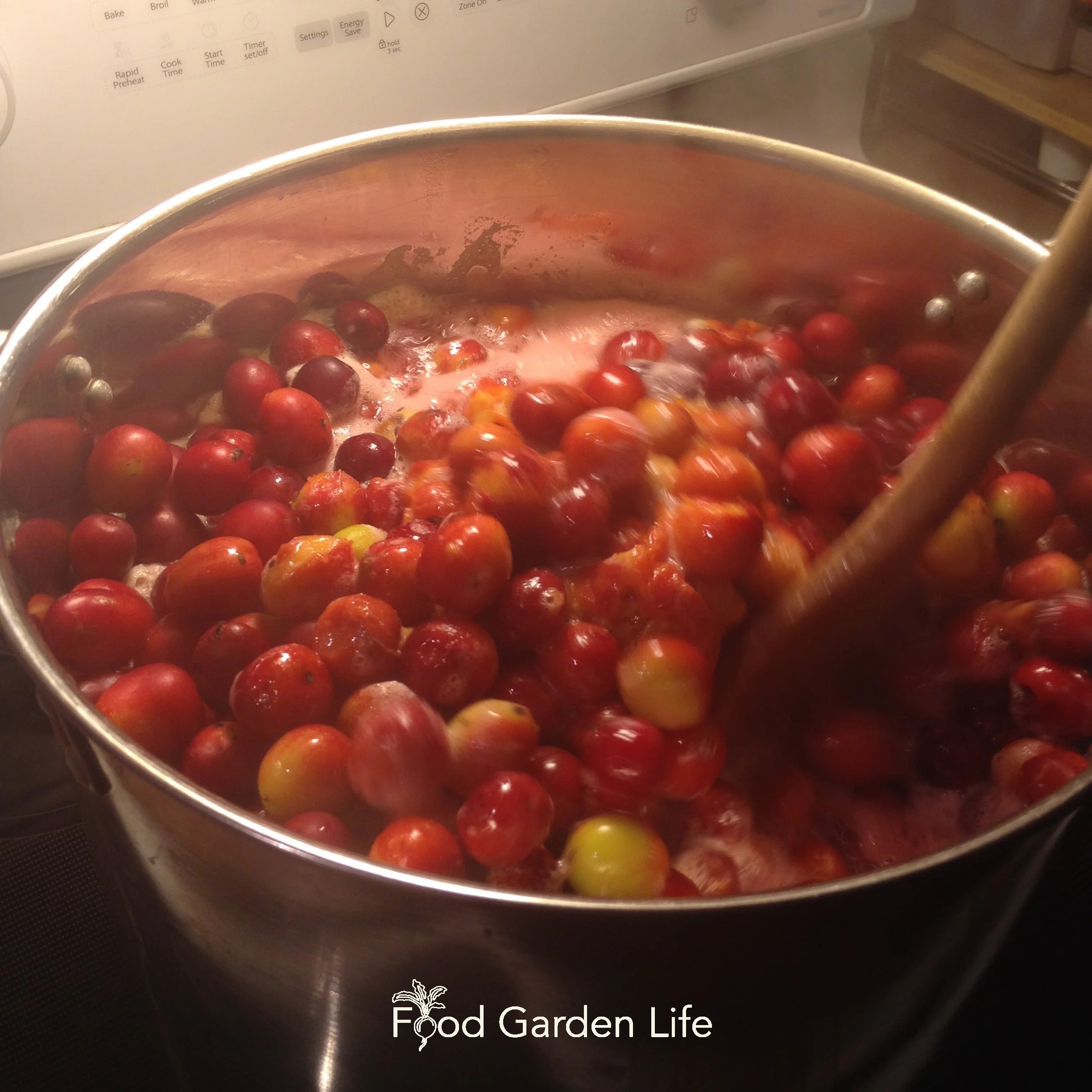
Cooking wild plums from the hedgerow.
Whenever I see a perfectly clipped cedar hedge boxing in a yard, I wonder what it would look like to instead have a perimeter of edible plants. An edible hedge.
An edible hedge is just a row of food-producing trees, shrubs, and herbaceous plants:
It can be a row of a single type of plant, like my former currant hedge – or it can be a mixed and layered planting, sometimes called a “food-forest hedge”
It can be manicured – or it can look more natural, like that plum-laden hedgerow
The plants in your edible hedge can have different edible parts:
Fruit (e.g. plum, blueberry, elderberry)
Nuts (e.g. hazelnut)
Flowers (e.g. rose, elderberry, redbud)
Leaves (e.g. grape leaves)
What is a Food-Forest Hedge?
Pin this post!
With a food-forest hedge, we take the idea of an edible hedge and weave in ideas used in permaculture, giving a dense, mulit-layered planting.
Whichever approach you prefer, with a diverse planting you can get a staggered harvest. In a home garden we’re focusing on a hedge for year-long grazing. We’re not trying to replicate the way a commercial grower maximizes yield over a short period.
One other thing: The more diverse the mix of plants in your edible hedge, the better your “garden insurance.” If one plant flounders, another takes over.
Using Edible Hedges in an Edible Landscape
There are different ways you can weave an edible hedge into an edible landscape.
Backbone. Use the hedge as the backbone of your garden, the feature that leads you into your space. I’ve often seen deep yards with long perennial beds that serve this goal…why not an edible hedge?
Backdrop. Your edible hedge is at the perimeter of your space. It defines the space, gives you privacy—and gives you food.
Windbreak. In open areas where wind is a challenge, use your edible hedge as a windbreak.
Garden room. Use your edible hedge to separate part of your yard and create a separate garden room.
Create Your Own Unique Edible Landscape
That fits for your yard, and your style!
Remember the Rules…and Maybe Break Them
If what I’ve said so far sounds like blasphemy to you—if you’re picturing a tangled mess—here’s a bit more to think about:
Small-space gardens don’t have to follow the rules that orchardist follow or that textbooks prescribe. You can plant multiple fruit trees in one hole! Check out these ideas from Dave Wilson Nursery.
Permaculture orchardist Stefan Sobkowiak joined me on The Food Garden Life Show to talk about his orchard system of “trios” that mixes up different fruit tree species with nitrogen-fixing trees. You can tailor the same sort of “polyculture” to your yard. Tune in here to hear about his system.
Gardening is a great cure for perfectionism.
Edible Hedge Plants Ideas
Here are plant ideas for your edible hedge, edible food-forest, or hedgerow.

Barberry bush in the winter. The berries are edible.
Barberry
I love barberry for the red berries that last right into the winter. Beautiful—and edible. (Try dried barberry with rice.)
Blackberry and Raspberry
Raspberry canes sucker a lot, so be prepared for them to spread. My thornless blackberries are well behaved and don’t sucker. (But they do “tip layer.” Here’s more on tip layering.)
Some raspberry varieties fruit only in summer. Some also fruit in the fall. Take your pick.
Blueberry
Not something I grow here because my soil isn’t ideal, but a staple for edible hedges where it grows well.
Bush Cherries
There are a few different members of the cherry family that have a bush-like growth habit and can be a good fit for an edible hedge, edible landscape, food forest, or hedgerow.
Nanking Cherry
Dwarf Sour Cherry
Evan’s Cherry
There are also a couple of native cherries that grow as small trees or bushes—and you can prune them so that they have a bush form.
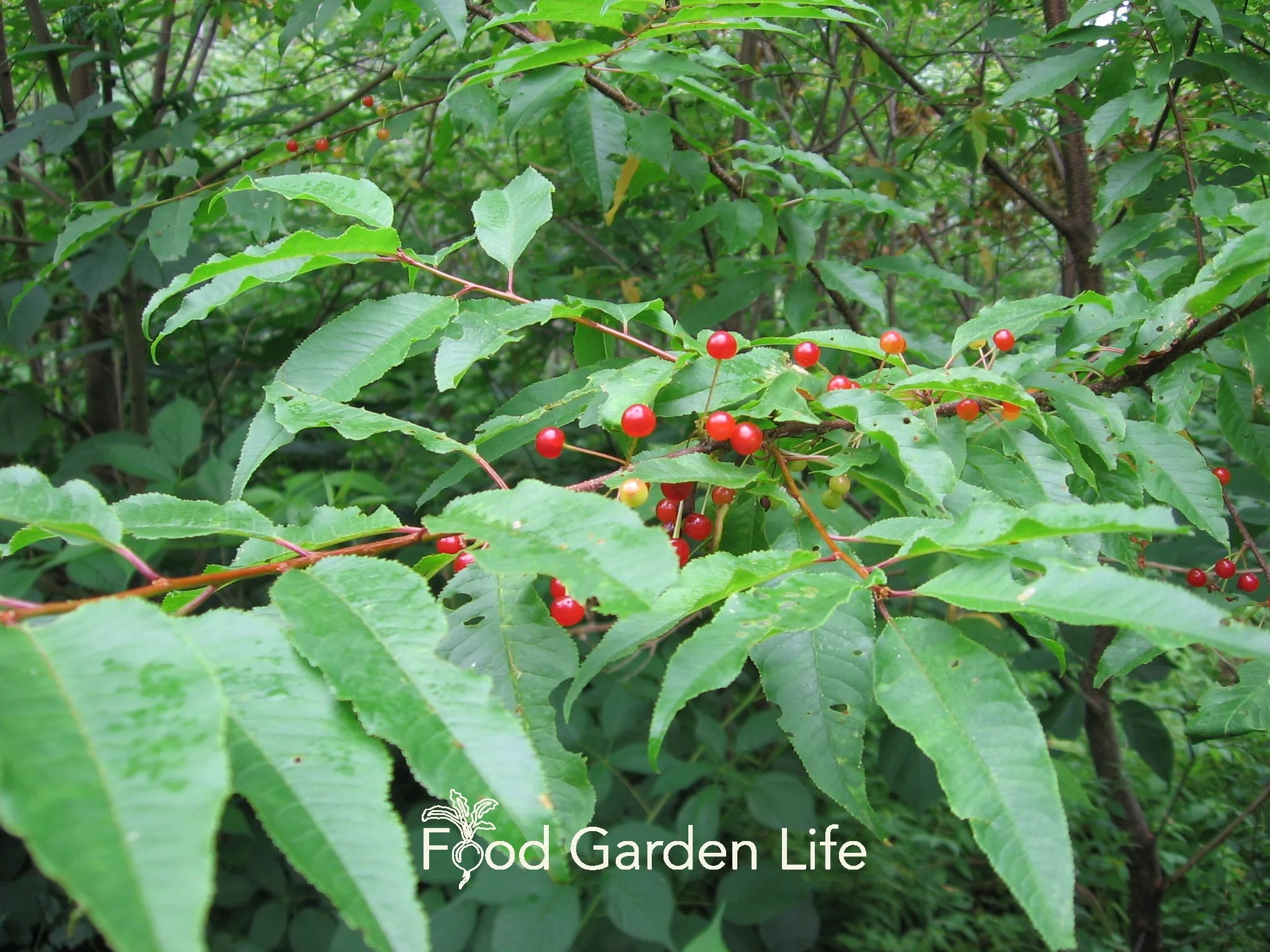
Pin cherry, a native cherry that works well in an edible hedge.
Chokecherry
Pin Cherry
Find out more about different cherries for your edible hedge.
Take a deep-dive into Nanking cherry.
Cherry Plum
The cherry plum (Prunus cerasifera) isn’t too common in the landscape trade—and that’s a pity. It’s extremely cold tolerant, had attractive spring bloom, edible fruit, and nice fall colour.
Chokeberry
The chokeberry (Aronia melanocarpa) is a native North American shrub that is often overlooked. It’s also simply called “aronia” sometimes. The fruit has pucker power, but mixed with other fruit in smoothies, or made into a syrup, it’s great.
Hear more about aronia in this chat with agronomist Laurie Brown.
Crabapple
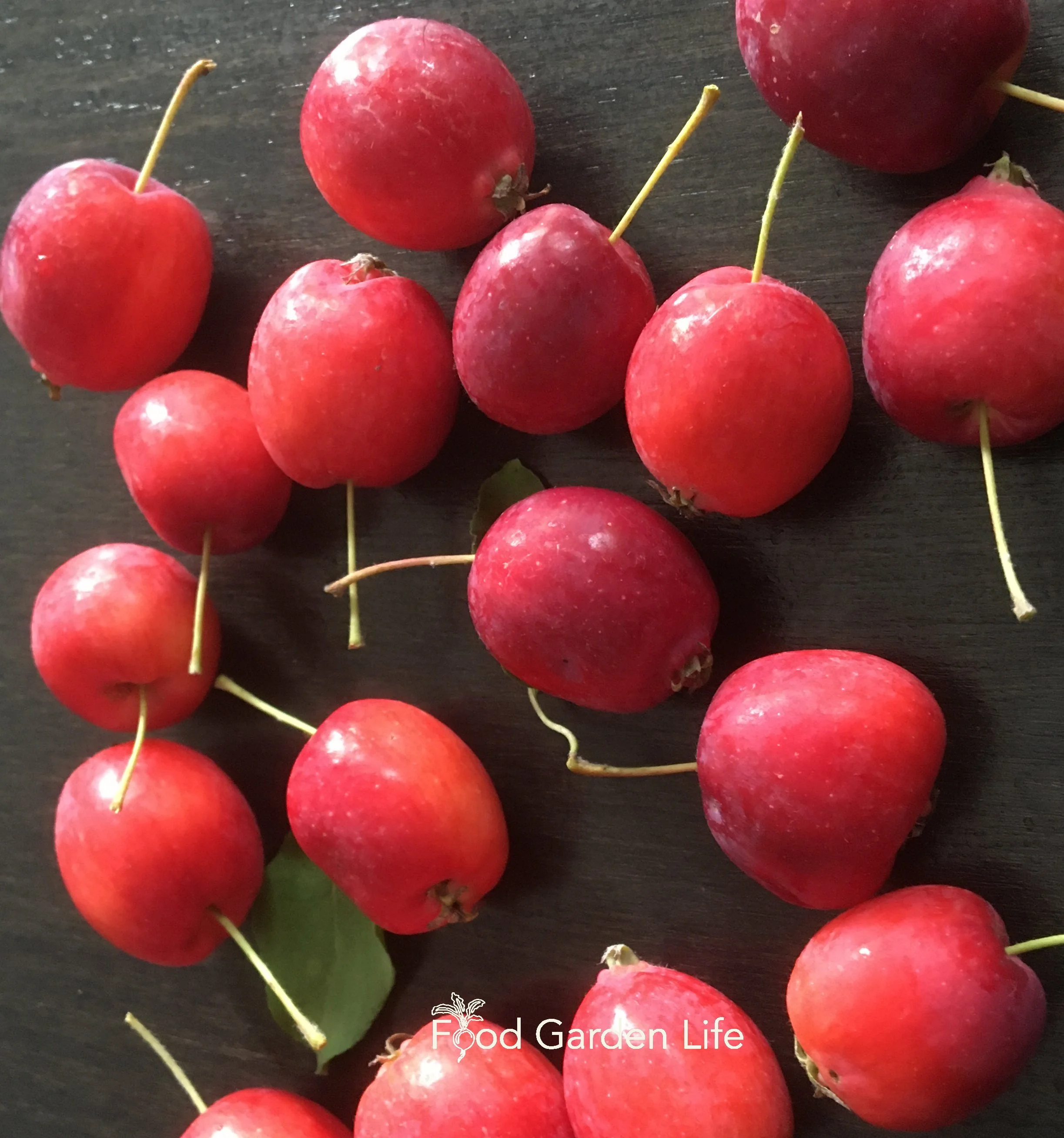
Dolgo crabapples.
There’s crabapple…and then there’s crabapple! Some are small and horrid, so sour and astringent that you’ll regret tasting them.
But there are others that are so tasty you’ll go back for more. My favourite crabapple is ‘Dolgo,’ a variety known for its excellent culinary properties. (We make it into a beautiful red sauce—and into crabapple ice cream.)
Currants
I have a lot of good things to say about currants (Ribes sp.) for home gardeners in cold climates. They’re great for edible landscapes, edible hedges, food forests, and more! In a nutshell, they tolerate shade and poor soil, and still fruit well even when not pruned to perfection.
Find out how to grow a great crop of currants.
Hazel
The American hazelnut (Corylus americana) is a fast-growing shrub that’s very cold hardy. If it weren’t for the army of squirrels that marches on my garden as soon as anything emerges, I’d have lots of hazel.
Like currants, it does fine in poor soil.
(And one more idea for you: If you’ve ever thought of coppicing as a way to produce your own garden poles and stakes, hazel is a good candidate.)
Hardy Kiwi
Here’s an easy-to-grow, hardy fruit vine that can be a nice addition to an edible hedge.
Hear about hardy kiwi as we chat with agronomist Laurie Brown.
Rose
Rose petals are edible, and rose hips (the fruit) are good for teas, jellies, and liqueurs.
Whatever you do, don’t put a hybrid tea rose or a fussy floribunda rose in your edible hedge. Get a disease-resistant shrub rose.
Elderberry
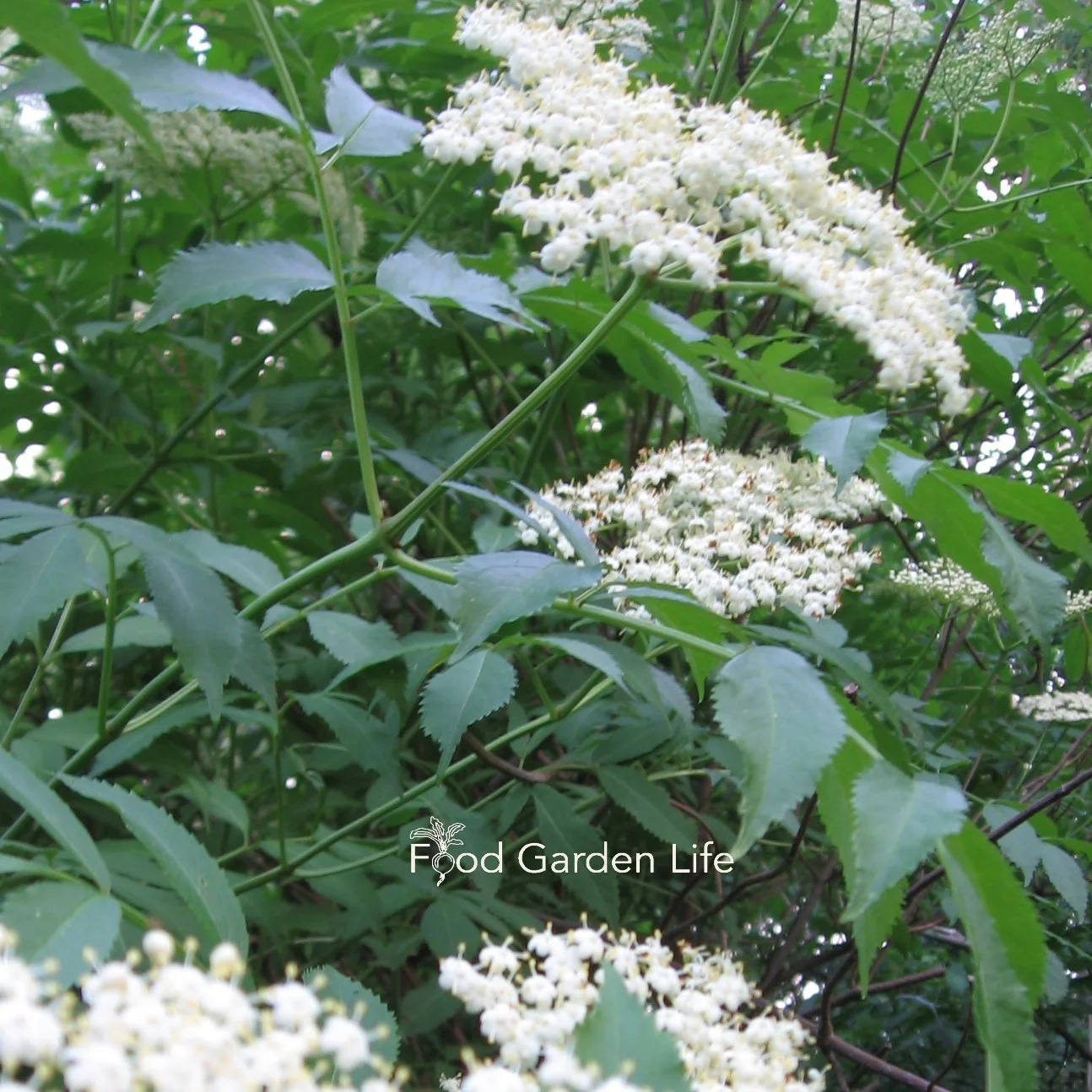
Flowers on elderberry are edible too!
Elderberry (Sambucus canadensis) has both edible fruit and flowers. We make elderflower champagne and elderberry syrup.
Elderberry tolerates partial shade and moist conditions. My first elderberry patch was from a wild plant I dug at a friend’s farm. But there are also improved varieties for larger fruit size and increaded yield.
Hear our chat about elderberry with agronomist Laurie Brown.
Grape
Probably not for those who want a more manicured look…but a grape vine can wend its way through a hedge until if finds space and light.
Remember, along with the fruit, young grape leaves are great for making dolmades (stuffed grape leaves.)
Looking for grape variety ideas but not sure where to start? Hear about “Canada’s Grape.”
Haskap
Haskap (Lonicera caerulea) is a very cold-hardy bush with fruit that looks like elongated blueberries.
They’re a great fit in a mixed planting such as an edible hedge because they’re the first fruit of the summer, usually ready at the same time as strawberries.
Hear our chat with Haskap breeder Bob Bors.
Highbush Cranberry
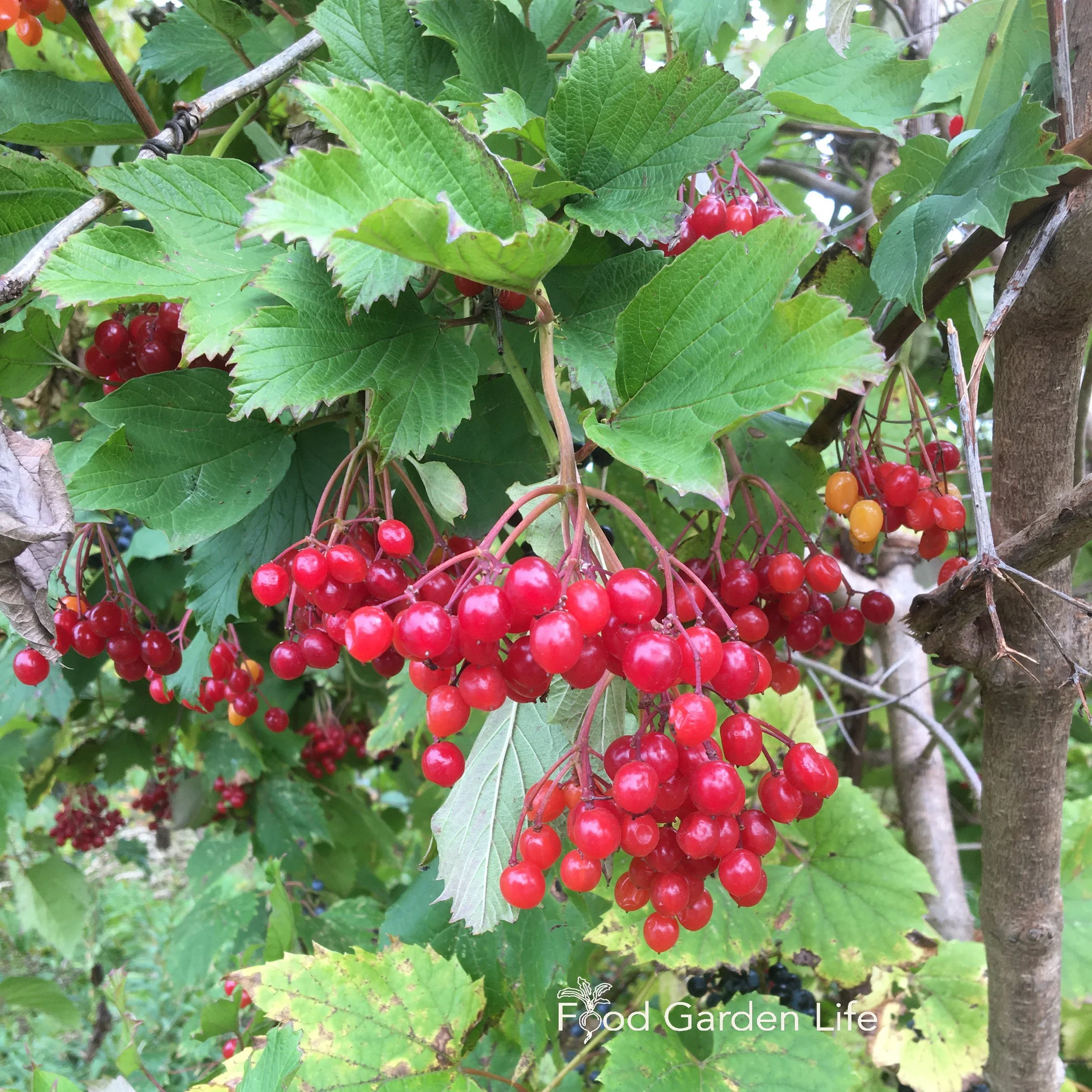
Highbush cranberry fruit.
Highbush cranberry (Viburnum trilobum) is a native North American plant that’s very cold-tolerant. It looks very nice too. There are flowers mid-summer, bright red berries for winter appeal, and you don’t harvest until after there’s been frost.
Like elderberry, it’s a good candidate for areas with more soil moisture.
(Highbush cranberry is not related to commercially produced cranberries.)
Hear foraging expert Robin Henderson talk about foraging highbush cranberry.
Plum
You have lots of choice when it comes to plums. There are wild plums, European plums, Japanese plums—and plum relatives such as damsons.
I planted damsons because I can’t find the fruit for sale anywhere…and I remember the damson-jam tarts my Nana made for me when I was a kid.
Quince
There’s the quince tree (Cydonia oblonga), and also the unrelated Japanese quince bush (Chaenomeles sp.). Both give fruit that’s too hard and acrid to eat when picked—but which can be cooked into marvellous delights.
Find out more about how to grow quince.
Sea Buckthorn
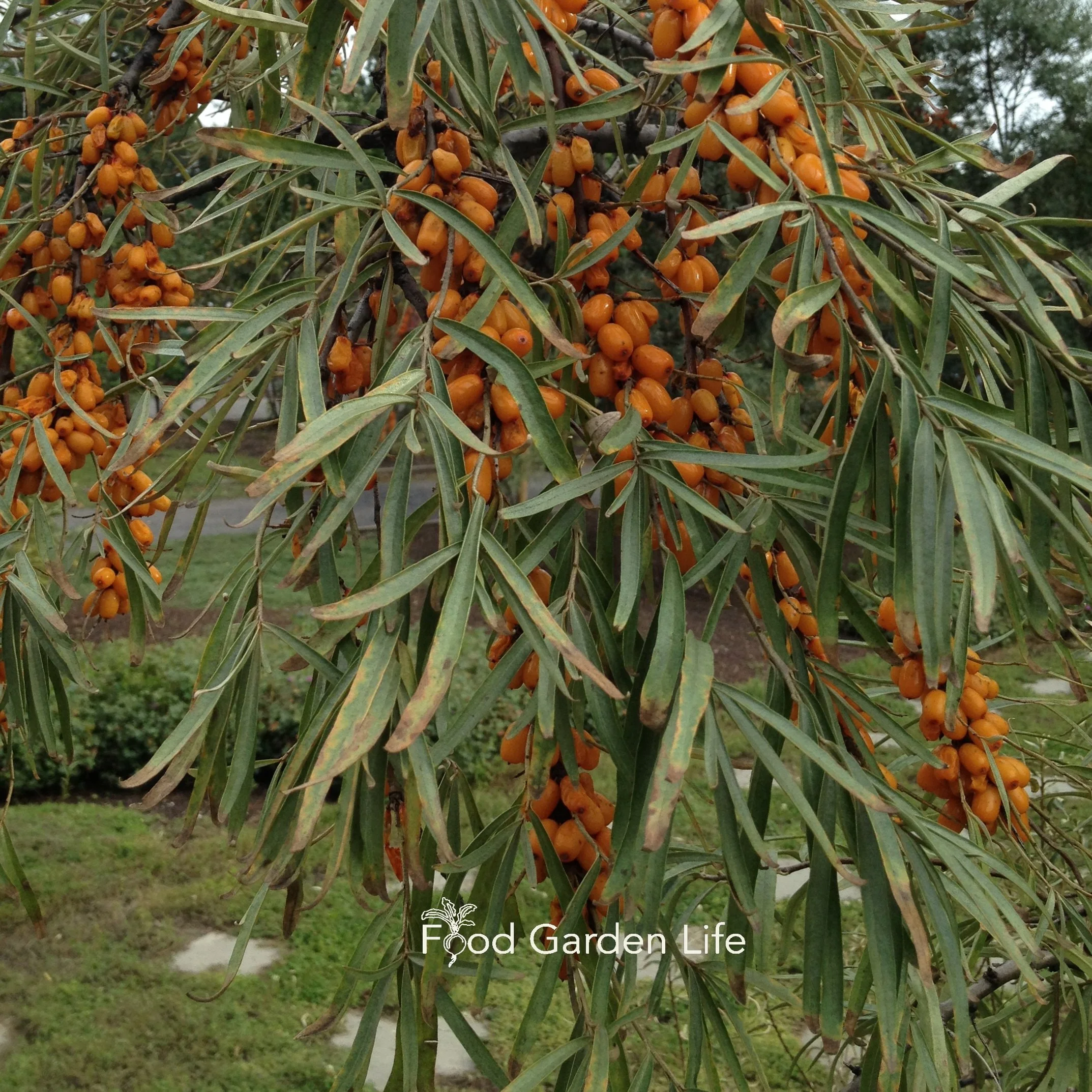
Sea buckthorn adds nice contrast to an edible hedge.
Sea buckthorn (Hippophae rhamnoides) is a super tough, wind, heat, and drought-resistant plant that grows in poor soil.
The silvery leaves and orange berries make it a beautiful addition to an edible hedge (although I can’t say I’m in love with the taste…)
Hear agronomist Laurie Brown talk about sea buckthorn.
Serviceberry
With serviceberry, we’re talking about a family of related fruiting bushes and small trees. Also called Juneberry in the USA. Saskatoon berry is a member of this clan that’s grown commercially, and has many improved varieties.
Find out how to grow the Saskatoon berry (a.k.a. Juneberry).
You Don’t Have to Rule Out Tree Fruits
If you’re not worried about a manicured hedge clipped to a low height, remember that you can add in fruit trees too.
And you don’t even have to grow them as trees…as Dr. Ieuan Evans tells us, many of what we think of as tree fruits can grow as bushes too. Find out more about growing fruit trees as bushes.
Remember You Can Add Herbaceous Plants
Permaculture design encourages multiple layers, something you can incorporate into an edible hedge.
Read about perennial edible plants for edible landscapes.
Looking for More Ideas?
Looking for more food-hedge ideas? Hedgerows might give you inspiration.
How About an Alcoholic Hedge?
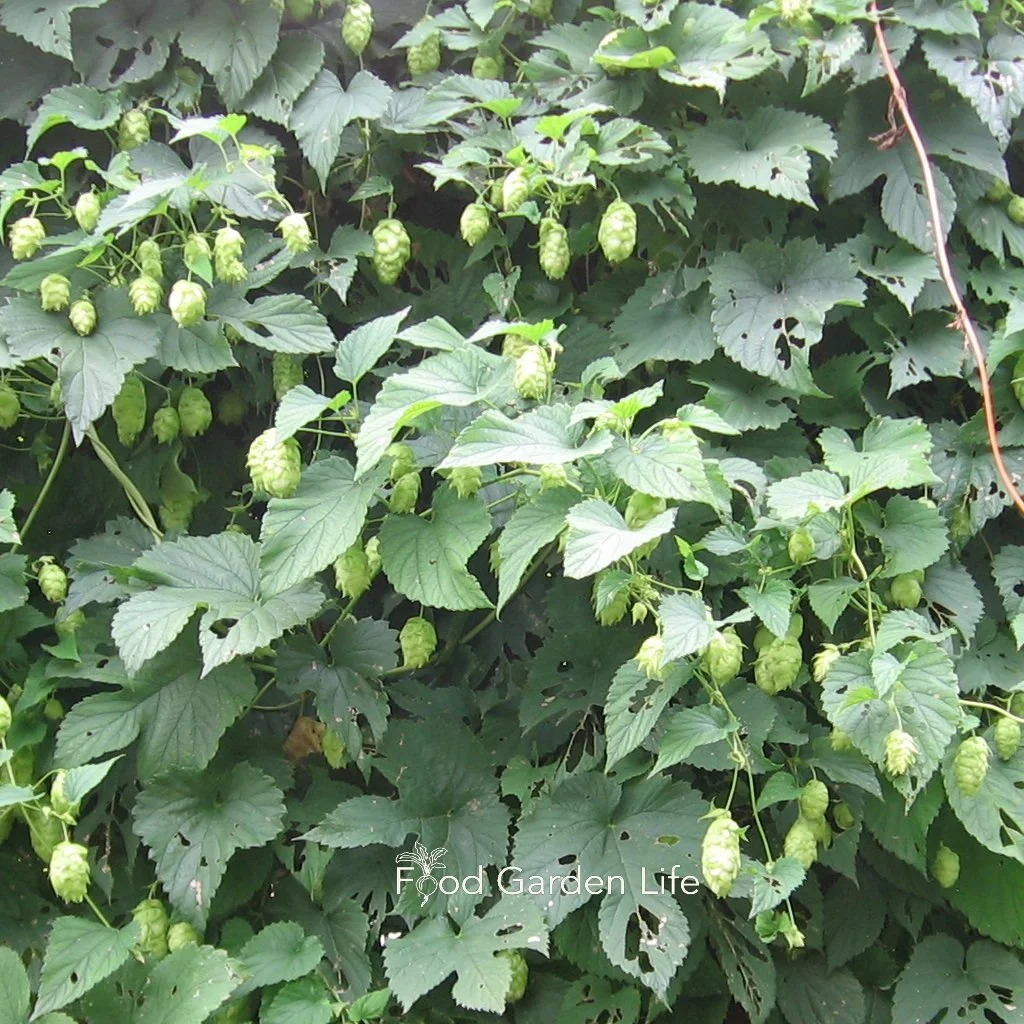
Hops as a hedgerow plant.
UK garden designer Matt Rees-Warren talks about hedgerows with food plants such as blackberry, sloe berry, hops, raspberry, and hazelnuts.
Wondering about sloe berries? They’re in the same family as plums—and are often used to make sloe gin. That’s why Rees-Warren says sometimes these hedgerows are called, “alcoholic hedges.”
Edible Hedges in Permaculture
Permaculture farmer Tim Southwell in Montana grows what he calls a “food hedge” (or “fedge”) on his permaculture farm. It provides privacy, blocks wind, attracts birds, and keeps livestock where they are supposed to be.
Find out more about Tim’s food hedge.
Edible Hedges Have Much in Common with Forest Gardens
Dani Baker is a forest-garden expert. A forest garden, like a food-forest hedge, is set up with layers of edible plants, designed to be a self-sustaining system once established.
Many of her ideas can be applied to an edible hedge. Hear about how to grow a home-scale forest garden.
Flowering Hedges that Produce Fruit
Véronique Alexandre of Hardy Fruit Tree Nursery grows in Zone 4. Yet she has a large palette of fruit trees and bushes to plant. Hear what she recommends for home gardens, and hear about growing a flowering hedge that fruits!
Edible Hedge Hints and Tips
Pick plants for your garden hardiness zone.
Think of sunlight…but don’t be a perfectionist, because a hedge isn’t a perfect setting for a crop.
Mulch so that weeds don’t get the upper hand.
FAQ

Pin this post!
How do I prune an edible hedge?
If you a growing an edible hedge with a number of different plants in it, forget having a manicured, uniform hedge.
Prune each of the different plants within the hedge to optimize fruit production. For example, elderberry fruits best on second-year branches—so when you get to your elderberry bushes, prune away many of the old branches to encourage new growth.
I said above to forget the notion of a manicured hedge, but that doesn’t mean you can’t pick a maximum height. You might want to cap the height so you can harvest without a ladder. (That’s what I do with my pawpaw trees, keeping them short enough to pick from the ground.)
But what about birds?
Depending on where you are, you might find that some of your edible crops are very attractive to birds. I know that my haskaps are ripe when I see robins darting into the bush!
My approach to birds is to pick fruit that they favour in good time. The longer it’s on the bush, the more they get. This doesn’t mean picking the fruit before it’s ripe—but not waiting long once it’s ripe. I don’t get as much as I would if I netted the bushes…but netting takes time.
What about plant spacing for edible hedges?
Spacing recommendations are often for commercial production. A hedge is different; we’re creating a dense, layered mix of plants. Don’t be afraid to play around with spacing.
What if my garden is shady?
If your garden is shady, you can’t grow everything I mentioned above. But you DO have options. Find out more about plants for shade.
Find This Helpful?
Enjoy not being bombarded by annoying ads?
Appreciate the absence of junky affiliate links for products you don’t need?
It’s because we’re reader supported.
If we’ve helped in your food-gardening journey, we’re glad of support. You can high-five us below. Any amount welcome!
More on Edible Landscaping
Need Help?
Get professional advice from horticulturist Steven Biggs.
Edible Gardening Course
7 Vegetable Garden Layout Ideas To Grow More Food In Your Garden
By Steven Biggs
Garden Layout for Vegetables
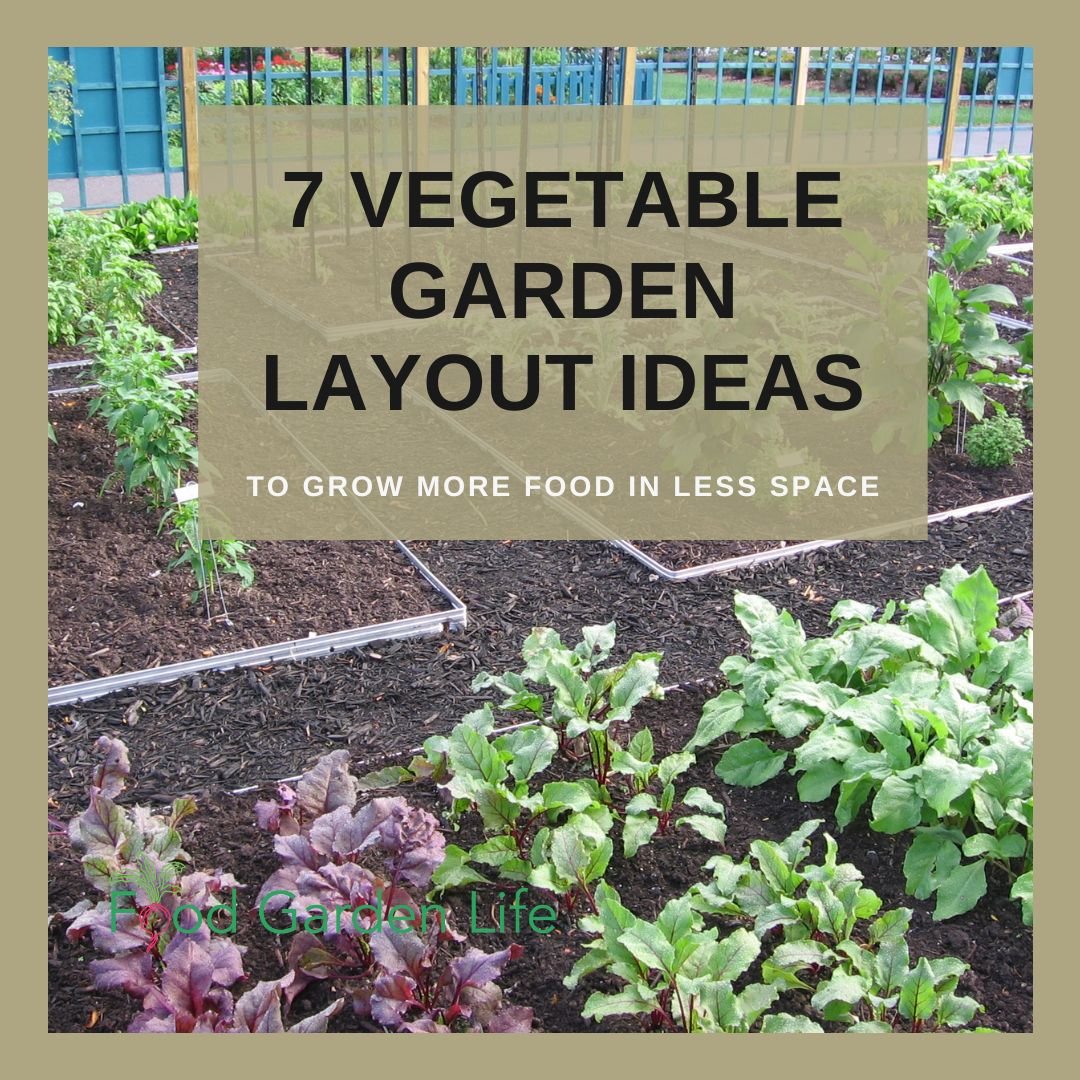
Need help planning a vegetable garden layout? Here are ideas to get your started!
I was delighted when a neighbour removed her front lawn to grow vegetables.
One more edible garden in the neighbourhood! It's a nice departure from the driveway-and-shrub aesthetic around here.
She asked me to help her plan her vegetable garden layout.
But...
I didn’t have a simple explanation about how to make a vegetable garden layout! Keep reading, because this inspired me to map out the way I think when I'm veggie gardening.
As we studied her small, partially shaded front yard, I saw numbers in my mind—distances between plants, between rows, and between crops. I saw centimetres and inches (because we’re in Canada and can’t decide on which to use.)
There's a simpler approach, and I share it below.
Before we get to my top tips: Remember that there are lots of possible vegetable garden layouts. There are many ways to organize and space out vegetables in a garden. There's the growing. And then there's a creative aspect to it. That means that two gardeners given the same garden bed can come up with completely different layout plans. Enjoy the creative journey! There’s no perfect vegetable garden layout—there’s a layout that suits you and your situation.
Keep reading for 7 tips to help you come up with a vegetable garden layout that suits your situation:
1. Grow in Blocks
Rows are for Farms
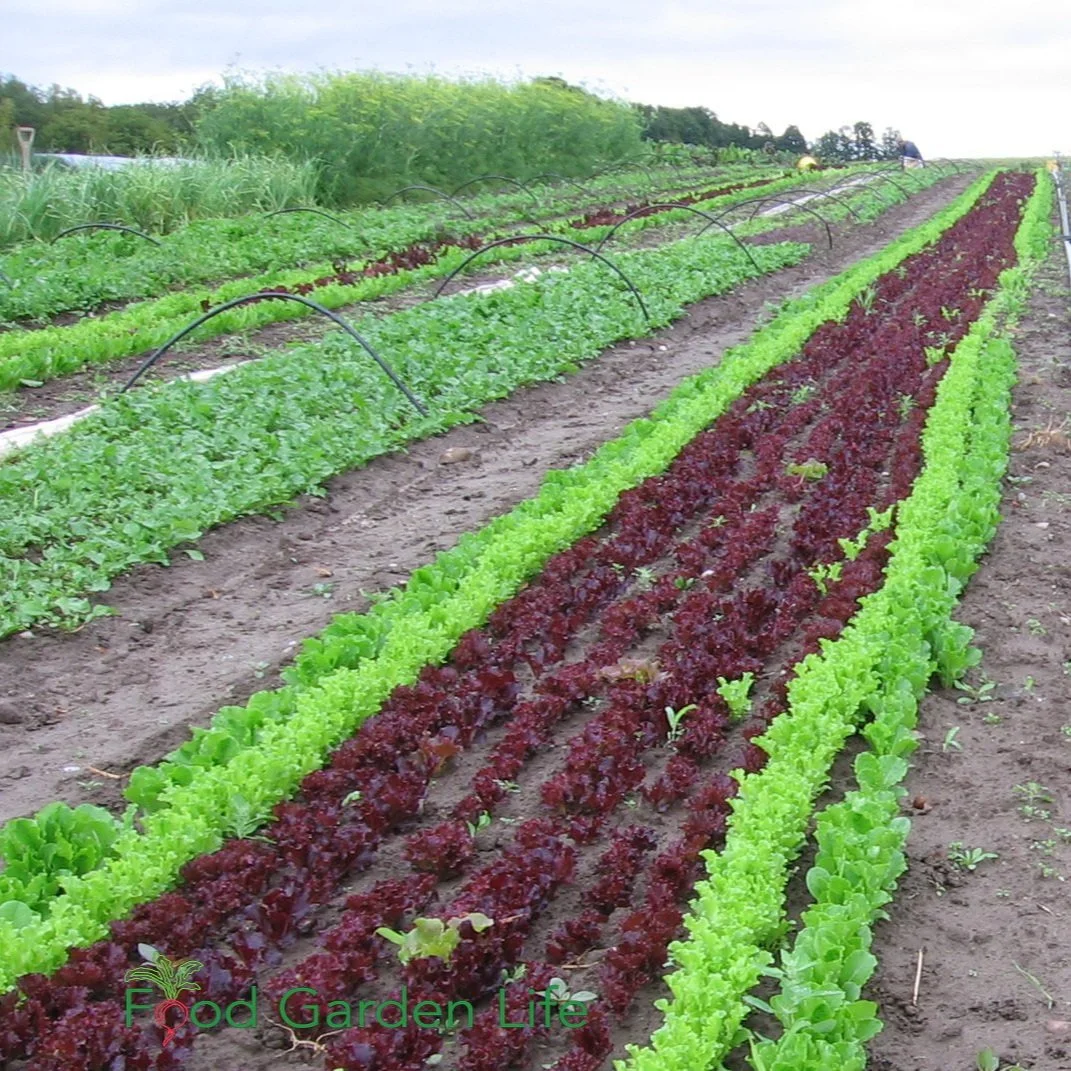
There’s lots of bare soil when growing in rows. Grow in blocks instead of rows to optimize the use of space.
In a traditional row-gardening layout, there's space between rows for cultivating. That cultivating chops down little weed seeds that are germinating. Gardening this way allows one person to weed and tend a lot of plants when labour—not space—is limited.
Planting in rows can make sense on big pieces of land.
But in a home vegetable garden, we're growing on a different scale. In a home veggie garden, we’re limited by space.
And that means growing some vegetables in blocks, instead of spread-out rows of plants. By growing in solid blocks of plants, we fit lots of plants into a plot and have less bare ground showing.
(There are still some vegetables that will do best as single rows of plants, and we'll cover them below.)
Perennial Plants
If your garden design includes perennial vegetable plants, give them a separate block.
2. Grow Vegetables Vertically
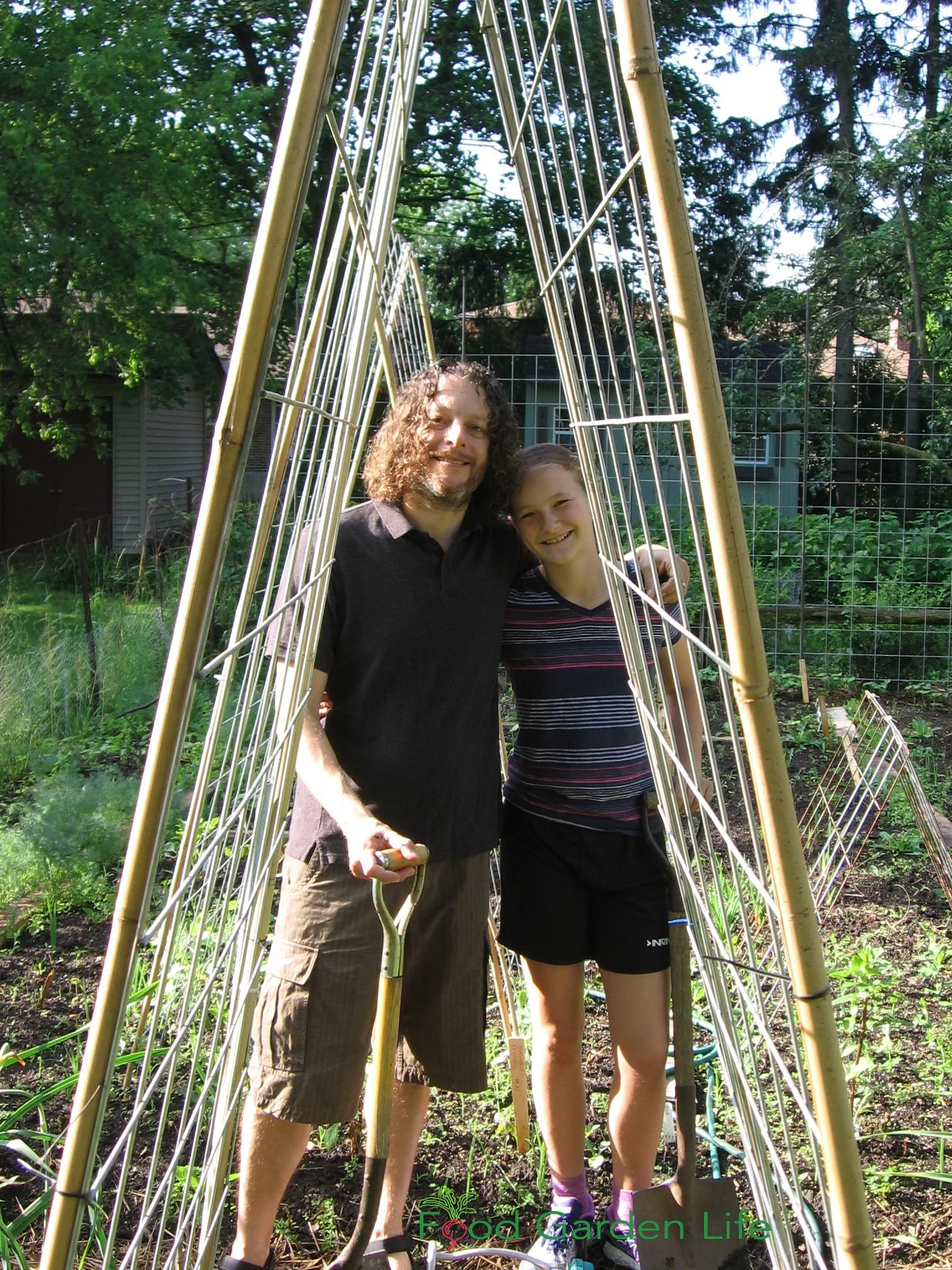
Add height to your garden plan! A bamboo-and-wire-mesh A-frame is one way to make good use of the vertical space in a garden.
Plan for the dimension of height in your garden. Use the vertical space! This just means growing some plants upwards instead of letting them sprawl around the ground.
For example:
Growing a climbing plant up a stake or trellis frees up space on the ground for different plants.
Grow crops in layers. By growing vertically, you can also grow more than one crop in a small space. For example, make an A-frame for cucumbers, and underneath the A-frame, plant leafy greens that benefit from some shade during the summer.
And one more idea if you're making layers in your garden: Hanging baskets. They're great for herbs and many of the leafy greens.
Climbing Plants for Vertical Gardens
Here are a few of my favourite climbers to grow in a small space.
Malabar spinach (a vining spinach substitute, not really a spinach…but excellent during the heat of summer)
Achocha (a.k.a. Bolivian cucumber, it’s absolutely prolific, and a fun novelty)
Vining peas
Pole beans
Runner beans
Cucumber
Squash
Need more ideas for climbing plants? Get more crop ideas in this article about vertical gardening.
3. Plant Densely, and then Thin
Seed Spacing…How Many plants?

Plant densely to grow more food in a small space. Here are densely planted carrots, and as the larger ones develop roots big enough to eat, they’re pulled out so there’s space for the remaining ones to develop.
Seed-spacing recommendations on seed packets and in articles are often geared towards commercial production. And these recommendations work fine in a home garden.
But…
Most plants do well with less than the spacing recommended on a seed packet.
So if you want to grow more food, plant more densely.
Forget Finicky
Commercial growers (or hard-core gardeners with big gardens) often use seeding machines to place seeds at a specific spacing. There are also hand-operated seed dispensers to help get perfect spacing.
Your plants won’t know the difference—and you can make your seeding less complicated by not being finicky.
Scatter-Seeding a Block is Not Finicky
When seeding a block, I hand-scatter seed. With practice, you can scatter seeds so that they are spread at approximately the distance you want. Don't sweat the exact spacing.
It’s not an exact process. You will get some seeds too close together; and some too far apart. (Remember, gardening is detox for perfectionists.)
Where seeds are too close, thin as plants start to grow.
Beets too close? Thin out a few and enjoy baby beet greens.
Carrots too close? Thin your block of carrots and have some baby carrots for supper.
When scatter-seeding blocks, you will use more seed than if you seed in rows.
That’s fine: It saves time and you get more veg from the same area.
4. Choose Crops to Maximize Your Harvest
To grow more food in less space, be strategic with your crop choices as you’re laying out a vegetable garden.
My first rule of vegetable gardening is to grow things you like. Sure, radishes are easy to grow. But do you like eating them three times a day?!
Here are three other things to think about as you fit more food plants into your space.

You might choose spreading crops that take a lot of space. That’s fine, just grow them upwards. You don’t see it in this picture, but there’s a whole crop of Swiss card below.
Next, avoid the space hogs. These are crops that take up a piece of garden for the entire growing season...and only give you something at the end of the year. That's right: if you have a small garden, think twice about those parsnips and Brussels sprouts!
Keep the vining space hogs, but grow them vertically (see above.) So instead of squash sprawling around the garden, grow it up a fence or trellis. (I’ve even grown squash along a cedar hedge!)
If you have a small plot, skip the stingy crops. I'm talking about something like edamame, which is easy to grow and delicious...but takes a fair bit of space considering what you get from it. You'll get way more bang for your buck with something like bush beans.
And let’s get back to the idea of rows versus blocks as we think about choosing which vegetables to grow.
What to Grow in Blocks
Here are examples of crops that I like to grow in solid blocks, instead of rows.
Beet
Carrot
Leafy greens
Garlic
Check out Edible Garden Makeover and have fun doing some vegetable garden landscaping!
What to Grow in Rows
It makes sense to grow certain crops in rows. Here are the ones I prefer to grow i rows:
Potatoes (so I can easily "hill" them)
Tomatoes (because I stake them, and it's easiest when I can access them from both sides)
Peas (for ease of picking)
Pole beans (for ease of picking)
5. Keep Pathways to a Minimum
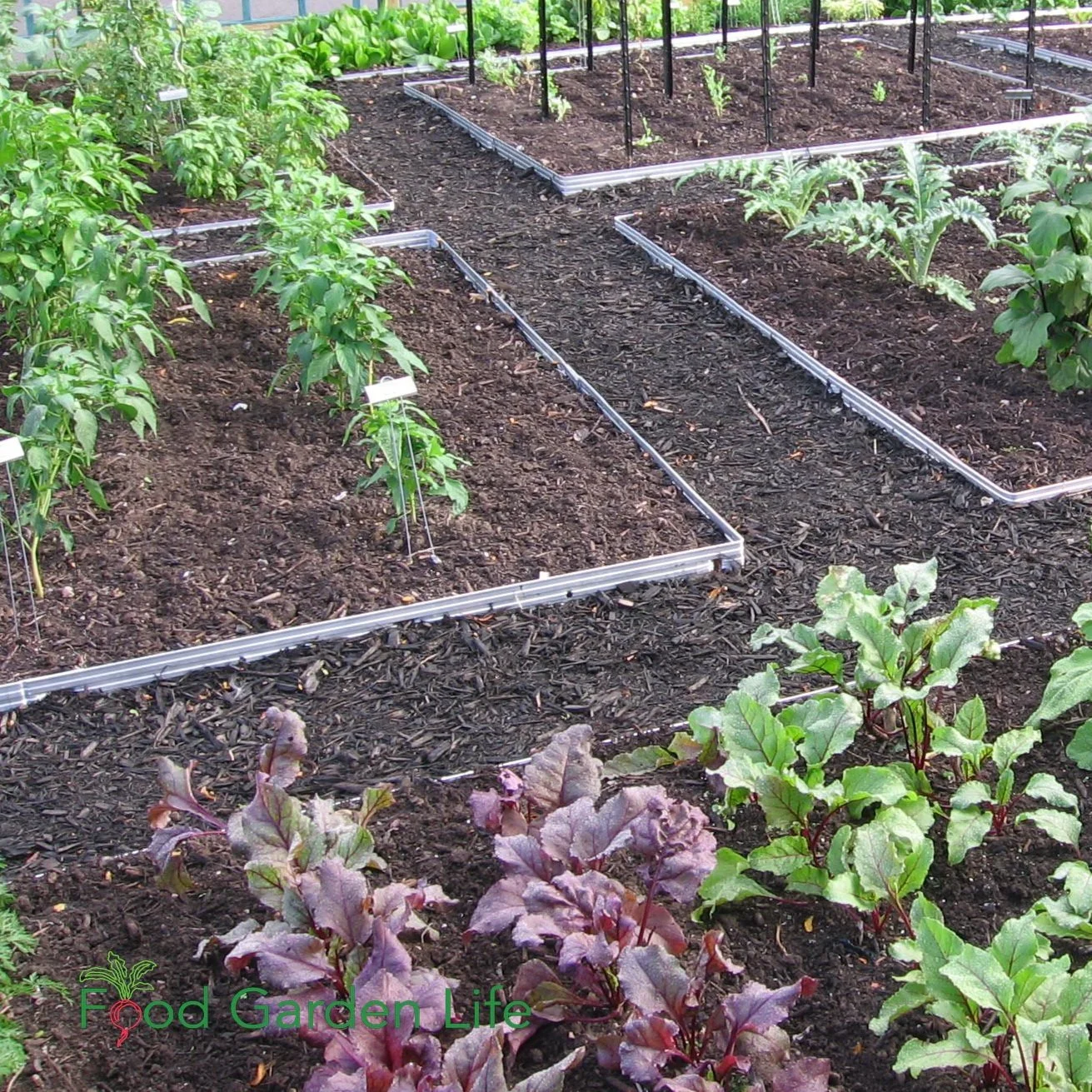
How much growing space could you add in this layout if the pathway down the middle didn’t go all the way through the bed? Lots!
An easy way to grow more food in less space has nothing to do with the distance between your plants!
Use less of the available ground for pathways.
As you map out your beds and pathways, play around with different layout options. Easy access is important, but sometimes there are ways to plan a garden that has access, but fewer pathways. A simple way to do this is with dead-end pathways that go part of the way into big beds…but not all of the way through. That way less of the growing space is sacrificed for pathway. (Having trouble picturing this? Imagine a keyhole garden, where there’s a pathway into the middle—but it doesn’t go all the way through.)
6. Plant Two Crops Together
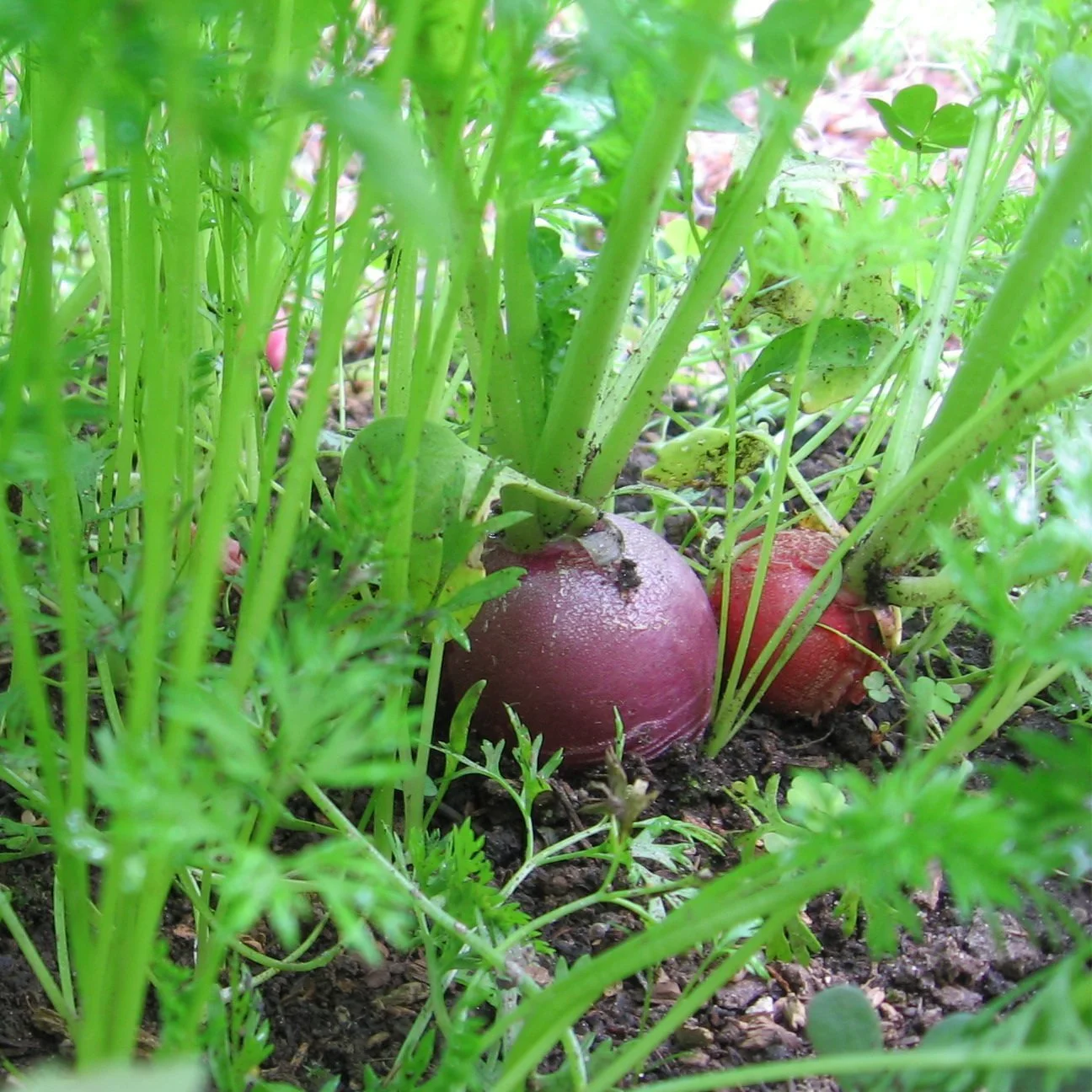
Radishes and carrots seeded at the same time,. The radishes are ready to harvest, while the carrots roots are nowhere near ready for harvest, even as baby carrots.
Companion planting is another way to fit more plants into your vegetable garden.
Plant two vegetables in the same space—ones that are good companions because they mature at different speeds.
My favourite combination is fast-growing radish, with slower-growing carrots or beets.
When I scatter carrot seed on a block of garden, I also scatter radish seed. The radish grows much more quickly than the carrot, and is ready to harvest while the carrot seedlings are still quite small.
Harvesting the radishes frees up space for the carrot seedlings, and as the tap root of the radish comes out, it also loosens the soil around the carrot seedlings. It's a perfect combination.
(There is a lot of rubbish information out there on companion planting. I suggest this science-based book: Plant Partners: Science-Based Companion Planting Strategies for the Vegetable Garden.)
7. Grow Succession Crops
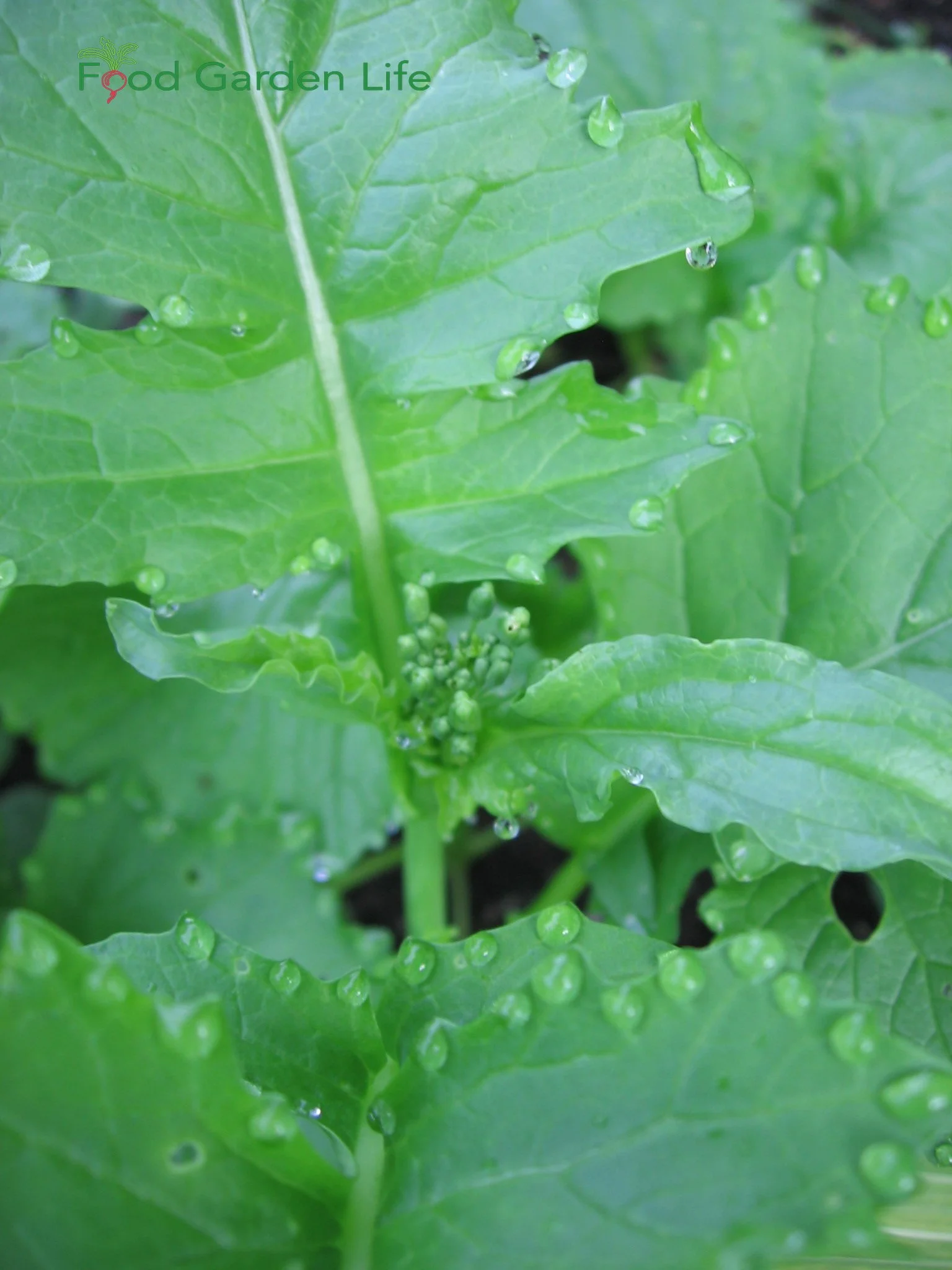
Rapini is one of my favourite summertime succession crops.
Growing vegetables in succession as each parcel of your garden makes sure none of it goes unused during the growing season.
As your spring-planted cool-season crops finish, plant a heat-loving crop for summer.
Bush beans done? Sow some beets.
Garlic done? I like to grow rapini (and for those of you who are avowed rapini haters because of the bitterness, get yourself a bowl of orecchiette pasta with rapini and some chunks of spicy sausage fried to crispy, and you’ll see rapini in a different light.)
Need more Vegetable Garden Layout Ideas?
In Edible Garden Makeover I walk you through lots of vegetable garden layout ideas, raised beds, making garden beds, raised beds, and lots of other ideas that help you grow your own food in a way that suits your setup. I help you imagine an amazing kitchen garden, and also an entire edible garden layout. Find out how you can make your yard into an edible landscape.
Still Not Enough Space?
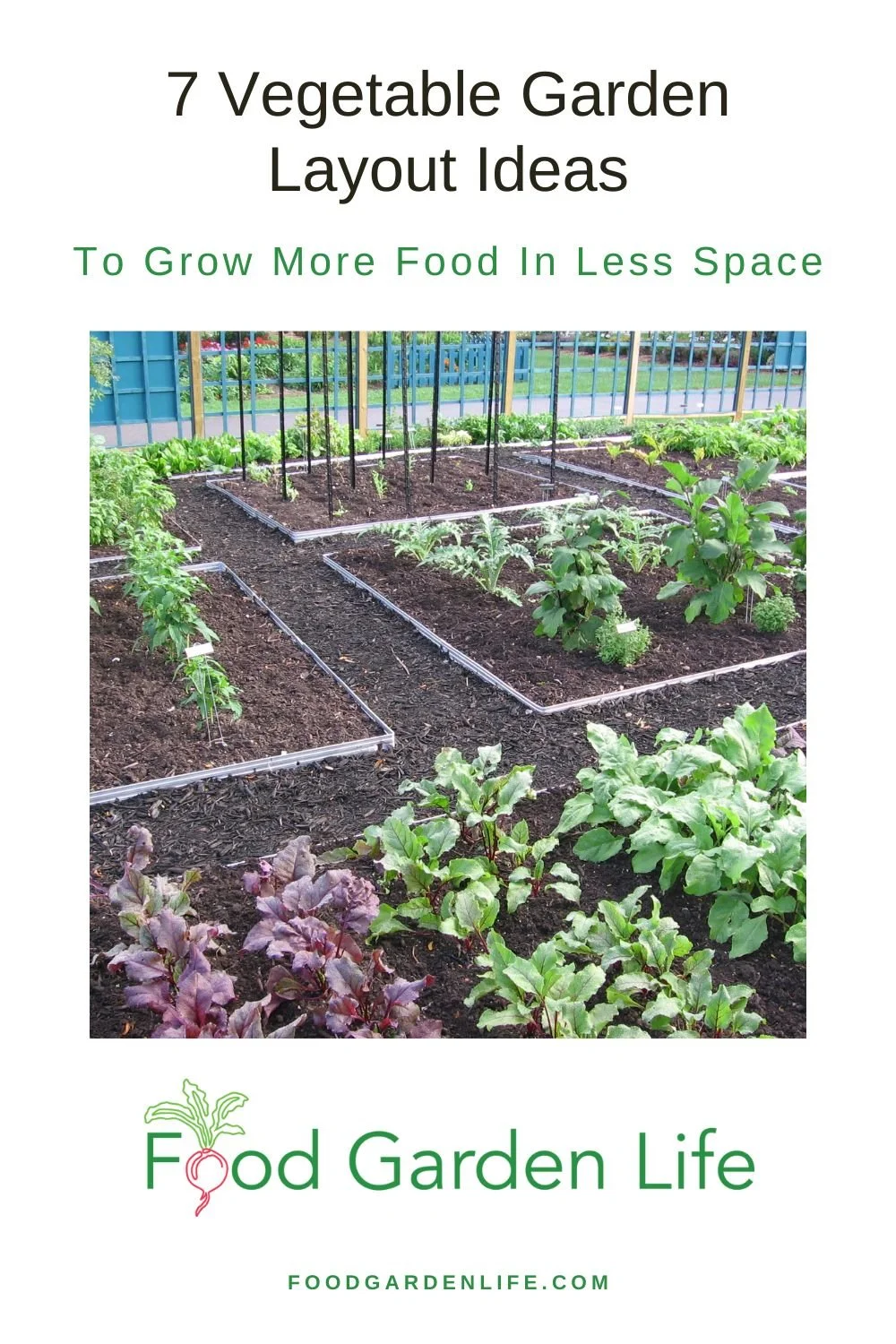
Pin this post!
If you're using these seven approaches to make the best vegetable garden layout for your garden area, and you still want to grow more, think about adding containers to your vegetable garden.
Plant vegetables in containers on:
Paved spaces such as driveways
Decks or balconies
See how I converted my driveway into a tomato plantation.
You can also incorporate containers as part of a vertical garden, to add the element of height. (I've squeezed in pepper crops between an asparagus and horseradish patch...where normally they wouldn't have stood a chance because of the competition. But because they were elevated above the ground in a container, they got sun exposure and had lots of growing space in the container.)
One more space-making idea for you, something that I've used to transform a long, little-used driveway into a tomato oasis.
This idea is quick to set up, easy to care for, and inexpensive compared with permanent container or raised-bed systems.
Add a straw-bale garden to your garden layout. Find out more about straw-bale gardens.
Wondering about Shade?
Shade is something we often deal with in home gardens. Don’t worry, there’s still lots you can grow. Find out vegetable crops that you can grow in the shade.
Find This Helpful?
Enjoy not being bombarded by annoying ads?
Appreciate the absence of junky affiliate links for products you don’t need?
It’s because we’re reader supported.
If we’ve helped in your food-gardening journey, we’re glad of support. You can high-five us below. Any amount welcome!
More Gardening Ideas
Courses
Here are self-paced online courses to help you grow an awesome vegetable garden.
Guide: Vertical Vegetable Garden Ideas and Plants
Harvest more from the same space with these vertical-vegetable-garden ideas and vertical gardening crops.
By Steven Biggs
Vertical Gardens to Harvest More
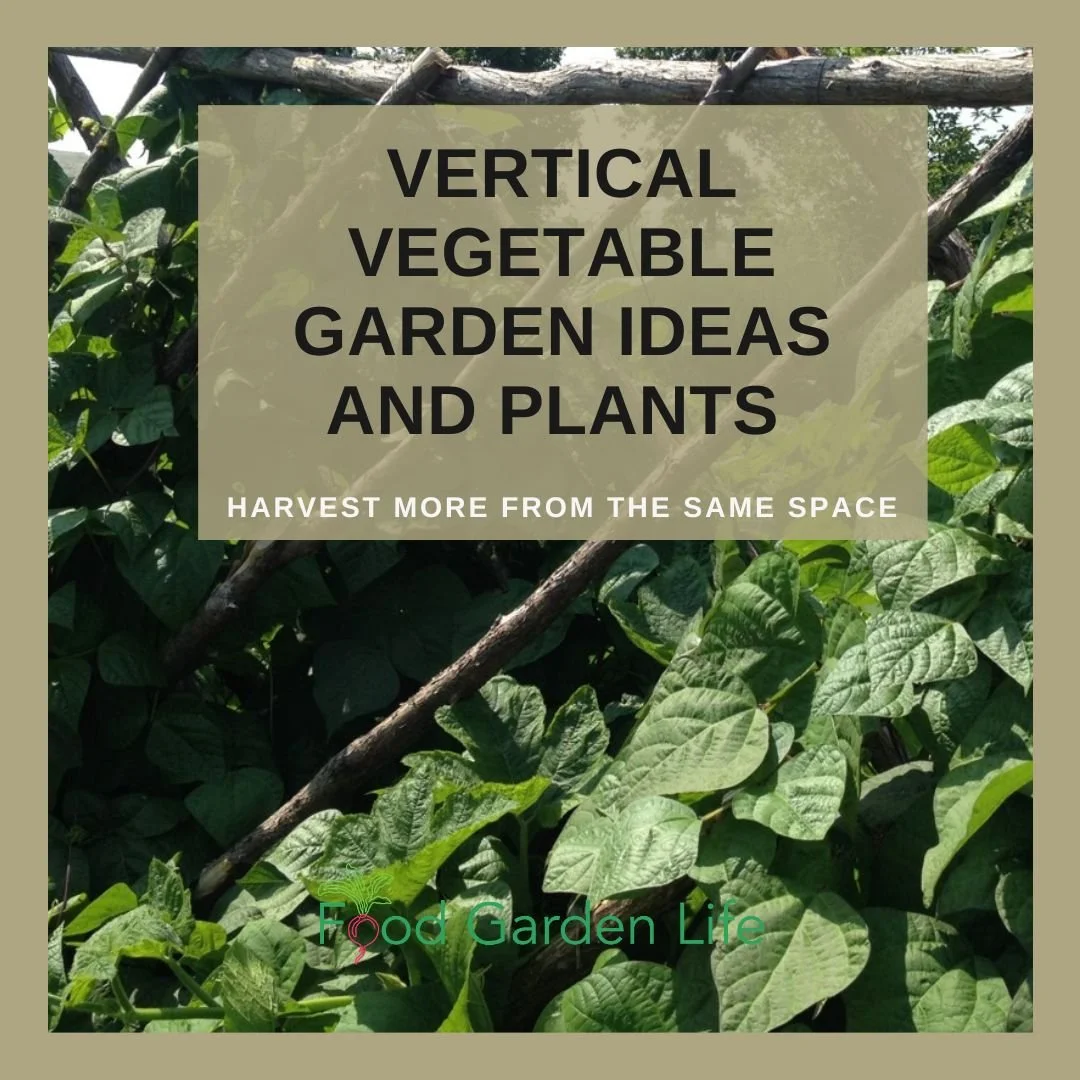
Vertical vegetable gardening squeezes more plants into a limited space by making use of space above the ground.
By growing sprawling plants upwards, there’s space on the ground to grow more plants.
Other Vertical Garden Benefits
Along with making it possible to grow more plants in the same space, a vertical vegetable garden has a couple of other benefits:
Vertical vegetable gardens for easy harvests. Less bending, because crops are raised
Vertical Gardens Help Provide Shade. Some crops do better in partial shade during the summer. Leafy vegetables grown on the ground space in the shade of a vertical vegetable garden are sheltered from the midday sun.
If you’re interested in creating more growing space to grow vegetables, keep reading. This article includes vertical garden crops, vertical vegetable garden ideas, and easy-to-work-with materials to make supports and trellises.
How to Add Vertical Crops to a Garden
Vertical Vegetable Garden Ideas
There are many ways to add vertical elements to a vegetable garden.
Look for ready-to-use products if you want to start small. It can be something as simple as a tomato cage to support a vining plant—or a window box for cascading herbs.
There are also lots of creative ways to make your own support structures so that you can grow vertically.
Add Tiers with Containers
Containers are a simple way to fit more plants into a garden. Having different tiers means that the canopies of different crops aren’t competing for space at the same level.
Another advantage of containers is that they make it possible to add a crop to an area where there is root competition from a neighbouring crop.
Fences to Support Vines

Squash growing on a fence as part of a vertical vegetable garden.
Fences can be a great opportunity to grow a vertical garden. If the space next to the fence is paved, consider growing in a container.
Tie tomato plants to a chain-link fence
Run twine along a board fence for cucumbers and other vining plants
Grow strawberries or herbs in planters fastened to the fence
Hanging Baskets and Hanging Planters
Vertical gardening doesn’t always mean training a plant upwards.
It can include plants dangling down. A hanging garden.
There are lots of crop options for hanging baskets. Here are ideas to get started:
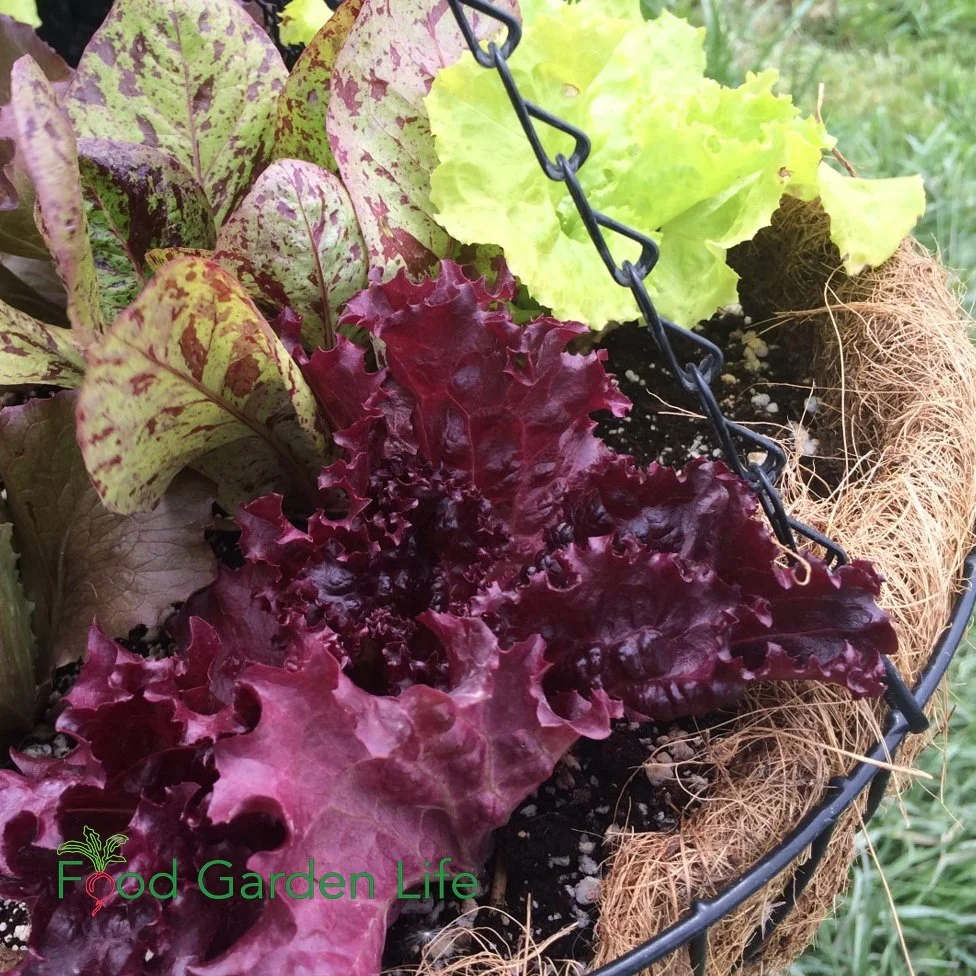
Add hanging baskets to vertical vegetable gardens.
Strawberries
Tomato plants
Herbs
Salad greens for hanging baskets in partial shade
Trailing nasturtiums (edible flowers!)
Stakes for a Vertical Vegetable Garden

Staked tomatoes leave space for some parsley plants at the ground level.
When staking a plant and growing it upwards you’re opening up space below for another crop. For many gardeners, the sight of staked tomatoes is familiar. Now picture those tomato plants with lettuce or parley underneath.
Some plants can wrap around or grab onto a stake. Other, such as tomatoes, must be tied to the stake.
Self-Supporting Structures for Vertical Gardens
There are many ways to make self-supporting structures for vertical growing.
Even if a vertical garden structure is self-supporting, it’s a good idea to secure it to the ground with a stake so that it doesn’t topple in strong wind.
Here are a few ideas to create vertical space:
Tee Pees
A-frames
A Row of angled, crossing poles jointed together with a pole laying across the top

Grow food vertically using simple bamboo structures such as teepees and A-frames.
Or make more permanent structures for climbing vegetables using lumber:
Lattice-and-lumber A-frame
Wood frames from which twine can be suspended for vining crops
Wooden A-frames over which vining crops grow; and under which shade-tolerant leafy greens thrive during the summer
Or make ornamental landscape features the double as support for growing crops:
Arbours
Pergolas
Use Plants in the Landscape for Vertical Growing Space
Use plants within the landscape to support vining vertical crops:
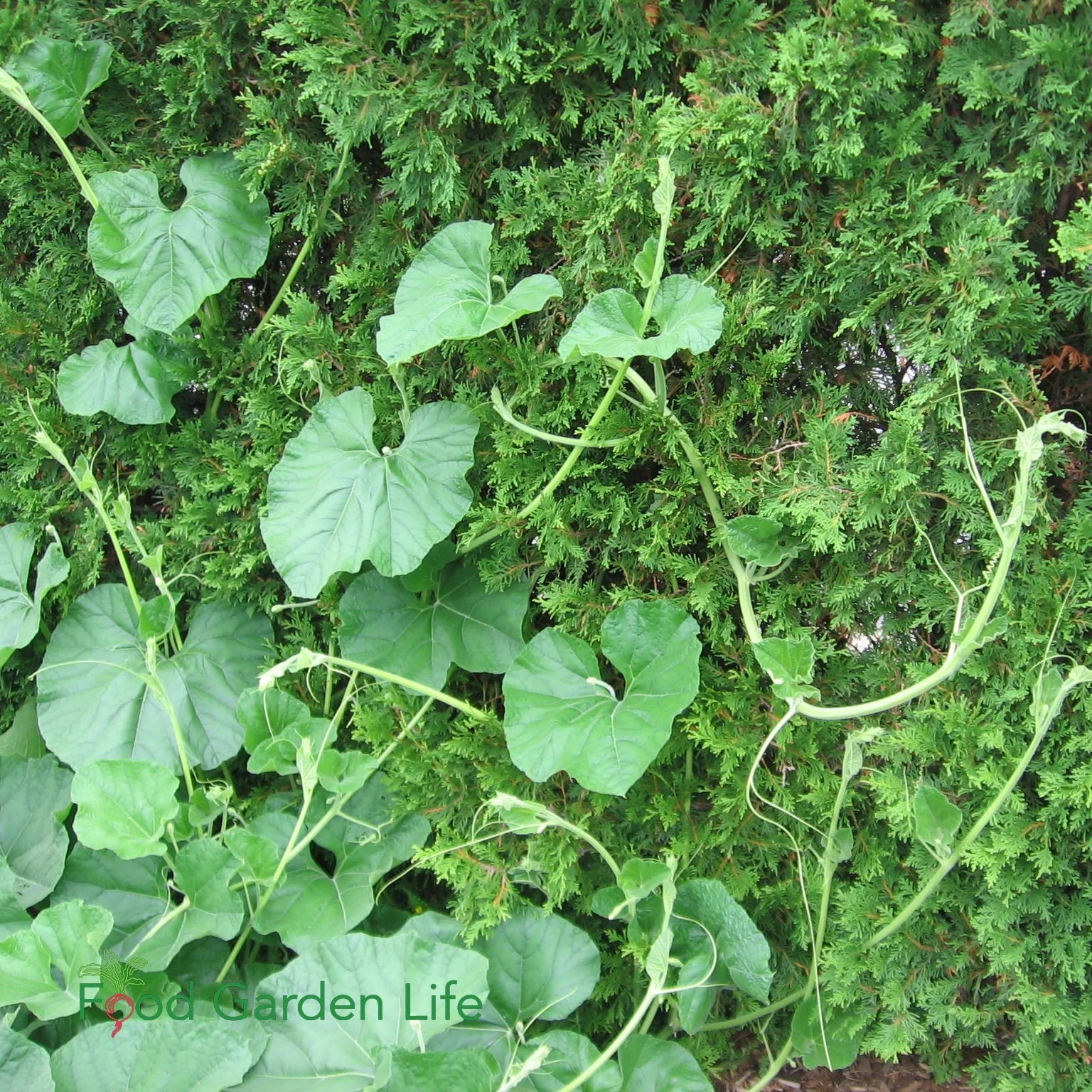
Save space by growing squash along a hedge!
Hedge (grow a squash vine along a hedge)
Tree (let runner beans grow into a small tree)
Sunflower or corn as a living trellis
Trellises for a Wall Garden
Trellises are a simple way to add more vertical growing space.
Turn an empty wall into a home for a vining crop
Add height to a fence with a trellis
Cover an unsightly utility pole and make it into a growing space
Vertical Garden Crops Ideas
Here are crops that are suited to growing vertically.
Achocha (a.k.a. Bolivian cucumber)

Achocha is a vining crop that’s easy to grow in a vertical vegetable garden.
If you’ve been frustrated by pests and diseases on more delicate vining crops such as cucumber, try achocha. It’s a survivor.
This vining crop has small pods that are eaten raw when small, and cooked when a bit bigger. (There’s a limit to how big they can get without being too woody, so aim to harvest them while small.)
Beans (pole beans and runner beans)
Both of these vining beans are a great addition to a vertical vegetable garden.
Grow them up trellises, garden structures, and tall fences.
Runner beans do better in cooler, maritime climates—and they tolerate partial shade.
Bitter melon
This vining crop has tendrils. Both fruit and young shoot tips are edible. Tolerates partial shade.
Burr Gherkin
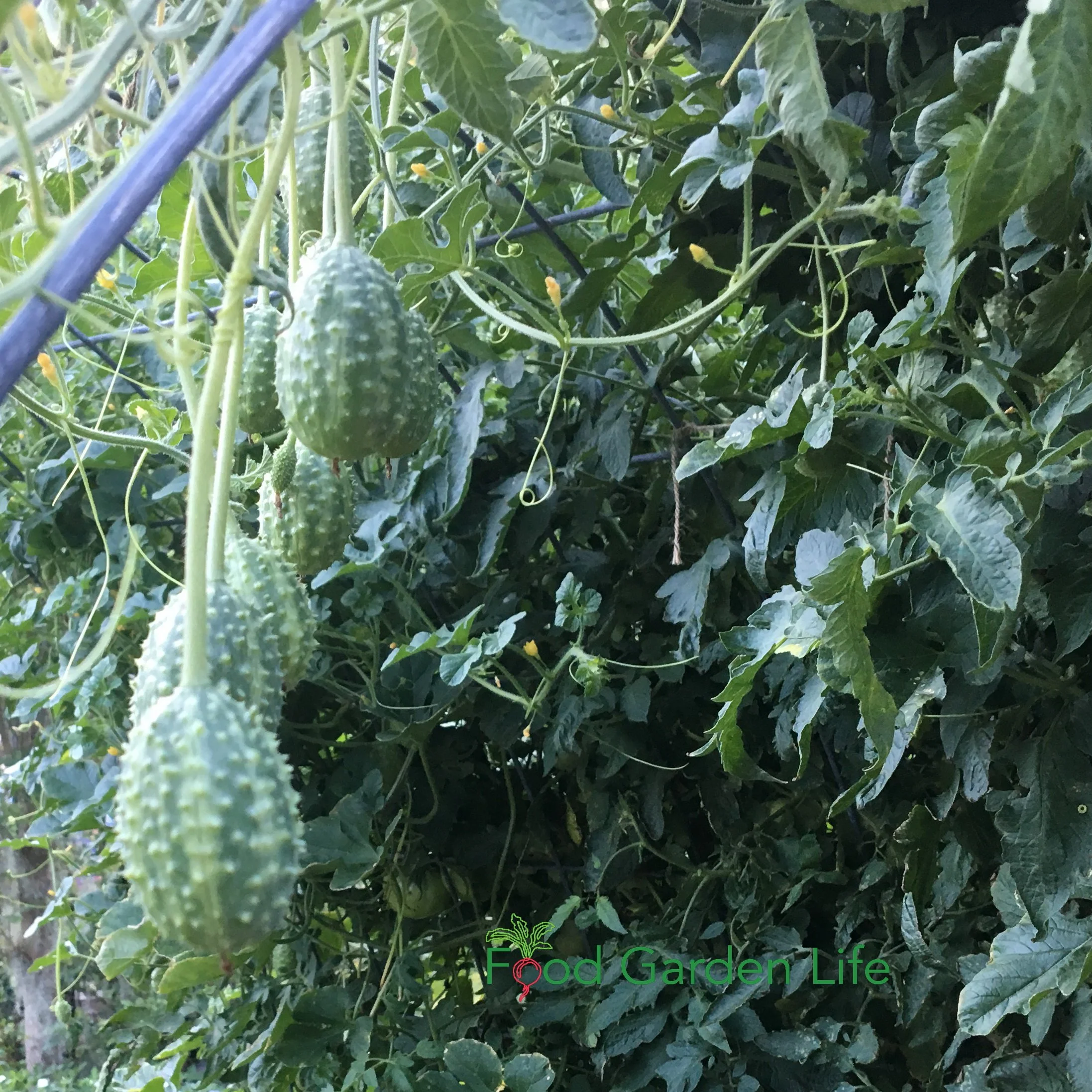
Burr gherkin is a vining crop that’s easy to grow in a vertical vegetable garden.
Spiky little cucumber relatives with a citrusy taste. Tasty fresh, and good for pickles too. Vines grow like cucumbers.
Cucamelon
(a.k.a. Mouse Melon, Mexican Sour Gherkin)
This cucumber relative has smaller leaves and fruit, but is a vigorous grow that easily climbs a trellis.
The small, thumbnail-sized fruit are cucumber-like, with a bit of citrus. Eat fresh, or make into pickles.
Cucumbers
Along with conventional cucumbers, look for Armenian cucumbers (not actually a cucumber…but a relative). Both make excellent vining crops.
Luffa
While many people think of using mature luffa fruit for the sponge-like scrubbies, the young luffa is edible—like a summer squash.
If you’re in a cold zone, know that this is a heat-loving crop that does best with a long growing season.
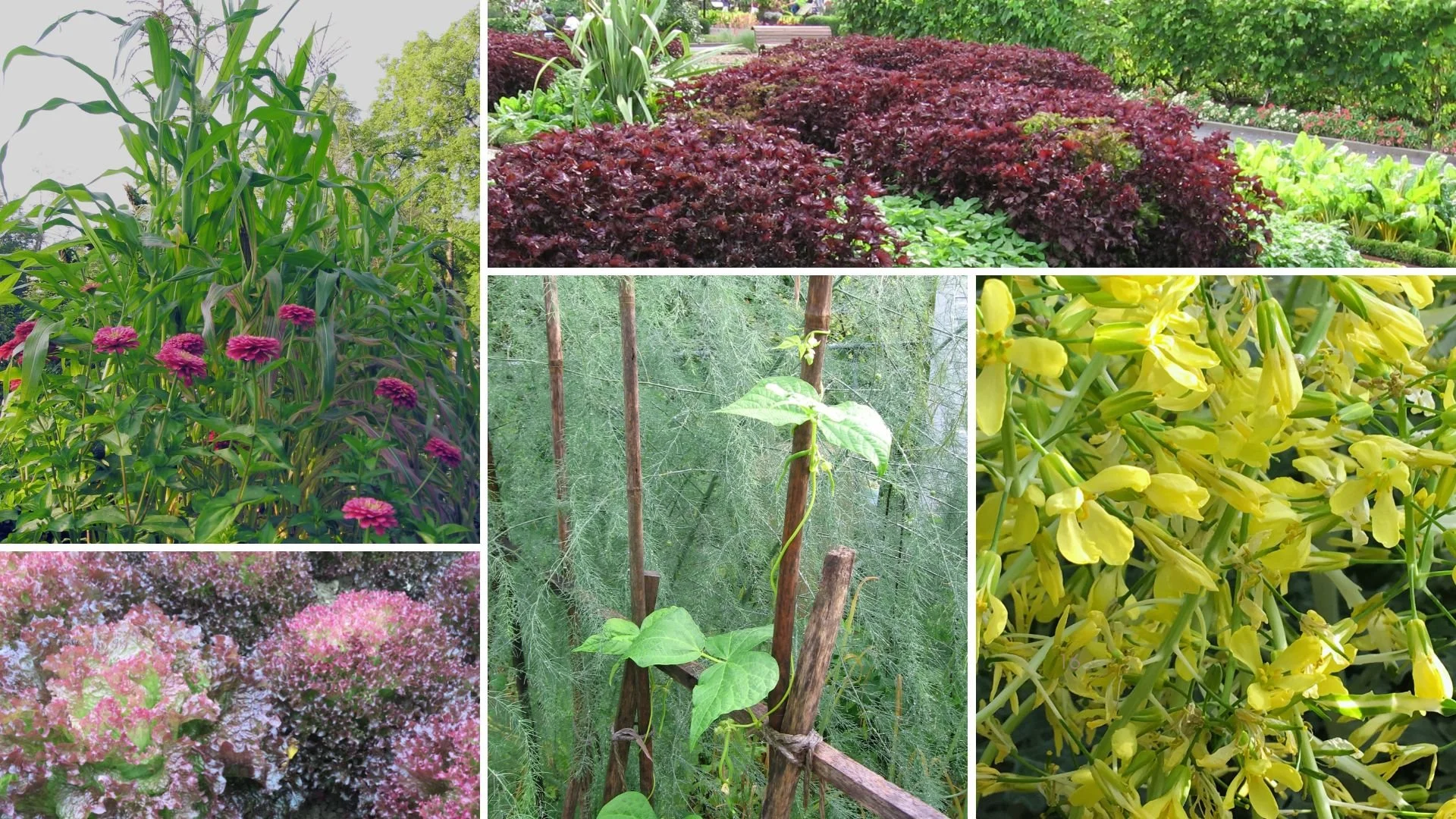
Create Your Own Unique Edible Landscape
That fits for your yard, and your style!
Malabar Spinach
(a.k.a Indian spinach, Ceylon spinach, vine spinach)
This vining plant is a spinach in name only. The leaves are thicker and waxier than true spinach. But it grows all summer—and grows well in heat of summer. The red-leaved varieties are quite ornamental.
Melons
Worried that you can’t grow melons and watermelons vertically because they’re too heavy? Don’t worry. Just make a sling to support the fruit.
Peas
If you've grown bush-types peas, you might not think of them as a vertical vegetable. For vertical gardening, get vining-type peas, which grow 6-8’ tall. ‘Tall Telephone’ is a well-known variety. (Remember, tendrils and shoot tips are edible too!)
Squash
Be sure to grow a vining squash variety, as many of the summer squash have a bush-like growth habit.
And…remember that you can eat more than just the squash fruit. Shoot tips are edible too.
Find out about eating squash tips and other lesser-known edible plant parts.
If you’re growing large winter squash, give extra support with a sling.
Tomatoes
Grow “indeterminate” tomatoes (a.k.a. vining tomatoes) for training upwards. They get taller and taller all summer long.
Most people think of growing tomatoes upwards…but some gardeners also let them dangle down. How about a curtain of tomato vines coming off a low-roofed shed or outbuilding?
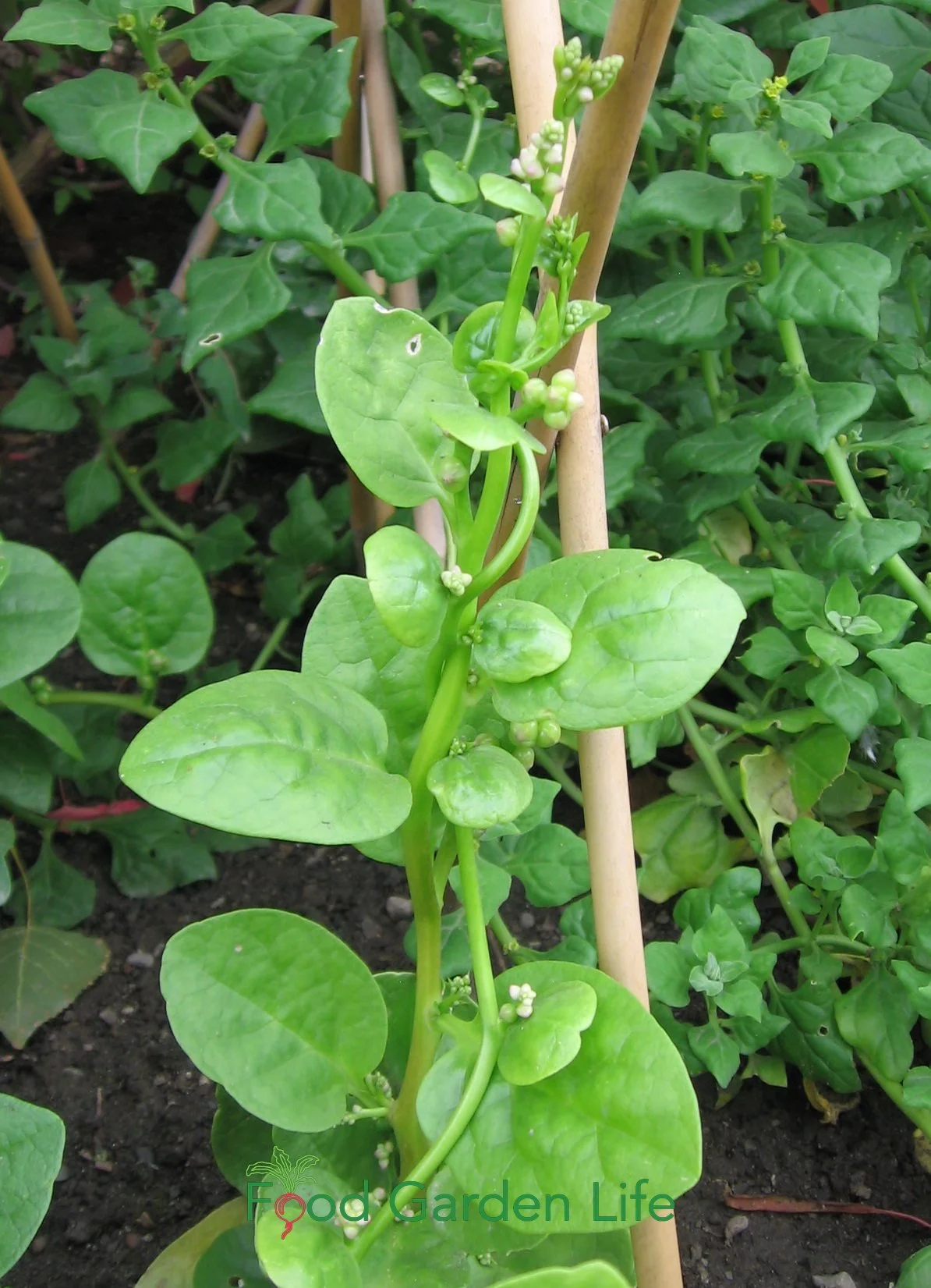
Malabar spinach.
Grow a Container Vegetable Garden
And get an early harvest of crops that usually take too long!
Materials for Making DIY Vertical Support Structures
Bamboo Poles
Bamboo poles are an easy-to-use material that is widely available.
Use bamboo poles to stake individual plants, or to make trellises and A-frames.
When attaching poles together to create a trellis or support structure, use twine or zip ties. (Just don’t use the bright yellow zip ties like the ones in the photo below…clear ones are much less noticeable!)
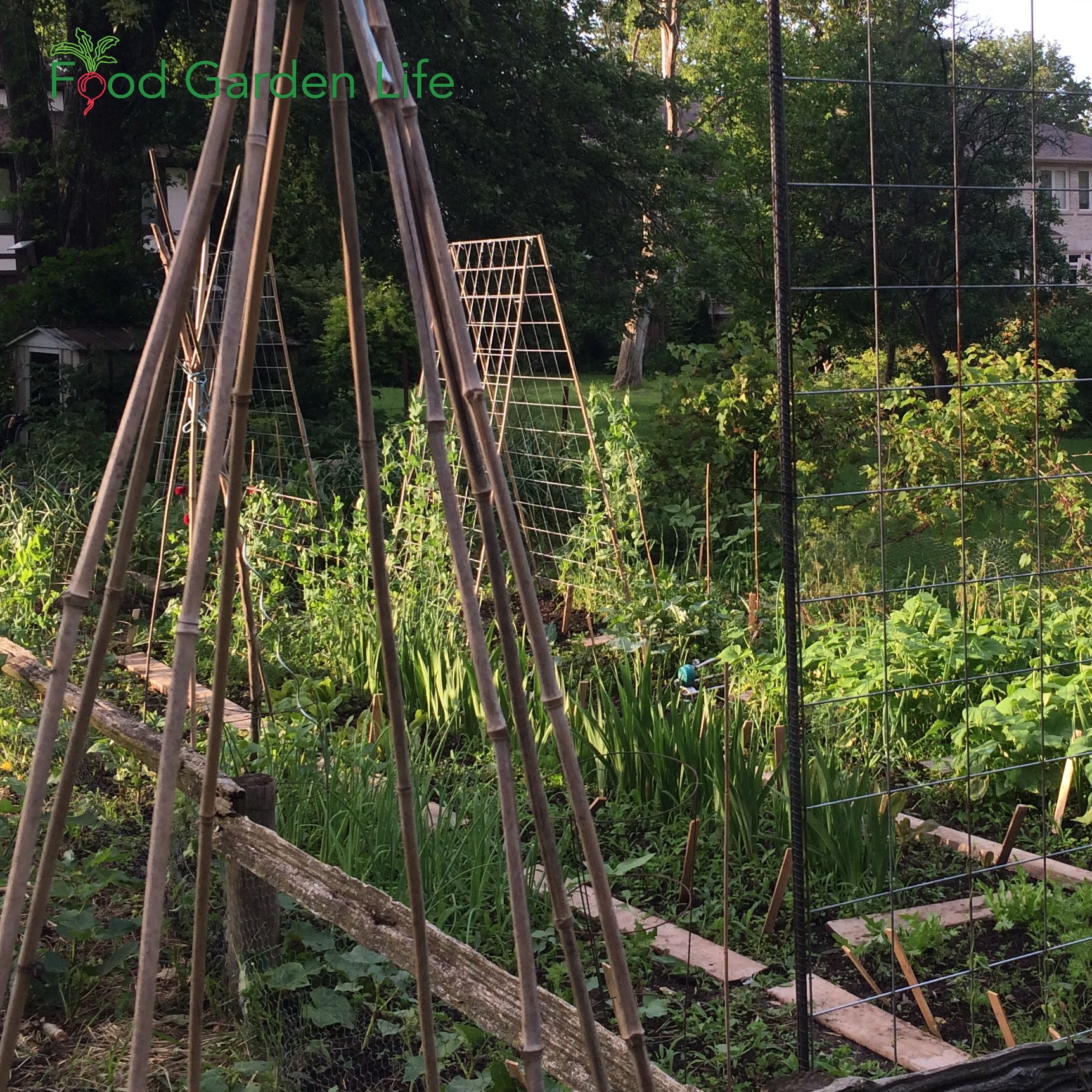
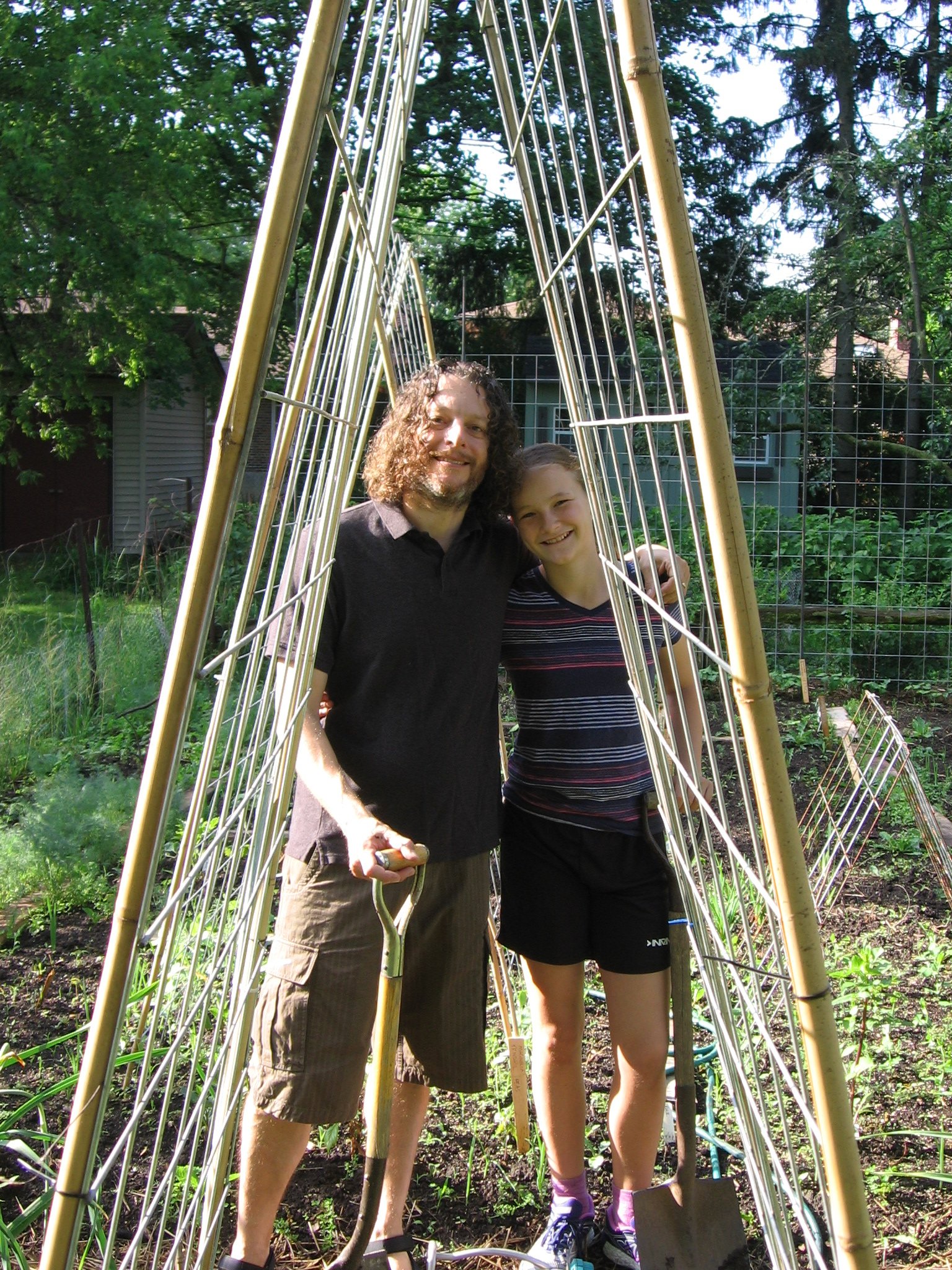
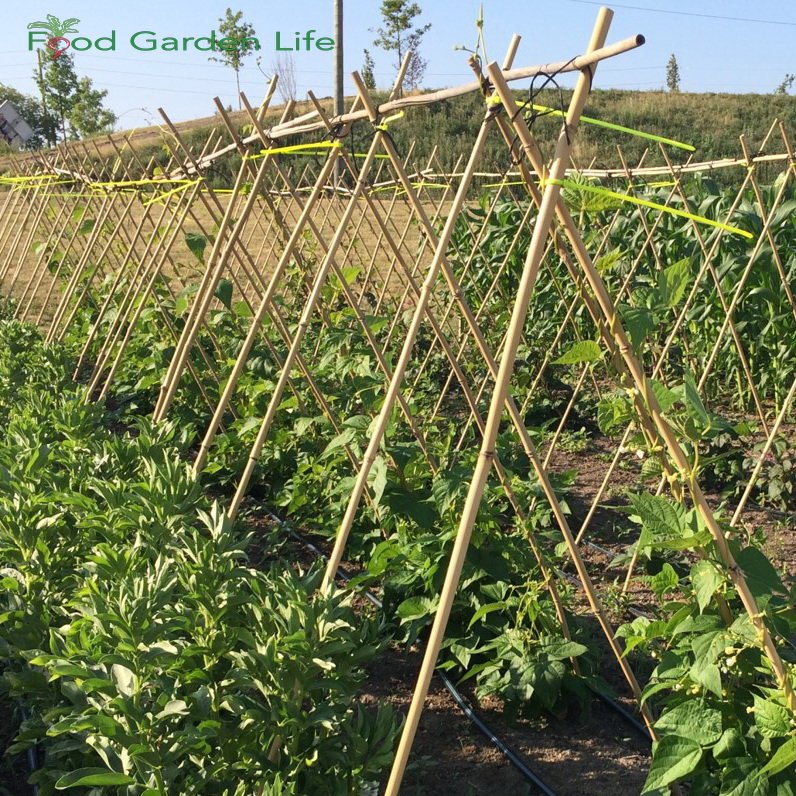
Branches
For a natural look—and for good economy—nothing beats branches.
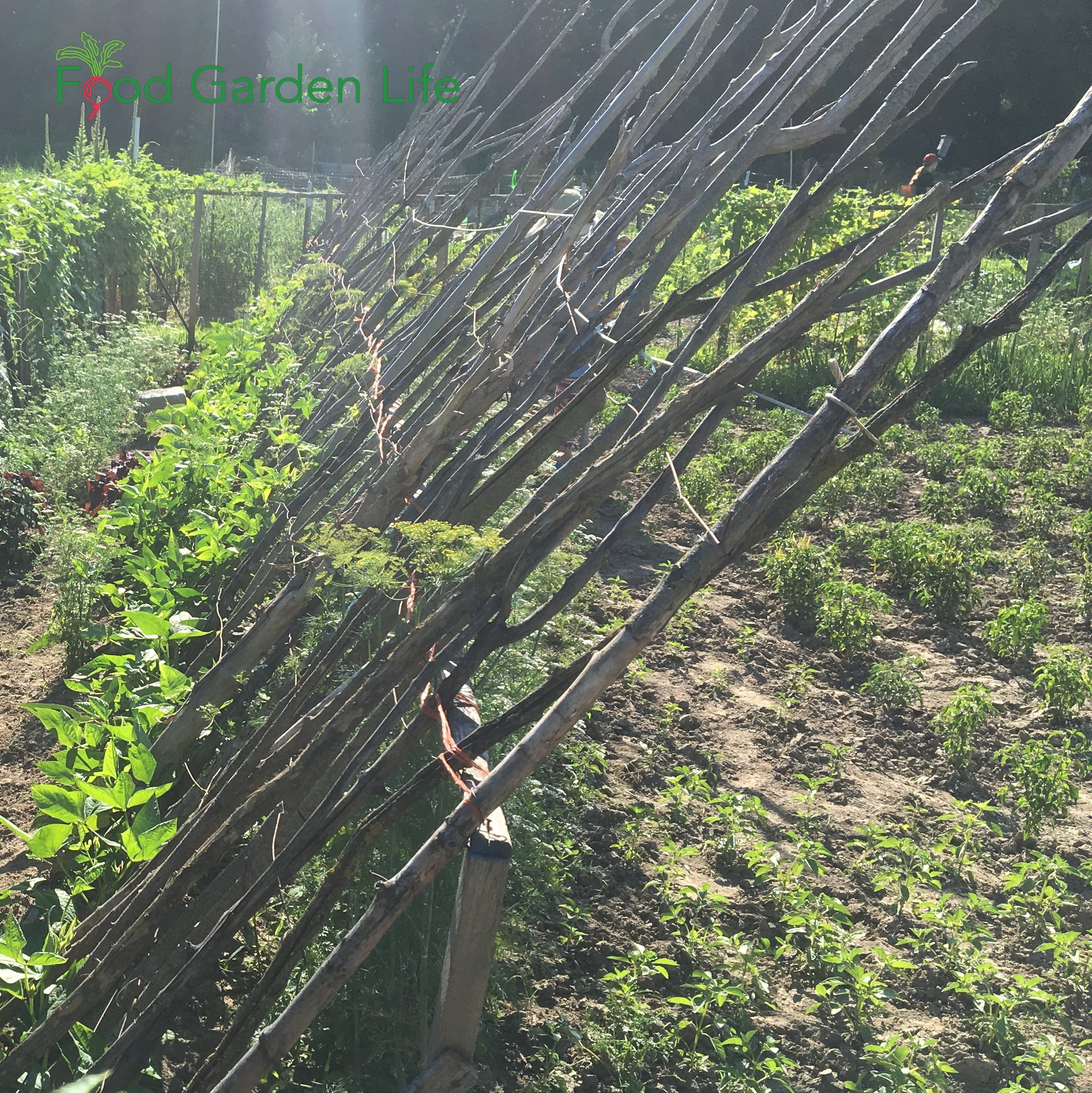
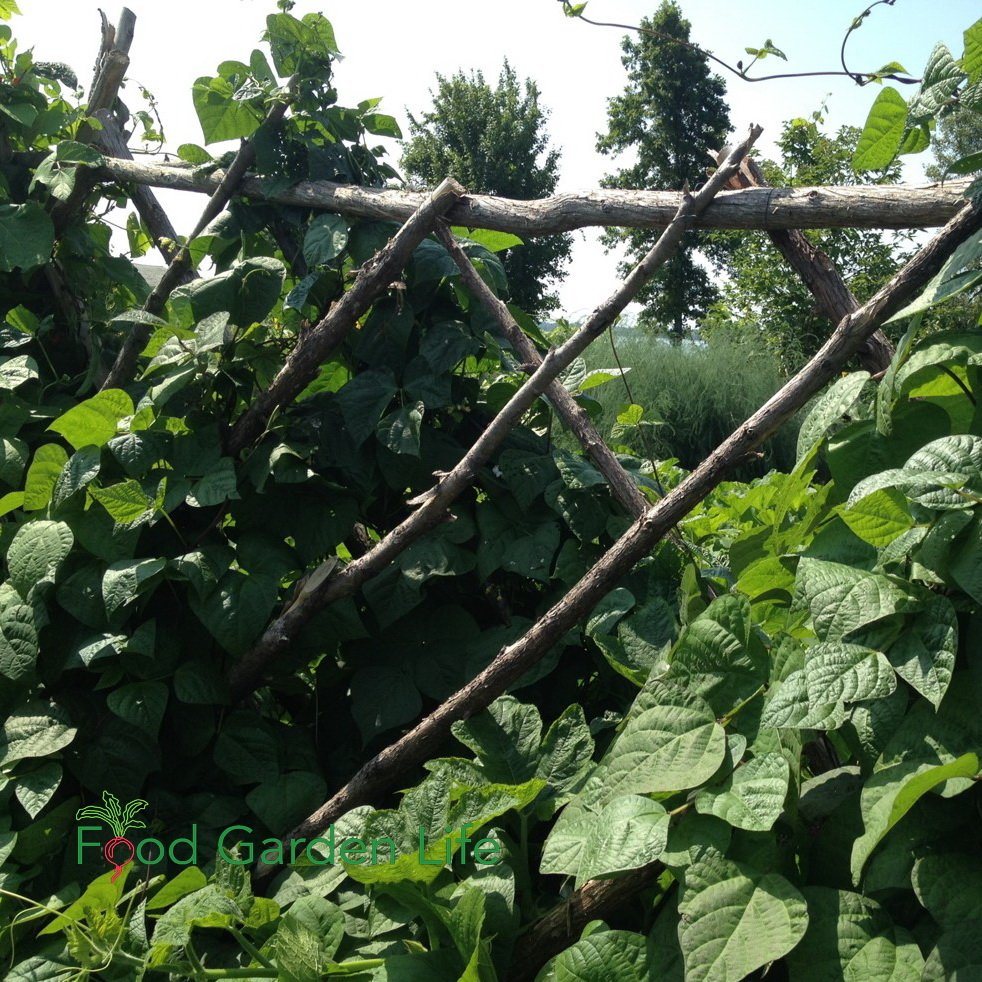
Twine
Natural-fibre twines such as jute and sisal readily break down when added to the compost pile or buried. They work well for tying plants and for making structures such as teepees.
If the twine will support a lot of weight (e.g. an 8’ high tomato-laden vine by the end of the season) consider something stronger. Either a thicker natural twine, or a synthetic twine.
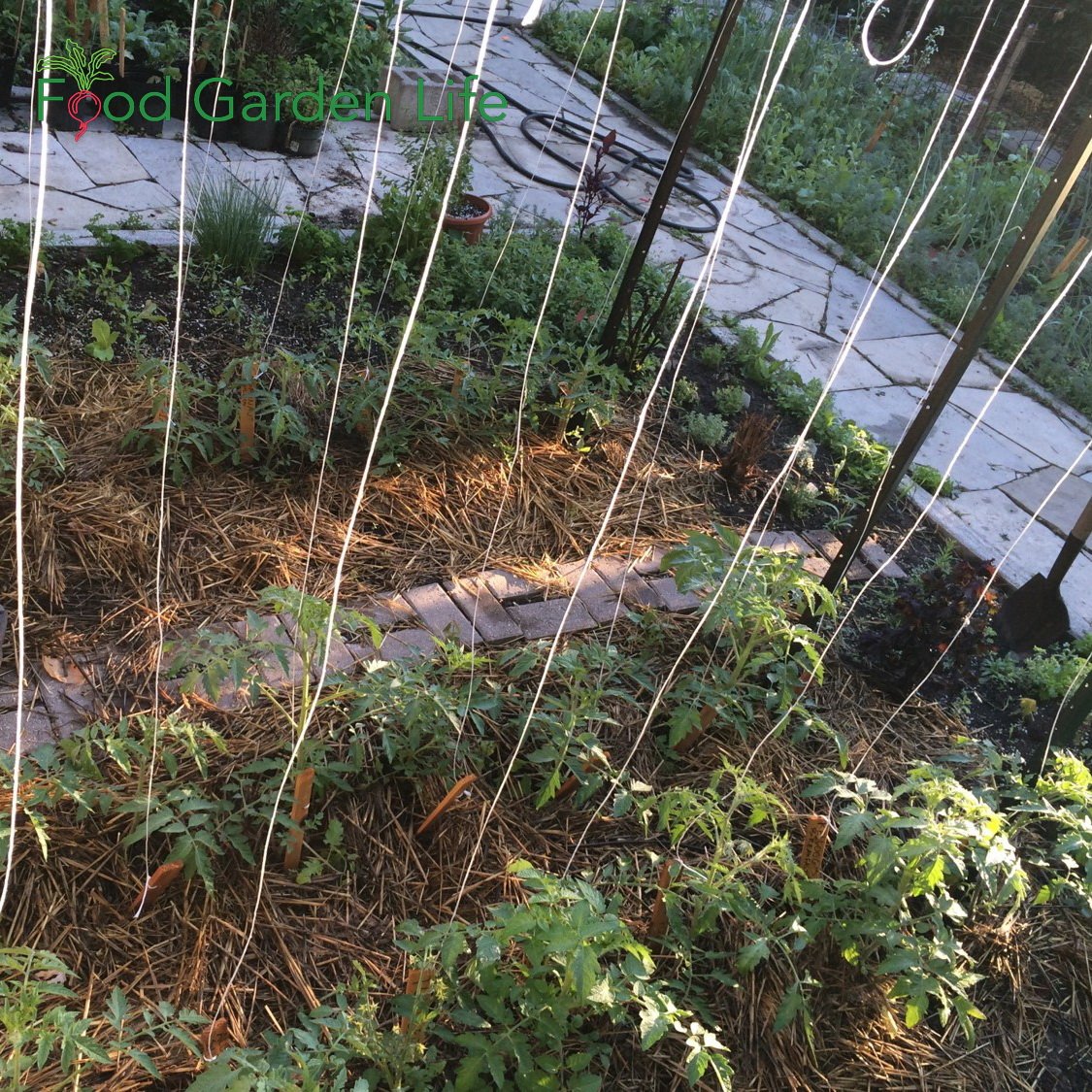
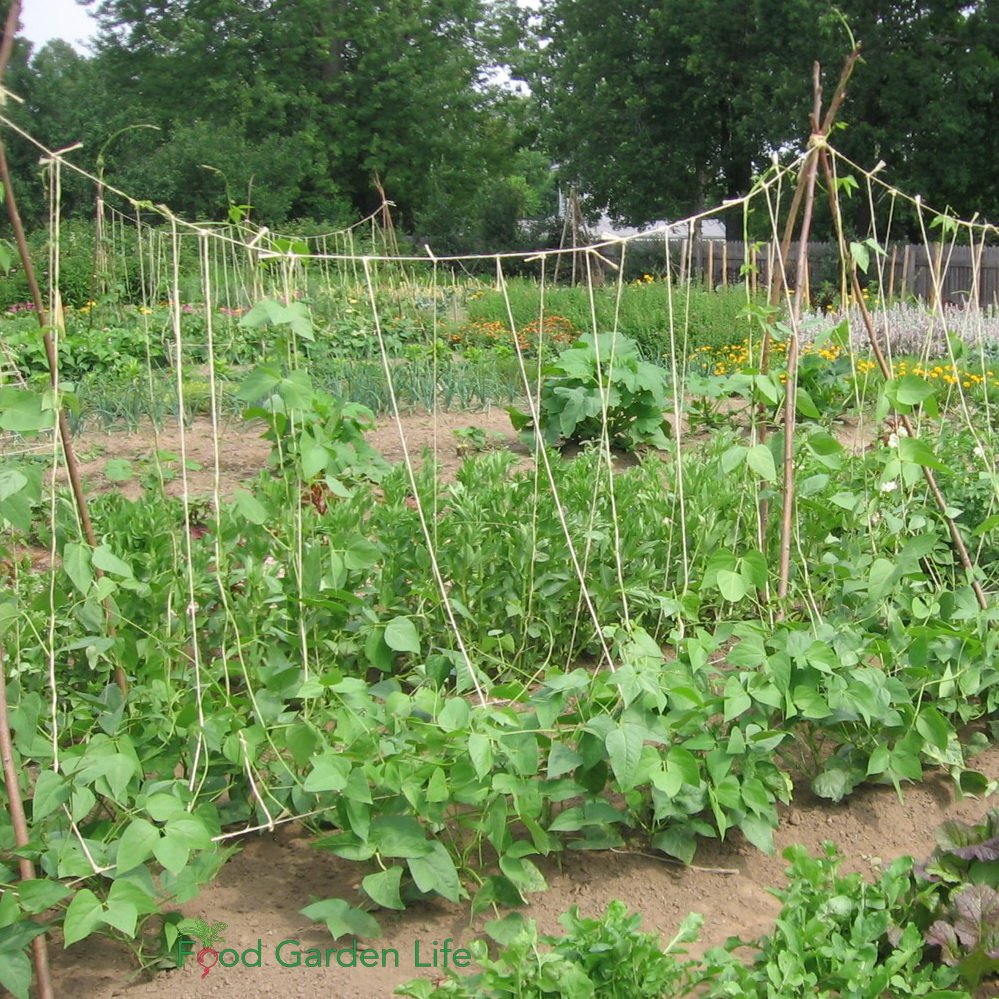
Lumber
Like branches, lumber can often be scavenged for free.
The one caveat: Don’t use pressure-treated wood. It contains copper compounds.
Lattice
Looking to combine vertical growing with some privacy shields? Lattice could be a building material to consider.
A sheet of lattice usually bends when stood upright, so plan to frame it with wood so that it doesn’t bend.
Create Your Own Unique Edible Landscape
That fits for your yard, and your style!
Metal Stakes
Metal stakes last a long time!
T-bar stakes. Strong. Plan to use a post driver or a sledge hammer to drive them into the ground
Iron rebar. Thinner than T-bars, meaning that if the soil is moist, it can often be pushed into the ground.
PVC Pipe
Use PVC pipe to create supports for your vertical vegetable garden. It's readily available,
Looking for ways to connect horizontal poles to an upright T-bar? Stick a PVC plumbing tee-join on top of the T-bar – and now there are holes on either side into which to slip a horizontal pole.
Wire Mesh
There are a few types of wire mesh available; not all of them at garden centres. See what you can find at hardware and building-supply stores. And if you’re in a rural area, farm-supply stores often carry a good selection of wire.
To get you started as you think about using wire mesh…
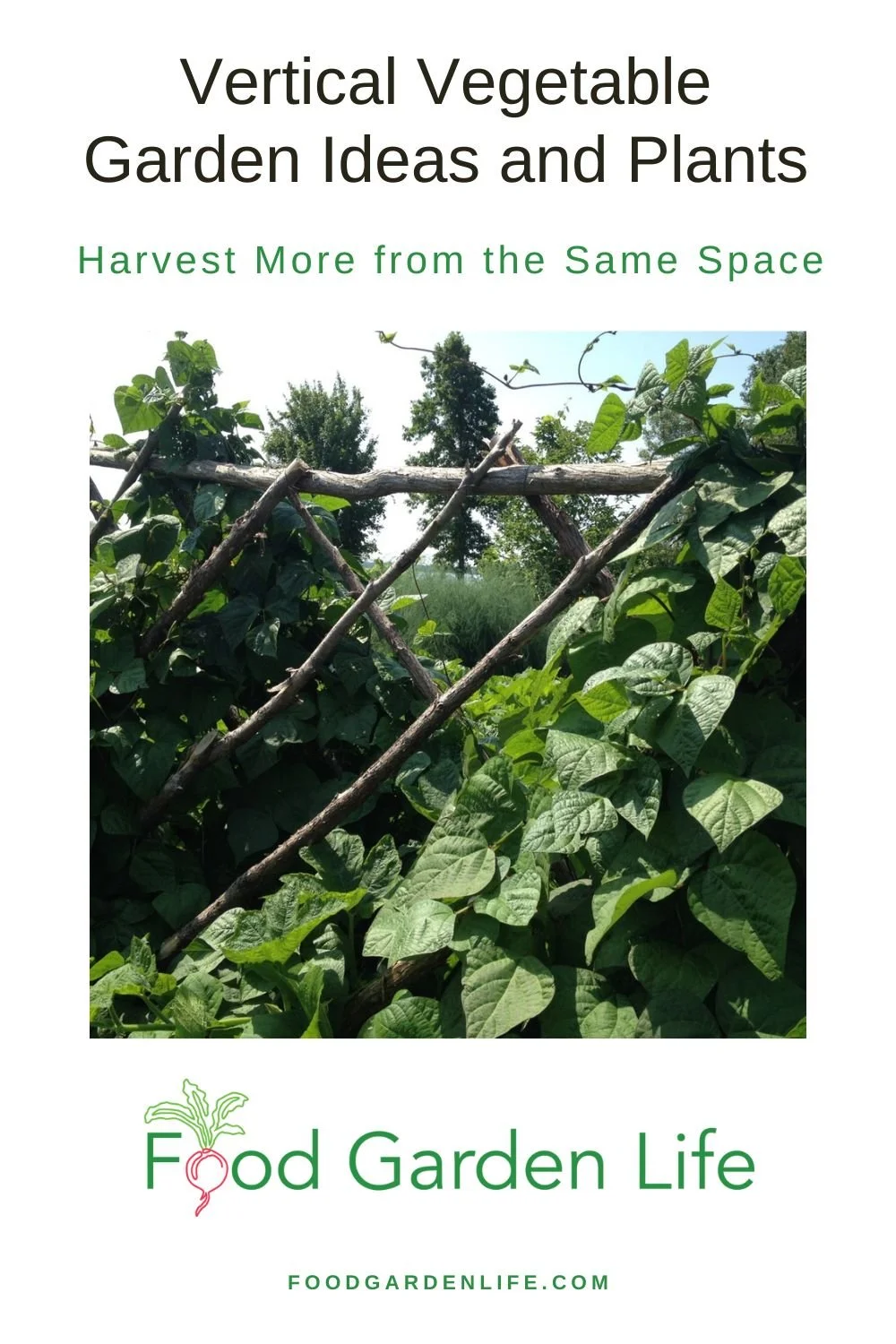
Pin this post!
Chicken wire. Easy to cut with tin snips.
Wire mesh to reinforce concrete. (A.k.a. remesh) Not galvanized like some other types of wire mesh, so it quickly takes on the patina of time and blends into the landscape. Tin snips won’t cut through this…plan for bolt cutter or a hack saw.
Hardware cloth. If you want closely spaced mesh that offers a visual shield, this can be an option. Cut with tin snips.
Cattle panels. Often galvanized. The spacing in the lower couple of courses of wire is often less than the other courses. More bendable than the mesh used for concrete—so if you’re looking to make an arch, a better choice.
Rolls of livestock fencing. Various gauges or wire and hole size available.
When buying mesh, think about this:
Do you want a galvanized product or not? Shiny obvious metal, or oxidized and less noticeable?
How will you transport it? Rolls can easily fit into the trunk of a car…but if you’re buying sheets of cattle panel or concrete mesh, you might need to put them on a roof rack (or track down a friend with a pickup truck!)
Find This Helpful?
Enjoy not being bombarded by annoying ads?
Appreciate the absence of junky affiliate links for products you don’t need?
It’s because we’re reader supported.
If we’ve helped in your food-gardening journey, we’re glad of support. You can high-five us below. Any amount welcome!
More Vegetable Gardening Information
Courses
Ornamental Vegetables for Fall
By Steven Biggs
Vegetable Crops That Look Great in the Fall
As I write this, it’s spring. But I’m picturing my fall garden.
I was just scouting out the spot where my Swiss chard will go this year.
I always fit in chard close to my kitchen window.
An Ornamental Edible
In the garden outside my kitchen window I weave together the ornamental and the edible. I especially treasure edible plants with ornamental appeal.
And that’s where chard fits in.
Swiss chard paints this part of my garden in yellows, reds, pink, and orange.
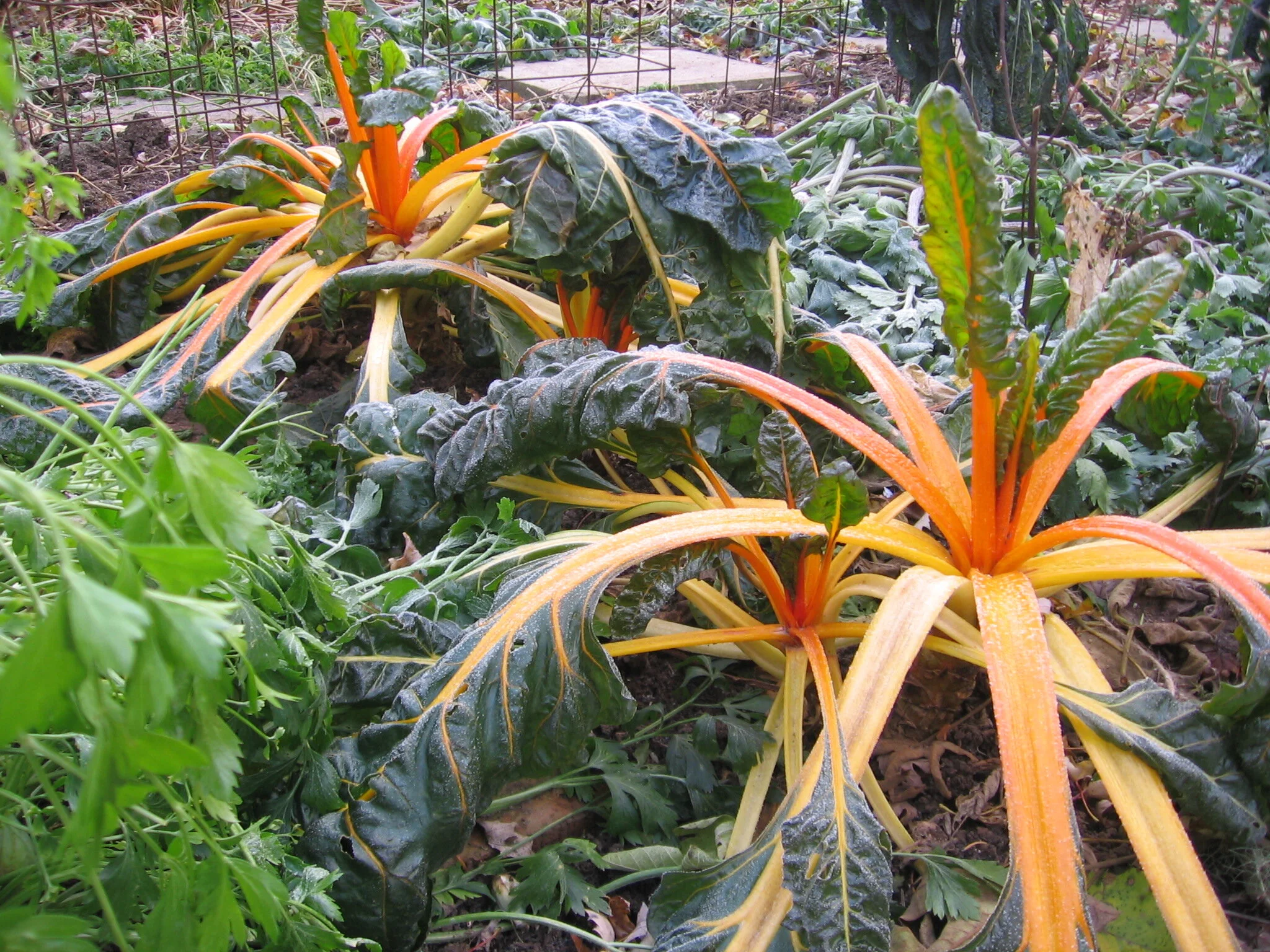
As cool, grey fall weather arrives, Swiss chard is a bright spot in a fading garden.
Summer-Long Production
Leafy greens like lettuce, spinach, and arugula come and go with summer heat.
They bolt
They get leathery
They get bitter
But Swiss chard sails through the heat with a prodigious output of tender leaves.
A Long-Lasting Edible
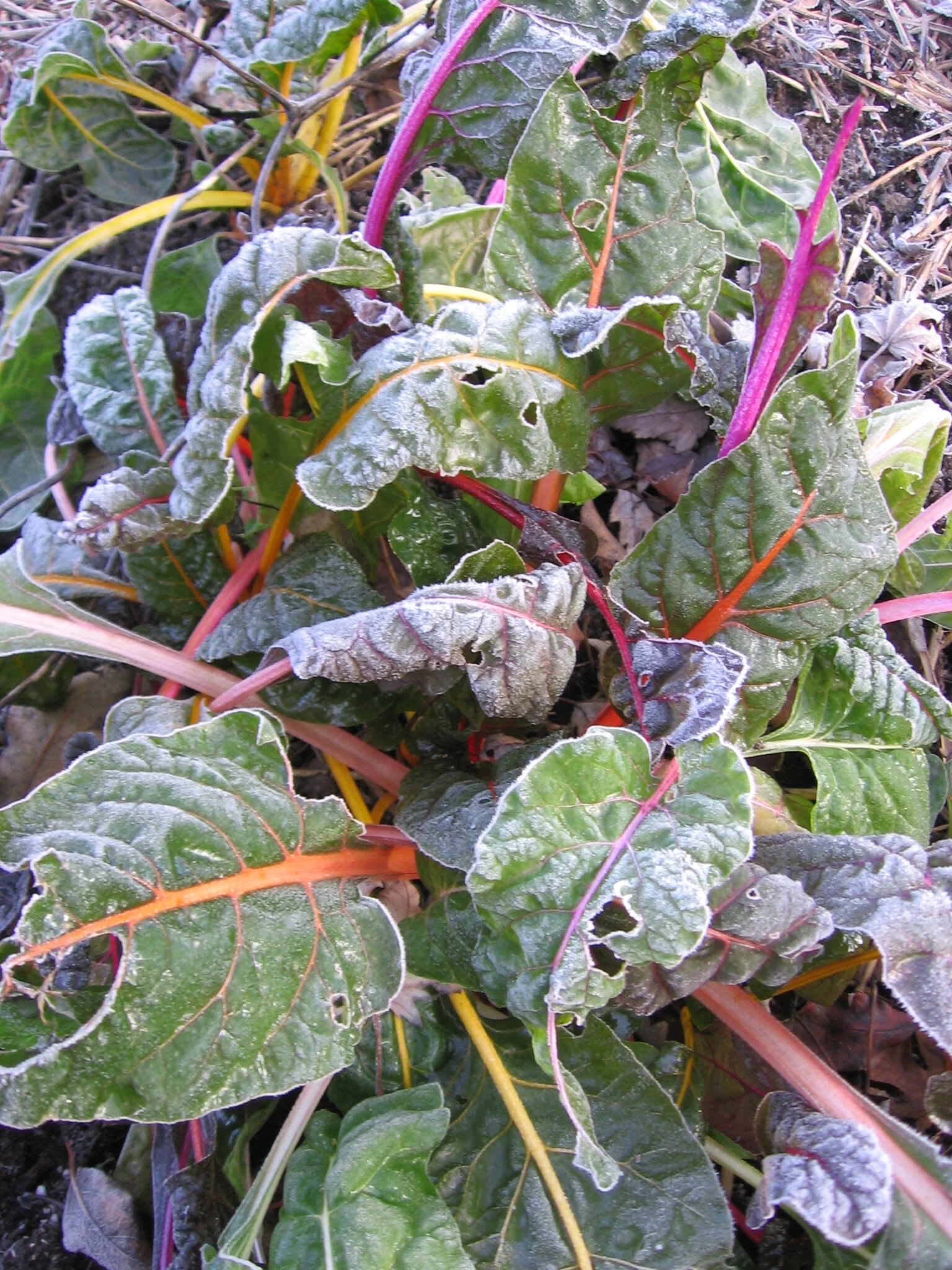
Swiss chard paints this part of my garden in yellows, reds, pink, and orange.
As cool, grey fall weather arrives, Swiss chard is a bright spot in a fading garden.
It shines.
When frost renders swathes of the garden a wilted green-brown, chard still shines. The bright leaves bow to the frost, then spring back up as sunshine warms them.
It perseveres until a hard freeze.
Put Chard Where You Can See it in the Fall
I’m picturing the spot where my chard will go, and making sure it’s somewhere I can enjoy looking at it from my kitchen window through the fall.
More Ornamental Vegetables for the Fall Garden
Cardoon is another ornamental vegetable that looks great in the fall. Find out more about cardoon.
Artichokes hold up nicely in fall weather. Find out how to grow artichoke.
Find This Helpful?
Enjoy not being bombarded by annoying ads?
Appreciate the absence of junky affiliate links for products you don’t need?
It’s because we’re reader supported.
If we’ve helped in your food-gardening journey, we’re glad of support. You can high-five us below. Any amount welcome!
Home Garden Soil Contamination
By Steven Biggs

Understanding the Risk of Soil Contamination Around Your Home
AFTER MOVING INTO MY WORLD WAR I-ERA HOUSE, I decided to find out if the paint-chip-studded soil next to the house was safe for growing edible crops.
Many pre-1991 paints contained lead, and those that are pre-1960s—particularly exterior paints—are thought to be the worst culprits.
Lead was also used as a gasoline additive into the 1990s. So urban areas with older buildings, where there have been years of car exhaust—and maybe even industrial emissions—tend to have higher soil lead levels than rural, agricultural areas.
With this in mind, I wanted to understand what, if any, risk lay hidden in my soil.
If you’ve wondered what, if anything, to check with the soil in your garden, keep reading for a practical way to approach soil contamination.
Conflicting Information

With an older house, I was worried about lead contamination from paint.
The more I delved into the question of urban soil contamination, the less clear the issue became.
I found a government fact sheet saying there was minimal risk to consuming veggies grown in soil with lead levels below 200 parts per million (ppm)
But one from another jurisdiction advising 300 ppm.
Both noted increased risk for children (think soil moving hand to mouth), in which case one gave a safe upper limit of 100 ppm.
I was left wondering whether I should go with 100, 200 or 300 ppm.
So I Got on the Phone
When I called Ontario’s Ministry of the Environment, I was told that contaminant levels in typical agricultural soil are often less than urban areas, but there should be no concern as long as the readings for my soil fell below the residential standards, as set out in the provincial Environmental Protection Act.
But…I should also keep in mind that a reading above that residential level isn’t necessarily unsafe.

Understanding soil contamination was starting to seem as fun as doing my tax return.
So, after scanning the Act, I added 45 ppm lead (for typical agricultural soil), 120 ppm lead (for residential standards), and a big question mark (for “isn’t necessarily unsafe”) to my growing list of values.
This was getting to be as much fun as preparing a tax return!
And just as filling in a tax return isn’t black and white—think of deciding what’s tax deductible and what’s not—I sensed balancing soil contamination and growing edibles had shades of grey, too.
So I set out to see how urban veggie growers can best tackle the question of soil contamination without being mired in conflicting numbers.
What Other Growers Do
Travis Kennedy, an agrologist involved in community garden projects, also raises produce at his Lactuca Micro Farm in Edmonton. “Pragmaculture,” he responds with a laugh, when I ask how he deals with possible soil contamination. His pragmatic approach to urban agriculture is to always use raised beds, bringing in soil he knows is safe, because he always assumes that there may be contamination.
Ward Teulon, also an agrologist, runs City Farm Boy in Vancouver, designing and building vegetable gardens. Teulon explains that sending backyard soil samples to a laboratory doesn’t always give a clear picture of what’s in the soil because urban soils are moved around a lot and are not uniform. He agrees, however, that interpreting results from expensive tests, which can cost hundreds of dollars, can be daunting. If there is a cause for concern, he believes money is better spent bringing in soil to make a raised bed. “Find out your property’s history,” he advises, because many urban soils are perfectly fine.
Luckily for me, my property’s history seems clear-cut, from agricultural to residential.
So, aside from the paint-chip-infested soil beside the house, I’m not worried. Gardeners who don’t know the history of their site could ask neighbours about past use and nearby properties, or check municipal records or archives.
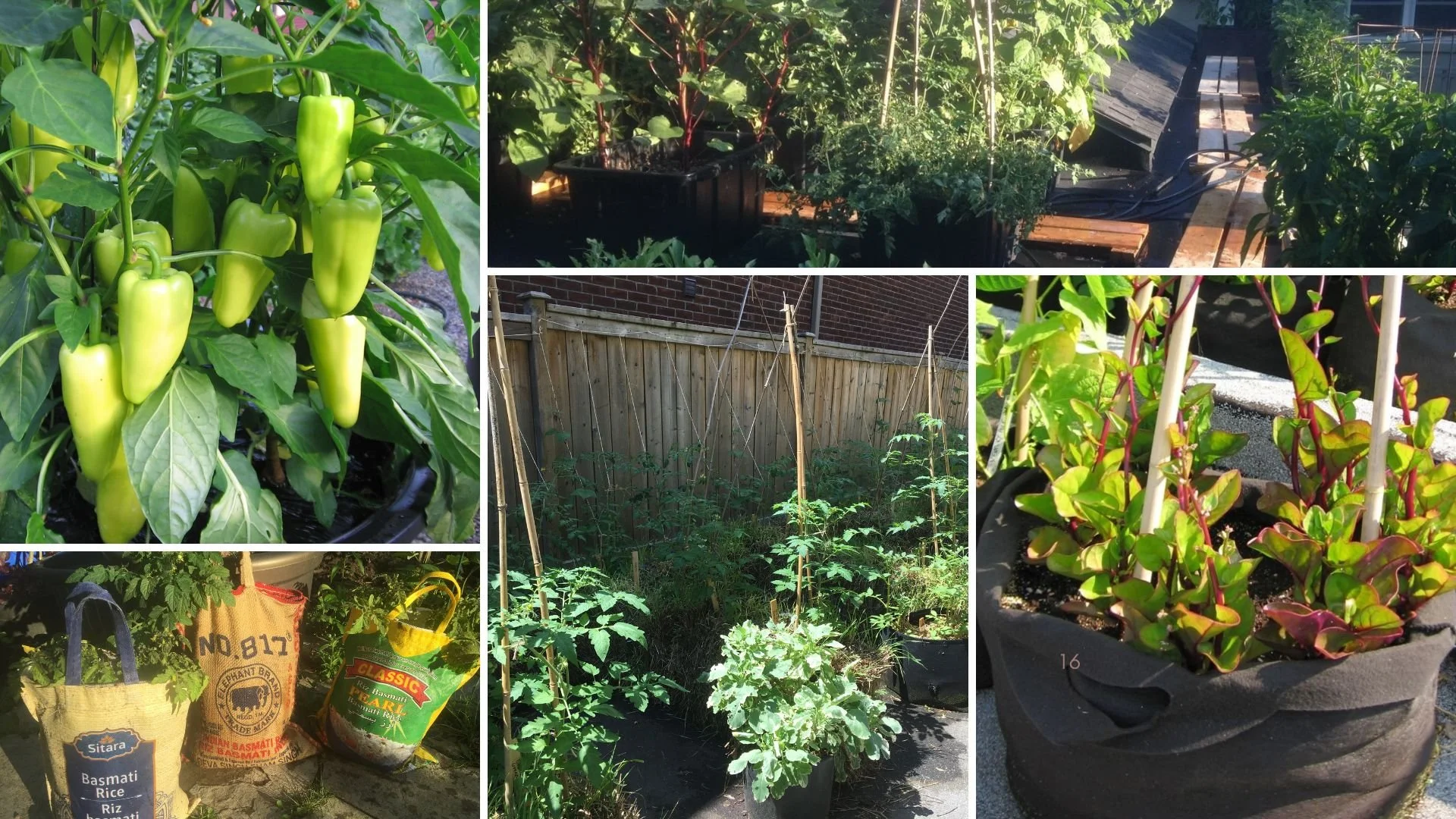
Grow a Container Vegetable Garden
And get an early harvest of crops that usually take too long!
Asssessing the Risk
In 2014, Toronto Public Health created a plain-language guide to help gardeners understand the issues surrounding possible soil contamination and growing edibles.
Josephine Archbold, who helped write the Guide for Soil Testing in Urban Gardens, says it’s wrong to think only experts can figure out when to grow and when to worry.
The guide moves away from the notion that soil is either safe or unsafe—a black-and-white approach.
“I think we need to move beyond the concept of ‘safe’ and ‘not-safe’ cut-off levels that tell gardeners to either garden (100 per cent) or not garden at all (0 per cent),” she says. Instead, the guide is intended to help gardeners think about the risk of contamination for a site, and gives options to deal with the situation. Testing is expensive, and raised beds can be expensive, too, so the guide encourages taking such actions only when the risk of contamination makes them appropriate.
Three-Step Guide
Step 1
Former orchard land is among those sites considered medium concern because of the legacy of old metal-containing sprays.
In the three-step guide, the first step is to establish a level of concern by looking at former land use. With high-concern sites (e.g., former gas stations), contamination is very likely, so the guide recommends skipping expensive tests and using risk-minimizing measures such as raised beds, container gardening, or cultivating fruit and nut trees—for which contaminant uptake isn’t a concern. Nor is soil testing recommended for low-risk sites (e.g., long-term residential areas).
There are medium-concern situations (e.g., hydro corridors and former commercial land) where testing is recommended, but even then, if gardens are smaller than 170 square feet (16 sq. m), raised beds are suggested because the cost of raised beds for such a surface area is likely less than testing. Surprisingly, former orchard land is among those sites considered medium concern because of the legacy of old metal-containing sprays.
After investigating the history of the garden site, another part of establishing a level of concern is physically inspecting soil: dig in a few random spots to see if there are unusual stains or odours, and note old equipment, tanks and debris that might provide clues to dumping. Dumping, burning, smells and staining can make for a high-concern site.
Step 2
When it comes to step two, testing the soil, the guide lists common contaminants, including some metals (such as lead, arsenic and cadmium), along with PAHs (polycyclic aromatic hydrocarbons), which Archbold explains are compounds that indicate past industrial activity. “Our soil screening values are specifically for urban gardening,” she says.
Create Your Own Unique Edible Landscape
That fits for your yard, and your style!
Step 3
The third step is to take actions to reduce risk. In keeping with the guide’s approach, the screening values don’t tell gardeners to either garden or not garden. The values help guide the actions of gardeners. For example, if test results or site history present a medium concern, suggested tactics are lowering the level of contaminants by adding clean soil and organic matter. Archbold says adding organic matter makes many contaminants less mobile.
Another example of how to reduce risk is reducing soil dust by covering soil with a mulch, peeling root vegetables before eating and avoiding crops more likely to accumulate contaminants (cabbage family, beets and spinach).
Suspect Contamination?
If you suspect contamination and opt for testing instead of raised beds, containers, or fruit and nut trees, the guide gives pointers about how to find an accredited lab in your area. When collecting soil samples, there are some important steps to follow—and the guide gives instructions for this as well.
As for the strip beside my house, I will plant a fruit tree. I still don’t know how many parts per million lead are in the soil there, but because the site inspection (namely, digging and seeing all those paint chips) points to a possibility of contamination, my guess is that lead levels could be on the high side. It’s a very small space, so I’ve ruled out expensive testing.
I’ve also ruled out a raised bed because I don’t want to redirect water into my neighbour’s yard. So, a fruit tree seems to me to be the most practical approach—and is an acceptable shade of grey for me.
Find This Helpful?
Enjoy not being bombarded by annoying ads?
Appreciate the absence of junky affiliate links for products you don’t need?
It’s because we’re reader supported.
If we’ve helped in your food-gardening journey, we’re glad of support. You can high-five us below. Any amount welcome!
More Food Gardening Ideas
Library of Articles
Courses

Hi, We’re Steve and Emma!
We help people grow food on balconies, in backyards, and beyond—whether it’s edible landscaping, a vegetable garden, container gardens, or a home orchard.
Courses

Free Food- Garden Guide
Books
Covering everything from lemon varieties, to location and watering, to pruning and shaping, to overwintering, dealing with pests, and more—and including insights from fellow citrus enthusiasts—this book will give you the confidence you need to grow and harvest fresh lemons in cold climates.
Orders may be shipped from Toronto or printed and shipped directly by our printing partner. Available destinations and shipping charges appear at checkout. All prices are in Canadian dollars.
Prefer an ebook? Find the Kindle edition on Amazon.