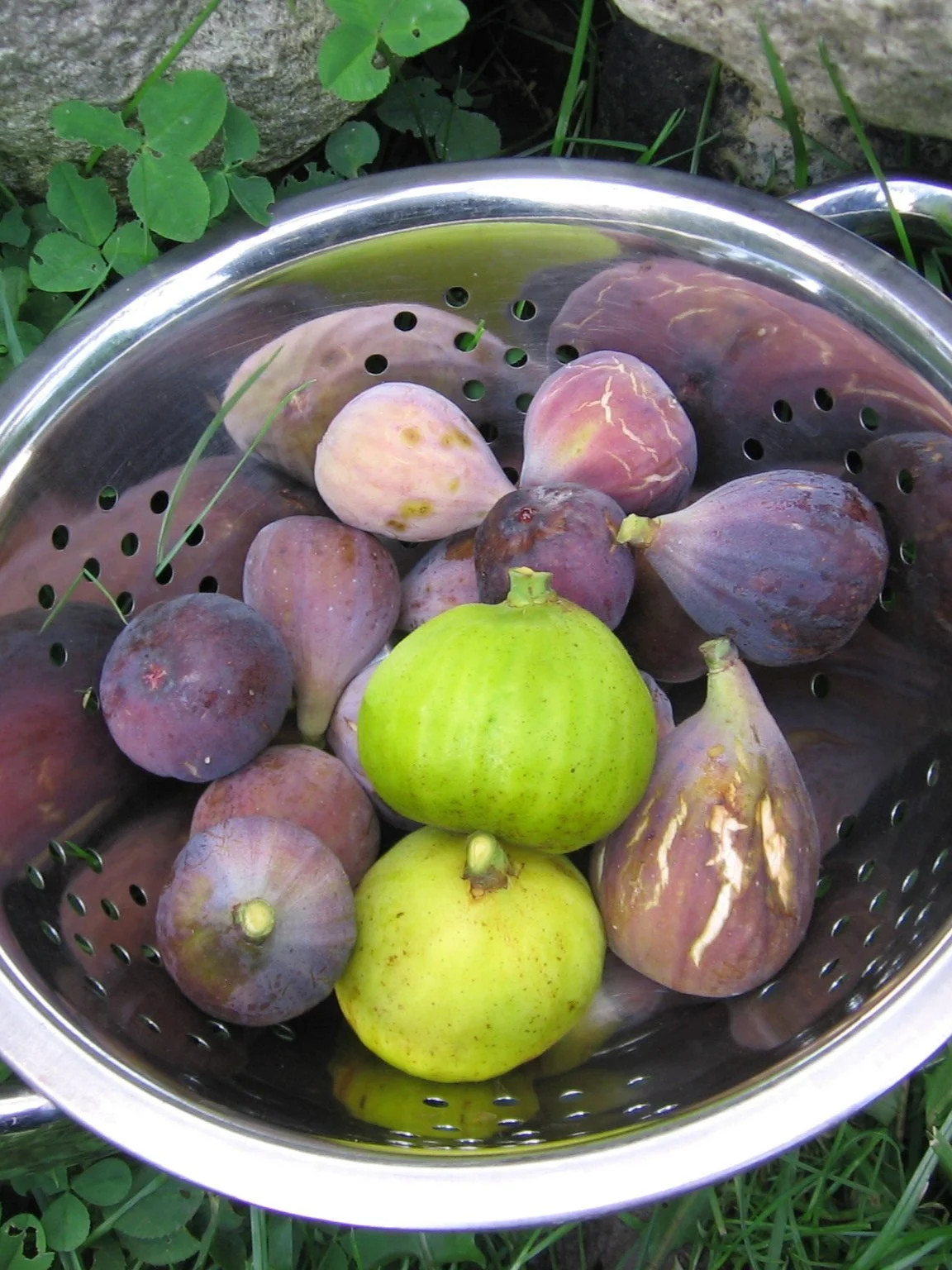
Cold-Climate Guide to How to Prune a Fig Tree
Growing figs in cold climates? This guide on how to prune a fig tree explains how to do it well.
By Steven Biggs
How to Prune a Fig Tree (and not Quit!)
I was really interested as one of the club members described how he clad his beloved fig tree in insulated panels every winter, making a temporary shed around it.
One of the pleasures of giving talks at garden clubs is that I get to meet lot of other plant lovers. And this guy was not only a plant lover—but a fig enthusiast too.
But then he told us that he “quit figs.”
He explained that the tree kept getting bigger…and he found it was too much work to protect it for the winter.
Please keep reading so that you don’t feel you have to quit figs. You can keep a fig tree quite compact. It’s just a matter of pruning.
Top Fig-Pruning Tip
In this article, I’ll talk about the idea of creating a permanent framework of branches on your fig plant. This framework will guide your pruning every year and make it simple. Think about your fig pruning this way, and it’s easy to prune well.
Overview of Fig Pruning
Things that Affect Fig Plant Pruning
First of all, there’s more than one approach to pruning a fig tree. There are a few things that affect how to do it, including the conditions in your garden, the variety, and the form you choose for your plant.
If that sounds overwhelming, just remember: Start by making a permanent framework of branches. After that, it’s easy.
Here are the first things to consider as we start to think about fig pruning:
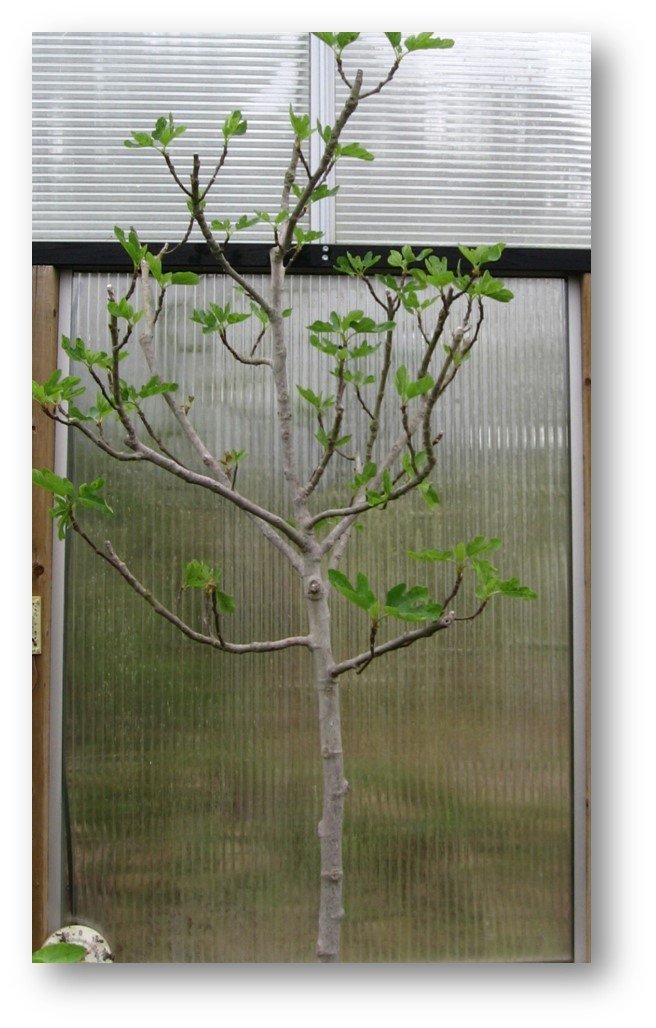
I love the look of trees, and find it’s easier to fit a number of narrow potted trees into a storage space over the winter.
Tree or bush: You can prune a fig tree into a tree or bush shape. There’s no right or wrong. I love the look of trees, and find it’s easier to fit a number of narrow potted trees into a storage space over the winter. But a bush is like having “fig insurance” because you have more branches in case there’s dieback over the winter.
Uniferous or biferous: This just refers to varieties that give either one or two crops. Uniferous varieties produce only the “main crop” figs later in the season; while biferous varieties produce a breba crop early in the summer, and then a main-crop fig later. We’ll dig into pruning for both of these types below, but just keep in mind that you can prune to optimize development and ripening of breba figs, main crop figs—or a bit of both.
Pot or in-ground: If you’re growing a potted fig, consider keeping your fig short enough that you can easily fit it through a door frame for winter storage. With an in-ground plant, height is still important, but there’s more wiggle room.

Get Your Fig Trees Through Winter
And eat fresh homegrown figs!
Here are a few more things to keep in mind as you get ready to prune your figs:
Unpruned figs get bushy, with lots of spindly branches that make small fruit…this is a plant that really benefits from pruning to optimize fruit production.
Breba figs form on branches from the previous year; main-crop figs on new wood…and we’ll relate this to pruning below.
If you chop back your plant too much, main-crop figs still form on the new branches…but it might be too late for ripening in short seasons (My neighbour Joe had an in-ground fig here in Toronto that he never protected. So it died to the ground every winter, and then regrew from the root…that dieback was like a very heavy pruning, except it was done by the cold weather. Those branches that grew did eventually form figs, but they never had time to ripen in our relatively short season because the figs formed too late.)

Remove branches that cross because fig plants have a tenancy to grow into a tangle of branches.
Remember, fig trees are quite forgiving. So if you make a mistake, don’t sweat it. Better to prune and make a mistake than not to prune at all.
Pruning Basics
A lot of pruning concepts that we use with other fruit trees work with fig trees too. So let’s review some of these pruning basics:
Remove branches that cross
Space out branches to allow light and air movement within the plant
Remove suckers
Cut back to a node or a branch (do not cut half way between nodes)
Fig Pruning Basics in 3 Words
Want three words to help you visualize good fig pruning?
Up
Out
Open
You’re pruning your tree to grow upwards, outwards, and have an open structure.
Types of Pruning Cuts

Didn’t think you can grow your own figs in a cold climate? Here’s all you need to know to grow exotic fresh figs, even if you live somewhere with cold winters. Find out about choosing the right location, watering, pruning—and how to conquer winter. You’ll also learn about varieties, dealing with pests, and get tips from cold-climate fig experts.
When we prune our figs, there a two types of cut we can make. The plant reacts differently to them—something we can use to our advantage.
Heading Cut. A heading cut is when you shorten a branch, but leave some of it. This type of cut encourages buds on the remaining bit of branch to grow. This is how you can get branches to grow where you want them.
Thinning Cut. This is when you entirely remove a branch, cutting it right back to what it came from. This is the type of cut to make when cleaning up a tangle of branches. It’s also what I use to form single-stem specimens. Energy is redirected to the remaining branch(es).
Whatever you do, don’t shear your fig plant like a hedge. If you do that, what you’re doing is a making a lot of heading cuts – and you’ll get willy-nilly sprouting of new branches and total tangled mess of branches.
Think of Pruning in 2 Stages

This book will help you apply creative “fig thinking” in your garden and harvest fresh figs even if you have a short summer or cold winters. With some fig thinking, you can harvest figs in areas where they don’t normally survive the winter! In this book, I share many of the questions I have been asked about growing figs in temperate climates, along with my responses.
Start with your formative fig pruning. This is where you shape a young, single-stemmed plant (often called a whip) to give you a permanent framework of branches.
(Your permanent framework of branches has “scaffold” limbs—the main branches. And it has secondary limbs coming off of these.)
Once you’ve created this framework, then every year you’ll do some maintenance pruning.
Developing a Shape
a.k.a. Formative Fig Pruning
Let’s get back to the idea of creating a permanent framework. Below I give pointers on how to create a permanent framework for a fig bush, tree, step-over, or fan.

When we create a bush we prune to induce branching low to the ground. Then we prune to have a permanent framework of multiple branches with an open centre.
Prune to Create a Fig Bush
When we create a bush we prune to induce branching low to the ground. Then we prune to have a permanent framework of multiple branches with an open centre. We simply using heading cuts to create a well-spaced branching form.
If you’re starting from scratch, here’s how you can do it:
Year 1
Start with a single-stem young plant.
At the end of the first season, cut back to 3-4 nodes high (this is a “header” cut that induces branch formation low down).
Year 2
New branches grow from buds on the piece of stem you left the previous fall.
At the end of year 2, keep three or four branches, cutting each of those branches back to 3-4 nodes.
Year 3
The fig bush will now grow more branches from the nodes you left on the new wood the previous fall.
At the end of year 3, cut back new growth to 3 nodes and remove spindly branches. Now you’ve made yourself a nice permanent framework of branches for a bush!
Get Your Fig Trees Through Winter
And eat fresh homegrown figs!
Prune to Create a Fig Tree
Year 1
Start with a single-stem young plant (or rooted cutting).
Pinch off side shoots and suckers.
Stake the stem if it’s flimsy. Staking and tying also helps to develop a straight trunk.
At the end of the first season, make a header cut at the height where you want the tree to branch out. (If the tree didn’t yet get to that height, continue growing it upwards in year 2 – the amount of growth it makes will depend on growing conditions.)
Year 2
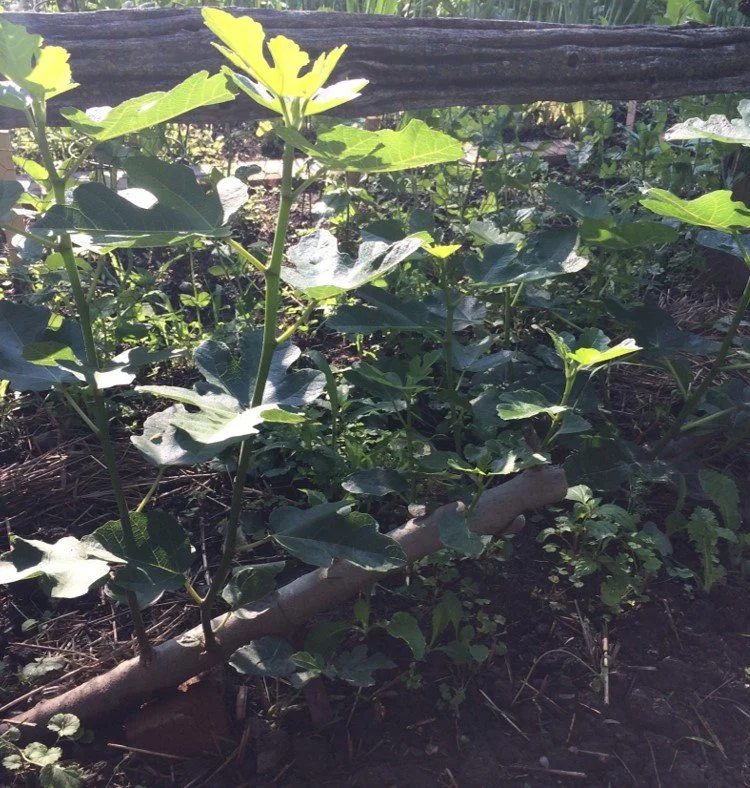
One way to make a step-over fig is to plant a single-stem fig tree on an angle so that the stem is horizontal.
New branches grow from the below where you headed the single stem.
At the end of year 2, keep three or four of the new branches, cutting each of those branches back to 3-4 nodes.
Year 3
The fig tree will now grow more branches from the nodes you left on the new wood the previous fall.
At the end of year 3, cut back new growth to 3 nodes and remove spindly branches. Now you’ve made yourself a nice permanent framework for a tree!
Prune to Create a Step-Over Fig
A step-over tree is a low-growing tree grown horizontally so that you can truly just step over it. I’ve seen apple trees growing in the step-over form—and love the appearance.
There’s something else about the step-over form too…
I think the step-over concept is well suited to cold-climate fig growers as low-growing, horizontal braches are relatively easy to insulate over the winter. Depending on where you are, a blanket of straw bales or leaves could suffice.
(While you could simply rake leaves over a step-over fig, sometimes when they get wet and packed down they don’t insulate as well. The solution is to fill large plastic bags with leaves, making “leaf pillows” to insulate your step-over fig.)
Here are tips if you want to prune your fig into a step-over form (often called a cordon):
Make a header cut at a low height to encourage branches that you can train horizontally.
If you try to immediately train those branches horizontally, they probably won’t grow as quickly. So let them grow upwards initially (or at a 45°angle), and then, as they get longer, gently bend and tie them so they are horizontal.
At the end of the season, gently bend the stems to a horizontal position and pin them down.
Or, if you’re in a hurry and have a single-stemmed fig tree, plant it on an angle so that the stem is horizontal.
Or…if it’s a single-stem young tree that is still very flexible, gently bend it into place (gently and slowly…I’ve snapped off plants unintentionally by trying to bend them too aggressively!)
Here’s a more detailed article about how to grow a step-over fig, a.k.a. a low cordon.
Prune to Create a Fig Fan

Fig espalier in a greenhouse.

The idea behind a fan is that you have a fairly flat form that can go against a warm wall.
You can also prune a fig tree into a fan shape. I once saw one at a nearby garden centre and was all set to take it home with me…until I saw that it was priced at $500. I didn’t think I could explain that expenditure to my wife.
So I made my own instead.
The idea behind a fan is that you have a fairly flat form that can go against a warm wall. The wall captures and releases heat. It’s a common technique for other sorts of fruit trees in cold climates, offering protection from frost and additional heat for ripening. Ripening figs in cold climates is all about heat…
Year 1
Start with a single-stem young plant
At the end of the first season, make a header cut at a low height to encourage side branches that you can train out in a fan shape.
Year 2
Make a fan-shaped trellis that you can tie the branches to.
Thoughts on Fig Height
I’m a firm believer that cold-climate fig growers should keep plants short enough so that figs are within reach of humans – not up high in the realm of squirrels or birds.
A 20-foot-high fig tree sounds lovely, but it’s not practical in a cold climate. Pruning is your way of keeping your fig tree at a height that you can manage for picking AND overwintering. And if you do it right, you can make a very fruitful tree that suits your particular needs.
Get Your Fig Trees Through Winter
And eat fresh homegrown figs!
Maintenance Pruning for Fig Trees
Above we looked at how to make yourself a permanent framework of branches for your fig tree or bush. Now let’s look at what to do once you’ve grown your fig plant to its ultimate size. (Yes, you control the size!)
When to do Maintenance Pruning
This book will help you apply creative “fig thinking” in your garden and harvest fresh figs even if you have a short summer or cold winters. With some fig thinking, you can harvest figs in areas where they don’t normally survive the winter! In this book, I share many of the questions I have been asked about growing figs in temperate climates, along with my responses.
We usually do this pruning while the tree is dormant. If I’m pruning potted figs that I store in my garage, I do this maintenance pruning when they’re dormant in the fall, before moving them indoors—so they take up less space. But for my in-ground figs growing outdoors (which I tip over and mulch for my growing conditions here in Toronto) I prune in the spring. I wait until the branches start to green up and buds swell, so that I can see if there is any winter die-back to trim off.
Prune Figs to Maximize Main-Crop Fig Production
Main-crop figs are the figs that grow on new wood from the current season.
Some varieties produce only main-crop figs. Other varieties (biferous varieties) give main-crop and breba figs. You might choose to prune a biferous fig top optimize main-crop figs (at the expense of breba figs) if you have other fig plants that give you breba figs.
Here’s an article about fig varieties for cold climates.
When pruning for main-crop figs, we are pruning to encourage new branches in the coming season.
While it’s Dormant
In the late winter or early spring, while the tree is still dormant, prune growth from the previous season to encourage new branches (remember, your main-crop figs grow on new wood.)
As we think about main-crop pruning, here’s something to keep in mind: Heavy pruning can delay ripening of main crop figs.
And in cold climates, where the length of our growing season is the limiting factor to ripe figs, that delayed ripening can be a challenge.
In warm areas a common practice is to prune back growth from the previous season to the permanent framework of branches—leaving just a short nub of each branch from which new branches can grow. This causes the plant to send out a lot of new branches, and on each of those are main-crop figs.
Didn’t think you can grow your own figs in a cold climate? Here’s all you need to know to grow exotic fresh figs, even if you live somewhere with cold winters. Find out about choosing the right location, watering, pruning—and how to conquer winter. You’ll also learn about varieties, dealing with pests, and get tips from cold-climate fig experts.
Here’s the challenge: This type of pruning can be too drastic in a cold climate—and few, if any, main-crop figs will ripen. It depends on the season, the variety, and how soon the plant started growing in the spring.
A safer way to prune for main-crop figs is to leave more of the growth from the previous season. Cut back branches part of the way—not all of the way—to the permanent framework. (Of course, over time this will give you a taller plant, but you can prune back a few branches to the permanent framework every year.)
While it’s Growing
There’s something else you can do for main-crop figs in cold climates: Pinching the tips in the summer.
Pinching might seem strange to fig growers in warmer areas, but in a cold climate such as Toronto, I know that I’ll only get 4-6 main crop figs to ripen on a given branch. Then cold weather arrives and we run out of time. So after a branch has 5-6 little figs growing on it, I pinch out the tip. This slows down shoot growth and formation of any additional figs, and directs more energy to those 5-6 little figs we’re hoping to ripen.
Prune to Maximize Breba Fig Production
Breba figs are the figs that grow on wood from the previous year. Because of this, the pruning approach above, for main-crop figs, won’t work. It removes growth from the previous year…so would not leave any branches with breba figs!
(Remember, breba figs grow on wood from the previous season.)
So when pruning for breba fig production, we want to keep growth from the previous season—it gives us figs.
Here’s what you do:
While it’s Dormant
Leave the year-old branches coming off the end of your permanent framework—it’s what gives you breba figs in the upcoming season
Prune off 2-year-old branches coming off the end of your permanent framework. These made breba figs the previous season…and if you leave them they’ll still make breba figs, but now those breba figs will be on the new growth, up high and out of reach. So cut these off, leaving about an inch of the branch remaining on your permanent framework from which new branches can form.
While it’s Growing
Here’s an additional step for breba-producing figs in cold areas where you’re protecting the plant over the winter. A shorter plant means less work protecting (wrapping or burying)…so let’s curb upward growth!
In spring and early summer, you’ll clearly see where the breba figs are, and, beyond that, the new growth that would eventually make main-crop figs. Pinch out the tip of that new growth to curtail the upwards growth of the plant.
Here’s more about winter protection for figs growing in cold climates.
Fig Pruning FAQ
I’m not starting with a young tree to grow into a nice framework. It’s already branched. What should I do?
There are probably some branches worth keeping. But if you’re new to pruning, mark branches before you start cutting. Put tape on the branches you want to remove before starting to prune. This will help you to visualize what the end result will look like.
Remember, with a heading cut you can make your fig grow branches where you want them.
What if I don’t prune one year?
If you miss a year, you certainly won’t hurt your fig tree. It will just get taller! Just be prepared to prune it back to your permanent framework the following year. And a heavier pruning might give you a bit less fruit production for a year—but it certainly won’t hurt the plant.
What if I have a mature bush that’s not well pruned?
Pick a four or five well-spaced branches to keep, and then tidy up the rest.
How small can I keep my fig tree?
Many new fig growers are reluctant to prune. It’s probably a combination of things: Pride at seeing the growth on the fig plants; and concern, too, that if they prune too much they might harm the plant. So please remember this: Like bonsai, the gardener determines the ultimate plant size. You’re the boss!
What can I do with the branches I pruned off of my fig plant?
This is the fun part! Root them.
I have an article about rooting fig cuttings here.
Another idea: If you like to make smoked food, fig wood gives a taste that’s very different from other fruit woods. Try it!
As well as using fig branches for a tasty smoke, you can cook with fig leaves. Find out how to use fig leaves in the kitchen.
What if I want to prune to get a mix of breba and main-crop figs?
You’ll take ideas from both of the pruning approaches above, so that you have a mix of branch tips from the previous season to give you breba figs, and you’re encouraging new branches that give you main crop figs. I’m working on that article next!
Find This Helpful?
Enjoy not being bombarded by annoying ads?
Appreciate the absence of junky affiliate links for products you don’t need?
It’s because we’re reader supported.
If we’ve helped in your food-gardening journey, we’re glad of support. You can high-five us below. Any amount welcome!
Want More Fig Information?
Articles + Interviews: Fig
There are lots of articles and interviews about growing figs on the Fig Home Page.
Books About Growing Figs in Cold Climates
Growing figs in a cooler climate? These books focus on how to grow figs where they won't normally survive the winter. Learn how to conquer winter and harvest figs!
Fig Books
Didn’t think you can grow your own figs in a cold climate? Here’s all you need to know to grow exotic fresh figs, even if you live somewhere with cold winters. Find out about choosing the right location, watering, pruning—and how to conquer winter. You’ll also learn about varieties, dealing with pests, and get tips from cold-climate fig experts.
This book will help you apply creative “fig thinking” in your garden and harvest fresh figs even if you have a short summer or cold winters. With some fig thinking, you can harvest figs in areas where they don’t normally survive the winter! In this book, I share many of the questions I have been asked about growing figs in temperate climates, along with my responses.
Fig Audiobook
Find out how to grow figs in a cold climate while you drive, garden, or work out at the gym!
Fig Course
Get Your Fig Trees Through Winter
And eat fresh homegrown figs!
Fig Tree Winter Protection with Ross Raddi
Here’s a chat I had with PA fig expert Ross Raddi about figs in cold climates.

Here’s a chat I had with fig expert Ross Raddi about figs in cold climates.
Ross is an innovative fig grower in PA who shares his fig adventures on his YouTube channel and on his website.
We chat about:
How I got into growing figs in a cold climate
My fig mentor
Protecting fig trees for winter
Find This Helpful?
Enjoy not being bombarded by annoying ads?
Appreciate the absence of junky affiliate links for products you don’t need?
It’s because we’re reader supported.
If we’ve helped in your food-gardening journey, we’re glad of support. You can high-five us below. Any amount welcome!
More Fig Growing Information
Fig Site
Books About Growing Figs in Cold Climates
Growing figs in a cooler climate? These books focus on how to grow figs where they won't normally survive the winter. Learn how to conquer winter and harvest figs!
Fig Books
Didn’t think you can grow your own figs in a cold climate? Here’s all you need to know to grow exotic fresh figs, even if you live somewhere with cold winters. Find out about choosing the right location, watering, pruning—and how to conquer winter. You’ll also learn about varieties, dealing with pests, and get tips from cold-climate fig experts.
This book will help you apply creative “fig thinking” in your garden and harvest fresh figs even if you have a short summer or cold winters. With some fig thinking, you can harvest figs in areas where they don’t normally survive the winter! In this book, I share many of the questions I have been asked about growing figs in temperate climates, along with my responses.
Fig Audiobook
Find out how to grow figs in a cold climate while you drive, garden, or work out at the gym!
Fig Masterclass
Get Your Fig Trees Through Winter
And eat fresh homegrown figs!
Intro to Growing Figs in Cold Climates
Get started growing figs in cold climates by understanding some of the basics about how the plants grow.
By Steven Biggs
Cold-Climate Fig Primer
I often hear from fig-lovers who travel to places where figs are so prolific that they grow from cracks in walls and pavement.
Big fig trees. Loaded with figs.
And these travellers come home to their gardens in colder areas and wonder if it’s possible to grow fig trees.
And if fig trees can they be kept small?
What to do with them in the winter?
And how much fruit can they expect?
If that’s you, keep reading. This post introduces you to growing figs in cold climates.
Fig Tree Size
Where the climate permits, fig plants can grow to 9 metres (30 feet) high.
But don’t worry!
If you’re gardening in a cold climate and took a deep breath at the mention of 9 metres — just remember that you control the size of the plant. Think of bonsai, where mature trees grow in small pots. As the gardener, you choose the size. (Keep in mind that the larger the fig tree, the more figs you can expect to get from it.)
Fig plants are naturally bushy, but can easily be pruned into a tree shape.
I keep my potted fig trees about 2 metres high, so that I can easily move them into a shed or garage for the winter. I also keep my in-ground fig trees short enough so that I can easily pick all of the figs without a ladder.
With pruning, you control the size. Find out how to prune in this Cold-Climate Guide to How to Prune a Fig Tree.
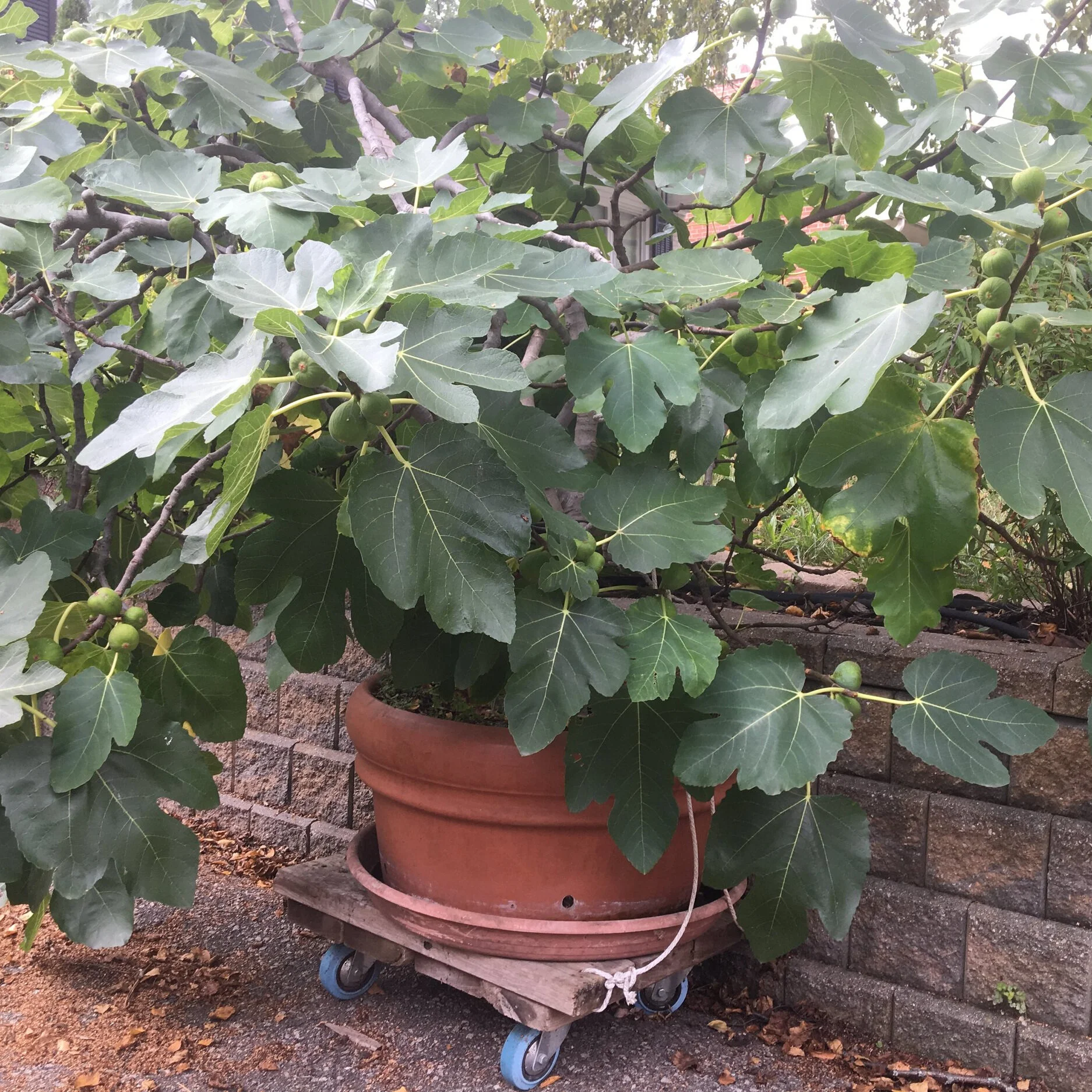
The gardener chooses how big the fig plant gets. This is my neighbour Natalie’s potted fig plant.
Fig Trees in Winter
Fig Trees go Dormant
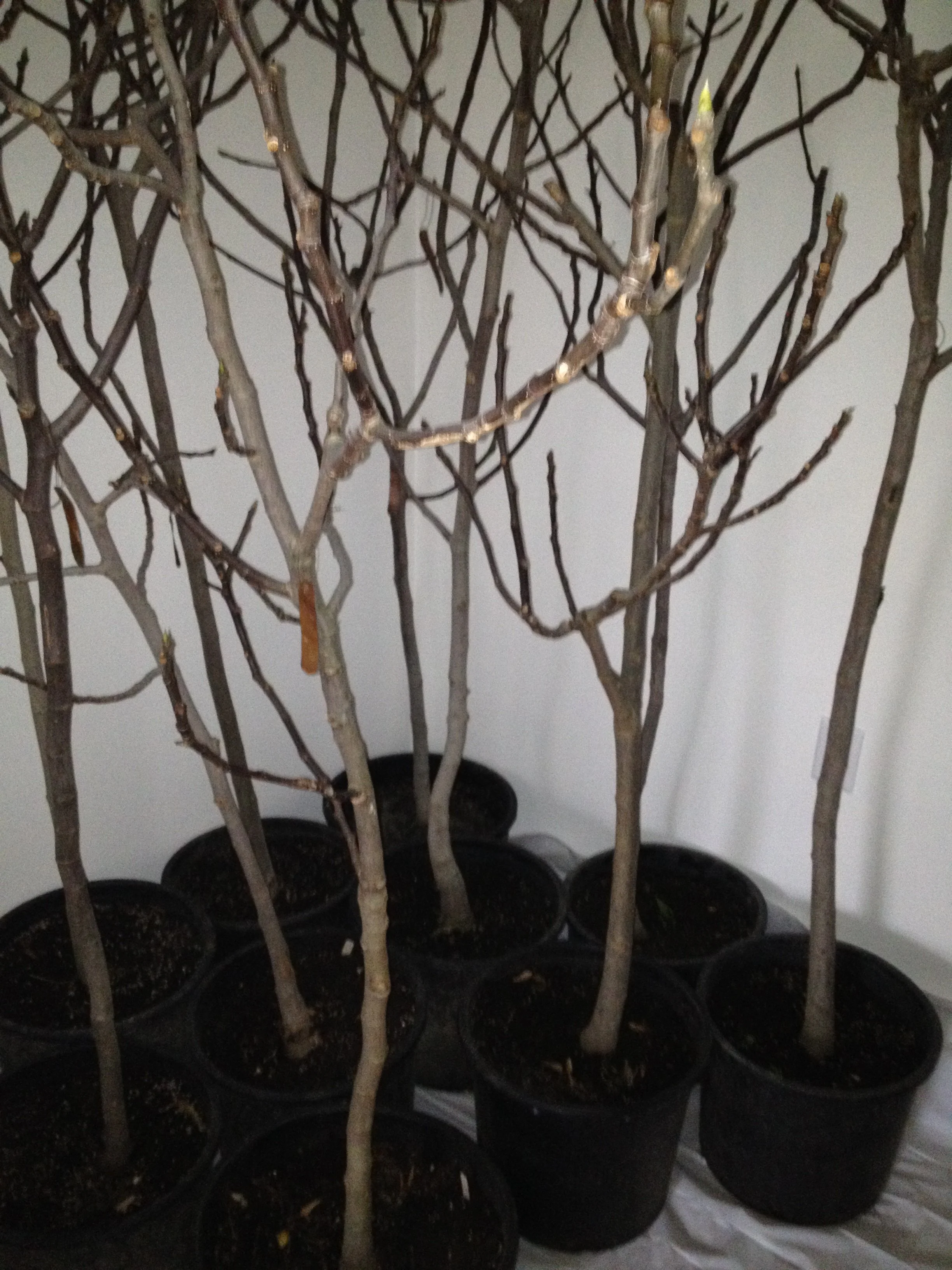
Because fig trees go dormant, there are many winter storage options. These are potted dormant fig trees that I store in my garage over the winter.
Many people associate figs with Mediterranean climates, with hot, dry summers and cool, wet winters. Figs grow and fruit well in these conditions. And in these Mediterranean climates, figs go dormant for the winter.
Our goal when growing figs in cold climates is to get our figs to go dormant. It gives us lots of options for overwintering. There’s no need for a greenhouse!
Where conditions permit, fig trees can grow year-round, so if you’ve heard of people growing them year-round, that’s why.
Fig Cold Tolerance
Fig plants tolerate colder temperatures than many people realize. Mature trees survive temperatures down to approximately -7 to -9°C (15-20°F).
Or colder…or, maybe, warmer. That’s because there are a few things that affect cold tolerance, so it’s not an exact science.
Fig Fruit
2 Possible Crops
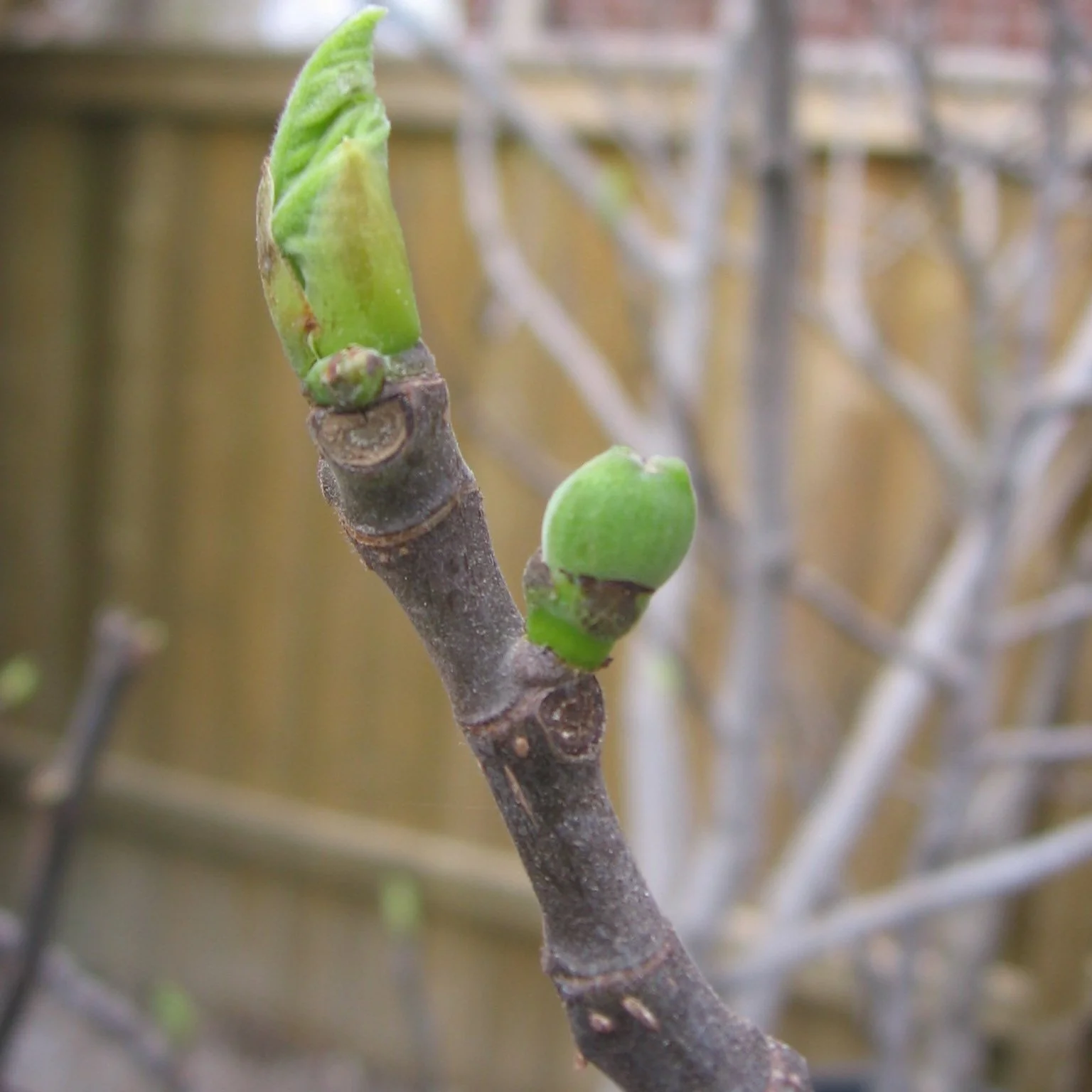
The “breba” crop grows on wood from the previous year.
Figs plants can produce two crops each year:
The “breba” crop grows on wood from the previous year.
The “main crop” grows on wood from the current year.
Not all fig varieties produce breba and main-crop figs. Some varieties produce only main-crop figs.
Here’s a bit of lingo you might come across as you read about different fig varieties. It refers to a variety giving one or both of the crops:
“Biferous” fig varieties produce breba and main-crop figs.
“Uniferous” varieties produce only a main crop.
Conditions for a Fig Tree
Fig trees give the best fruit production in full sunlight. Look for a location that has at least 8 hours of sunlight per day.
But there’s another reason that we want lots of sunlight when growing figs in cold climates: The warmer conditions in a sunny area help to speed up ripening. That’s important because season length is a limiting factor to fig production in cold climates.
Get Your Fig Trees Through Winter
And eat fresh homegrown figs!
Types of Fig Trees
This book will help you apply creative “fig thinking” in your garden and harvest fresh figs even if you have a short summer or cold winters. With some fig thinking, you can harvest figs in areas where they don’t normally survive the winter! In this book, I share many of the questions I have been asked about growing figs in temperate climates, along with my responses.
There are four fig variety types. In cold climates, we grow the latter two types:
Caprifig (figs are non-edible, but provide pollen for Smyrna and San Pedro types)
Smyrna (figs must be pollinated to mature, otherwise they fall off before fully ripening)
San Pedro (the breba crop doesn’t need pollination; but the main crop does)
Common (both breba and main-crop figs develop without pollination)
Wondering about pollination? The deed is done by a small wasp. But we don’t have that little wasp in cold climates, which is why we can’t get smyrna figs and the second crop of San Pedro figs to ripen. They will form…and start to grow…but then fall off before fully ripening.
So in cold climates we grow Common and San Pedro type figs.
Fig Harvest
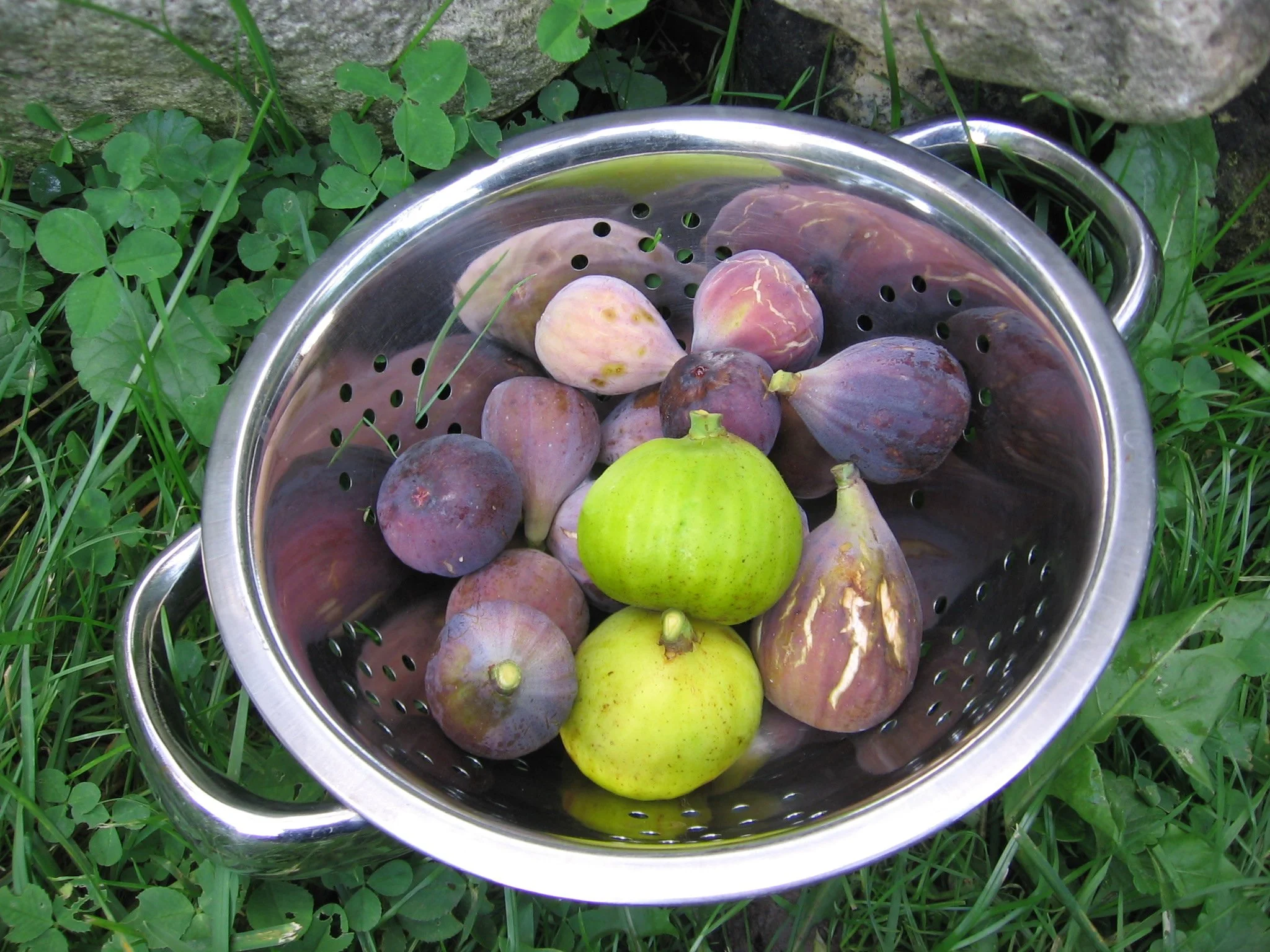
The size of the fig harvest you can expect in a cold climate depends on the variety, plant size, growing conditions, and season length.
The size of the fig harvest you can expect in a cold climate depends on a few things:
Variety
Plant size
Growing conditions
Season length
But if you give your fig plant favourable growing conditions, it’s not unreasonable to expect 100-200 figs from an 8’ high bush.
Figs don’t all ripen at the same time. Maturity is sequential, beginning with lower fruit.
Ripening slows down in cool weather, and then stops as the plant drop its leaves and goes dormant.
Find This Helpful?
Enjoy not being bombarded by annoying ads?
Appreciate the absence of junky affiliate links for products you don’t need?
It’s because we’re reader supported.
If we’ve helped in your food-gardening journey, we’re glad of support. You can high-five us below. Any amount welcome!
Looking for More Fig Tips?
Interviews with Cold-Climate Fig Growers
Find out what these 2 cold-climate fig growers do.
More Fig Articles and Interviews
Fig Masterclass
This online course tells you how to grow figs in a cold climate—and how to do it in a way that fits your space.
Get Your Fig Trees Through Winter
And eat fresh homegrown figs!
Books About Growing Figs in Cold Climates
Growing figs in a cooler climate? These books focus on how to grow figs where they won't normally survive the winter. Learn how to conquer winter and harvest figs!
Fig Books
This book will help you apply creative “fig thinking” in your garden and harvest fresh figs even if you have a short summer or cold winters. With some fig thinking, you can harvest figs in areas where they don’t normally survive the winter! In this book, I share many of the questions I have been asked about growing figs in temperate climates, along with my responses.
Didn’t think you can grow your own figs in a cold climate? Here’s all you need to know to grow exotic fresh figs, even if you live somewhere with cold winters. Find out about choosing the right location, watering, pruning—and how to conquer winter. You’ll also learn about varieties, dealing with pests, and get tips from cold-climate fig experts.
Fig Audiobook
Find out how to grow figs in a cold climate while you drive, garden, or work out at the gym!
Find This Helpful?
Enjoy not being bombarded by annoying ads?
Appreciate the absence of junky affiliate links for products you don’t need?
It’s because we’re reader supported.
If we’ve helped in your food-gardening journey, we’re glad of support. You can high-five us below. Any amount welcome!
Fig Fetishists: Oakville, Ontario
By Steven Biggs
In 2009, I wrote an article for Edible Toronto magazine feature two “fig fetishists” here in Southern Ontario. Below is part one, about Adriano Ferreira, a fig expert in Oakville, Ontario.
Adriano Ferreira on Growing Figs in Cold Climates
WHEN I’M ABLE TO BLURT OUT only a hesitant good afternoon, Adriano Ferreira pats me on the shoulder and graciously explains that the correct phrase is “bom dia,” which means good morning. With a mere half dozen Portuguese words in my vocabulary, I’m far from fluent, but have eagerly scanned my phrasebook before this visit because Ferreira had told me he will only share his most important secrets if I speak to him in Portuguese.
Although we’re in a Toronto suburb, you’d hardly know it in this manicured backyard filled with fig trees, plum trees, hardy kiwis, and grape vines. Ferreira points out a recent addition—a peach tree to which he has grafted a variety that bears doughnut-shaped fruit. Then, pointing to a fig tree in the ground with a trunk the diameter of a coffee mug, he says, “Anybody who has a house can have a big plant like that.” And the secrets to doing so are exactly what I’m here to learn.
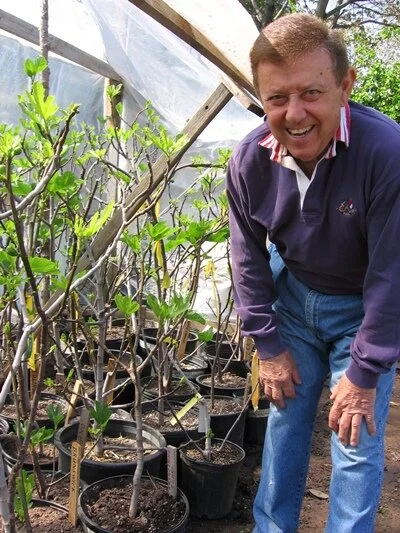
Adriano Ferreira
It’s figs that occupy most of Ferreira’s yard—and his heart. “Once you grow them, they’re the only fruit you’ll want to grow,” he exclaims.
While he jokes about guarding his fig-growing secrets, he is very generous with his time, taking a couple of hours to coach me through growing, overwintering, pruning, propagating, and ripening figs. It’s clearly a passion, and his enthusiasm shines through when he points out the techniques he’s developed to overwinter and coax fruit from his trees here in Ontario, Canada.
It Started in Massachusetts
Now retired, Ferreira started growing figs about thirty years ago while working in real estate. Reading a gardening magazine, he stumbled across the name of a fig-tree nursery in Massachusetts and noted that it was close to where his brother lived.
So on his next visit out there, he contacted the nursery owner who, it turns out, grew up near Ferreira in a neighbouring town in the Azores. They struck up a friendship that helped kickstart Ferreira’s fig tree collection.
A Rather Big Collection
Today, Ferreira’s collection takes up a good part of his yard where, along with well known varieties from fig-growing regions in California, Portugal, Spain, France and Italy, he has varieties from places such as the Canary Islands, Majorca, Austria, the former Yugoslavia, Iraq and Iran. He has two hundred varieties, which he claims is one of the largest private collections in the world—and the largest in Canada.
A recent addition is a tree that came up from seed in his garden around the time his granddaughter was born; he named it after her, calling it Angelika.
Ferreira fields enquiries from fig enthusiasts worldwide, both private collectors and researchers. A collector from Thailand recently paid him a visit. On another occasion, a foreign collector called just to make sure he really existed, surprised that such an avid fig collector—and fig trees—existed in Canada. But Ferreira is for real; he knows this fruit and his collection intimately, pointing to a particular tree and then describing its growth habit and fruiting characteristics.
Get Your Fig Trees Through Winter
And eat fresh homegrown figs!
Why Figs?
Didn’t think you can grow your own figs in a cold climate? Here’s all you need to know to grow exotic fresh figs, even if you live somewhere with cold winters. Find out about choosing the right location, watering, pruning—and how to conquer winter. You’ll also learn about varieties, dealing with pests, and get tips from cold-climate fig experts.
Someone who has tasted only dried figs or store-bought imported “fresh” figs might not understand the fascination with this fruit. Store-bought figs are never truly ripe because a fig picked too early never ripens to perfection, remaining corky in comparison to its tree-ripened cousin. When properly ripened, the neck of the fruit becomes limp and the body droops. Then a glistening drop of nectar escapes from the eye. This is the only time to pick it. By now, the fruit is dead ripe and far too fragile to withstand shipping.
There are light- and dark-fleshed varieties, and light- and dark-skinned ones, too. Ferreira’s website offers vivid descriptions such as lemon-yellow skin, melting in your mouth, strawberry flavour, and honey surrounding the pulp. When I wonder about the taste difference between varieties, he likens it to wine. An uninitiated palate might not perceive subtle taste nuances, but a connoisseur will.
“That’s a hard one,” he says, pausing when I ask about his favourite. He especially likes a variety called Desert King because its first crop ripens earlier than most varieties. But there are others he favours because of their flavour.
Growing Figs in Ontario, Canada
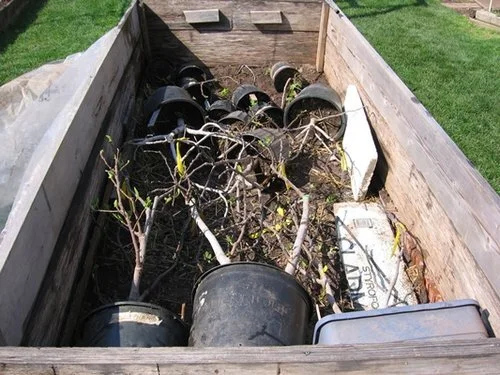
Adriano Ferreira overwinters potted fig trees in a wooden box.
Adriano Ferreira overwinters potted fig trees in a wooden box.
In warmer climates, figs grow to be large, branching trees. Small, specialized pollinators—fig wasps—look after pollination in fig-growing regions. But there are some varieties that requiring no wasps to produce figs.
There are two crops per season, one formed on the previous year’s growth, ripening in mid-summer, and one formed on the current season’s growth, ripening in September and October. The key to getting both crops is extending our relatively short season at both ends, and protecting trees from frost. “I’m always prepared,” says Ferreira as he points to the plastic he keeps ready to cover plants if there’s a late or early frost.
Ferreira explains the good news: you don’t need a greenhouse to grow figs here.
Many people with family ties to fig-growing regions keep potted trees that they bury outdoors or overwinter indoors. Instead of burying them, Ferreira bends over his in-ground trees and then covers them with an insulated A-frame, which offers sufficient protection from the cold. But most of his plants are in pots. These he lays on their sides within a wooden box that he covers with insulation, moderating the temperature sufficiently that they survive. On my visit in early May, they were beginning to leaf out.
Trees defoliate and go dormant with the first frost, he explains. In that dormant state, they can also be stored in a cool, dark basement. The key, he says, is to provide that dormant period. “They have to sleep,” he cautions; otherwise, they might not fruit.
Ferreira’s Secrets
Ferreira bends over in-ground trees and then covers them with an insulated A-frame, which offers sufficient protection from the cold.
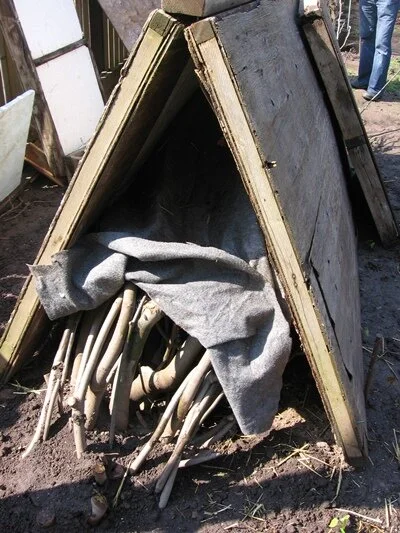
Ferreira bends over in-ground trees and then covers them with an insulated A-frame, which offers sufficient protection from the cold.
The real secret to coaxing the fruit to ripen in our climate is to gain a few days of ripening time.
Ferreira shows me a couple of trees over which he’s draped clear plastic bags. This creates a warm micro-climate around the tree, helping it to come out of dormancy more quickly. Once the current year’s growth is underway and figs are forming, another trick is to break off the tip of the branch, leaving four leaves on the current year’s growth.
What’s Ferreira’s big secret? Extra virgin olive oil. In the first week of September, he looks for figs that don’t seem as if they will ripen before winter, and puts a drop of extra virgin olive oil on the eye. After six or seven days, he repeats the step. While this doesn’t work on all of the fruit, he says, it helps some to ripen.
When I ask how big the collection will grow, Ferreira says, “I think I’m gonna stop,” saying he can only fit so many plants into a suburban yard. But then we visit his potting shed where he shows me a new method he’s developed to root cuttings from other collectors, and he shows me how he grafts hard-to-root varieties. I'm not certain I believe he will ever stop.
Before I leave, Ferreira introduces me to his neighbour Domenic, who has an immaculate vegetable garden and fig trees in his greenhouse. Grinning, he motions to Ferreira to look at his well developed fig trees. The secret, Domenic says, is that he sings to his figs in Italian. Ferreira laughs and responds that he sings to his figs in Portuguese.
Find This Helpful?
Enjoy not being bombarded by annoying ads?
Appreciate the absence of junky affiliate links for products you don’t need?
It’s because we’re reader supported.
If we’ve helped in your food-gardening journey, we’re glad of support. You can high-five us below. Any amount welcome!
More on Growing Figs
Fig Articles and Interviews
Fig Masterclass
Get Your Fig Trees Through Winter
And eat fresh homegrown figs!
Books About Growing Figs in Cold Climates
Growing figs in a cooler climate? These books focus on how to grow figs where they won't normally survive the winter. Learn how to conquer winter and harvest figs!
Fig Books
Didn’t think you can grow your own figs in a cold climate? Here’s all you need to know to grow exotic fresh figs, even if you live somewhere with cold winters. Find out about choosing the right location, watering, pruning—and how to conquer winter. You’ll also learn about varieties, dealing with pests, and get tips from cold-climate fig experts.
This book will help you apply creative “fig thinking” in your garden and harvest fresh figs even if you have a short summer or cold winters. With some fig thinking, you can harvest figs in areas where they don’t normally survive the winter! In this book, I share many of the questions I have been asked about growing figs in temperate climates, along with my responses.
Fig Audiobook
Find out how to grow figs in a cold climate while you drive, garden, or work out at the gym!
Ever Thought of Growing Olives?
Fig Leaves in the Kitchen
By Steven Biggs
Fig Leaf Ice Cream

It starts with an e-mail. The subject line reads, “fig leaves.”
Expecting the usual early-fall question about fig rust, I am surprised when I open the e-mail and read:
“I am looking for fig leaves to make dishes with at my restaurant (fig-leaf ice cream, jelly, savoury sauces, custards etc.) Is there any possibility of getting some from you, before they fall for the winter?”
Sweet Smell of Fig Leaves
I have never tasted anything made using fig leaves. But right away I think of the sweet, slightly earthy, coconut-like smell that wafts over from the figs trees in my garden on a hot day.
So it was that Chef David Salt drops by my garden for some fig leaves in early October, before they get nipped by frost. He tells me that when he was a chef in London, England, he knew where to go for fig leaves. But here in Toronto, he hasn’t been able to find a supply…until now.
He fills a couple of bags with fig leaves, which he will freeze until he is ready to use them. Then we agree that I’ll drop by the restaurant some time to taste his fig-leaf creations.
Get Your Fig Trees Through Winter
And eat fresh homegrown figs!
Tasting Fig-Leaf Dishes
I stop in at the restaurant a couple of weeks later to try a fig-leaf grappa, a fig cheese, and a fig-leaf ice cream.
Fig-Leaf Ice Cream

Cooking with fig leaves
David explains that this light coloured ice cream is made with the extract from steeped fig leaves. It’s lucky that I have come when I do, because there is only a little bit left in the container. At first I don’t taste the fig leaves, but then, slowly, a gentle fig-leaf flavour comes through at the back of my mouth.
David finds the fig-leaf flavour goes well with something sweet; I agree.
Fig-Leaf Cheese
While I’m tasting the ice cream, Sous Chefs Udit and Mandar go to get a ball of fig-leaf cheese, and then peel back the cheese cloth so that we can all taste it.
David’s fig-leaf cheese, while unintentional, is delicious. I tell David that I have heard of fig sap being used to make a yogurt-like dairy product and as a rennet substitute for making cheese.

Chef David Salt. The fig-leaf ice cream was a hit.
This ball of cheese is sweet because it was originally intended to be a batch of ice cream. As David made a batch of fig-leaf ice cream, it split on him—so he strained the curds to make this fig-leaf cheese.
Fig-Leaf Grappa
I can’t drink too much of the fig-leaf grappa as I am on my way to teach a college class. Pity. David says it was an incredible green infusion when they first made it, but the colour faded within a day. I don’t smell anything, and I don’t taste the fig leaves at first. But a moment later, the fig-leaf flavour comes through—again, at the back of my mouth. It’s a flavour that lasts, so I continue to enjoy it as I walk to class.
But What About…
If you grow figs, you’re thinking as you read this that they don’t always smell nice.
I find that in the fall, as fig trees drop their leaves and go dormant, there can be a strong smell, which some people describe as cat pee. (The other time I’ve encountered that smell is when I leave fig plants in my car for too long on a hot day.)
David got those leaves early enough that there was only the sweet, slightly earthy, coconut-like smell that wafts over from my figs trees on a hot day.
FAQ Fig-Leaves
Can you eat fig leaves?
You don’t actually eat the leaf, but extract the flavour from the leaf (as in a syrup or panna cotta) or use the leaf to flavour a dish (as in meat wrapped and cooked in a fig leaf.)
Can you make fig-leaf tea?
Some people dry fig leaves for use in teas.
Find This Helpful?
Enjoy not being bombarded by annoying ads?
Appreciate the absence of junky affiliate links for products you don’t need?
It’s because we’re reader supported.
If we’ve helped in your food-gardening journey, we’re glad of support. You can high-five us below. Any amount welcome!
More About Figs and Fig Trees
Articles and Interviews
Online Fig Masterclass
Get Your Fig Trees Through Winter
And eat fresh homegrown figs!
Talking Figs on The Grow Guide

Talking about growing figs on The Grow Guide
I had a great time chatting about how to grow figs in cold climates with Dave and Maggie on The Grow Guide Podcast.
We talked about:
Why grow figs
Figs through the four seasons: what to do with fig plants in the spring, how to grow figs over the summer, what to do with fig plants in the fall, and keeping fig plants over the winter
Fig trivia
Basics on Growing Figs in Cold Climates
Chatting about Figs in Cold Climates
I had a great time chatting about growing figs in cold climates with hosts Joanne and Matt on the Down the Garden Path Podcast!
Biggs with 5 Tips on Figs
Watch this video for 5 tips on growing fig trees in cold climates.
Thanks to my friend Susan Poizner of Orchard People for making this!
Fig Fetishists: Brantford, Ontario
By Steven Biggs
In 2009, I wrote an article for Edible Toronto magazine feature two “fig fetishists” here in Southern Ontario. Below is part two, about Peter Vicano, a fig enthusiast in Brantford, Ontario.
Peter Vicano
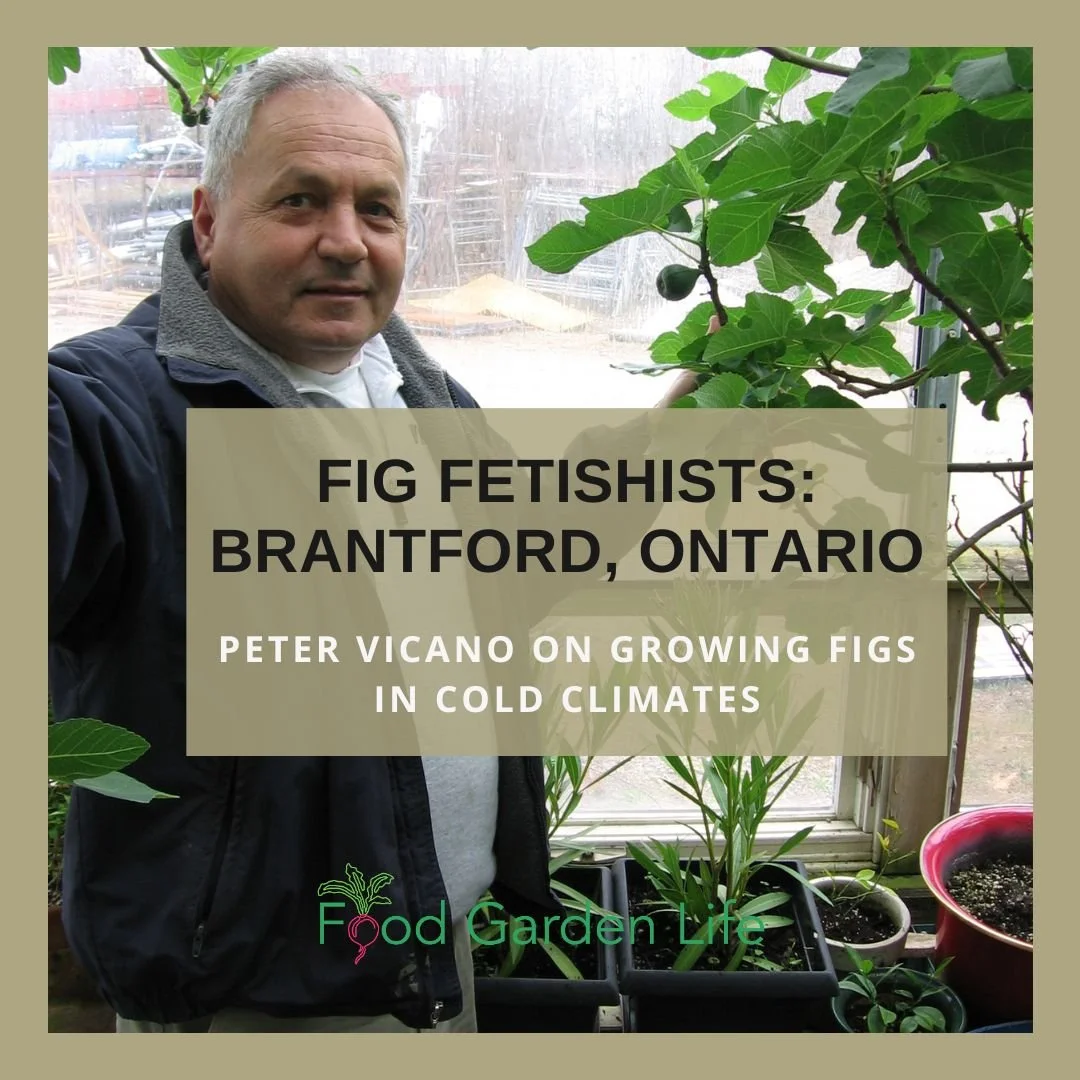
I’ve come to Brantford to see Peter Vicano’s fig collection, housed in the “figatorium” he built at his house.Meeting him at the offices of his construction company, we start by touring the small greenhouse he’s also built there so he can have figs at work, too. “I have a fetish for figs,” he laughs.
“You haven’t lived until you’ve eaten a fig off a tree,” he says.
For Vicano, no other fruit compares to a fig. “It’s the most exotic fruit; it’s the only word I can use to describe a fig, exotic.”While Vicano is passionate about figs, he’s fussy, too: “You can’t buy a really good fig,” he says, explaining that a ripe fig should be eaten within three hours of picking.
Besides being exotic, figs play an important role in Vicano family tradition. He tells me that it is customary to place fig leaves on the bottom of a basket filled with figs which, when given as a gift, wishes wellbeing.
Vicano has been playing with figs for the past twenty-five years, since he got his first tree from his dad, who brought a fig plant from Italy when he immigrated to Canada in 1956.
Figs in the Family
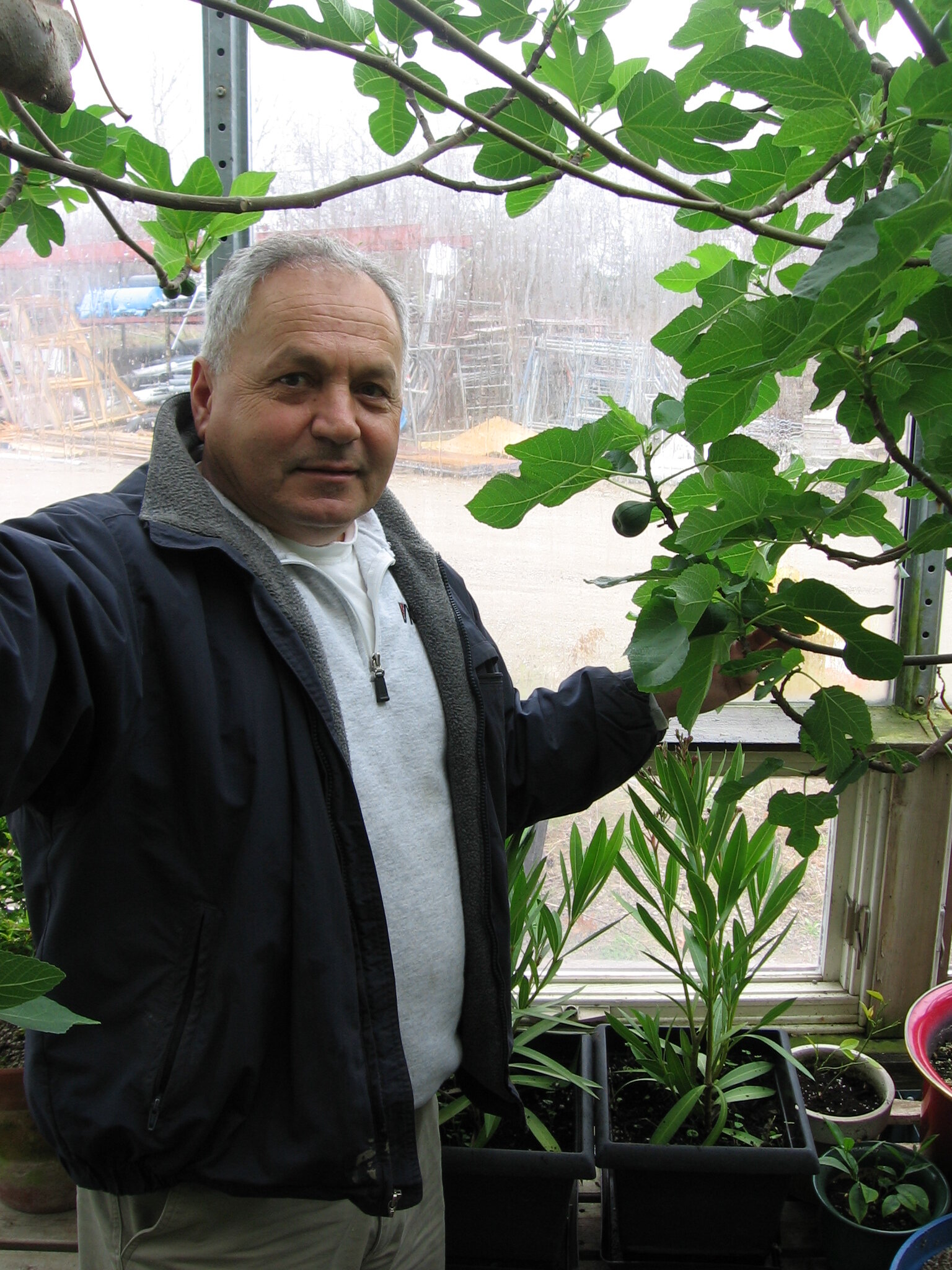
Peter Vicano with one of his late Uncle Rocco’s fig trees.
Vicano’s late uncle Rocco was a top-notch fig grower, with whom he had a friendly rivalry. Vicano is now custodian of one of his late uncle’s prized fig trees. His aunt still grows a potted fig tree, although he hasn’t been able to replicate the large crop she gets, and she won’t tell him her secret. Vicano’s mom, at the age of eighty, is also still tending a couple of fig trees. And his four children all love figs, he says.
“A fig tree will grow anywhere; you stick it in the ground, and it will root,” explains Vicano. He currently has ninety-four fig trees from all over Italy.
Despite his zeal for figs, he plays down his knowledge, saying, “I’m far from the expert.” When referring to relatives who consistently get good crops, Vicano says, “Certain people have knacks.” Then he suggests talking to a collector by the name of Adriano Ferreira...
A Figatorium
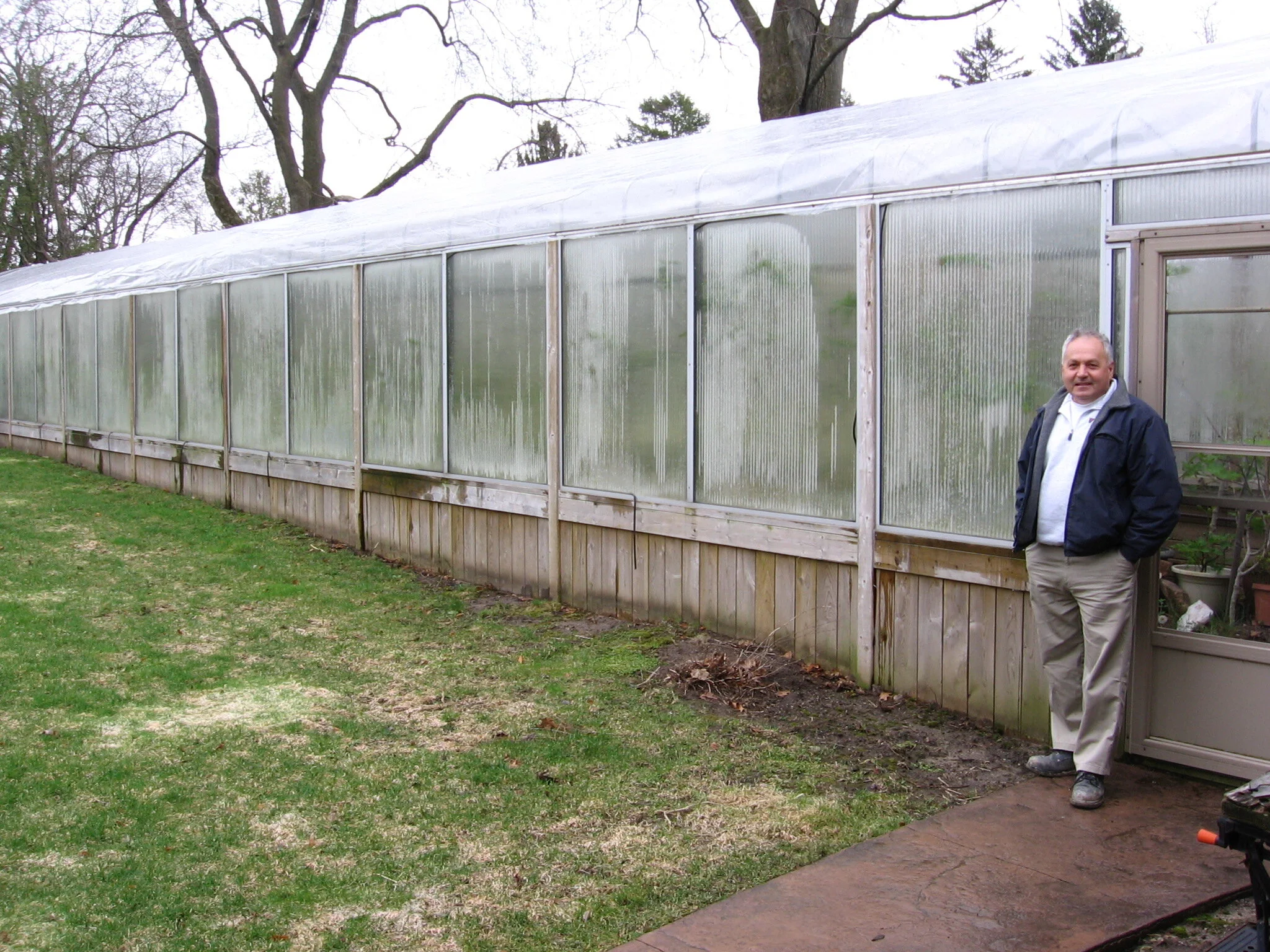
Peter Vicano with his “figatorium”
Vicano used to overwinter his fig trees by burying them. But he always wondered if there was a better way. “I’d lay awake at night thinking about this,” he says, as we talk about what he jokingly refers to as his figatorium. Vicano says many people lose the first crop of figs when they uncover their trees too early.
He describes the figatorium, now in its third year, as being like the Toronto Sky Dome, with a retractable roof.
The purpose is to get two pickings – and to exclude squirrels and chipmunks. Heated by a water boiler, the structure is a greenhouse with permanent walls and a removable plastic roof that he lifts off in the summer.
“My wife really didn’t want me to do it,” Vicano chuckles as we drive up towards the 84-foot-long building in front of his house.
Get Your Fig Trees Through Winter
And eat fresh homegrown figs!
Figs won’t taste right if grown indoors, according to Vicano, which is why he has the removable plastic top, allowing them exposure to the elements. With the figatorium, he says, he eats figs from the beginning of June until November. While the picking window is only about two weeks per plant, he gets a fairly continuous supply thanks to the numerous varieties he grows. It’s the second crop, which ripens in September and October, that has a more intense, sweet flavour.
While the squirrels and chipmunks get fewer figs, there is still the occasional hitch: Vicano explains that the heating system recently failed and that sometimes it gets too hot in the figatorium and the figs don’t get enough dormancy to fruit properly.
“I really enjoy it,” says Vicano, talking about all the work that goes into raising figs. He often sends guests home with plants and I’m no exception, returning home with two new fig trees for my garden.
Vicano has added an Ontario twist to the family fig traditions. Once the crop begins to ripen, he and a friend sit down to celebrate the ripening of the figs – by pairing freshly picked figs with a bottle of cold icewine.
Find This Helpful?
Enjoy not being bombarded by annoying ads?
Appreciate the absence of junky affiliate links for products you don’t need?
It’s because we’re reader supported.
If we’ve helped in your food-gardening journey, we’re glad of support. You can high-five us below. Any amount welcome!
More Fig Resources
Fig Books
Didn’t think you can grow your own figs in a cold climate? Here’s all you need to know to grow exotic fresh figs, even if you live somewhere with cold winters. Find out about choosing the right location, watering, pruning—and how to conquer winter. You’ll also learn about varieties, dealing with pests, and get tips from cold-climate fig experts.
This book will help you apply creative “fig thinking” in your garden and harvest fresh figs even if you have a short summer or cold winters. With some fig thinking, you can harvest figs in areas where they don’t normally survive the winter! In this book, I share many of the questions I have been asked about growing figs in temperate climates, along with my responses.
Online Fig Masterclass
Fig Fanatics
Talk to five northern fig fanatics and you'll probably hear five different overwintering tactics. There's no single "right" way.
Doug is Home and Garden editor for the Pittsburgh Tribune-Review and an Emmy Award winning producer, television host and writer

Tipping Over an In-Ground Fig Tree for Winter
Niagara fig grower shares his recipe for overwintering his fig tree in a cold climate.

Richard’s fig tree tucked in for winter.
By Steven Biggs
Find a Method That Suits You and Your Garden.
When teaching new gardeners, I often turn to the analogy of making tomato sauce: I know five neighbours with five different recipes. They are all good.
Overwintering fig trees in cold climates is like making tomato sauce: if you talk to five different growers, you will probably get five different fig-overwintering recipes.
After my latest newsletter, Richard, who gardens in Niagara, sent me the note below explaining his recipe for overwintering his fig tree. With his permission, I’m sharing it with you.
When it comes to overwintering your fig trees, be creative and find a system that works for you and your situation.
NOTE: I really like the way Richard uses ratchet straps to reduce the amount of work that he has to do. Mental note to self to do this next year. Thanks Richard!
Richard’s Overwintering Technique
This is my fourth year overwintering a fig tree in Niagara. This is a method I learned myself, when, after the first year, my tree "died".
Then in late spring, shoots sprung up from the root ball - and my fig tree was given a second chance in at life.
My fig tree is now three-and-half years old and twelve feet high! We usually get two to three dozen figs a year.
I overwinter my fig tree in the following manner:
Start of second week in November
Wrap a ratchet strap around the girth of the tree and tighten the branches together
Wrap the tightened tree configuration with burlap
Tie the burlap with twine
Secure another ratchet strap about two thirds up the tree
Pound a stake in the ground in front of the tree about 7/8 the height of the tree away
Lay a tarp on the ground in front of the fig tree. Tarp should be at least two feet longer than the height of the tree. (The tarp will cover the stake)
Cut a small slit in the tarp to expose the stake underneath the tarp
Take some twine and tie it off to the ratchet end of the strap, and the other end to the stake
Slowly ratchet the entire tree toward the tarp so that it is about eighteen - twenty four inches from the tarp
Cover the burlap-wrapped tree with a bale of straw
Wrap the sides of the tarp up around the straw and tree and secure with ratchet straps at third points along the tarp
Cover the wrapped tree with another tarp and stake the perimeter to the ground (but not forcing the tree any tighter to the ground than what it is already).
Heap the base of the tree with black bark mulch
End of first week in April
Remove the tarps and the straw. Leave the burlap wrapped around the fig tree
The tree will spring up but will still have a lean to it. Leave it covered with burlap for another week
After a week, remove the burlap and mulch from the base of the tree (end of second week in April)
The lean in the tree will not affect leaf or fig development - and after a month, the tree will straighten with warm sun
One Additional Thought…
Very high humidity and condensation can cause dormant fig plants to rot. For that reason, I usually advise people to use an insulating material that breathes — something like leaves or straw or soil.
In the method above, Richard uses tarps — which don’t breathe. But he also removes them early in spring to check on and air out the plants.
Find This Helpful?
Enjoy not being bombarded by annoying ads?
Appreciate the absence of junky affiliate links for products you don’t need?
It’s because we’re reader supported.
If we’ve helped in your food-gardening journey, we’re glad of support. You can high-five us below. Any amount welcome!
More Fig Information
Articles and Interviews
Fig Masterclass
Get Your Fig Trees Through Winter
And eat fresh homegrown figs!
Books About Growing Figs in Cold Climates
Growing figs in a cooler climate? These books focus on how to grow figs where they won't normally survive the winter. Learn how to conquer winter and harvest figs!
Fig Books
Didn’t think you can grow your own figs in a cold climate? Here’s all you need to know to grow exotic fresh figs, even if you live somewhere with cold winters. Find out about choosing the right location, watering, pruning—and how to conquer winter. You’ll also learn about varieties, dealing with pests, and get tips from cold-climate fig experts.
This book will help you apply creative “fig thinking” in your garden and harvest fresh figs even if you have a short summer or cold winters. With some fig thinking, you can harvest figs in areas where they don’t normally survive the winter! In this book, I share many of the questions I have been asked about growing figs in temperate climates, along with my responses.
Fig Audiobook
Find out how to grow figs in a cold climate while you drive, garden, or work out at the gym!
Bury Fig Trees for Winter in Cold Climates
A common way to protect in-ground fig trees over the winter is to lay them flat to the ground, and then insulate them with mulch or soil.
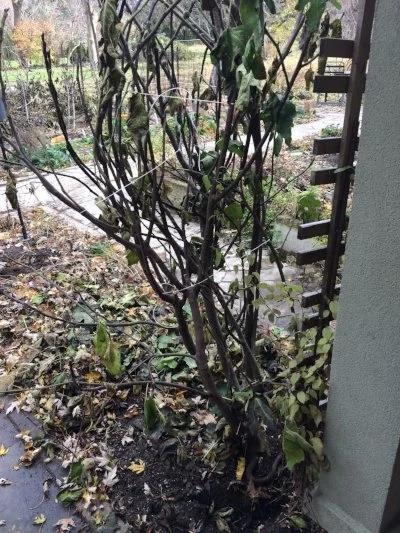
Fig tree ready to protect for the winter. I use twine to pull in tie the branches together before laying the plant against the soil.
By Steven Biggs
IT’S MID NOVEMBER and my fig trees here in Toronto have dropped their leaves and gone dormant. I moved my potted fig fig trees into my garage (I keep the temperature in the garage near freezing over the winter.)
But like many fig growers in areas with cold winters, I still grow figs in the ground and give them extra winter protection.
A common way to give that protection is to insulate the tree by burying it.
Chop Roots on One Side
At this time of year, I use a spade to chop away the roots on one side of the fig plant—and then lay it flat against the ground.
How Deep?
Some people avoid the burying method of overwintering figs, worried about the work of digging.
Once, after I gave a talk about figs, an audience member came up to me to confide that he had tried burying his fig tree, but it was too much work to dig down six feet!
I reassured him that it’s not necessary to dig his fig plant a grave—that at the most he needed a shallow trench. Then I explained that around here, the fig plants are usually fine if you lay them flat against the surface of the soil and put a thick mulch on top. You don’t even need to dig a trench!
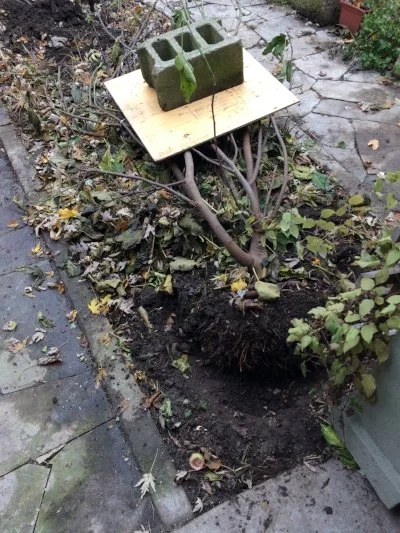
Fig tree with roots loosened on one side, tipped over to lie on the ground. The board and concrete block weigh it down. Next step is to add leaves or straw over top to insulate it.
Next, the Covering
You will see in the above photos one of my fig trees before and after. Once the roots on one side are loosened and I’ve tipped over the plant, I put a board and concrete block over the top to hold it in place. Soon, I’ll put a thick layer of straw or leaves over the top to insulate it. And when it snows, I’ll heap on some snow too.
Remember the Rodents
But I don’t rush the mulching…mice love to eat fig bark, and I want them to find a home elsewhere before I mulch my figs.
Find This Helpful?
Enjoy not being bombarded by annoying ads?
Appreciate the absence of junky affiliate links for products you don’t need?
It’s because we’re reader supported.
If we’ve helped in your food-gardening journey, we’re glad of support. You can high-five us below. Any amount welcome!
More Information on Figs and Winter
Figs on the Prairies
Getting creative when overwintering fig trees on the prairies, in Edmonton Alberta.

Overwintering figs in Edmonton
By Steven Biggs
Overwintering Figs in Edmonton
Over the past few years I’ve been in touch with Bernie, a fruit grower in Edmonton, Alberta, Canada. Bernie’s minimum winter temperature can dip to -40°C (-40°F)…so his figs need a bit of help making it through the winter.
Laying the plants flat to the ground and mulching, as I do here in Toronto, isn’t enough protection for his figs from winter temperatures.
Buried Fig Tree
Bernie sent me this photo. There’s a fig tree in there, even though you can’t see it!
The fig tree is buried in a trench alongside the foundation of his house. He covers the buried fig tree with a few bags of leaves—like a blanket to keep it even warmer. Once snow arrives, he covers it with snow for added insulation.
Why bury the fig tree beside the foundation of the house? The soil close to the foundation stays a bit warmer.
Bernie uses a max-min thermometer to track temperatures. Last winter, the soil temperature around his buried fig tree dropped to 2°C (36°F), while outside, the air temperature outside dropped as low as -36°C (-33°F).
Some Figs in the Garage Too
Bernie also has potted fig trees that he stores in the safety of his garage for the winter—a more common fig overwintering technique in his garden zone.
Video
Check out Bernie’s video below.
Protecting In-Ground Figs: Door Method
Old doors: a simple way to protect in-ground figs growing in cold climates.
By Steven Biggs
Grow Figs in Pots or in the Ground?
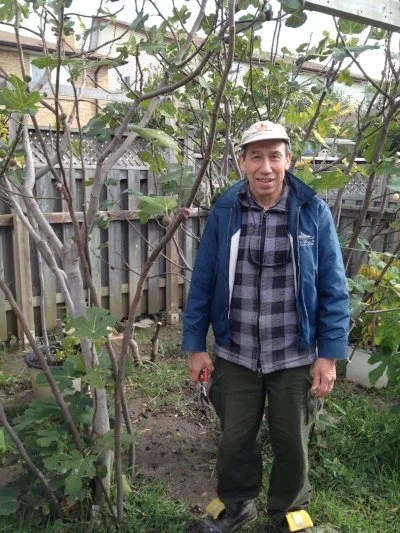
Alberto with one of his in-ground fig trees.
Mississauga, Ontario fig grower Alberto grows figs in pots, but says that he likes in-ground trees best because they get big.
And bigger trees mean more figs.
Simple Way to Protect In-Ground Figs
He keeps winter protection for his in-ground fig trees simple using old doors. “The neighbours must wonder what I’m doing when I take old doors I see in the garbage,” he says with a laugh.
Insulate the Doors
He attaches a sheet of foam insulation to one side of the door.
Then, in late fall, he bends the trees to the ground. Once they’re flat to the ground, he lays the foam-backed door atop the plant. The door-and-foam combo gives enough winter protection in his growing zone.
Difficult to Tip Fig Trees
When it comes to larger trees that are difficult to tip, even with the soil loosened on one side, Alberto has a tip: Hammer a metal rod into the ground, and then tie the uncooperative tree to it. Tighten it a bit at a time, until the tree is fully tipped over.
Find This Helpful?
Enjoy not being bombarded by annoying ads?
Appreciate the absence of junky affiliate links for products you don’t need?
It’s because we’re reader supported.
If we’ve helped in your food-gardening journey, we’re glad of support. You can high-five us below. Any amount welcome!
PA Fig Grower Uses Heat Tubes to Overwinter Figs
PA fig grower uses creative heat-tube technique to protect his fig trees over the winter.
By Steven Biggs
Banner Fig Harvest
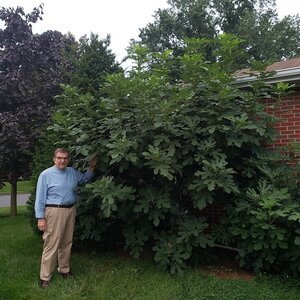
Will Pananes with a 12-foot-high fig tree in his Pennsylvania garden.
“This year appears to be a banner year, nearly 1,000 figs,” Pananes says as we chat about his creative fig-overwintering technique.
1,000 figs: Not bad for a backyard fig harvest in a zone where figs don’t normally survive the winter. “My growing zone is Pennsylvania 6B,” Pananes notes. (USDA zone 6)
Pananes’ creative heat-tube fig-overwintering method means he has attractive fig trees planted in the landscape around his home—yet he doesn’t need to schlep around potted figs every spring and fall. “I have been using this process successfully for 40 years to ensure my in-ground fig trees don't freeze to the ground, resulting in too short a growing season to ripen figs,” he tells me.
Fig Heat-Tube Method Explained

Pananes has in-ground fig trees incorporated in his landscape.
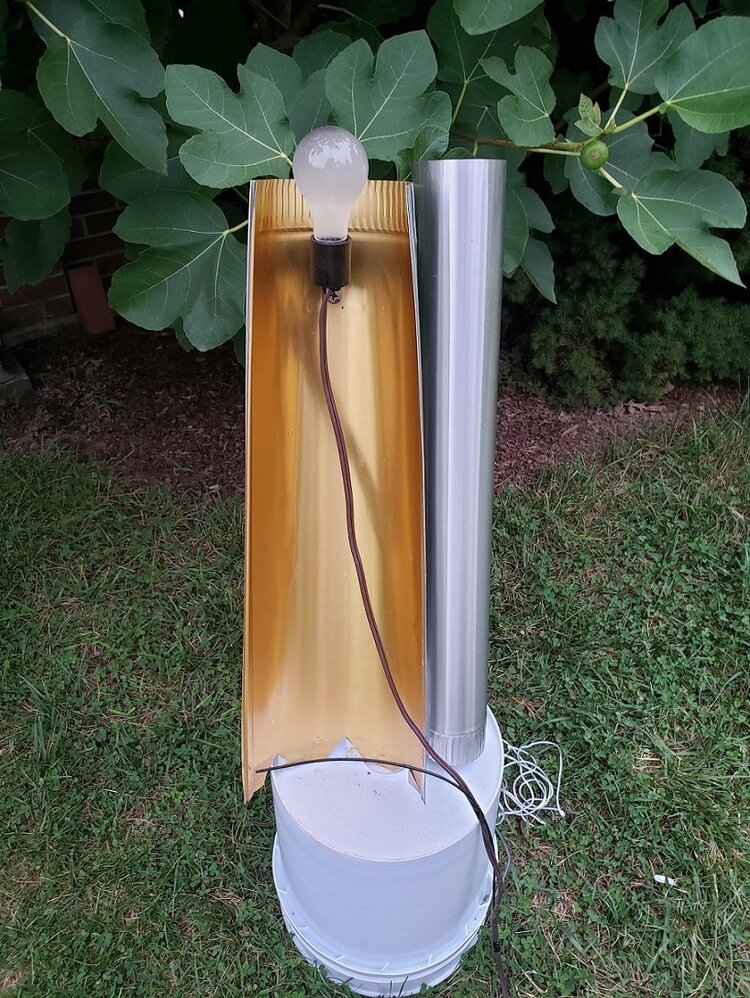
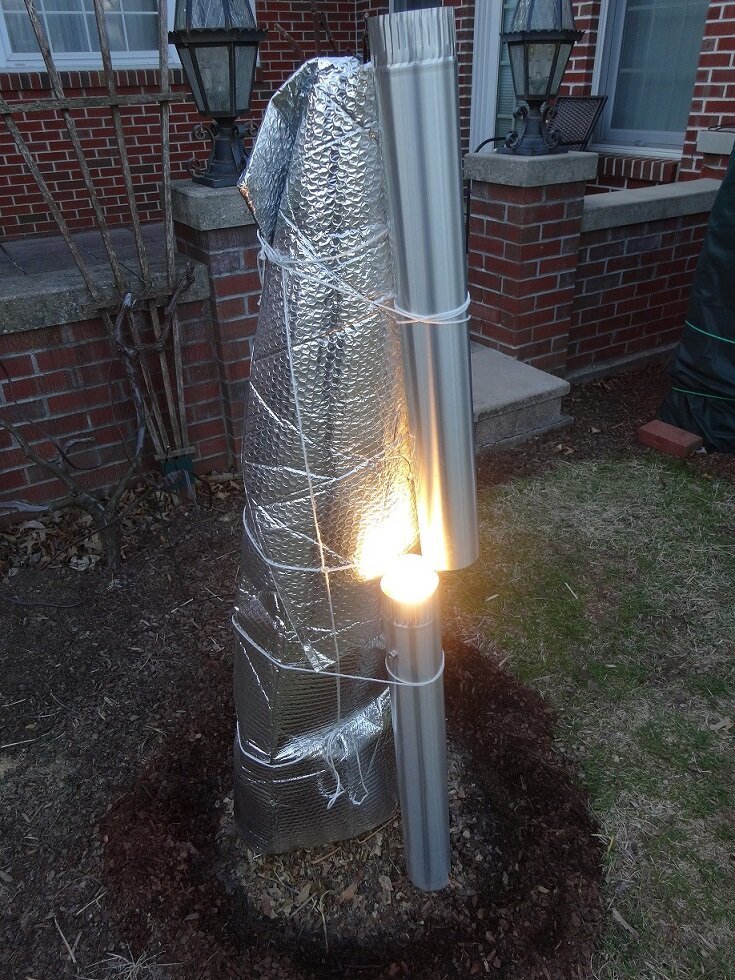
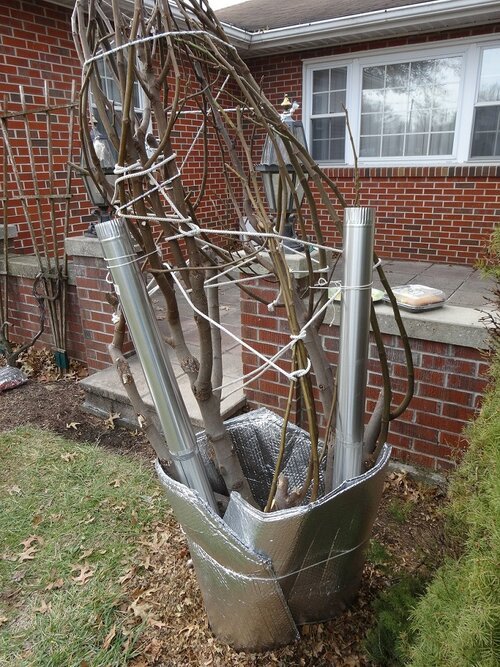
At the heart of Pananes’ fig-overwintering method is using an incandescent light bulb, which emits heat. When I was first in touch with him a few years back, he told me that the first time he used a light bulb, it burnt a hole in the burlap protection around his fig tree.
To prevent burning, he started to enclose the light bulb in a metal tube. (See photos below.)
Here is the process, explained in Pananes’ words:
The most important component of my winterizing fig tree process is the heat tube.
I started out with a single exposed light bulb. But when I discovered a burnt hole in the burlap-wrapped tree, I decided that the light bulb needed encased in a metal tube.
This metal tube is two three-inch hot water exhaust pipes, each 24-inches long with a 60-watt incandescent rough-service bulb mounted in the centre for easy access. This makes a four-foot heat tube, which will suffice for most trees.
I plug the heat in when temperatures get down to 15°F (-9°C) and turn off when temps exceed 15°F (-9°C).
A light socket with a metal mounting is attached to the exhaust pipe.
Near the bottom of the tube is a fibre optic cable, which extends outside the tree wrap, and confirms that your light bulb is producing heat.
Another test to ensure your bulb is operating is to do a continuity test across the prongs of the electric plug. An "open" indicates a bad bulb. You don't want to go to all this trouble only to freeze your tree because of no heat.
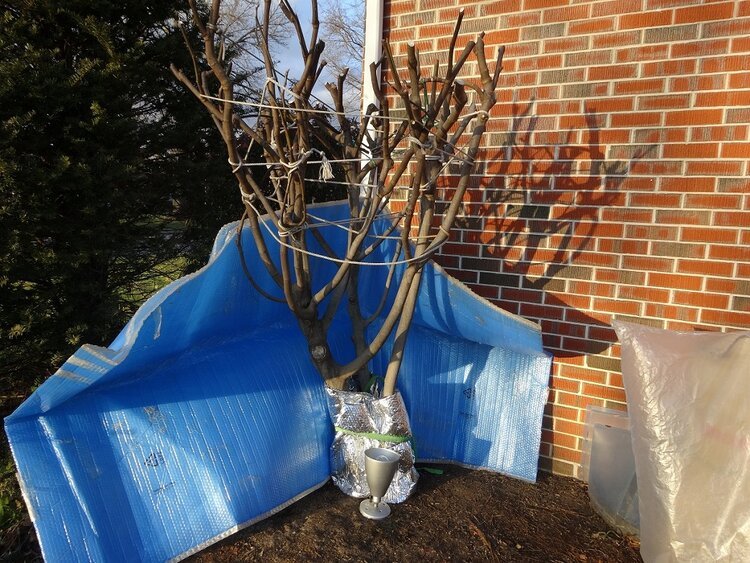
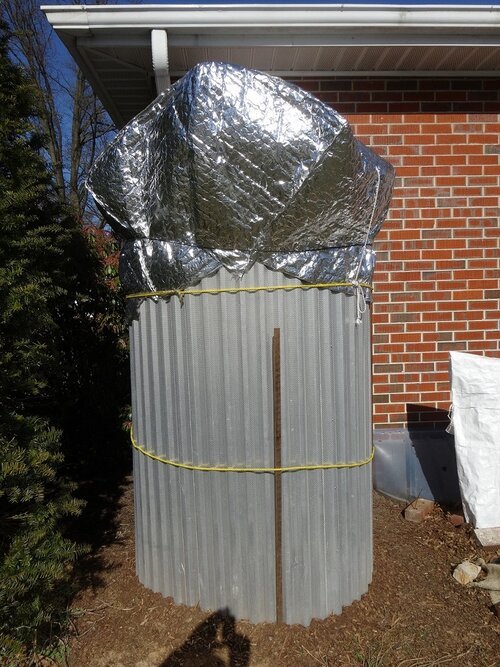
The Fig-Overwintering Heat Tube
Overwintering Smaller Fig Trees
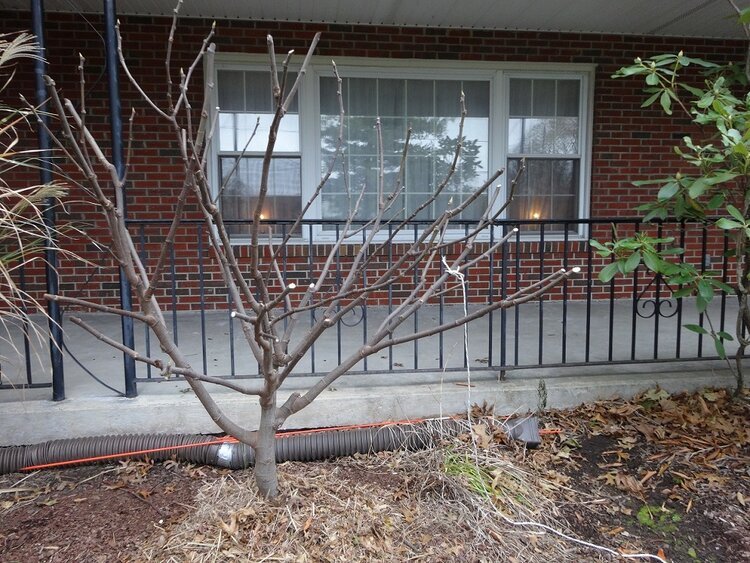
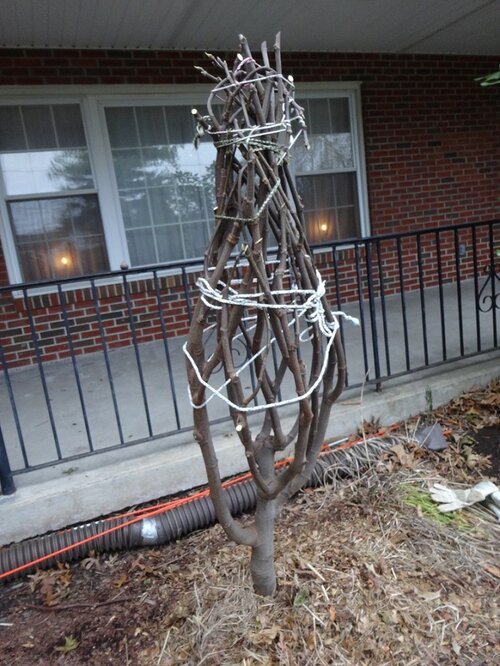
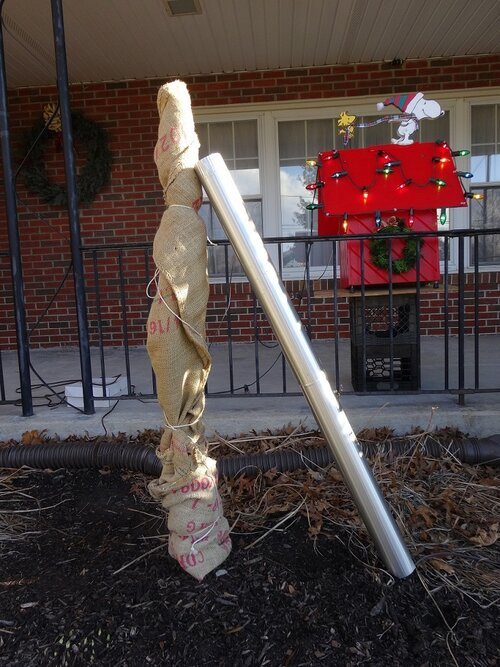
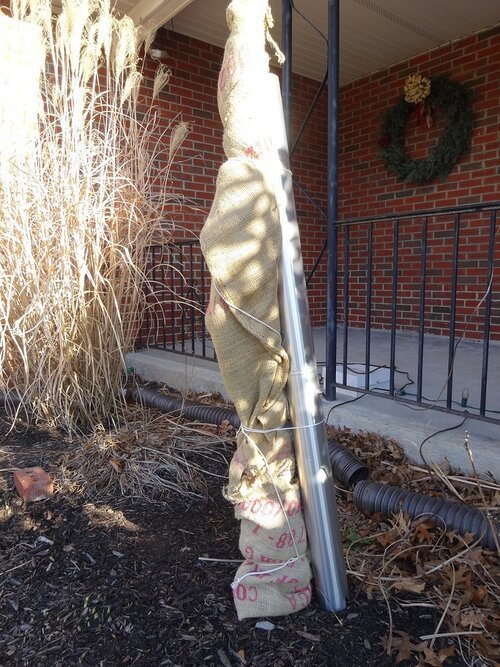
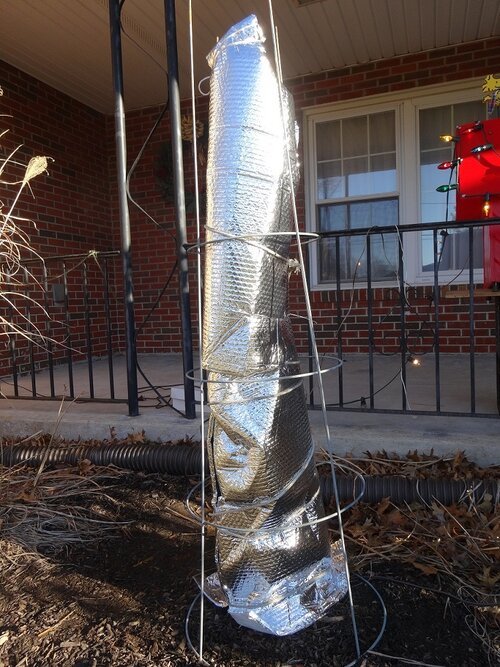
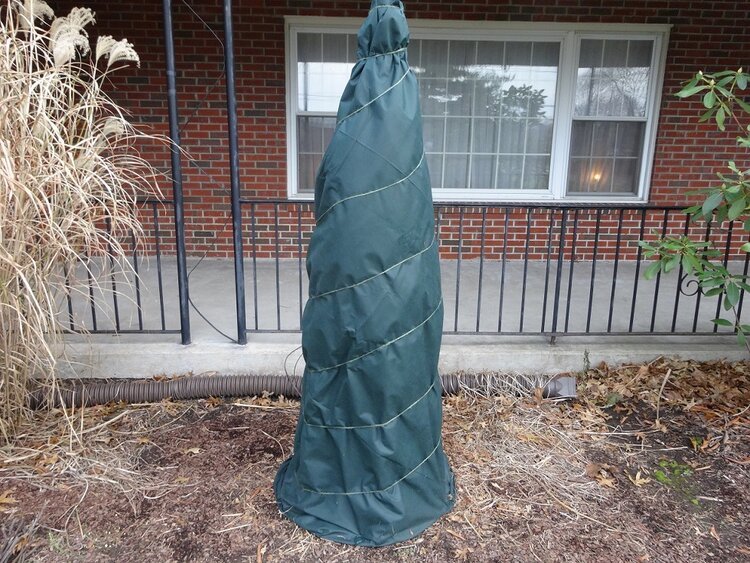
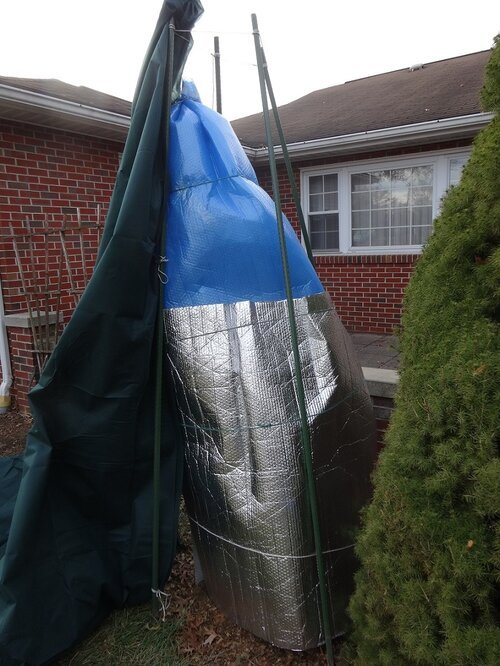
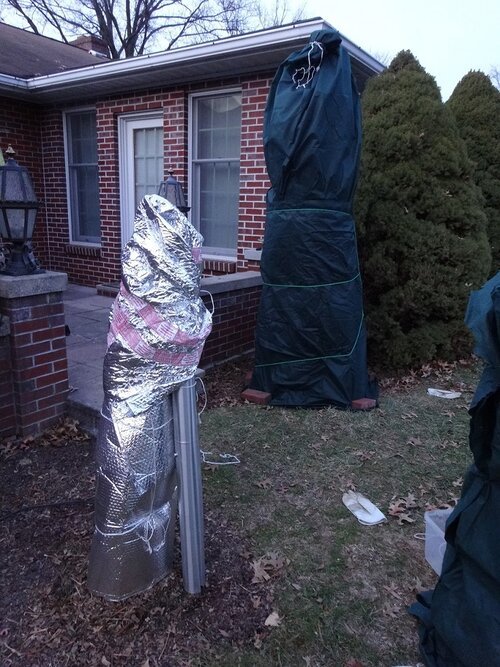
Overwintering Larger Fig Trees
Find This Helpful?
Enjoy not being bombarded by annoying ads?
Appreciate the absence of junky affiliate links for products you don’t need?
It’s because we’re reader supported.
If we’ve helped in your food-gardening journey, we’re glad of support. You can high-five us below. Any amount welcome!
Top Tip for Growing Figs in Cold Climates
Things to think about as you decide how to overwinter your fig trees in a cold climate.
By Steven Biggs
Push Fig Zone Boundaries
My top tip when teaching people to grow figs in cold climates is to be creative.

My top tip: be creative and find an overwintering method that meets your needs.
Find a fig overwintering method that suits you, that ties in with your approach to gardening, and works with the features that you have around your property.
Here are things to think about as you decide how to overwinter your fig trees:
Your zone: How much protection your fig tree needs over winter depends on your plant hardiness zone.
Microclimates: Are there “microclimates” around your property? These are spots with conditions that are different from other parts of the garden. E.g. a south-facing brick wall that captures heat by day, and releases it by night.
You: The way that you decide to protect your fig over the winter will depend on how much lifting and schlepping you can deal with.
Your Property: Each house and yard is different. I once met a Toronto gardener with what he called a “fig cave”…a tunnel-like stairwell between his garage and his house, which was on a hill. It was ideal for him to overwinter his potted figs. Think about what options you have for overwintering figs around your property.
Your Budget: There are unusual gadgets for people who want to innovate when overwintering figs. (For example, I know a gardener with a thermostatically controlled outlet that runs the heating cable around his fig.) Other gardeners innovate using commonly available supplies.
Overwinter Figs on Balconies in Cold Climates
Ideas about how to overwinter dormant figs trees on balconies.
By Steven Biggs
Overwinter Figs on Balconies
I recently spoke with fig grower who grows figs on a condo balcony in Toronto...a small condo balcony where winters are cold!
I was so impressed with his creative approach to overwintering figs that I asked if I could share it. Here it is below, in his words.
I give my thanks to this fig pig (who prefers to remain unnamed) for sharing his experience!
Re: Overwinter Figs Where You Think You Can't: Fig Overwintering for Condos/Apartments
Hi Steve,
I read the excerpt from your book Grow Figs Where You Think You Can't about overwintering figs, and I applied the basic principles for a condo/apartment situation. I grow figs on my condo balcony in Toronto but have no yard (so no ability to earth-insulate), and no unheated garage or cold, dark room either.

Wooden planter lined with foam
My first year I had only 1 fig tree (about 2' tall). I took a rectangular wood planter box (approx. 3' x 1' internal) and lined it with Styrofoam (and cut out a Styrofoam lid too) to serve as an insulated container. I placed my dormant fig inside.
Since I planned to store it outside on my balcony over winter, I considered various heat source options (e.g. seedling heat mat, light bulb, coffee warmer, etc.). I ended up buying a small 7.5 watt flat oval fish bowl heater (meant to go under aquarium gravel), which I placed into a mason jar full of water that I put inside the insulated wood planter.

Aquarium heater in jar
The aquarium heater is my version of a DIY water radiator. It has the added benefit of the water jar acting as a thermal mass for heat energy storage and temperature regulation. That is, the water is slow to warm and slow to cool, so temperature changes are gradual and moderated. The other advantages of fish tank heaters are that they are 100% waterproof (so they're safe for wet environments) and they're inexpensive too. A seedling mat was my initial choice but they were far more expensive, plus they lack the inherent thermal mass storage and regulation properties of a water radiator.
The flat plasticized fish bowl heater I used the first year provides continuous heat (no thermostat) and it basically kept the water above freezing and about +5°C to +10°C above the ambient air temperature. Only on the coldest of Toronto nights (e.g. those -20°C nights) did it get a bit too cold, and I needed to wrap the whole container in extra blankets to add insulation.

Plastic cooler with dormant fig and heater.
The next year I bought 3 more figs and needed a larger container so I bought the largest picnic cooler I could find, a marine cooler intended for boaters. I also upgraded to a higher wattage glass fish tank heater with a built-in thermostat. I supplemented it with a thermostat controlled AC plug switch, a ThermoCube TC-3, which turns on AC power to the heater around 2°C ambient air temperature and turns it off around 7°C.
I managed to fit all 4 figs in the large cooler and placed the fish tank heater in a large glass jar filled with water, the power cord running out the top. I taped shut the glass jar top to prevent water splashing out when jostled. I set the fish tank heater thermostat to the lowest level but when paired with the ThermoCube TC-3, the ThermoCube on\off temperatures are the primary thermostat.
Because I needed to lay my figs flat on their side, to prevent dirt from falling out I wrapped the figs in scraps of old cotton bed sheets. Initially I tried plastic but I was concerned about the lack of air flow and felt it trapped too much moisture.
For peace of mind, I also bought an electronic wireless thermometer (ThermoPro, $20) which includes a hygrometer to measure humidity. The sensor component was placed inside the fig cooler and the display screen kept indoors for easy monitoring. That kept me from constantly worrying and wondering what was happening with my figs.
The first year's fish bowl heater was 7.5w and just $13 (Hydor 7.5w Slim Heater for Mini-Aquariums and Bowls up to 5 gal). The second fish tank heater was 200w and just $20 (Pawfly HT-2200 Submersible Aquarium Heater 200W with Thermometer and Suction Cup, 50 gallon).
In my experience, the 7.5w heater was slightly undersized for my DIY insulated wood planter (but it would depend on how insulated the container is and the 200w is certainly overkill even for the larger cooler since the cooler is well insulated. I would suggest anything above 25w would probably work, depending on water jar and container size, and on insulation level.

Having more power is fine as long as you have a thermostat-controlled AC switch such as the ThermoCube to prevent over warming. Most fish tank heaters are intended to maintain water temperature above normal room temperature, and the thermostat minimum on the 200w heater was 16°C. Even with the 7.5w heater and without the ThermoCube, I found I was unplugging it manually on days when the ambient outdoor air temperature was above freezing, and it stayed mostly unplugged beginning early spring.
Bottom line: using a ThermoCube removes the guesswork and the risk of over warming.
Also, since picnic coolers are quite well sealed when the lid is closed, I would recommend leaving the lid ajar to prevent excessive humidity build up and to provide more air flow. Since the fish tank heater is submerged in water, that might also provide an additional source of humidity depending on how well sealed the water container is.
I would recommend only a very light watering before placing the dormant figs inside the cooler as the humidity can remain high in such an enclosed space. In my case, I watered my 4 figs thoroughly before they went into the cooler and they were still moist months later when I took them out in the spring.
Anyway, that's my fig overwintering technique for condo living. I hope this helps others in similar circumstances. It's very satisfying to be able to grow (and overwinter) figs where I thought I couldn't, on a balcony in an urban northern climate. Thanks for the inspiration!
Items Needed:
Insulated container (e.g. picnic cooler) large enough to fit your figs
Fish tank/aquarium heater and water jar/jug
Thermostat controlled AC plug (e.g. ThermoCube)
Wireless electronic thermometer with hygrometer (optional)
Find This Helpful?
Enjoy not being bombarded by annoying ads?
Appreciate the absence of junky affiliate links for products you don’t need?
It’s because we’re reader supported.
If we’ve helped in your food-gardening journey, we’re glad of support. You can high-five us below. Any amount welcome!
Bury Fig Trees for the Winter
Laying fig trees over and mulching or burying them is a common way to protect them in cold climates.
By Steven Biggs
You Can Bury a Fig Tree
In the book Grow Figs Where You Think You Can't, I explain how you can overwinter your fig tree outdoors in a cold climate by burying it.
And depending where you live, you might not even need to bury it…sometimes laying it flat to the ground and mulching it heavily is enough.
Why Tip Them Over?
The air temperature fluctuates more — and more often — than the soil temperature. So keeping your fig close to the soil protects it from frequent and extreme temperature swings.
What it Looks Like

Here's what I say in the book:
When it comes to overwintering figs outdoors, the method most people seem to know is burying them. Earlier, I mentioned fig orchards on the outskirts of Paris, France. This is the sort of technique that was used there.
I call it the graveyard method.
I used to bury my lone fig tree, but this method is no longer practicable given the number of trees I have. But don’t discount this method if you haven’t a suitable spot indoors for dormant plants.
If you dig the hole deep enough, you can cover the plant with a layer of soil, although this is overkill in my area. A mulching material suffices here. If in doubt, deeper with more mulching and soil over top will be safer for your fig.
Here’s what you do:
Dig a trench on one side of your fig. It should be as long as the tree is tall. Where I live all that is needed is a trench just deep enough to bury it;
Tie together the branches once your tree or bush is dormant (this is so you don’t need to dig as wide a hole);
About 30 cm (12 inches) from the trunk on the side opposite to your trench, chop down with a spade to sever the roots, which will make it easier to bend over the plant;
Bend the plant so it lies in the trench, then weigh it down with something heavy or peg it into place;
Fill the trench with a thick layer of mulch, and cover with a tarp (you can cap this with a board and soil for additional insulation if you like).
Find This Helpful?
Enjoy not being bombarded by annoying ads?
Appreciate the absence of junky affiliate links for products you don’t need?
It’s because we’re reader supported.
If we’ve helped in your food-gardening journey, we’re glad of support. You can high-five us below. Any amount welcome!
Ripen More Figs in the Fall
Season length is a limiting factor to the fig harvest in cold climates. Here are thoughts on how to ripen more figs in the fall.
By Steven Biggs
Turn up the Heat for Your Figs

Dark coloured paving stones capture heat by day, and release it through the night.
Around here, we’re only a couple of months away from that first fall frost that puts an end to any hope of ripening more figs.
But if you turn up the heat, you can ripen more figs between then and now.
Remember Radiated Heat
How can you turn up the heat?
You can turn up the heat for your figs by remembering materials that capture and then slowly release heat.
I’m talking about things such as brick, tile, and concrete.
In late summer, as temperature swings between day and night become greater, using radiated heat in the garden is a technical-sounding, yet simple way to given fig plants more heat.
Remember: More heat for our fig plants means more ripe figs before the fall frost arrives!
Walls and Driveways
If you already have your fig near a paved driveway or brick wall, then it’s benefiting from thermal mass. At night, the driveway or brick slowly radiates heat that has been stored during the day, keeping the air temperature around your figs a bit warmer.
I was reminded of how much of a difference radiated heat can make a couple of weeks ago when I visited a friend who recently planted a fig hedge (which she intends to overwinter with an insulated A-frame).
As I stepped—barefoot—onto the patio surrounding the fig hedge, the dark stone singed my feet.
It was scorching hot.
When it rained a short while later, the stone dried within minutes because it was so darn hot!
That fig hedge has a really great “micro-climate.” They’re surrounded by that heat-capturing and heat-radiating stone. At night, those figs bathe in radiated heat.
Find This Helpful?
Enjoy not being bombarded by annoying ads?
Appreciate the absence of junky affiliate links for products you don’t need?
It’s because we’re reader supported.
If we’ve helped in your food-gardening journey, we’re glad of support. You can high-five us below. Any amount welcome!

Hi, We’re Steve and Emma!
We help people grow food on balconies, in backyards, and beyond—whether it’s edible landscaping, a vegetable garden, container gardens, or a home orchard.
Fig Masterclass
This self-paced, virtual Fig Masterclass is hosted by Horticulturist and Cold-Climate Fig Expert Steven Biggs.
Free Fig Guide
Fig Books
This book will help you apply creative “fig thinking” in your garden and harvest fresh figs even if you have a short summer or cold winters. With some fig thinking, you can harvest figs in areas where they don’t normally survive the winter! In this book, I share many of the questions I have been asked about growing figs in temperate climates, along with my responses.
Didn’t think you can grow your own figs in a cold climate? Here’s all you need to know to grow exotic fresh figs, even if you live somewhere with cold winters. Find out about choosing the right location, watering, pruning—and how to conquer winter. You’ll also learn about varieties, dealing with pests, and get tips from cold-climate fig experts.