
Overwinter Figs on Balconies in Cold Climates
By Steven Biggs
How One Toronto Grower Overwinters Figs on a Balcony
Can you overwinter a potted fig tree on a condo balcony in Toronto?
One local fig grower does exactly that. He has no garden where he can bury the tree, no garage, and no cold room. Instead, he created an insulated outdoor storage box with a small, thermostatically controlled source of heat.
I was impressed by his creative approach and asked if I could share it. Below, he explains the system in his own words.
My thanks to this inventive fig pig, who prefers to remain unnamed.
Below is his email, lightly edited for clarity:
Re: Overwinter Figs Where You Think You Can’t: Fig Overwintering for Condos and Apartments
Hi Steve,
I read the excerpt from your book Grow Figs Where You Think You Can't about overwintering figs, and I applied the basic principles for a condo/apartment situation. I grow figs on my condo balcony in Toronto but have no yard (so no ability to earth-insulate), and no unheated garage or cold, dark room either.
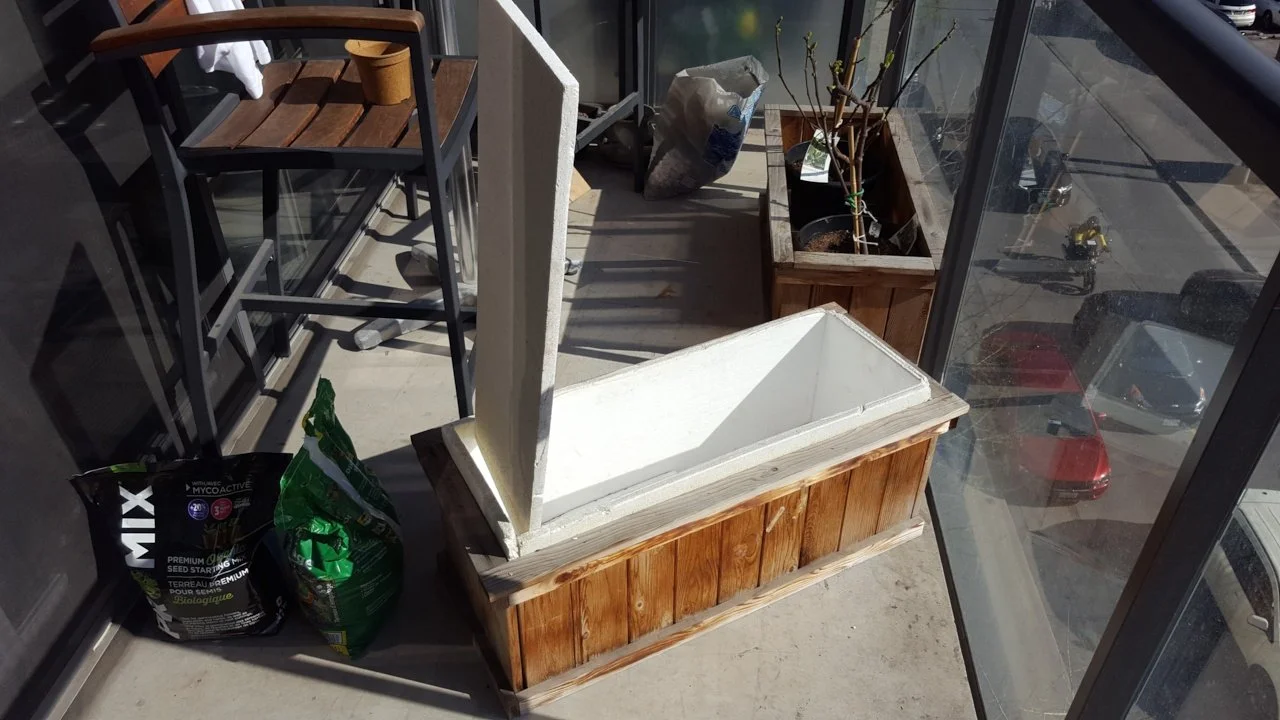
A wooden planter lined with rigid foam insulation became the first winter-storage box.
In my first year, I had only one fig tree, about 60 cm (2 feet) tall. I took a rectangular wooden planter box, approximately 90 × 30 cm (3 × 1 feet) inside, and lined it with Styrofoam. I also cut out a Styrofoam lid. This served as an insulated container for my dormant fig. I placed my dormant fig inside.
Since I planned to store it outside on my balcony over winter, I considered various heat-source options, including a seedling heat mat, light bulb, and coffee warmer. I ended up buying a small, flat, oval 7.5-watt fish-bowl heater designed to go under aquarium gravel. I submerged it in a Mason jar filled with water and placed the jar inside the insulated wooden planter.
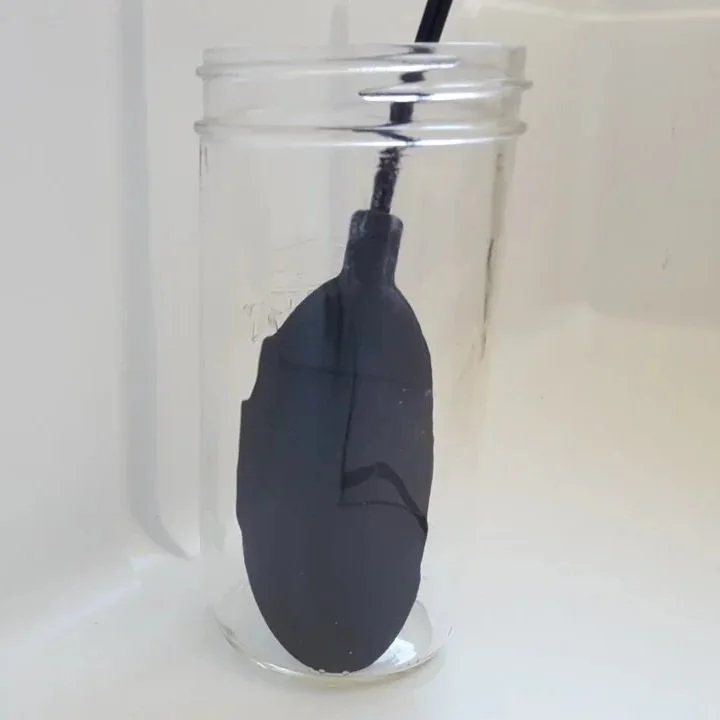
A small aquarium heater submerged in a jar of water provided gentle heat inside the insulated box.
The aquarium heater was my version of a DIY water radiator. The jar of water also acted as thermal mass: the water warmed and cooled slowly, moderating temperature changes inside the box. The heater was designed to remain submerged, and it was inexpensive. A seedling mat was my initial choice, but it cost considerably more and lacked the thermal mass provided by the water.
The flat, plasticized fish-bowl heater I used during the first year provided continuous heat (no thermostat) and it basically kept the water above freezing and about 5-10°C above the ambient air temperature. Only on the coldest of Toronto nights approaching -20°C did it get a bit too cold, and I needed to wrap the whole container in extra blankets to add insulation.
Scaling Up to Four Fig Trees
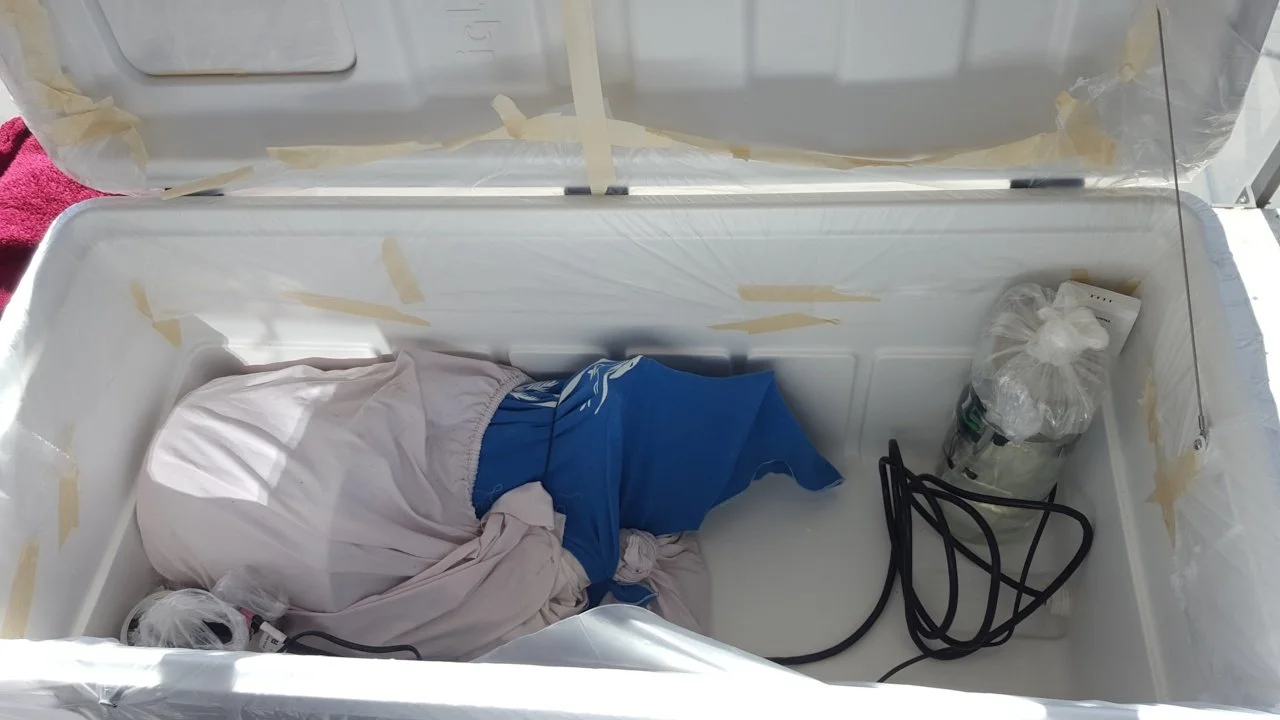
A large insulated cooler provided enough room to overwinter four dormant potted fig trees.
The next year I bought three more fig trees and needed a larger container. I bought the largest picnic cooler I could find—a marine cooler intended for boaters.
I also upgraded to a higher-wattage glass aquarium heater with a built-in thermostat. I paired it with a thermostatically controlled outlet, a ThermoCube TC-3, which turns on the power at about 2°C and turns it off at about 7°C.
I managed to fit all four figs in the cooler. I submerged the aquarium heater in a large glass jar filled with water and ran the power cord out through the top. I covered the jar opening to reduce splashing if it was jostled.
Because I had to lay the trees on their sides, I wrapped the figs in scraps of old cotton sheets to keep the potting mix in place. I initially tried plastic, but it restricted airflow and trapped too much moisture.
For peace of mind, I added a wireless thermometer and hygrometer. I placed the sensor inside the cooler and kept the display indoors, where I could monitor temperature and humidity without repeatedly opening the lid.
The heater in my first setup used 7.5 W and was slightly undersized for the wooden box. The heater in the larger cooler used 200 W—far more than the well-insulated space needed.
The amount of heat required depends on the size of the enclosure, the quality of the insulation, and the lowest outdoor temperature. More wattage isn’t necessarily better: the important part is controlling the heat so that the trees remain cold and dormant without freezing.
Controlling Temperature and Moisture
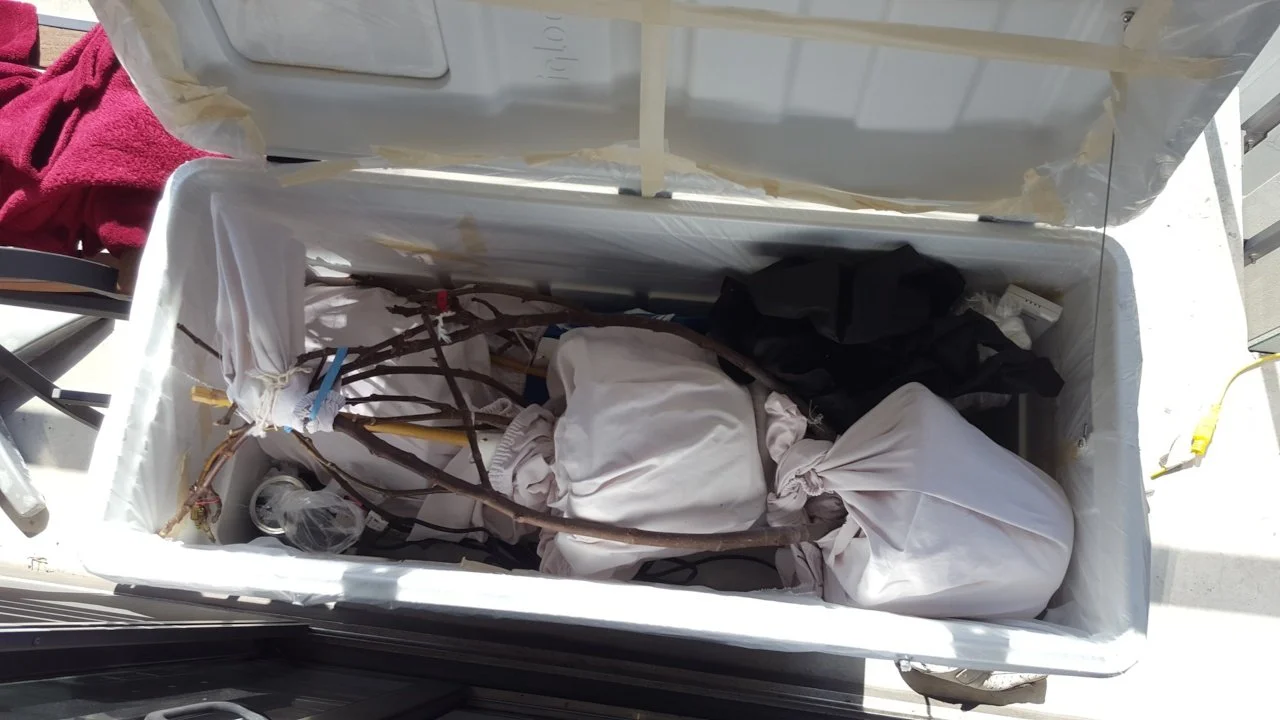
Four dormant potted fig trees packed into the insulated cooler for winter.
A higher-wattage heater can warm the water more quickly, so some form of temperature control is important. Most aquarium heaters are intended to keep water much warmer than a dormant fig tree requires. The minimum setting on my 200 W heater was 16°C.
The ThermoCube prevented the heater from running in milder weather. It turned the power on when the temperature around the plug fell to about 2°C and turned it off when it rose to about 7°C. I used the wireless thermometer to monitor the actual temperature inside the cooler.
Without the ThermoCube, I found myself manually unplugging the smaller heater whenever the outdoor temperature rose above freezing. By early spring, it remained unplugged most of the time.
The cooler also retained a great deal of moisture. I left the lid slightly ajar to improve airflow and reduce humidity. Because the heater was submerged in water, I covered the water container to limit evaporation.
Water dormant figs very lightly before putting them into an enclosed storage system. I watered my four trees thoroughly before storage, and the potting mix was still moist when I removed them months later.
Anyway, that's my fig overwintering technique for condo living. I hope this helps others in similar circumstances. It's very satisfying to be able to grow (and overwinter) figs where I thought I couldn't, on a balcony in an urban northern climate. Thanks for the inspiration!
What This Grower Used
An insulated container large enough to hold the dormant potted trees
An aquarium heater submerged in a water-filled container
A thermostatically controlled outlet
A wireless thermometer and hygrometer for monitoring conditions
Cotton fabric to hold potting mix in place when pots lie on their sides
Why This Balcony Fig System Works
The goal isn’t to keep the fig trees warm. It’s to keep them dormant while preventing damaging cold.
This setup combines four useful principles:
Insulation slows temperature changes. The cooler protects the trees from rapid swings and reduces the amount of supplemental heat needed.
A small amount of heat limits extreme cold. The heater doesn’t create spring-like conditions; it raises the temperature enough to reduce the risk of freezing injury.
Monitoring replaces guesswork. A remote sensor shows what’s happening inside the container without repeatedly opening it.
Limited watering and some airflow reduce excess moisture. Dormant fig trees use very little water, while an enclosed box can remain damp for months.
Every balcony is different. Height, wind exposure, winter sun, the shelter provided by the building, container size, and local minimum temperatures all affect how well a system like this performs. Test and monitor your setup rather than assuming that one combination of insulation and heat will work everywhere.
Pin this post!
Get Your Fig Trees Through Winter—and Harvest Figs
Growing figs where winters are cold takes a bit of creative thinking.
In Fig Camp and the self-paced Fig Masterclass, I explain how to grow figs in pots or in the ground, extend the growing season, ripen more fruit, and protect your trees through winter.
Explore Fig Camp and Fig Masterclass
Keep Growing Figs
Looking for more cold-climate fig-growing ideas? Visit the fig home page to browse articles about varieties, pruning, propagation, ripening, winter protection, and more.
Grow Figs Where You Think You Can’t
My revised and expanded fig book is a practical guide to growing figs in pots and cold climates—from choosing varieties and pruning to ripening fruit and conquering winter.
Find This Helpful?
Enjoy not being bombarded by annoying ads? Appreciate the absence of junky affiliate links for products you don’t need?
This site is reader supported. If it has helped you in your food-gardening journey, you can give us a high-five below. Any amount is welcome.