Everyday Fig Loaf: A Nourishing Seed & Nut Bread You’ll Crave
This dense, sliceable, flavour-packed fig loaf is made entirely from good stuff: dried figs, seeds, nuts, olive oil, and a touch of honey. It’s nourishing—and indulgent too!
This recipe comes from my friend and co-author, Signe Langford. As we test out recipes for our upcoming book about growing and cooking olives, lemons, and figs, we’re sharing little glimpses on Instagram at @oliveslemonsfigs—finished recipes and behind-the-scenes testing as the book takes shape.
Why This Fig Loaf Is So Good
Naturally wholesome ingredients
This isn’t your typical flour-heavy quick bread. Instead, it leans on almond flour, seeds, and psyllium to create structure. This gives it a rich, satisfying texture. It feels substantial without being heavy.
A smart way to use dried figs
Dried figs give sweetness and a deep, caramel-like flavour. They pair beautifully with the nuttiness of sunflower and pumpkin seeds.
Flexible and forgiving
You can easily swap in and out other dried fruit (currants, raisins, cranberries) or the fat (olive oil, butter, ghee, or coconut oil). It’s a forgiving recipe that adapts to what you have on hand.
What Does Fig Loaf Taste Like?
Think of this as somewhere between a bread and an energy bar. But I’d say it’s better than both. Signe served it to me straight out of the toaster, smeared with butter. Delicious! It’s:
Slightly sweet, thanks to figs and honey
Nutty and rich from seeds and almond flour
Moist, dense, and sliceable
Perfect toasted or plain
A slice in the morning with coffee is a great start to the day.
Tips for Success
Let it rest: The 4-hour (or overnight) rest is key. It allows the psyllium and chia to absorb water and bind everything together.
Line your pan generously: The parchment overhang makes removing the loaf much easier.
Cool completely before slicing: This loaf firms up as it cools—cut too early and it may crumble.
Measure oil first: A small trick that makes measuring honey much easier (it won’t stick).
Get Your Fig Trees Through Winter—and Harvest Figs
Growing figs where winters are cold takes a bit of creative thinking.
In Fig Camp and the self-paced Fig Masterclass, I explain how to grow figs in pots or in the ground, extend the growing season, ripen more fruit, and protect your trees through winter.
Recipe: Every Day Fig Loaf
Prep time: 10 minutes (+ 4 hours or overnight rest)
Bake time: 50 minutes
Makes: 1 loaf
Ingredients
1 cup coarsely chopped dried figs
1 cup raw sunflower seeds
½ cup ground flax seeds (flaxmeal)
½ cup raw pumpkin seeds
½ cup currants, raisins, or dried cranberries
1 cup almond flour
2 Tbsp. chia seeds
4 Tbsp. psyllium powder
1 tsp fine sea salt
3 Tbsp. olive oil, melted butter or ghee, or melted coconut fat
1 Tbsp. runny honey or maple syrup
1 ½ cups water
Directions for baking fig loaf
Line a loaf pan with parchment, making sure to use more than needed so there is overhang; set aside.
Add all ingredients to the bowl of a stand mixer or large bowl; stir until well combined and a sticky batter has formed.
Transfer batter to prepared loaf pan; spread and press down the mixture. Use the back of a spoon or spatula for this.
Cover with a damp tea towel or cutting board and allow to rest on the counter for at least 4 hours; overnight is better.
When ready to bake, preheat oven to 350F.
Bake for 20 minutes, then retrieve from the oven, remove the loaf from the pan by gripping the parchment paper, then place the parchment-wrapped loaf back into the oven, directly on the oven wrack. Bake for a further 30 minutes.
Allow to cool completely before slicing.
How to Serve Fig Loaf
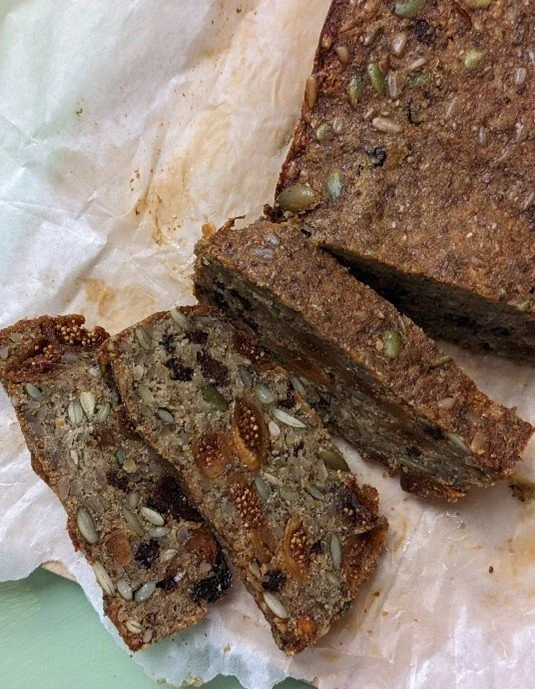
Every day fig loaf. Photo: Signe Langford.
This fig loaf (of fig bread, if you prefer) is incredibly versatile. Try it:
Toasted with a smear of butter or cream cheese
With a drizzle of honey or extra olive oil
Alongside cheese (especially goat cheese or aged cheddar)
As a satisfying snack on its own
It also travels well, making it perfect for lunches or hikes.
If you’re looking for more fig recipes, visit our library of fig recipes.
A Recipe from Our Cookbook Kitchen
This recipe reflects exactly what we love about cooking with figs: simple ingredients, rich flavour, and recipes that fit into everyday life.
Signe Langford brings the culinary creativity, and I bring the plant perspective—together, we keep coming back to ingredients like figs, olives, and lemons that are both timeless and full of possibility.
If you enjoyed this recipe, you can follow along as we develop the cookbook over at @oliveslemonsfigs on Instagram. We’re sharing recipes, ideas, and inspiration centered around some of our favourite ingredients. We’ve been sharing early recipes and ideas there first…
About
We're Signe Langford and Steven Biggs. Signe is a chef, recipe developer, culinary instructor, and food writer. Steven is a horticulturist and horticulture teacher specializing in edible gardens and food plants. We both love olives, lemons, and figs. We’re sharing recipes and growing tips here as we work on the book. Thanks for joining us on this journey.
Keep Growing Figs
Looking for more cold-climate fig-growing ideas? Visit the fig home page to browse articles about varieties, pruning, propagation, ripening, winter protection, and more.
Grow Figs Where You Think You Can’t
My revised and expanded fig book is a practical guide to growing figs in pots and cold climates—from choosing varieties and pruning to ripening fruit and conquering winter.
Find This Helpful?
Enjoy not being bombarded by annoying ads? Appreciate the absence of junky affiliate links for products you don’t need?
This site is reader supported. If it has helped you in your food-gardening journey, you can give us a high-five below. Any amount is welcome.
Figs Didn't Ripen? Try These Unripe Fig Recipes and Uses
Did your fig tree drop its leaves for winter…but is still loaded with unripe figs? Here are unripe fig recipes and other ideas for getting the most from your fig tree.
Unripe Figs Every Fall
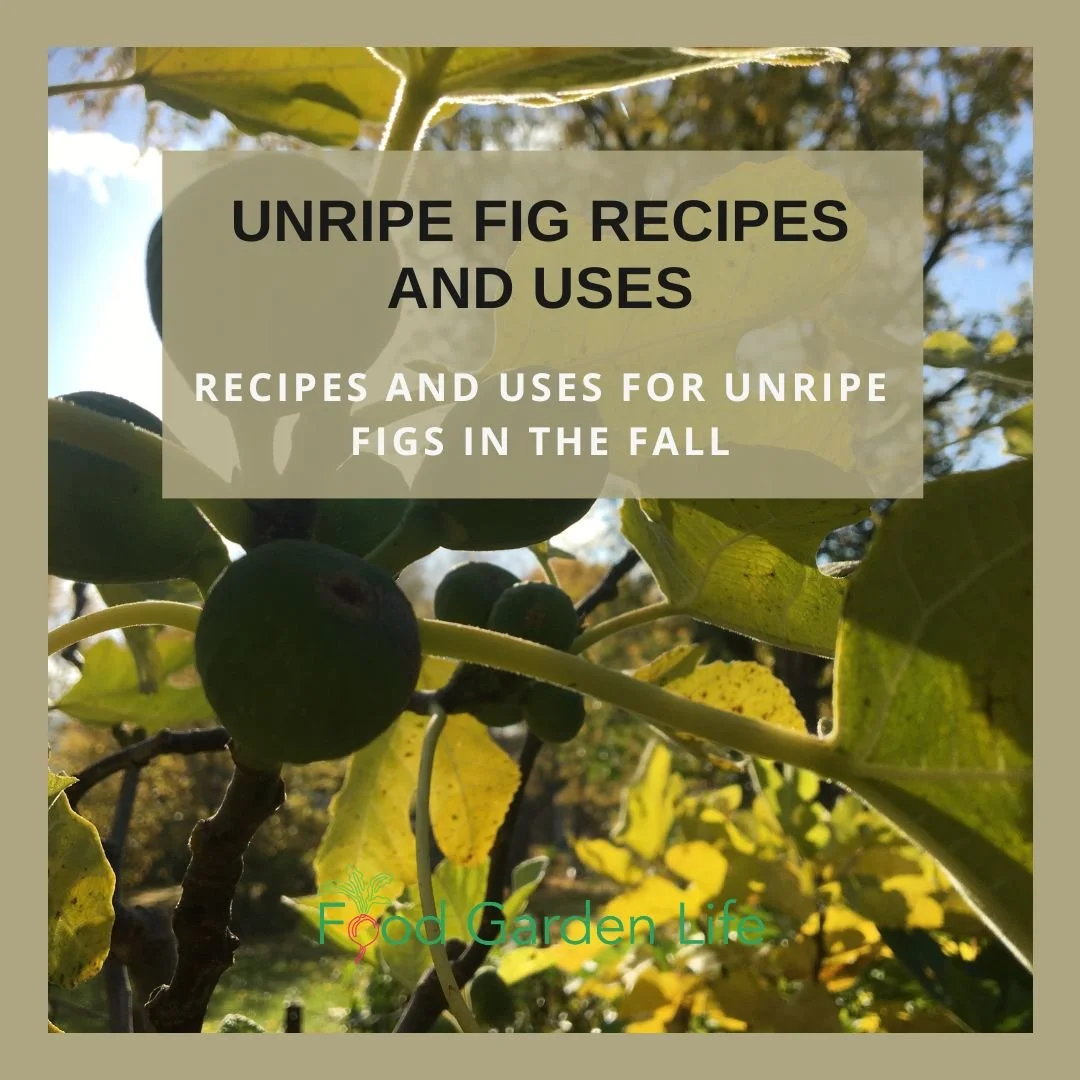
It’s a frustrating sight for a cold-climate fig grower: A naked fig tree loaded with unripe figs.
As a fig tree goes dormant and drops all its leaves, the unripe figs remain—all the more noticeable because the tree is leafless.
Think of all the figs you didn’t get to eat…
(I won’t use the term “green figs” to refer to unripe figs—because there are lots of fig varieties that are green when they’re ripe.)
Once a fig tree is dormant, the unripe figs won’t ripen any more. Don’t leave them over the winter and hope they’ll ripen next year. They won’t.
But there are things you can do with unripe figs, and this article gives you an unripe fig recipe and more ideas.
Unripe Fig Recipe
Grilled Unripe Figs
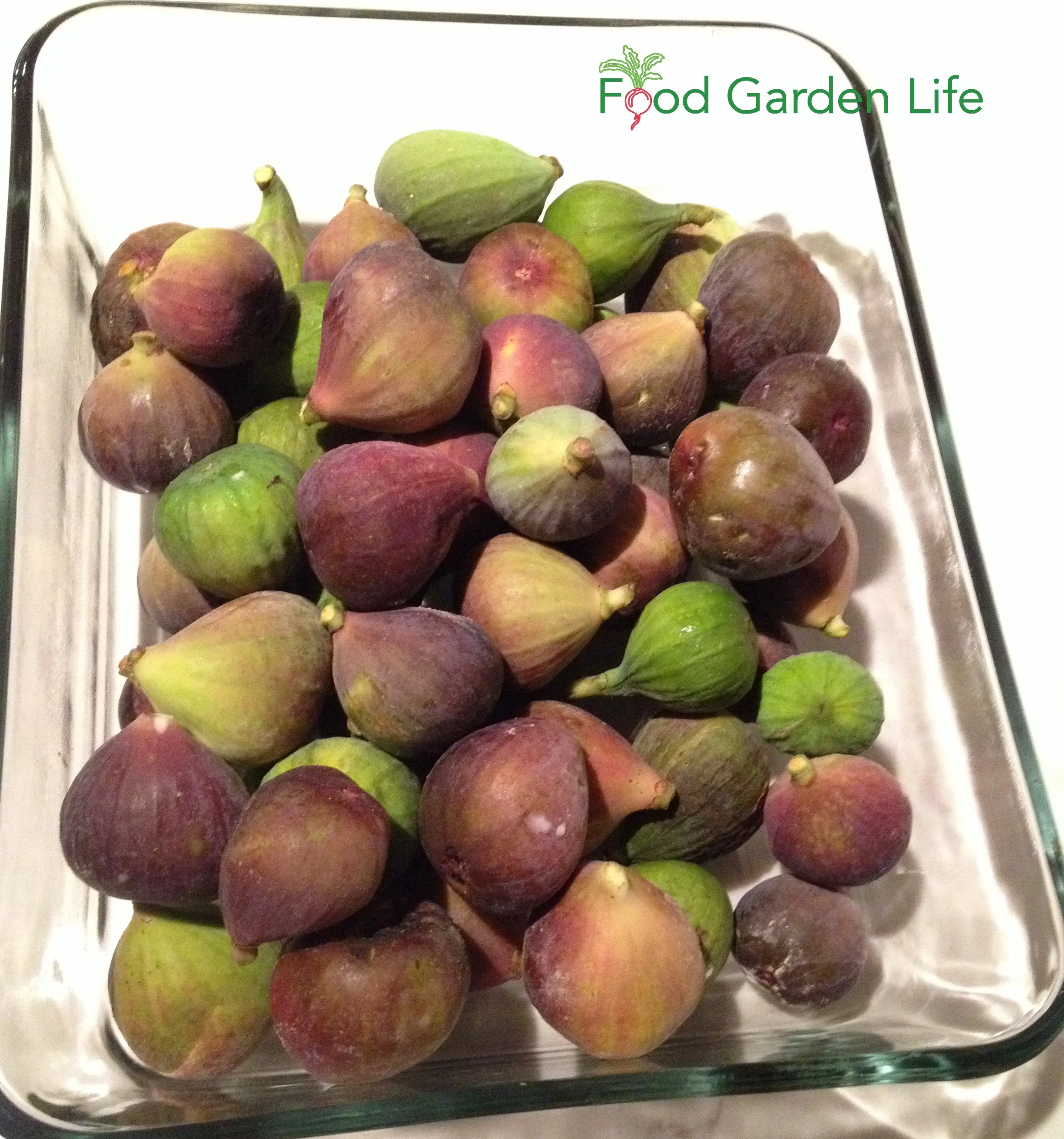
Recipe for unripe figs using “almost-ripe” figs that are a good size and starting to soften…but are not too sweet.
Here’s a recipe from my fig-growing friend Alberto. He says to use “almost-ripe” figs in this recipe.
These almost-ripe figs are ones you might be tempted not to eat because although they’ve reached a good size, and softened a bit…they’re not soft, and not very sweet.
Alberto grills these unripe figs on the barbecue. I cook mine in the oven in a baking dish. Both work well.
Here’s what to do:
Put the almost-ripe figs directly on the grill, or on foil (or a cookie sheet or baking dish if you’re cooking them in the oven)
Cook until they become soft and the inside starts to ooze out
Place in a dish and allow to cool
Mix with cinnamon, pine nuts, oregano, honey, and a touch of balsamic vinegar
Enjoy!
You’ll see that there are no amounts for the other ingredients—add them to suit your taste.
Alberto introduced me to his “door” method of overwintering figs.
Preserves with Unripe Figs
My friend Voula told me that her family in Greece makes “spoon sweets” using unripe figs.
Spoon sweets are unripe figs are cooked in syrup until soft.
I’ve never tried this—so I don’t have a recipe for you. But you’ll find recipes online.
Don’t Waste Dormant Branches You Prune Off
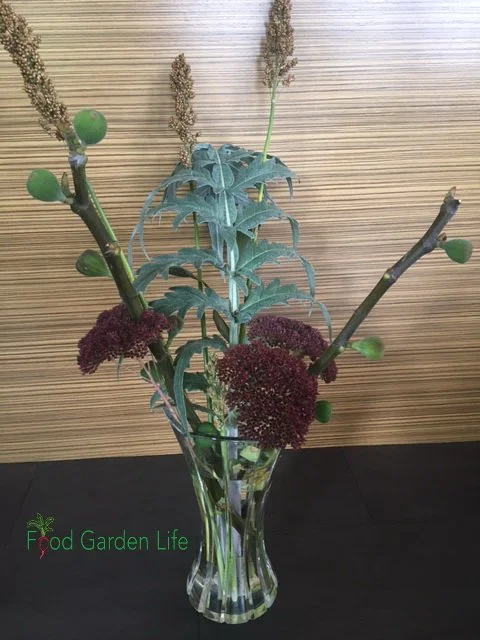
This flower arrangement, picked from the garden after it’s had frost, includes unripe figs on branches, a cardoon leaf, broom corn (sorghum), and stonecrop sedum.
Here in Toronto, I grow some of my fig trees in the ground. I lay the trees flat to the ground over the winter and insulate them. Find out more about how to overwinter fig trees in cold climates.
Before I tip over my fig trees, I prune back some of the taller branches (so that there’s less tree for me to cover.)
Flower Arrangements with Unripe Figs
When I prune off branches with unripe figs on them, I use them in flower arrangements. Thanks to Joanna at Arthur Greenhouses for this idea. She told me that she saw it when she worked in the cut-flower industry.
Fig Branches for Smoking Food
I usually smoke meat using apple, cherry, or plum wood. All of these fruit woods have a nice flavour, suited to smoking food.
Fig wood has a taste and smell that is very distinct from these other fruit woods. If ever I put a fig branch on the bonfire, I can smell it right away. It’s recognizable—and it’s nice.
Interested in smoking food? Here’s how I cook a turkey on a charcoal barbecue, and use branches to add a smoke flavour.
Fig Branches for Cuttings
Of course, some of the fig branches I prune end up as cuttings.
Find out how to grow fig plants from cuttings.
Other Cool Culinary Uses for Figs
Pin this post.
Fig Sap as a Coagulant
Fig sap can coagulate milk. I chatted with someone once who described a yogurt like food that his family makes in Greece, using fig sap to coagulate milk.
Flavouring Food with Fig Leaves
Fig leaves have a flavour I’d describe as a combination of coconut and toasted almond.
The leaf is not eaten—rather, the flavour is extracted from it.
Toronto chef David Salt introduced me to the culinary joys of fig leaves. I’ve sampled his fig-leaf cheese, fig-leaf ice cream—and fig-leaf grappa!
Here’s a delicious fig-leaf panna cotta recipe.
Find out more about using fig leaves in cooking.
(If you’re interested in cooking with fig leaves but don’t have time to do it in the fall, freeze some fig leaves.)
Keep Growing Figs
Looking for more cold-climate fig-growing ideas? Visit the fig home page to browse articles about varieties, pruning, propagation, ripening, winter protection, and more.
Grow Figs Where You Think You Can’t
My revised and expanded fig book is a practical guide to growing figs in pots and cold climates—from choosing varieties and pruning to ripening fruit and conquering winter.
Find This Helpful?
Enjoy not being bombarded by annoying ads? Appreciate the absence of junky affiliate links for products you don’t need?
This site is reader supported. If it has helped you in your food-gardening journey, you can give us a high-five below. Any amount is welcome.
Fig-Leaf Syrup Recipe
Capture the sweet smell of fig leaves with the fig-leaf syrup recipe.

The Flavour of Fig Leaves
Working in the garden next to my fig trees on a hot summer day, I often get wafts of a sweet, delicious smell.
It's the smell of fig leaves.
Often overlooked, those sweet-smelling fresh fig leaves can be used in many recipes. It's just one more reason to grow a fig tree!
When using fig leaves in cooking, the leaves are discarded once the flavour is pulled out of them.
I like to use fresh fig leaves. Some people use dried fig leaves to make fig-leaf tea. And if you want to enjoy fig leaves over the winter, just freeze some. I freeze fig leaves by stacking a few of them and then placing them in a freezer bag.
Keep reading to find out more about using figs leaves in cooking, and for a simple fig-leaf syrup recipe.
How to Use Fig Leaves
Here are a few ways to use fig leaves:
Fig-leaf ice cream
Fig-leaf granita
Fig-leaf panna cotta (a favourite in my family!)
Here's the recipe for fig-leaf panna cotta.
Here's a chef making fig-leaf grappa and fig-leaf cheese.
What do Fig Leaves Taste Like?
I describe fig leaves as having a flavour that combines toasted almond, coconut—and touch of herbaceous.
The fig-leaf flavour works well in desserts. The fig-leaf flavour also pairs nicely with savoury dishes. (I once had partridge served with a fig-leaf glaze!)
Find out how chef David Salt uses fig leaves.
Fig Leaf Syrup Recipe

Ingredients
4 fig leaves (fresh leaves in the summer, or frozen leaves in the winter)
1 ½ cups granulated sugar
500 mL water
Directions
Place fig leaves flat in a heat-proof bowl
Put sugar and water in saucepan and bring to a boil until sugar dissolves to make a sugar syrup
Pour the hot liquid over the fig leaves
Allow to steep until it cools to room temperature
Refrigerate overnight
Remove leaves and it's ready to use
What is fig syrup good for?
The delicate flavour of fig leaves pairs nicely with fruit such as strawberries and blueberries. But fig leaves also go well in savoury dishes, so try some fig-leaf syrup drizzled atop poultry or fish.
Keep Growing Figs
Looking for more cold-climate fig-growing ideas? Visit the fig home page to browse articles about varieties, pruning, propagation, ripening, winter protection, and more.
Grow Figs Where You Think You Can’t
My revised and expanded fig book is a practical guide to growing figs in pots and cold climates—from choosing varieties and pruning to ripening fruit and conquering winter.
Find This Helpful?
Enjoy not being bombarded by annoying ads? Appreciate the absence of junky affiliate links for products you don’t need?
This site is reader supported. If it has helped you in your food-gardening journey, you can give us a high-five below. Any amount is welcome.
Fig Leaves in the Kitchen
By Steven Biggs
Fig Leaf Ice Cream
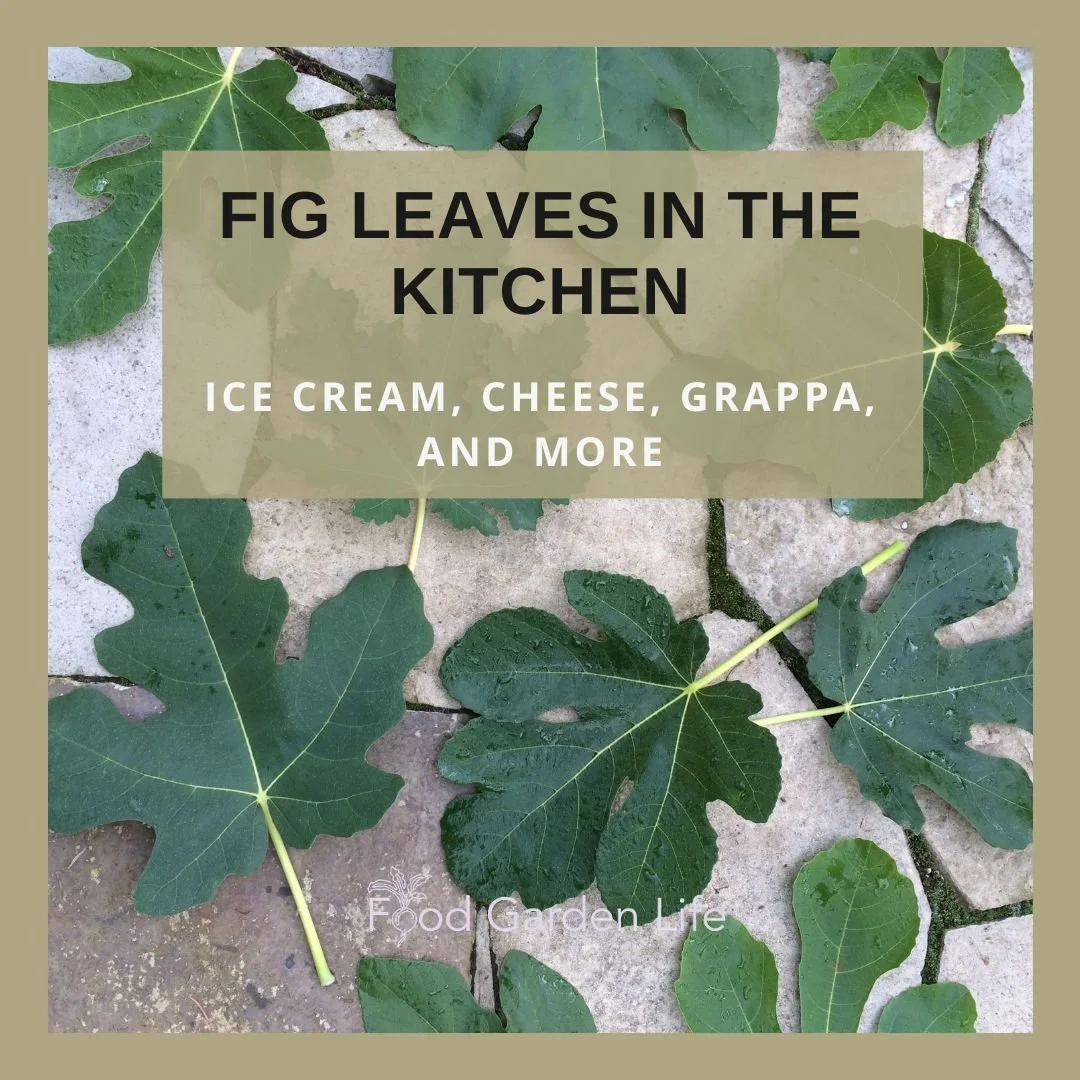
It starts with an e-mail. The subject line reads, “fig leaves.”
Expecting the usual early-fall question about fig rust, I am surprised when I open the e-mail and read:
“I am looking for fig leaves to make dishes with at my restaurant (fig-leaf ice cream, jelly, savoury sauces, custards etc.) Is there any possibility of getting some from you, before they fall for the winter?”
Sweet Smell of Fig Leaves
I have never tasted anything made using fig leaves. But right away I think of the sweet, slightly earthy, coconut-like smell that wafts over from the figs trees in my garden on a hot day.
So it was that Chef David Salt drops by my garden for some fig leaves in early October, before they get nipped by frost. He tells me that when he was a chef in London, England, he knew where to go for fig leaves. But here in Toronto, he hasn’t been able to find a supply…until now.
He fills a couple of bags with fig leaves, which he will freeze until he is ready to use them. Then we agree that I’ll drop by the restaurant some time to taste his fig-leaf creations.
Tasting Fig-Leaf Dishes
I stop in at the restaurant a couple of weeks later to try a fig-leaf grappa, a fig cheese, and a fig-leaf ice cream.
Fig-Leaf Ice Cream

Cooking with fig leaves
David explains that this light coloured ice cream is made with the extract from steeped fig leaves. It’s lucky that I have come when I do, because there is only a little bit left in the container. At first I don’t taste the fig leaves, but then, slowly, a gentle fig-leaf flavour comes through at the back of my mouth.
David finds the fig-leaf flavour goes well with something sweet; I agree.
Fig-Leaf Cheese
While I’m tasting the ice cream, Sous Chefs Udit and Mandar go to get a ball of fig-leaf cheese, and then peel back the cheese cloth so that we can all taste it.
David’s fig-leaf cheese, while unintentional, is delicious. I tell David that I have heard of fig sap being used to make a yogurt-like dairy product and as a rennet substitute for making cheese.

Chef David Salt. The fig-leaf ice cream was a hit.
This ball of cheese is sweet because it was originally intended to be a batch of ice cream. As David made a batch of fig-leaf ice cream, it split on him—so he strained the curds to make this fig-leaf cheese.
Fig-Leaf Grappa
I can’t drink too much of the fig-leaf grappa as I am on my way to teach a college class. Pity. David says it was an incredible green infusion when they first made it, but the colour faded within a day. I don’t smell anything, and I don’t taste the fig leaves at first. But a moment later, the fig-leaf flavour comes through—again, at the back of my mouth. It’s a flavour that lasts, so I continue to enjoy it as I walk to class.
But What About…
If you grow figs, you’re thinking as you read this that they don’t always smell nice.
I find that in the fall, as fig trees drop their leaves and go dormant, there can be a strong smell, which some people describe as cat pee. (The other time I’ve encountered that smell is when I leave fig plants in my car for too long on a hot day.)
David got those leaves early enough that there was only the sweet, slightly earthy, coconut-like smell that wafts over from my figs trees on a hot day.
FAQ Fig-Leaves
Can you eat fig leaves?
You don’t actually eat the leaf, but extract the flavour from the leaf (as in a syrup or panna cotta) or use the leaf to flavour a dish (as in meat wrapped and cooked in a fig leaf.)
Can you make fig-leaf tea?
Some people dry fig leaves for use in teas.
Keep Growing Figs
Looking for more cold-climate fig-growing ideas? Visit the fig home page to browse articles about varieties, pruning, propagation, ripening, winter protection, and more.
Grow Figs Where You Think You Can’t
My revised and expanded fig book is a practical guide to growing figs in pots and cold climates—from choosing varieties and pruning to ripening fruit and conquering winter.
Find This Helpful?
Enjoy not being bombarded by annoying ads? Appreciate the absence of junky affiliate links for products you don’t need?
This site is reader supported. If it has helped you in your food-gardening journey, you can give us a high-five below. Any amount is welcome.

Hi, We’re Steve and Emma!
We help people grow food on balconies, in backyards, and beyond—whether it’s edible landscaping, a vegetable garden, container gardens, or a home orchard.
Fig Masterclass
This self-paced, virtual Fig Masterclass is hosted by Horticulturist and Cold-Climate Fig Expert Steven Biggs.